One of the minor brouhahas at Copenhagen has been over one of the many pieces of public art put up for the conference, Survival of the Fattest, sculpted by artist Jens Galschiot (2004), sponsored by sevenmeters.net.

(I am putting up an image from a blog I frequently read, the “I am a middle-aged gay libertarian Conservative, living in dignified isolation in rural Eastern Ontario, Canada” Diogenes Borealis blog.  It has a longer post on various pieces of art at the Copenhagen conference, titled “Hideous Public Art, Copenhagen Edition.” Eric has a good commentary on the problems of political art, activist art, looking not just at this piece but several others at Copenhagen as well.  Read the whole thing, as Glenn R. might say.  Reactions to art, and political art, differ, so if you want a different take than Eric’s, check out this post with lots of photos on the sculpture, as well as how it was vandalized by someone pushing it over into the water, and then set back up again with a crane.)
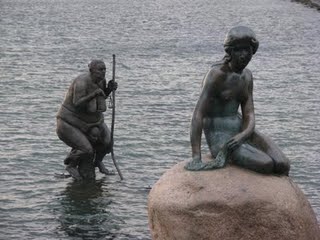
Rich world sits atop starving African man, sculpture at Copenhagen

Rich world sits atop starving African man, sculpture at Copenhagen

The sculpture is accompanied by text, reading in part:

I’m sitting on the back of a man.
He is sinking under the burden.
I would do anything to help him.
Except stepping down from his back.

The website goes on to explain (in part):

The sculpture ’Survival of the Fattest’ is a symbol of the rich worlds (i.e. the fat woman, ‘Justitia’) self-complacent ‘righteousness’. With a pair of scales in her hand she sits on the back of starved African man (i.e. the third world), while pretending to do what is best for him.

The sculpture dates back to 2004, when it was exhibited in London.  On that occasion, it apparently was to symbolize the evils of globalization and free trade; it has morphed into a new message about climate change with apparently little need to change anything except the captions.  One wonders in what cause it will be re-deployed, with a quick change of the captions and text in a few years, in some other European city.  The rest of the statement accompanying the photo says that the rich world is responsible for what climate change will do, it says, to Africa.  (The sculpture itself?  In my view, while puerile as agit-prop, if completely stripped of the fashionable, and fashionably shifting, political references, it is an interesting piece as sculpture of the body.  If it were simply placed in a sculpture garden somewhere, without the pretentiousness of the politics, I would rather like it, particularly as a late derivative work in a declining tradition.)

My take on the Copenhagen conference is that, at this point in time, it is less about climate change as such – because there is tacit recognition by the leading parties that either they will not reach an agreement with teeth or that it will not be adhered to over the coming years as countries jostle for economic benefit – and far more a negotiation over global wealth transfer to poor countries under climate change as a device.  It is possible that countries will walk away with obligations that will cause at least some of them, including the US, voluntarily to adopt economy-impairing measures, for the reason that they lead to increased tax regime possibilities for states seeking both revenues and greater political control over larger areas of economic activity.

But watching the conference unfold currently, my take is that the real arguments about real things are about welfare transfers from the rich world to the poor world.  That is the fundamental connection between the 2004 and 2009 deployments of this statue, and the apparent seamlessness of shifting from anti-free-trade to climate change.  In that case, however, whether one talks of global wealth transfers to fund the UN’s Millennium Development Goals or any of the other grand development strategies that failed so consistently over the entire post-war period, or now wealth transfers in the name of climate change amelioration, one has to talk about where development money has gone in the past and what it has accomplished.

Which is to say, not much if anything.  It is important to ask what is going to be different in this particular proposal for a massive wealth transfer.  The question is pertinent particularly as the way in which the poor countries are framing the moral appeal at Copenhagen seems aimed at sending the money to their governments, as official aid from the poor country climate change fund to these governments.  Does that seem like such a good idea, given the long and sad history of such aid efforts?  Because at the end of the day, whatever the justification, it is still a development program, and is likely over time to become just another funding base for development.

This is so in part because the effects of climate change over the long term are uncertain and so wind up merging into general development goals – thus, for example, it turns out that the best way of addressing climate change in Africa is to help Africans try and get out of poverty.  If one is going to fund a new development initiative, with lots of money, this seems to me a vastly better idea than trying to fund projects based on speculative views about what will address the effects of climate change projected into the future.  I can think of few grosser immoralities in the matter of international development than diverting aid for speculative green projects at the expense of HIV-AIDS or malaria eradication and management efforts; I am an unapologetic Lomborgian in these matters.  But in that case, this is just … international development under a new rubric.  And while we do not know very much about how to do successful development on a large scale basis, we do know quite a lot, from bitter experience of failure, about what does not work.  The problem is, looked at simply as a development initiative, it appears to fall directly into the grand tradition of failed development plans that started from grand moral premises.

(Update, pulled up from my response to Yankee below.  I might not have been clear enough in this post that in considering alternatives — as in cost benefit analysis, particularly; it’s something we’ve discussed in various VC posts, and I discuss in this paper — it is essential that one consider actual alternatives. Not alternatives that are merely logical possibilities or possible worlds or mere proposals, shift this to that. The comparison of comparables has to be about actual comparables, not hypothetical ones. That is one of the big problems with John Mueller’s writing on terrorism, for example — comparisons with lightning strikes and so on. Here, I am making an argument, implicitly and perhaps not plainly enough, that these are comparables. The reason is that if you accept — you might not — that this is fundamentally a development fund under a climate change rubric, then you are in the baseline of comparables for African development work. In that case it seems to me quite a “live” question as to what one funds, including choices between disease, water, elementary education, anti-corruption efforts, etc. That’s one of the reasons I think it important to understand that, particularly as the African representatives who have been speaking at Copenhagen see it, this is really a development fund, the latest in a long series of moral efforts globally, under a particular banner this time around, but subject to the same issues, choices, constraints, and long burden of failure that these efforts have always had.)

But then return to the politics of the sculpture.  What is the moral condition represented here?  It seems to be something like the rich world sitting atop of the poor world, or anyway sub-Saharan Africa, in exploitation of it, and refusing to get off of it.  It’s ambiguous where not muddled, so one can extract many alternative readings.  But I’d suggest that the real problem, at least from a global welfare standpoint, about the poorest of the poor in Africa in relation to the rich world, is really quite different.  It’s not exploitation.  I put it this way in a manuscript on US-UN relations, and discussed  it a bit in an article a few years ago on microfinance; this section probably won’t survive the edit (and a good thing, too – ed.), but:

We are good people and, just to be clear, we do not wish anyone dead.  Poverty and suffering move us, because we are the good global bourgeoisie.  We want our governments to contribute to relieve global poverty, we want UN agencies to do their part, we want to pool our rich world contributions to Christian Children’s Aid or Oxfam and know that they help girls in Africa get schooling or staff AIDS clinics or provide bed nets against malaria, and we want to contribute to Bono and Sir Bob’s causes to make sure the attention of the rich world remains upon the world’s poorest poor, and in the meantime, forgive us our debts as we forgive those corrupt, kleptocratic, authoritarian sovereign debtors.

We are good people, true, but it is nonetheless hard to resist a little twinge, imagine, go ahead, indulge your imagination, imagine a world in which the world’s poorest poor had never existed, had never been brought into being.  Africa, where so many of the poorest of the poor reside; impoverished, malnourished, diseased, preyed upon by mosquitoes, living lives that are, come to that, not just poor but squalid, miserable, brutish, and in competition with the lions and mountain gorillas and cheetah and very destructive of the natural environment, too, that gorgeous natural environment, because, in the end, there are just too many of them, the humans, and not enough cheetah.  Not that we wish anyone ill, of course, but still, it can’t hurt to imagine what an Africa would be like without poor Africans in its forests and plains, an Africa magically and mysteriously converted, without any damage (of course) to the human beings who once lived there but mysteriously disappeared one day, into a vast game park, where the animals roam free in their natural habitat un-pressed by human beings, or anyway only a manageable number of them in their natural cultural tribal habitat, including colorful native dress, the humans.  The rest of us, the good global bourgeoisie, can debit our Amex Carbon Cards and fly in for a visit.

The fantasy is wicked in its way.  Nonetheless, it points to a central, unavoidable truth at the core of international development, aid, and economic growth.  Whether we call them the poorest of the global poor, the ‘bottom billion’, bottom fifth, or anything else, they have a specific relationship to the global economy and globalization.  Viz., they have no relationship to it to speak of.  They are superfluous to it.  These are the “superfluous poor” – people who lack the skills to take part in the global economy even at the bottom.  They are too poor, too unskilled even to exploit.  It is hard to take part in a market in which you have nothing to exchange – but you have many needs.

The “superfluous poor” contrast with what we might call the “global reserve army of labor,” or perhaps the world’s “working poor.”  The billions across China and the rest of Asia, and elsewhere, who toil in manufacturing for the rest of the world.  They labor for low wages, in textiles or fish farming or maquilladoras assembling electronics or mining.  It is their rise into the ranks of the global money economy that accounts for the remarkable fall in overall global poverty.  Programs of international development cannot be credited with that transformation.  It is owed largely (in total numbers) to a single country and society, China.  But also to an economic shift over the last few decades particularly in the Asian economies, and particularly the so-called ‘Asian tigers’:  they utilized export growth and foreign direct investment structurally to transform their economies.  And third, more recently, to economic growth in India.  Connection and interdependence with the global economy have raised standards of living for billions as well as their expectations.  Interdependence has also made them subject to the ups and downs of the global economy as well.

83 Comments

  1. ArrowSmith says:

    Need any more evidence AGW is a religion, complete with religious artwork? Disgusting.

  2. Mark Buehner says:

    Funny how nobody ever asks the third worlders if they would prefer we blow a few trillion dollars on climate change, or AIDS drugs/malaria/food etc.

  3. Idahonian says:

    I, too like the sculpture, if not the interpretation. I would interpret it as corrupt African governments sitting atop a starving African man, or top-heavy socialistic governments sitting atop struggling African immigrants, or perhaps the world held aloft by a struggling middle class (perhaps the ‘lady’ on top could be throwing candy to passers-by).

  4. M. Gross says:

    Yeah, it really does look like it’s a pretty well done sculpture.

    I suppose the artist at least had talent, if not precisely political vision.

  5. yankee says:

    I can think of few grosser immoralities in the matter of international development than diverting aid for speculative green projects at the expense of HIV-AIDS or malaria eradication and management efforts; I am an unapologetic Lomborgian in these matters.

    I’ve seen this general line of argument (how can you justify taking money away from worthy cause X to spend it on Y?) in regard to many issues, and it is almost always problematic. It’s based on the implicit assumption that not spending money on Y would cause us to spend an equivalent amount of money on X, and this assumption is usually unfounded.

    The problem is the same here: would not investing in “speculative green projects” cause us to spend an equivalent amount of money on anti-HIV or anti-malaria projects? Perhaps, but I see no actual evidence of this. Certainly you have not presented any.

  6. Soronel Haetir says:

    Perhaps I am just dense but I see no reason for self-developed nations to help people who are unwilling to help themselves. So long as people are willing to tolerate despotic rule I say they deserve what they get, whether than be HIV/AIDS or being drafted into a child army.

    Misery has always been the price of overpopulation. The main difference between now and yesterday is that the misery is seen rather than being heard of second hand.

  7. Kenneth Anderson says:

    Yankee: I might not have been clear enough in the post. I agree with you that in considering alternatives – as in cost benefit analysis, particularly – it is essential that one consider actual alternatives, not alternatives that are merely logical possibilities or possible worlds or mere proposals, shift this to that. The comparison of comparables has to be about actual comparables, not hypothetical ones. That is one of the big problems with John Mueller’s writing on terrorism – comparisons with lightning strikes and so on. Here, I am making an argument, implicitly and perhaps not plainly enough, that these are comparables. The reason is that if you accept – you might not – that this is fundamentally a development fund under a climate change rubric, then you are in the baseline of comparables for African development work. In that case it seems to me quite a “live” question as to what one funds, including choices between disease, water, elementary education, anti-corruption efforts, etc. That’s one of the reasons I think it important to understand that, particularly as the African representatives who have been speaking at Copenhagen see it, this is really a development fund, the latest in a long series of moral efforts globally, under a particular banner this time around, but subject to the same issues, choices, constraints, and long burden of failure that these efforts have always had.

  8. Eric Rasmusen says:

    Good question about the purpose of the conference. The poor countries’ leaders get cash, yes, that makes sense. What do the rich country leaders get? — they want praise from the poor countries, and evidence that they are fighting global warming. So I guess my prediction would be that poor countries will promise to reduce CO2, get cash in advance, then as expected not do anything, and get blamed later on. Thus, they’ll help out the rich country leaders twice– now, with the promises, and later, by being scapegoats— and the pay will be commensurate.

  9. ChrisIowa says:

    My first question was how is this thing financed?

    The article with the pictures say that the artist paid for the cranes etc to reset the sculpture after it was knocked over, out of his own funds. Cranes and workers to run them are not inexpensive. It’s also not inexpensive to haul this statue from country to country for free exhibition.

    To afford these expenses this artist must be fairly wealthy, and must make his income from selling art to the Rich World he decries in the commentary on the art. So a more complete portrayal would have the artist portrayed atop the fat lady, making his living at the expense of all.

  10. Daniel Charlies says:

    Less is more.

    See, all I’m saying is our pundits today give too much of themselves online. In the back of my head reading this post, there was always the unforgettable nugget of yesterday’s complaints about UPS not getting the $800 CostCo tv there on time.

    Wish I could turn it off — take you serious on those posts you wish to be taken seriously. But again, the back of my head knows this was written by the guy with the wife with the big tv, and I take that into this reading too.

    Hth. Sometimes it’s better to vent in more private places, and keep other areas clear for work befitting one’s professional record. OR, “sometimes… less is more.”

  11. Houston Lawyer says:

    The fate of the starving African is the natural state of the world. In order to improve his fate, he would need to adopt the very Western ideals that the “artist” seems to despise. In addition, the whole idea that cap and trade or a carbon tax is somehow going to improve his situation is laughable.

  12. Daniel Charlies says:

    It’s like, I’m thinking of your wife out there, on the UPS guys shoulders, lugging her and the tv … and she’s unhappy because he’s not moving fast enough.

    Oh yeah, and there’s a snowstorm.

  13. Tires says:

    I agree, This seems to be falling on the wrong shoulders if you ask me.

  14. MCR says:

    Damn, Daniel. You can let go after a day. It’s alright. We won’t judge you.

  15. pireader says:

    Professor Anderson wrote — [It's] less about climate change as such … and far more a negotiation over global wealth transfer to poor countries under climate change as a device.

    This seems a very odd thing to believe about developed-country politicians. Why would they suddently want to hand out their governments’ (i.e., their voters’) money to developing countries?

    It seems much more plausible that this is about clinmate change– that they’re trying to bribe the developing countries to limit greenhouse gas emissions.

  16. Kenneth Anderson says:

    Pireader: Very interesting point. And a good question as to why the developed world would agree to this – and an implied question as to whether they will, once the photo op is over, actually pony up the cash. But one reason I doubt that it is a bribe is that it would be largely directed to the wrong parties. The poor Africans who are the principal subject of this post, and really of the Fund, make their primary contribution to CO2 by breathing. If you thought it necessary to bribe someone, it would, of course, be China. At last glance at the conference proceedings (something might have changed in the last bit), China had been ruled out of the cash transfer.

  17. Daniel Charlies says:

    Kenneth Anderson wrote: Hmm. This, from the commenter who might forever be remembered on this blog as the one who said … “Women often frazzle easily over the little things.”?

    I stand by that one, and y’all are liars, or p.c. suckups, if you’ve never observed it.

    Women often do frazzle easily over the little things. Anyone raising kids? You ever intervene when the wife wants the kids to keep their hands to themselves (instead wrestling around) or calls them to play less roughly as to keep their play clothes clean?

    Often times, that’s when a man — or a more masculine/robust woman — can step in, and assure her more feminine sensibilities, “No, it’s ok. Let them have at it a bit. Within safe structures.”

    Yin/yang buddy. As I also mentioned yesterday, these two can complement each other greatly. One person — often the feminine with the list, the organization, the inflexibility initially when things don’t go according to plan — freaks out because the tv is late. The more masculine, bigger-picture person might want to put things in perspective.

    Ditto childbirth. No matter how you plan and make sure you’ll be in control of everything (again, often the woman), things happen and sometimes you have to toss the script and adjust. Very often, the male who understand his role here (to help her adjust, dial down expectations, keep things in perspective) is better than the one who joins her in screaming for the nurses to get there faster and just do their job dammit! because can’t you see there’s an emergency here, yadda yadda.

    In short, I stand by that very un-p.c. observation that, in my circles at least, women tend to frazzle unnecessarily. (As you move “up” in society and there are less and less gender differences, you might see more passivity and feminization in the men though, so your mileage may vary.)

    Sorry Kenneth. I try to keep your posts separate, so I can hear your scholarly voice ring true. But the more you write, the more I see that heavyset couple buying a Costco tv online, and then complaining when the shippers don’t deliver the same as the guy who buys one, puts it in the truck, takes it home, sets it up, and enjoys romancing the wife with it after dinner.

    We all spend our dollars differently and contentment varies, I guess. So long as you guys aren’t creating any property insurance mandates for me to cover your acquisitions though, it’s not like we have to wonder about health comparisons between the do-ers and the complainers…

    But I’ve said too much already. Take it for it’s worth, and continue to share what you will.

  18. Mahan Atma says:

    Soronel Haetir: So long as people are willing to tolerate despotic rule I say they deserve what they get, whether than be HIV/AIDS or being drafted into a child army.

    Wait — so children deserve to be drafted into a child army because they won’t overthrow their despotic rulers??

    I knew this comment thread was going to be bad, but you’ve exceeded my expectations…

  19. Daniel Charlies says:

    MCR @ 11:32 — That’s the point. Once you read and learn of such details, how do you “let it go” in forgetting and go back to taking the guy seriously?

    I also note that, like Orin Kerr, Kenneth Anderson appears to use that delete button to comment and then recall his comments, manipulating the threads.

    You guys emulating those climate social scientists, in trying to make your points?

  20. MCM says:

    Perhaps I am just dense but I see no reason for self-developed nations to help people who are unwilling to help themselves. So long as people are willing to tolerate despotic rule I say they deserve what they get, whether than be HIV/AIDS or being drafted into a child army.

    Does that include the United States propping up their despots, like Habré and Mobutu Sese Seko? Kind of a circular argument there… they deserve the despots we put in power because we put them in power?

    Not to mention US and European agricultural subsidies make it hard for African farmers to “help themselves”, since they can’t compete with subsidized grains. So maybe we should stop using state terror and socialism to oppress Africa first, then judge them.

  21. DjDiverDan says:

    Art, and Beauty, truly is in the eye of the beholder. I like the sculpture, but I prefer to think of the fat man as the Federal Government, and all of its private dependants, sitting on top of the American Taxpayer. I will think of this sculpture every time I’m in a Walmart Grocery Store, waiting in line behind a lady riding one of those scooter carts because she’s WAY too fat to walk on her own, ready to pay for her groceries (including pounds of bacon, lard, butter and whole milk) with her Food Stamp Card.

  22. Soronel Haetir says:

    Does that include the United States propping up their despots, like Habré and Mobutu Sese Seko? Kind of a circular argument there… they deserve the despots
    we put in power because we put them in power?

    Yes that includes the US backed despots. If you aren’t willing to do anything about the situation you find yourself in you deserve the outcome of that situation.

  23. egd says:

    it seems to me quite a “live” question as to what one funds, including choices between disease, water, elementary education, anti-corruption efforts, etc.

    Yes, lets keep giving money to corrupt dictators so that we can fight corruption in these countries.

    Foreign aid is all that keeps most of these despots in power. The best thing we could for these countries is send in a few warplanes, take out the national armies being used against the people, and let the citizens determine their own government.

    But self-determination seems to be an idyllic pipe dream, so instead we’ll spend billions propping up dictators and thugs, often with food under the guise of “human rights,” which then gives the despots the power to destroy crops and enslave people by controlling the only source of food.

    A brilliant strategy.

  24. Martinned says:

    I kinda like the statue. (Not so much aesthetically, but rather as a way to make a point.) It seems like a very poignant way to pose a question. Certainly the artist seems to have his idea of the answer ready, too, but that’s the beauty of art: you get to have your own answer. Hell, as some of the commenters above have argued, you even get to have your own question, depending on how you interpret the statue.

    On the occasion of the Copenhagen summit, it doesn’t hurt to be reminded of one’s presuppositions in this way: Always be careful when your own seemlingly flawless logic leads you to a result that you already like anyway. (Such as: we don’t have to give money to anybody.)

  25. Laura(southernxyl) says:

    Soronel Haetir: Yes that includes the US backed despots. If you aren’t willing to do anything about the situation you find yourself in you deserve the outcome of that situation.

    There are those who would use this very argument to justify terrorist attacks in this country.

  26. MCM says:

    Wait — so children deserve to be drafted into a child army because they won’t overthrow their despotic rulers??
    I knew this comment thread was going to be bad, but you’ve exceeded my expectations…

    Yeah. Maybe Soronel Haetir knows of magic anti-despot spray that those African kids should be buying from their local Walmart.

  27. David Schwartz says:

    pireader: This seems a very odd thing to believe about developed-country politicians. Why would they suddently want to hand out their governments’ (i.e., their voters’) money to developing countries? It seems much more plausible that this is about clinmate change– that they’re trying to bribe the developing countries to limit greenhouse gas emissions.

    Then how do you explain the strange fact that so much of the support comes from people who would favor these policies with or without climate change to back them up?

    The whole point of being able to give A’s money to B is that you don’t have to care how much it hurts or helps A or B. You can solely consider what’s in it for you.

  28. MCM says:

    Yes that includes the US backed despots. If you aren’t willing to do anything about the situation you find yourself in you deserve the outcome of that situation.

    Congratulations on justifying 9/11.

  29. Mark Buehner says:

    The problem is the same here: would not investing in “speculative green projects” cause us to spend an equivalent amount of money on anti-HIV or anti-malaria projects? Perhaps, but I see no actual evidence of this.

    Look at it this way- the aid we send poor state, government and private, is a certain percentage of our GDP. How that GDP rises over time (or fails to), directly reflects the level of aid flowing into those nations. This compounds over time just as our level of wealth compounds over time. Its probably worse because as our absolute level of wealth increases our percentage of charity increases. So even assuming we don’t divert a penny from climate change to foreign aid, the foreign aid loses out because we have stunted our wealth generation significantly.

  30. RowerinVA says:

    I am most curious about the hypocrisy of using lookism/bodyism/whateverism to make a left wing point. Here, the statue’s viewer is invited to make the assumption that one person is bad/venal based on that person’s race, sex, and body mass, whereas another is virtuous based on the same factors. If done in another context, one can easily imagine the howls of protest. Why should the artist be permit to trade on negative stereotypes of fat people, or particularly fat white women? If that’s not a white woman in the statue, my apolgies (the picture isn’t clear), but the point still applies w/r/t fat.

    I don’t go in for such faux outrage myself but I’m always interested when the outrage can be turned on so easily in one context, and then kept absent in another.

  31. Shelby says:

    Along the lines of what ChrisIowa said above, I’m struck by the enormous sums of money that have apparently been spent to promote this conference and to influence its attendees. Based on the reporting I’ve seen, it is entirely in one direction, to act immediately and in a huge way. Clearly there are interests that expect to benefit from such action — why is there no reporting on them? Who is paying these millions upon millions of dollars (okay, euros) for billboards, sculptures, ad campaigns, etc.?

    I’ve read plenty of innuendo that “climate denialists” are paid stooges for oil companies and the like. There’s never any evidence, but so be it. Meanwhile, with all this evidence that a great deal of money is being spent to promote AGW and schemes to affect it, where is the investigative reporting on whose money is at work?

  32. pete says:

    So are the conference attendees going to take their limos to view the sculpture or is it faster to get there by cab?

  33. Will says:

    what bothers me is they stuck this goofy sculpture behind the little mermaid – a beautiful danish landmark and cultural icon. They should’ve placed it in the front yard of some left wing org.

  34. frankcross says:

    I rather like it but would deconstruct it differently. The man clearly could dump the fat woman off his back but he chooses not to do so. He could simply drop underwater. This picture to me looks like great altruism of a man for a wife or mother, or whomever, the opposite of what was intended.

    On the second issue, Daniel, I didn’t see your post. But I have observed in the past that Orin is a smart good person and the people whose posts he deletes do not seem at all smart and good (rather typically shallow and hateful). So look within.

  35. Twirlip says:

    Rich world sits atop starving African man

    This would be comical if the subject matter were not so serious. The reality is that the only thing keeping Africa from being even more of a humanitarian disaster than it is at present is .. a lot of aid from the rich world. That starving African man is getting fed with foreign grain, probably American.

  36. MCM says:

    That starving African man is getting fed with foreign grain, probably American.

    Which is exactly why Africa will remain poor and starving, because their domestic markets for grain are dumped on by socialized American grain. You want to end African hunger, end corn subsidies in America.

  37. Twirlip says:

    Which is exactly why Africa will remain poor and starving, because their domestic markets for grain are dumped on by socialized American grain

    It’s a chicken and egg thing. America does not “dump” grain on Africa just because they need someplace to put it. It’s done with the best of intentions, and neccessary to prevent widespread starvation.

    Inevitably, it is also disruptive of the African grain market. But if the African grain market was capable of feeding people on its own, there would be no need for the aid.

    Mass starvation is almost always political in origin, and that is the case in Africa. The reason there is little in the way of a functioning free market anywhere on the continent is that the majority, perhaps all, of the states there are run as some sort of dictatorship.

  38. Twirlip says:

    You want to end African hunger, end corn subsidies in America.

    Food aid is just that – aid. It’s given for free or for pennies on the dollar. The market price of corn in America does not factor into it.

  39. pete says:

    MCM: You want to end African hunger, end corn subsidies in America.

    You might want to end the Mugabe regime before that.

    Not that I support corn subsides, but when you are devestating your once successful breadbasket farm economy through “land reforms” corn subsides are not your biggest problem.

  40. JMA says:

    Corn subsidies in the states = African hunger? …How much of our exported corn accounts for imported grain in Africa, again?

    I is confuzzled, maybe.

  41. midasear says:

    I have to echo Daniel Charlies complaints. The people who operate this blog seem to feel increasingly entitled to post on any topic of their choosing. When will they post on topics of interest to me? I’ve been coming here for years and despite this blog’s name, I have yet to read a word about Omelian Volokh’s counterrevolutionary conspiracy against the interests of the peaceful workers and peasants of the Ukrainian SSR. It’s shameful.

    It’s not like we have any control over what websites we visit. Or the ability to start our own blogs. When will the injustice end?

  42. Twirlip says:

    Corn subsidies in the states = African hunger?

    It’s a poor equation for a number of reasons. if Africans do have the option of buying cheap (US taxpayer subsidized) grain over more expensive home grown grain, that’s a bad deal for African grain farmers. But it’s a good deal for African grain consumers, who get to eat a meal paid for in part by the US taxpayer. There’s no reason why corn subsidies in the states should lead to African hunger, even by the principles of the market.

  43. MCM says:

    Food aid is just that — aid. It’s given for free or for pennies on the dollar. The market price of corn in America does not factor into it.

    Food aid? Food aid? Who’s talking about food aid?

    I’m talking about market competition. Farming in African countries is not competitive because subsidized American grain is far cheaper. Thus domestic African agriculture never develops. It’s one of the few things they would be able to compete in a world market for, but they can’t because their northern competitors are so heavily subsidized.

    Not that I support corn subsides, but when you are devestating your once successful breadbasket farm economy through “land reforms” corn subsides are not your biggest problem.

    I absolutely agree. But, of course, starvation is not limited to Zimbabwe.

  44. Soronel Haetir says:

    Laura(southernxyl):
    There are those who would use this very argument to justify terrorist attacks in this country.

    Which is why the US should do something. I have no problem with terrorists trying to destroy the US, I have problems with them succeeding.

  45. MCM says:

    There’s no reason why corn subsidies in the states should lead to African hunger, even by the principles of the market.

    Sorry, I was imprecise. Corn subsidies primarily contribute to African poverty. Persistent poverty exacerbates hunger.

    There is a large body of economics work on this issue, on any number of crops and countries.

  46. Twirlip says:

    Food aid? Food aid? Who’s talking about food aid?

    I was, in the comment you responded to.

    Farming in African countries is not competitive because subsidized American grain is far cheaper.

    They have rather more pressing problems than dealing with competition in the market. Your attempt to offer a market analysis makes no sense in a situation in which people are dying of starvation. If cheap foreign grain was replaced by more expensive home grown grain, this would avert starvation .. how?

    People dying of hunger is a flashing red signal telling you that they’re not getting food, period.

    Thus domestic African agriculture never develops.

    Domestic African industry of any sort never develops for the reasons which have been pointed out to you.

    I highly recommend to you Dark Star Safari by Paul Theroux. Stock up on the anti-depressants before reading though. Theroux, a political liberal, basically ends up saying that what Africa needs is a return to a sort of colonialism.

  47. Twirlip says:

    of course, starvation is not limited to Zimbabwe.

    Neither are crazy dictators. And Zimbabwe used to feed its neighbors.

  48. Twirlip says:

    Corn subsidies primarily contribute to African poverty. Persistent poverty exacerbates hunger.

    All right, I see where you’re going with this.

    But I still think you have a poor understanding of the reality on the ground in Africa. It’s not going to have a thriving agricultural industry, regardless of the price of corn in America. A prerequsite to having a thriving industry of any sort is the rule of law. And from the Med to the Cape, that’s in very short supply.

    There are plenty of good reasons to scrap US corn subsidies though, so I’m with you there.

  49. midasear says:

    Theroux, a political liberal, basically ends up saying that what Africa needs is a return to a sort of colonialism.

    Around 600 A.D., Britain, Gaul and Spain needed a return of Ceasar’s legions.

    That didn’t happen either.

  50. ForestGirl says:

    On that occasion, it apparently was to symbolize the evils of globalization and free trade

    According to Reason, it sounds like the artist’s original intention was the opposite of this.

    Back then, Galschiot was protesting the west’s refusal to live up to its rhetoric on free trade.

  51. MCM says:

    They have rather more pressing problems than dealing with competition in the market. Your attempt to offer a market analysis makes no sense in a situation in which people are dying of starvation.

    The reason that they have these “pressing problems” is directly because of their inability to compete with subsidized Americans.

    There is no food because their domestic agricultural sectors are underdeveloped.

    If cheap foreign grain was replaced by more expensive home grown grain, this would avert starvation .. how?

    The cost of domestic production would drop if more Africans farmed. They can’t now because they go out of business. American corn is so heavily subsidized that it is priced BENEATH the cost of production. You cannot compete with it: you will lose and go out of business. So if you’re an African trying to figure out how to feed yourself and/or run a business, farming is the LAST thing you will try.

    I highly recommend to you Dark Star Safari by Paul Theroux. Stock up on the anti-depressants before reading though. Theroux, a political liberal, basically ends up saying that what Africa needs is a return to a sort of colonialism.

    Of course he would. Reading Sachs’ The End of Poverty, I’m familiar with the liberal idea that we have to somehow “save” Africa. I would be happy if we would just stop doing things that hurt them. I would recommend some William Easterly.

    Corn subsidies affecting third-world producers is not some new, controversial concept. Many aid organizations, economists, and politicians have reached the same conclusion.

  52. ArrowSmith says:

    yankee:
    I’ve seen this general line of argument (how can you justify taking money away from worthy cause X to spend it on Y?) in regard to many issues, and it is almost always problematic.It’s based on the implicit assumption that not spending money on Y would cause us to spend an equivalent amount of money on X, and this assumption is usually unfounded.The problem is the same here: would not investing in “speculative green projects” cause us to spend an equivalent amount of money on anti-HIV or anti-malaria projects?Perhaps, but I see no actual evidence of this.Certainly you have not presented any.

    Umm when you’ve diverted trillions of dollars away from the private economy then of course you can fund green-projects. I mean what will be done with all those trillions on carbon-tax revenue?

  53. MCM says:

    For a decent (non-scholarly) introduction to the problem, try article in Der Spiegel (in English).

  54. Twirlip says:

    American corn is so heavily subsidized that it is priced BENEATH the cost of production. You cannot compete with it: you will lose and go out of business. So if you’re an African trying to figure out how to feed yourself and/or run a business, farming is the LAST thing you will try

    Even if you’re dying of starvation? You’re an African trying to figure out how to feed yourelf, and you can’t …. because American grain is too cheap?

    I get the impression that you’ve arrived at your concluson and are casting about for reasons to justify it.

    Corn subsidies affecting third-world producers is not some new, controversial concept

    It’s not. I think Theroux even mentions it.

    But people here have tried to point out to you that Africas problems are a lot more serious and deeply rooted than you think, and you just won’t even engage with that.

  55. MCM says:

    But I still think you have a poor understanding of the reality on the ground in Africa. It’s not going to have a thriving agricultural industry, regardless of the price of corn in America. A prerequsite to having a thriving industry of any sort is the rule of law. And from the Med to the Cape, that’s in very short supply.

    True, but you need some kind of basic self-sufficiency before you can establish the rule of law.

    Food aid has become a tool for corrupt thugs. They seize aid and distribute it to their political allies and withhold it from enemies, like in Stalinist Russia or Maoist China.

  56. MCM says:

    Even if you’re dying of starvation? You’re an African trying to figure out how to feed yourelf, and you can’t …. because American grain is too cheap?

    If you’re starving, it’s too late to start farming. Crops do take time to grow.

    But people here have tried to point out to you that Africas problems are a lot more serious and deeply rooted than you think, and you just won’t even engage with that.

    I did! The first thing I said in this whole thread was “Does that include the United States propping up their despots, like Habré and Mobutu Sese Seko?”

    Obviously we don’t prop up every despot in Africa – the Soviets did, and China does, their own shares of the damage. But maybe we should just cut back on toppling African governments and see if things don’t get better. And ending crop subsidies would help, I think.

    I’m just trying to look at things the West can actually do (or stop doing) to help, since that’s the context of the entire post.

  57. Twirlip says:

    but you need some kind of basic self-sufficiency before you can establish the rule of law.

    There’s that chicken and egg thing again.

    But historically, rule of law has usually preceded basic self-sufficiency (for the masses) and is normally a prerequsite for it.

    Zimbabwe had rule of law, and more than basic self-sufficiency. It lost the latter when it lost the former, not the other way around. India used to lack basic self-sufficiency, but it had rule of law and so was able to correct that problem eventually.

  58. Daniel Charlies says:

    But I have observed in the past that Orin is a smart good person and the people whose posts he deletes do not seem at all smart and good (rather typically shallow and hateful). So look within.

    Oddly enough, they deleted their own comments, not mine. So take a read at my mere observation that, as a reader, I was having difficulty separating the Kenneth Anderson writing this one, with the one who wrote of yesterday’s big-screen tv adventures with his wife.

    Passive aggressive? No, just sharing what one reader is thinking, and making a suggestion for the gentlemen to consider. I also copied Mr. Anderson’s remark to me that was later deleted, so there’s nothing missing from this smart, good person either. People disagree, and think differently. Why does it bother you to hear such things?

  59. Tweets that mention The Volokh Conspiracy » Blog Archive » Survival of the Fattest and the Global Superfluous Poor in the Negotiations in Copenhagen -- Topsy.com says:

    [...] This post was mentioned on Twitter by PostRank – Law, Eugene Volokh. Eugene Volokh said: Survival of the Fattest and the Global Superfluous Poor in the Negotiations in Copenhagen: One of the minor bro.. http://bit.ly/8hM8aU [...]

  60. Daniel Charlies says:

    (To answer that last question: I suspect some longtime academics simply aren’t used to practical objections to their own assumptions, as they live in a semi-cloistered world. Such honest observations come across as “rude” in the civil worlds they inhabit where disagreement is politely shelved away after it’s determined who is higherup on the heirarchy chart, and controlling of the venue discussion.)

  61. Curious passerby says:

    I think it should stand for the men of the world who have supported their women throughout history. Put it in front of a divorce court.

  62. Sandy MacHoots says:

    It’s not the subsidies that are interfering with Africa. It’s the donation. If we simply burned the subsidized grain instead of giving it to the Africans, they’d have plenty of incentive to turn to agriculture.

  63. Ryan Waxx says:

    JMA: Corn subsidies in the states = African hunger? …How much of our exported corn accounts for imported grain in Africa, again?

    I is confuzzled, maybe

    You need to start with the premise that “everything is America’s fault” and then it makes perfect sense.

  64. AlanDownunder says:

    Since Jim Lindgren does some hit-and-run no-comments purveying of denialist poison elsewhere on this site, I link to the antidote here.

  65. NickM says:

    If you don’t want to read through the frantic screaming at Tim Lambert’s blog, basically, the Darwin weather station moved for a really good reason (the old one was blown up in WWII), thus causing a temperature adjustment on subsequent temperatures [which is justifiable, although you still have to be correct as to themagnitude]. The data file didn’t indicate that the adjustment was due to a change in station, or even that there had been a change in station.

    It’s sloppy, and it looks like it induced a mistake by Eschenbach.

    There have been subsequent increases in the adjustment, with no reason provided in that thread for them.

    Nick

  66. HarryEagar says:

    I’m trying to figure out why Africans dying of an African disease is my fault.

  67. HarryEagar says:

    Nick, that won’t wash. No way in hell could you relocate a station within a thousand miles of Darwin and get a 6 degree ‘adjustment.’

    The mistake was not Eschenbach’s.

  68. Dan Hamilton says:

    I am sorry but the only thing you get by feeding starving people is more starving people. If it was just a crop failure or something like that then it would be right to help people until the next crop comes in but that is not the case. Sending them food makes the sender feel good but doesn’t help the starving people, that assumes the food gets to the starving people and is not stolen by the government or thugs. Sorry in Africa that is the same thing.

    Feeding starving Africans just makes the people sending food feel good. The senders don’t realy care that the people aren’t helped. If they did they would do something different. Such as hire people to change the governmets and actually help the people but violence never solves anything. So people starve, government thugs get rich, and senders feel good. Same old, same old.

    Politicaly incorrect Kipling had it right. In the White Man’s Burden. It is not the White Man’s Burden. It is the West’s Burden. If the PC a$$holes would allow it.

  69. AlanDownunder says:

    HarryEagar,

    The “frantic screaming” that NickM referred to got really strident when it linked to an extremist nutzoid rag (Bulletin of the American Meteorological Society Vol 78, No 12, December 1997) that gets really loopy at pages 2844-2846.

    Talk about clowns spouting know-nothing nonsense! Where do these scientists get off? Time to close down every university meteorology department in the country. They’re all a waste of money and a waste of space, no?

  70. NickM says:

    Nice non sequitur, Alan. Come back when you’re done with strawmen too.

    Harry – as I eyeball the graph, the 1942 adjustment was about 1.2 degrees C. Subsequent adjustments aren’t counted in that figure.

    Nick

  71. AlanDownunder says:

    Nick,

    If only Lindgren, Eschenbach and the rest of the ideology-trumps-science brigade were made of straw.

    Love your cooler-than-thou schtick though. Very impressive.

  72. David Schwartz says:

    Not to mention US and European agricultural subsidies make it hard for African farmers to “help themselves”, since they can’t compete with subsidized grains. So maybe we should stop using state terror and socialism to oppress Africa first, then judge them.

    Doesn’t “people are starving because food is too cheap” fail the giggle test?

  73. Today's Tom Sawyer says:

    Well, I don’t get what everyone is arguing about.

    This sculpture is obviously “Rearden Refuses To Shrug” because we have Hank Rearden, looking sickly because he continues to bear the leeches that always work to drag the creators in society down, and yet refuses to rid himself of his burdens, as exemplified by Lily Rearden whom he carries on his bent back, and is obviously both herself and a proxy for the looter State which he continues to support through his acquiescence. In the foreground to that, we have the youthful and healthy Dagny Taggart, transformed by her act of “shrugging” as shown through her physical transformation into a mythical mermaid (which is especially interesting because it shows that she is human, and yet at the same time is something more). She is clearly ignoring Hank in the background due to his refusal to embrace the truth and shrug, and she calmly waits for the time when she and John Galt can be reunited in their strength together.

    If this whole law school thing doesn’t work out, I should become an art critic/interpreter….which I would never get hired due to what I just did to the leftist artwork shown above.

  74. Harry Eagar says:

    Nick sez: ‘as I eyeball the graph, the 1942 adjustment was about 1.2 degrees C.’

    And the Quarternary International journal sez: ‘The topography of the Darwin region is dominated by a relatively flat to gently undulating surface generally less than 30–40 m above sea level.’

    And 12 degrees from the equator with a monsoon (the ‘Wet’).

    So you tell me what sort of move between 2 positions in Darwin will yield a 1.2-degree difference. (We can leave aside, for the moment, the later, huge adjustments.)

    So far, Lambert has not grappled with Eschenbach’s main point, which was that there are not 5 stations near to Darwin to adjust from, which requirement is stated in the nutzoid paper by the AMS.

    There may have been a station change after April 1942, when Darwin port was wrecked by Japanese bombing and Darwin was abandoned as a military base, but the graphs clearly show that the step-up came in 1940, so all the yapping Deltoid comments about 1942 can usefully be ignored.

  75. Mark Buehner says:

    Regarding subsidies- because food is cheaper than it should be via the market (because of subsidies), African’s can’t grow it profitably, which means they can’t grow it. Subsidies are taking wealth from one segment of an economy via taxation to benefit a different segment at the expense of anyone trying to compete with that segment.

    Its little different than setting up a welfare system where you make just as much money not working as working- rationally people will not work. But they will also never acquire the experience etc that would be helping them work more profitably for a higher wage. Its the same with African farmers- its more rational for them not to grow food, so they never achieve the economy of scale and experience necessary to do so well.

  76. Twirlip says:

    Regarding subsidies– because food is cheaper than it should be via the market (because of subsidies), African’s can’t grow it profitably, which means they can’t grow it.

    By this logic, American grain subsidies should be causing world-wide starvation.

    The thing preventing African famers from making a profit is their governments, which have a habit of simply taking money from people at gunpoint whenever they feel like it.

  77. AlanDownunder says:

    Harry:
    So you tell me what sort of move between 2 positions in Darwin will yield a 1.2-degree difference.

    Off the top of my modestly-endowed head: one with a different shade structure with different orientation, materials and dimensions situated in a different microclimate due to different topography, vegetation, evaporative conditions and exposure to sea breezes.

    Which says something about heads that lead with their ideology.

  78. Harry Eagar says:

    And your evidence for those 9 conditions is? Oh, and make them retroactive. How do you do that?

  79. AlanDownunder says:

    Harry, you asked “what sort of move … could have. I mentioned some factors. You counted them and asked “And your evidence for those 9 conditions is?”.

    The “evidence” for all of what “could have” is 8th grade physics (well it is in my country – gotta wonder about yours these days). I take it that you aren’t so educationally challenged as to really want links to wikipedia for that stuff; that you’re just confused or being rhetorical.

    In answer to your real question (“How do you do that?”) read pages 2844-2846. Unlike some, I don’t pretend to have a better answer than that, or to be able to critique that answer despite the handicap (some might say disqualification) of inexpertise.

    Then there’s that other handicap – bias. Ehrenbach, so gleefully quoted by Lindgren, cherry picked the most striking homogenisation of weather station data that he could find while keeping silent about all the other homogenisations all over the planet that went in the opposite direction. You can fall for slant as amateurish as that if you’re suitably ideological.

  80. Laura(southernxyl) says:

    Today’s Tom Sawyer has it.

  81. Harry Eagar says:

    You didn’t read Eschenbach’s statement, did you, Alan?

    I did read pages 2844-2846, which require 5 nearby stations for adjustments. As Eschenbach reported, there aren’t 5, so how did they do that?

  82. Todd says:

    There is a 2 hour debate at MIT on the Hadley CRU scandal: The Great Climategate Debate. Panelists: Kerry Emanuel ’76, PhD ’78
    Judith Layzer PhD ’99
    Stephen Ansolabehere
    Ronald G. Prinn SCD ’71
    Richard Lindzen

    Lindzen is fantastic.