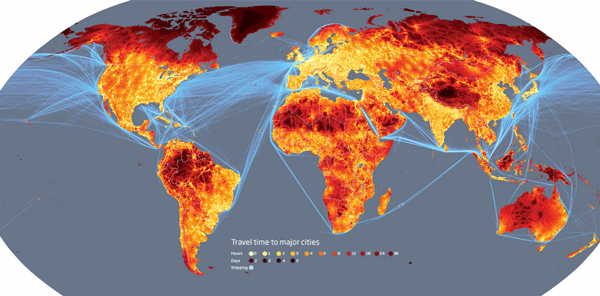
World Map of Remoteness

This map has been making the rounds  (h/t Bill Easterly at Aid Watch and Tyler Cowen).

labels

world-map-of-remoteness6001

Categories: Uncategorized    

    29 Comments

    1. David says:

      You aren’t kidding. The guy is completely blotto!

    2. Can't find a good name says:

      See http://bioval.jrc.ec.europa.eu/products/gam/index.htm for the original source (which includes a link to a much larger image of the map, data sources, etc.).

    3. Cato The Elder says:

      This map reminds me of the fact that one of the most ignored regions on Earth (relative to its size) is Central Asia.

    4. Kenneth Anderson says:

      Thanks for the original source!

    5. Sammy Finkelman says:

      It’s kind of misleading. This seems to have bene put together considering only regularly scheduled airline flights and freight shipping.

      It ignores charter flights and political considerations – whether or not people are granted visas in or out.

      In this map almost all of Alaska is more remote than North Korea!

      There is a section around Anchorage that’s about equal to South Kopread and most of North Korea – which appear about identical in remoteness,

      I guess that’s part of the usual tendency on the part of the European Union and similar organizations and people to ignore politics – to worry about “global warmin” and not about Iran or Pakistan.

      Newfoundland and northern Canada is remote and Greenland is *really* remote in this map.

      This is map that ignores politics and that ignores any trip that is not by common carrier or regularly used shipping.

    6. Skyler says:

      Sammy, it would seem to be the point that it relies on regular shipping. If you want custom travel, then You can be parachuted to any spot on the globe within a few hours.

    7. Skyler says:

      But I will say that I’ve been to northern Ghana and it takes a couple days to get there. Since they only look at cities of 50,000 or more, that seems to skew the remote areas that don’t have cities that large.

    8. Case3L says:

      Sammy, if you look at the data source tab on the above linked source info, you’ll see that they worked out travel distances using a variety of means. One way that they did it was to assign different levels of roads different speeds, where motor highways are 0.5 min/km and so on down all the way to barely navigable tracks. They also looked at rail networks, navigable rivers etc.

      I’ve lived in a few of the more remote places on that map, and blowing up the map big to see the detail, I see that they did a pretty good job, especially with respect to Central Asia and the Middle East.

    9. AJK says:

      It’s a cool idea but I’m skeptical — in whose mind is Fairbanks, Alaska more remote than Pyongyang?

    10. Sammy Finkelman says:

      Case3L: Sammy, if you look at the data source tab on the above linked source info, you’ll see that they worked out travel distances using a variety of means. One way that they did it was to assign different levels of roads different speeds, where motor highways are 0.5 min/km and so on down all the way to barely navigable tracks. They also looked at rail networks, navigable rivers etc.&nbsp.

      Yes, I see. They did take into account private car (or more probably truck)

      I think this is all comncerned with how long would it take to ship goods in commerce back and forth, although it still ignores all border crossing considerations.

      It sounds like they only had three speeds for motor traffic: 120 kilometers an hour (sbout 75MPH) for motorways, which is probably too fast, even in Montana and Germany, 60 Kilometers per hour (37 MPH) for major roads, which is probably too slow, but may work out if you condider the final mile problem, and 10 kilometers an hour (6MPH) for “tracks” which seem to be the only alternative.

    11. Sara says:

      I’m surprised that shipping lane density to South America is so comparatively small.

    12. Fiftycal says:

      Why is Antartica left off the map? It exists, doesn’t it? Is this where the secret One World Government is REALLY located? Don’t you want to show all the secret flights down there and how, like Da Nang in the 60′s, THAT is the most busy airport in the world? WHAT ARE YOU HIDING?

    13. Sammy Finkelman says:

      AJK: It’s a cool idea but I’m skeptical — in whose mind is Fairbanks, Alaska more remote than Pyongyang?

      Someone who treats all cities in the world of 50,000 or more as equal. And who gives the map a misleading description. Someone who’s looking only at commerce, or rather potential commerce,
      as if there were no legal or monetary obstacles in the world as it exists, AND who assumes all data can be trusted. Someone who tries to use only technical considerations in their measurements.

      I, at first, accepted that this is an attempt to measure isolation from the world. But that’s not what this is.

      This is isolation from any city of over 50,000 population. Any c city.

      The logic, I suppose, is that every city of 50,000 will pretty much have everything or regularly get it and that major roads or waterways will be used. It is presumably assumed nothing will go by air to any place of less than 50,000 population.

      This whole thing is measuring isolation FROM any city over 50,000. So now, Hawaii would probably appear very isolated (air travel not being allowed) except that it already contains a city of over 50,000 population: Honolulu. That also explains the exception of Anchorage; It is not how much Anchorage Alaska itself might be isolated but the difficulty of getting things FROM Anchorage (or Seattle) to other places in Alaska.

      And North Korea? Pyongyang already has more 50,000 people people,
      and is itself a FROM location, not a TO destination. What about the rest of North Korea? North Korea has a whole bunch of citiese that have a population of over 50,000, or that are supposed to hasve as population of over 50,000 even though they may not have them any longerr because of starvation, mass arrests and some internal migration because they had such a population at the close of World War II and the North Korean government is not going to publish statistics that tell you anything unknown, and then they also probably rely on North Korean map that tell you roads on which nothing but military vehicles ever travel? Who knows even the conditions of these roads? I guess they accept whatever North Korea tells them. (I don’t think they sare using Google Earth to double check) And so North Korea is pretty much 100% covered, and not isolated at all in this map!!

      Fairbanks, Alaska, which has only about 35,000 people, is isolated in this map, but if it were to gain an extra 15,000 people – or a little over 40% -voila – it would not longer be isolated at all!

      Places with large populations come out looking good in these statistics, while any area of low population and large area comes out looking bad except places, like Wyoming or Nevada, with a lot of Interstate highways or major roads running through it. (They do look a little bit isolated, as does the Applachians)

      Now it might be correct that, legal obsctacles aside, it would take longer to get a shipment of flu vaccine, socks, Coca Cola, or radios to Pyongyang from somewhere else than it would take to get it to Fairbanks from the nearest distribution center but it is not even that even consider that’s there’s actually nothing of any consequence being imported into North Korea except private stuff for very high ranking officials and it is comoing there from Japan probably.

      The fact that the whole country of North Korea – with 20 million people in it or more – is isolated from the world, counts for nothing, and any legal travel restrictions within the country are probably ignored, if the idea is even contemplated.

      That’s what happens when you try to be strictly non-political. Y You become a fool. Although maybe this does work, sort of, in many parts of the world.

    14. Sammy Finkelman says:

      It is impossible to edit this once saved so there is some garble in my comment.

    15. Sammy Finkelman says:

      Sara: I’m surprised that shipping lane density to South America is so comparatively small.

      South America, although it has a high rate of population GROWTH, has a relatively low population compared to other continents, so there’s not all that much shipping there. South America has only about 12% of the world’s population. Europe has less bnut it is more interconnected. South America isnt between anything else.

      I don’t even know why they are even showing shipping lanes, because it has almost no effect on their measure of isolation. It may be there mainly to mislead casual readers. Maybe somebody thought it would make as pretty picture.

      I notice that there is no shipping at all, of course, to or from North Korea, but North Korea is not shown as isolated, because it is full of cities of over 50,000 people and Japanese era motor roads to connect them.

      (

    16. Sammy Finkelman says:

      Skyler: Sammy, it would seem to be the point that it relies on regular shipping. If you want custom travel, then You can be parachuted to any spot on the globe within a few hours.

      Actually, I think this is all wrong. I don’t think they measure any kind of interconnectiveness that goes beyond or between places of over 50,000 population. All that they show of shipping lanes is just to make a pretty picture, at best – illustrate
      the IDEA that the world is shrinking. But that’s not wehat they decided to measure. Thus is, as they say, a “map of Travel Time to Major Cities”

      You have to read two paragraphs down, that by “major cities” they mean “large cities of 50,000 or more people.”

      For the sake of unclarity and confusion, and hoping people don’t catch on, they changed the word “major” in the frst paragraph to “large” in the third. Most people will assume they are not the same and taht somewhere else in the piece, which they didn’t gte around to reading, “major city” is defined. But no, I think, a “major” city is the sqame thing as a “large” city and means a city of over 50,000 population.

      Whoever put this together would have made a “good” lawyer. Or maybe a climate researcher.

      Now back to custom travel. Although I see that this is actually now irrelevant to this map, I want to say a few words. There are some placess in the world, that people travel to, that when they want to go there, they go by chartered airplane or helicopter,

      And one place that really uses airplanes, and because of that has not built many roads, is Alaska. Here are two links:

      http://www.outdoorsdirectory.com/directory/airtaxi.htm

      http://www.nytimes.com/1999/08/09/us/risk-aside-bush-pilots-are-a-must-in-alaska.html?scp=2&sq=alaska%20bush%20pilot&st=cse

      “Crisscrossing the vast gray-green tundra of southwest Alaska, the bush pilots of Yukon Aviation fly high school teams to games, shoppers to the market, patients to hospitals, jurors to court, criminals to prison and people in body bags to the coroner.

      And then there is pizza. ….

      … Far more than in any other state, airplane travel is a way of life in Alaska, which has the most pilots per capita (six times the national average) and the most planes (16 times the average), Federal Aviation Administration records show. A third of Alaska’s population has no access to the state’s roads, meaning their communities can be reached only by airplane or boat. Thus, bush pilots like the four men who fly for Yukon act as virtual taxi drivers in the sky, hopping over the kettle ponds and grassland of the tundra to deliver people for reasons that are sometimes critical and often mundane.

      But if airplane travel is an everyday and necessary affair here, it is also a dangerous one…”

    17. Sara says:

      I don’t know Sammy but by looking at shipping lanes on this map, I surmise that coastal Alaska is less remote than South America or North Korea. Is that misleading?

    18. Tweets that mention The Volokh Conspiracy » Blog Archive » World Map of Remoteness -- Topsy.com says:

      [...] This post was mentioned on Twitter by Omer Tene, Eugene Volokh. Eugene Volokh said: World Map of Remoteness: This map has been making the rounds  (h/t Bill Easterly at Aid Watch and Tyler Cowen)… http://bit.ly/8AYt22 [...]

    19. Skyler says:

      Sammy, I realized after I posted that it wasn’t travel from Europe but travel to any city of size 50,000.

      This seems rather strange since a city of 50,000 is not necessarily very civilized or has a decent hospital of the sort that believes in sterilization, let alone x-ray machines. And it certainly doesn’t presuppose the quality of trade being undertaken.

      This is an interesting graphic but as they admit, it is of very limited utility.

    20. J. Otto Pohl says:

      Central Asia is not remote. We are in the center of the world.But, it does take a long time to fly from Bishkek to remote places like Los Angeles.

    21. Sammy Finkelman says:

      Sara: I don’t know Sammy but by looking at shipping lanes on this map, I surmise that coastal Alaska is less remote than South America or North Korea. Is that misleading?

      No, it is not misleading. What’s misleading, or just plain wrong is to call any of this a measure of remoteness.

      This is all based on a paper by Andrew Nelson that attempted to develop a new index of population concentration. (How urban it is in different countries)

      Andrew Nelson works for the Global Environment Monitoring
      (GEM) Unit – one of six scientific units that make up the Institute for Environment and Sustainability (IES) at the European Commission’s Joint Research Centre (JRC). The European Commission seems to be another name for the European Union, which used to be called the Common Market.

      Andrew Nelson and Hirotsugu Uchida (of the University of Rhoode Island who was a consultant for the World Bank who worked together with Andrew Nelson called what they developed an ‘Agglomeration Index.”

      GEM then takes one of the three components of urbanization in
      the agglomeration index, which they then call travel time to major cities, although Andrew Nelson and Hirotsugu Uchida only wrote of “large cities” and it is only large in comparison to other cities, and they call it a global map of accessibility,
      WHICH IT ISN’T!
      ~~~~~~~~~~~~~~

      It’s a measure of urbanization, or, as they prefer, agglomeration, because there are different definitions of urban and rural all over the world.

      And this map, which GEM puts out, can only be called a “Global map” because it covers the whole world – with the exception of Antarctica. It is NOT a map of how much the “world” is internally connected, but it is supposed to be a map of how well each individual section is internally connected. Really each country, because I don’t think they cross international boundaries here, except maybe in the EU.

      The shipping lanes don’t belong here at all, because they don’t matter, but they would matter if you used a definition of 500,000 people for a large city. I have no idea actually where they come from. Yes, they come from some kind of commercial database, but what they are doing here isn’t clear at all, unless it is to mislead people as to what this map is all about. It doesn’t look like this should have appeared in anything that Andrew Nelson produced or worked on.

      Nelson and Uchida only consider using 30 minutes, 60 minutes and 90 minutes in their agglomeration index, but in the course of developing that index they must have estimated travel time (to the center of a “large” city) from all places.

      After GEM has misnamed the travel time map, as a global map of Accessibility, Kenneth Anderson then comesd along and calls it a “world map of remoteness” which is even worse. It is not that at all.

      -

    22. Sammy Finkelman says:

      Skyler: Sammy, I realized after I posted that it wasn’t travel from Europe but travel to any city of size 50,000.This seems rather strange since a city of 50,000 is not necessarily very civilized or has a decent hospital of the sort that believes in sterilization, let alone x-ray machines. And it certainly doesn’t presuppose the quality of trade being undertaken. This is an interesting graphic but as they admit, it is of very limited utility.

      The smallest unit Andrew Nelson and Hirotsugu Uchida could use where there was reasonably good data for further subdivisions – they couldn’t make good calculations using 20,000 as the defintion of a lartge city. The (comparitive) results, they say, asre about the same if they used a definition of 100,000 people for a large city, but using 500,000 drives the gglomeratio index too low in many regions.

    23. Hadur says:

      Does shipping include only water or air as well?

    24. Case3L says:

      Central Asia is not remote. We are in the center of the world

      I don’t know – I felt pretty isolated living in Khorugh Tajikistan

    25. Northern Dave says:

      Actually, the number of days from my experience is about right (unless you’re super-rich and are spending oodles of cash to accelerate the process – what’s the name of that private security group, I think based in D.C. or Virginia, that will find anyone on the planet for you in 3 days?) for regular travel in Canada. In fact, with some Northern authorities one has to get permission to travel there first (1st Nations issue) so I guess that would add to travel time too…

      This map is great if one is looking to base a business that’s looking to cater to a truly international clientele and seeks a hub everyone from Kansas City to Budapest can reach quickly.

      How many would argue that getting to the centre of Greenland is more time consuming from New York than getting to Rio? (Unless you’ve got your own jet and are an experienced parachute jumper :-) ).

      Personally, getting away from hordes of touristas seems heavenly to me! Just cross reference this map with one of population densities and voila!

    26. 3L says:

      Lord, help lawyers.

    27. LarryA says:

      Sammy Finkelman: It sounds like they only had three speeds for motor traffic: 120 kilometers an hour (sbout 75MPH) for motorways, which is probably too fast, even in Montana and Germany,

      The speed limit on Interstate Highway 10 where it goes past my Central Texas hometown is 70 MPH, but you’ll regularly get passed at that speed. A couple of miles west of here the legal limit jumps to 75 MPH, and further west it’s 80 MPH.

      OTOH it’s 500 miles from here to Texas’ west border at El Paso, just about as far as it is to the east Texas border.

      Sammy Finkelman: Places with large populations come out looking good in these statistics, while any area of low population and large area comes out looking bad

      For some of us a degree of isolation is a feature, not a bug.

      The map does ignore political roadblocks to travel. OTOH, they aren’t quantifiable. Politically the capital of North Korea is much more accessible for a diplomat half-a-world away than to any ordinary person from South Korea. An average between the two would be meaningless.

      Sammy Finkelman: Kenneth Anderson then comesd along and calls it a “world map of remoteness” which is even worse. It is not that at all.

      If you look at the scale as “How long would it take you to physically get here using normal transportation from the nearest city, ‘remoteness’ seems accurate.”

    28. World’s Strangest | Map of the Most Remote Places on Earth says:

      [...] Map Link and Article Link via Volokh Conspiracy [...]

    29. thelastguanche says:

      NO place to RUN