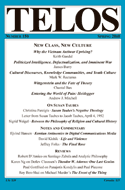
TELOS150

The critical theory journal, Telos, returns to one of its earliest themes, the critique of what its editors in the 1970s and 80s termed the “wholly-administered society” and “New Class” analysis.  It shifted away from those themes and modes of analysis for a long time, but it has re-opened that discussion with a bang.  Editor Russell Berman, Stanford comparative literature and European studies professor and Hoover Institution senior fellow, introduces a short special section of articles on the New Class with a first rate introductory essay that offers the backdrop to New Class categories and defines their relevance today.

This is a marvelous short essay.  Telos is a difficult, intellectually challenging journal; it is not for everyone.  But its editors – who break along many intellectual, ideological, political, and other lines; there’s a Left Telos and a Right Telos and many others besides – are ferociously intelligent and never suffer fools gladly.  (Its founding editor, the late great Paul Piccone, never suffered fools at all.)  Beneath a tough intellectual language that many will find incomprehensible, Telos is that rarest of things, an intellectual journal of the highest order beholden to no academic department, no academic politics, intrigue, budgets, tenure decisions, careerism, or anything else.  No one’s academic career ever flourished on account of writing for Telos, so far as I know.  On the other hand, its alumns over the decades include a remarkable number of great scholars in social theory.

Berman makes a persuasive case for the relevancy of New Class theory and the theory of the wholly administered society in today’s urgent circumstances.  This will almost certainly not be Telos’s last venture into this terrain in today’s times.  This essay is highly readable; Telos is not.  Be warned.  But it needs to read and debated by intellectuals looking for new ways of exploring contemporary society, and its difficult language and insights deployed into wider intellectual thought.  Pop sociologists on the Left like David Brooks or Thomas Friedman – and many journalists on the Right, too – are instinctively and correctly drawn to these kinds of knowledge class categories.  They have some terms but no theory; and theory is sometimes necessary to understanding, social theory, and not just surface theories of economic rationalism.

To talk of a “new class,” then, conjured up the unquestionable epistemology of class analysis, while simultaneously challenging the notional outcome: instead of the end of the state and classlessness, one was stuck with police states and a new class that, while eminently cooler than the Bolsheviks of yore, still exercised a dictatorship (of the not-proletariat) while skimming off the benefits of unequal power. The phrase turned Marxism against Marxism during those decades when the fall of the Berlin Wall was not even imaginable.

Migrating across the Atlantic, the term took on a new meaning in the last third of the twentieth century as a designator of the rise of a new post-industrial professional class, the cohort of the student movement after 1968 on its trajectory into social, cultural, and political power. At stake was the gradual displacement (if not disappearance) of the old markers of class distinction and the alternative privileging of sets of linguistic and intellectual capacities, combined with the assumption that greater intelligence implied a de facto natural claim on greater power: meritocracy means that the smarter should rule. Yet this trope just reiterated, in a new context, the problem of intellectuals and power, a curious echoing of East European rhetoric. As the best and brightest claimed power in order to rule better and with greater radiance, their critics came to dub them a “new class” in order to draw attention to their sanctimonious aspirations to pursue their own interests by remaking society in their own image. Paradoxically, the conservative critique of the new class could make the “Marxist” move of pointing out how universalist claims masked particularist interests. What ensued was a decades-long conflict between, on the one hand, advocates of more enlightened and ever more expansive administration of society, and, on the other, proponents of reduced state oversight, defenders of society against the state, and the deregulated market against the long reach of political power. The political wrangling of our current moment still takes place within this framework. The complexity of the new class and its culture, however, is that while it sets out to administer society and establish bureaucracies to regulate social and economic life domestically, at the same time it attempts to ratchet down the political and military power that might be projected externally: a strong state toward its subjects, a weak state toward its enemies!

The new class transition to linguistic, cultural, and technocratic expertise unfolded during the profound shift toward a symbolic service economy—new class ascendancy took place during the era of the dramatic decline of manufacturing and the concomitant shift of unionized labor organization primarily into the public sector—and it privileges capacities of semiotic manipulation over material production or even military prowess. Its signature contribution to foreign policy is “smart power,” a term that nobly implies that boots on the ground are dumb and that some—still elusive—strategic rhetorical eloquence will make enemies vanish without ever firing a gun, since language is its ultimate power. The corollary economic policy is negative, defined by discourses of environmentalism that imagine achieving greener national spaces by exporting dirty manufacturing and energy consumption to the developing world: not in our backyard. This is not to deny environmental concerns, but rather to recognize them as laden with implications for traditional economic sectors. Most importantly, the transition to the culture of the new class has, in complex ways, taken part in the revolution of the new technologies, with the new class at first benefiting from them, thanks to their advantaging the educated and wealthy—that social inequality known as the “digital divide.” But the new technologies, especially the new networks of communication, have undermined the former concentrations of media power and opinion-making, allowing for the emergence of new populist forces, decidedly not new class in their character and programs.

As contemporary as these developments may seem, it is equally important to recognize how traditional, indeed classical, is the question that lurks inside the problem of the new class: intellectuals and power, enlightenment and politics, conceptual thinking and lived life. From one point of view, the rise of the new class involves the priority of thinking—not any thinking, however, but a technocratically foreshortened, instrumentalist, and administrative thinking—over the lifeworld of everyday interactions, communities, and traditions, and the orders of human nature. It is the assertion of the primacy of logic against the complexity of living, and it runs the risk therefore of collapsing either into an irrelevant ineffectiveness, an idealism incapable of grasping the real, or a destructiveness, when it tries to refashion ways of life into its own invented programs. Human communities frequently show resilience and creativity, and they can survive more than one expects; but those existential resources are not infinite, and aggressive programs of social engineering can eventually destroy the patterns of living, the structures of meaning—the families, communities, faiths, nations, cultures, traditions—when they try to control them. Dismantling those patterns of familiarity leaves a world less familiar—not more open and freer, as modernists believed, but colder and less welcoming, perhaps the real new class agenda. It lays claim to a higher morality; it wants to make the world better; it wants to make us better, but it may only make us more alone.

Categories: Politics, Socialism    

    88 Comments

    1. Anonsters says:

      Um… David Brooks on the Left??

    2. Randy says:

      “Telos is a difficult, intellectually challenging journal; it is not for everyone.”

      Regular readers here at the VK eat difficult intellectually challenging journals for breakfast.

    3. Sandy MacHoots says:

      If this is the “good” writing in Telos, I’m sure I won’t be able to get through the hard stuff. The author might occasionally try putting a subject in front of a verb, slipping out of the passive voice, and adding some occasional periods. If Gottlob Frege could write simple declarative sentences, these folks ought to be able to manage it.

    4. RowerinVA says:

      I’m puzzled by this. What’s not obvious about this passage? The observation that every society has elites, and those elites tend toward self-perpetuation rather that ideal justice for the other “classes” (however one defines the other), is prosaic in the extreme. Plato and Socrates would have shrugged.

      Is the point that someone on the extreme right or left believes that the foregoing is shocking, and therefore it needs to be said even if it’s obvious to the rest of us?

    5. Mark N. says:

      RowerinVA: Is the point that someone on the extreme right or left believes that the foregoing is shocking, and therefore it needs to be said even if it’s obvious to the rest of us?

      At least among academics, there’s a tradition, perhaps pretty obviously self-interested, of attempting to claim that the academic left or the academic right is really part of the “normal” part of society, working on its behalf, not a separate technocratic elite working on its own behalf. To use the academic left as an example (it’s larger and has better-developed theory on this), many academic Marxists consider themselves “intellectual workers”, a particular part of the proletariat whose tools are pens and books and whose role is to ensure the victory of ideas that benefit the working class—as opposed to a class separate from the working class, whose role is to ensure the victory of ideas that benefit their own class. Lenin’s “What Is To Be Done?” is the most explicit early statement of that viewpoint.

    6. byomtov says:

      Really trying to understand this whole thing. For example:

      It is the assertion of the primacy of logic against the complexity of living, and it runs the risk therefore of collapsing either into an irrelevant ineffectiveness, an idealism incapable of grasping the real, or a destructiveness, when it tries to refashion ways of life into its own invented programs.

      Is he just saying that the world is more complicated than simple theories suggest? Well, I agree with that, but am far from sure that that’s his point.

    7. Anonsters says:

      byomtov: Is he just saying that the world is more complicated than simple theories suggest? Well, I agree with that, but am far from sure that that’s his point.

      And that running some network of social programs or schemes on the basis of these (“technocratically foreshortened, instrumentalist, and administrative”) theories runs the risk of destroying “the lifeworld of everyday interactions, communities, and traditions, and the orders of human nature.”

    8. Reader says:

      I’m sorry, but it strikes me as just a badly-written version of what hundreds of critics of “modernism” have been saying for decades, with a little “knowledge economy” [oops, I mean "semiotic manipulation"] thrown in to make it seem up to date.

      > No one’s academic career ever flourished on account of writing for Telos

      I hope not, if this piece is representative.

    9. Mark Field says:

      It is the assertion of the primacy of logic against the complexity of living

      Holmes said this much better, and he knew enough to stop there rather than to add 4 lines of jargon. Hell, Hegel wrote better English than the sentence you quoted, and he wrote it in German.

    10. juris imprudent says:

      Is he just saying that the world is more complicated than simple theories suggest? Well, I agree with that, but am far from sure that that’s his point.

      FOOL! This is a journal of critical theory – any meaning you find is NOT what the author intended, but is only a construct of your own bias, self-interest and ignorance.

      Can I collect a Ph.D. now? [/tongue firmly in cheek]

    11. Anonsters says:

      Mark Field: Hell, Hegel wrote better English than the sentence you quoted, and he wrote it in German.

      Now, Mark Field, that is taking it a step too far. Hegel’s writing is some of the most tortured stuff known to man. Even Kant facepalms at Hegel.

    12. aeolius says:

      The writer seems to have in fact a rather popular philosophy: If you cant wow then with your wisdom,baffle them with your bullshit.
      As far as I can see his constituency seems to be the losers ” At stake was the gradual displacement (if not disappearance) of the old markers of class distinction” What was their claim to fame? Other then what their multi-grandfather may have been competent (or a crook) And they looked at ease in a tuxedo.
      While I am no fan of PC-ism it is no worse then that of the lamented High-Class.
      When he laments the techieness of the new class, I imagine he has troubles programming the microwave.
      In fact this is the most American of ruling classes, based on achieved rather then ascribed status.
      This may be much to the sorrow of the blogger

    13. SenatorX says:

      Hmm I enjoyed it agree with it’s attack on the left.

    14. Stephen Lathrop says:

      It reads funny. It’s got all these great little bits that seem to be shackled in leg irons. They struggle along together, but do less work than they might if you freed them up a little.

    15. Hyman Rosen says:

      Oh, now I understand what The Onion meant here:
      http://www.theonion.com/content/news/nation_shudders_at_large_block_of
      “Nation Shudders At Large Block Of Uninterrupted Text”

    16. ScottB says:

      This has got to be the most timid defense of liberty I’ve ever read. “…it wants to make us better, but it may only make us more alone.” Jeez- I see better on Instapundit every day.

    17. B-Daddy says:

      I guess no one had the class to comment on the Telos web site itself.

    18. Perseus says:

      Anonsters:
      Now, Mark Field, that is taking it a step too far. Hegel’s writing is some of the most tortured stuff known to man. Even Kant facepalms at Hegel.

      Agreed (speaking as someone who tries to teach a bit of Hegel to poor undergraduates). The obscurity and turgid prolixity of Berman’s prose, however, is reminiscent of Heidegger. And Berman’s habit of employing abstractions and making them act like real people (e.g., a term migrates, an idealism tries to refashion ways of life, etc.) exemplifies the sort of writing that Tocqueville believed would characterize democratic societies.

    19. rosignol says:

      aeolius: The writer seems to have in fact a rather popular philosophy: If you cant wow then with your wisdom,baffle them with your bullshit.

      Yup.

      For some reason, it is common for people react to statements they don’t understand by assuming that the person making the statement is smarter than they are. I saw it many times working in IT, and it appears to be fairly common in academia as well.

    20. Nick says:

      The word “lifeworld” is a reason to not read this, I think. In the original German, however, I don’t mind it so much. Some words are less pretentious in untranslated German, I guess.

      If you want to read a great article in Telos, read The Bankruptcy of the Republican School by Luigi Marco Bassani. It’s from 2002.

    21. Instapundit » Blog Archive » ELITES, NEW-CLASS THEORY and the critique of the wholly-administered society…. says:

      [...] ELITES, NEW-CLASS THEORY and the critique of the wholly-administered society. [...]

    22. ObiJohn says:

      What this article says in a nutshell is this:

      Smart, inexperienced people inevitably believe that they know more than the rest of us, and that they should be acknowledged as our leaders because of their Ivy League-demonstrable intellectual superiority. These smart yet inexperienced people, whom I’ll refer to as ‘fools’ to reflect their ignorance of how the world works due to their stubborn belief that intelligence equals wisdom, further believe that any objection to their leadership or their ideas is due to ignorance and fear on the part of the less-enlightened. Further, the ‘fools’ believe that there are smart, evil people who exploit the fear and ignorance of the less-enlightened to thwart the ‘fools’ as they seek to raise us all out of the muck of present-day society and culture. And finally, ‘fools’ believe that their intellectual superiority by itself can overcome any type of resistance or hostility including hostile resistance from less-enlightened nation-states, because intellectual superiority always trumps physical or military superiority.

      In short, ‘fools’ believe despite all evidence to the contrary that the world’s problems are due to the less-enlightened not following the ideas of ‘fools.’ And so, therefore, in order to save us from ourselves the ‘fools’ will deceive, dissemble, and ‘deem’… whatever it takes.

      I think the ‘fools’ or at least the ones controlling the US federal government are going to discover this November that we won’t be fooled again.

    23. RKV says:

      “The complexity of the new class and its culture, however, is that while it sets out to administer society and establish bureaucracies to regulate social and economic life domestically, at the same time it attempts to ratchet down the political and military power that might be projected externally: a strong state toward its subjects, a weak state toward its enemies!”

      I wouldn’t describe this as a positive, rather, the so-called “new class” (same as the old class, btw) is focused that which is less important, but easier to achieve. External challenges require dealing with hard issues and harder opponents. As Deming wrote “Survival is not mandatory.” The “new-class” ignores this fact because their options are all unpleasant. Time will prove them to be feckless, and Mead’s “Jacksonian” America is going to be called on to save their bacon – again, and maybe sooner rather than later.

    24. SenatorMark4 says:

      Excellent post ObiJohn! The only problem I see is that what follows the election this fall is Republican and we’ve already seen how principled they are. I mean, really, after acting like Democrats they finally come to the position of swearing off earmarks after sitting, actually sitting through one of the largest spending sprees in history. Not one filibuster where someone talked about it. Just watching the world and our future pass by. I’m hopeful. Not.

    25. burst says:

      rosignol said:

      ‘For some reason, it is common for people react to statements they don’t understand by assuming that the person making the statement is smarter than they are. I saw it many times working in IT, and it appears to be fairly common in academia as well.’

      What seems like dissembling to some, for their lack of interest or knowledge in a subject, is a life’s collection of memories and meaningful discourse for others. The problem is not in the text but in those interpreting it. After all, we have made much of Heraclitus, and E.E. Cummings and Joyce could explain the world with what appeared to be gibberish. In other words if there’s no interest or knowledge in the discussion it will appear meaningless. This is a social problem more than an intellectual problem.

    26. baronstamp says:

      Obijohn says directly and succinctly what the author says in a cloud of lengthy academic obfuscation.

    27. Fat Man says:

      ScottB: …I see better on Instapundit every day.

      Blog father could reduce Telos to a single Heh, without taking his fingers off his keyboard.

    28. liamascorcaigh says:

      Telos is that rarest of things, an intellectual journal of the highest order beholden to no academic department, no academic politics, intrigue, budgets, tenure decisions, careerism, or anything else.

      And it is delivered to your door by Don Quixote astride a unicorn. Methinks Kenneth oversold Telos bigtime, as we post-Marcuseans say, and the readers, condescended to outrageously by talk of its rambunctious intellectual impenetrability, reacted to their preemptive marginalization with appropriate panache.

      The rampaging elitism of the introduction is ironic in light of the solemn deconstruction of elitism in the quoted extract; but ironic a la mode Sartresque, like the filtered smoke of a suicide’s last gaulloise hesitating quizzically over the still warm corpse before dispersing in the fragile early winter sunlight of a disengaged Paris afternoon when only the routine rapture of adultery punctuates the sedulous ennui of the desiccated bourgeoisie of the Fourth Republic.

      Ah, dear old Jean Paul, I’d miss him terribly except Roland Barthes once informed me that he was never alive to begin with, being an author and all…

    29. JFP says:

      The new class is nothing but the old class. Meritocracy means the smarter should rule, but who are the smarter? Why, it’s those who went to elite schools. And who are they? Why it’s generally the rich. There’s a lot of leftist rhetoric being thrown around, but really these are rich people looking out for their interests. Occasionally, they allow an Obama to join their club, just to show that they aren’t as exclusive as they seem. But take a look at how academics are dealing (that is, how they are not dealing) with the problem of adjuncts to see how flimsy that rhetoric is.

    30. Joe Hooker says:

      Not exactly a new idea, is it? China was ruled by intellectuals — the so-called “scholar-gentry” for thousands of years. He seems to be positing something like that here, altho it’s hard to tell …

    31. CatoRenasci says:

      Perseus:
      Agreed (speaking as someone who tries to teach a bit of Hegel to poor undergraduates). The obscurity and turgid prolixity of Berman’s prose, however, is reminiscent of Heidegger. And Berman’s habit of employing abstractions and making them act like real people (e.g., a term migrates, an idealism tries to refashion ways of life, etc.) exemplifies the sort of writing that Tocqueville believed would characterize democratic societies.

      And, some 40 years ago when I was a graduate student in intellectual history and political philosophy, a German scholar told me that even some German graduate students read Hegel’s Phenomenology in English translation because, as the constraints of translation impose a certain need for consistency, the English translation provides a relatively coherent reading (though, he stressed, not necessarily a correct one) of Hegel. I’m not sure I agree, it was interesting as I struggled through the German that I often thought the translation was not quite right: not completely wrong, exactly, but not close to right either. The head swims.

      This also seems a rather abstract and abstruse way to make most of the points about holistic social engineering made by Karl Popper and the Austrians like Hayek and von Mises, and by the critics of radical revolutions from Burke on the French through the present.

      I found the whole ‘new class’ analysis interesting in the ’60s and ’70s, but hardly surprising to the student of history. The real question is whether it adds enough insight to the discussion to justify the terminological baggage.

      The older I get, the more I am inclined to think that once philosophy becomes too technical or abstruse to be understood by a bright layman who applies himself to the argument, it has gone beyond usefulness.

    32. Becky says:

      How smart is it to use strong power toward citizens (or subjects as the article uses) and weak power outside the country? It seems stupid to set up a contender to your throne (foreign force becoming the smarter power) by weakening those who will eventually have to save your butt.

      You can tell who the intellectuals are usually by their clean hands. They hire out all actual work and therefore blame (in a Macheavellan sense). The top dog intellectual is the totalitarian in the crowd.

    33. CatoRenasci says:

      I would also add that the possibility of rule by an intellectual elite such as our current would be “new class” depends entirely on the sufferance of those who make up the warrior caste. These leftist intellectuals may talk in metaphors of war, but they are no more capable of dealing violence directed against them in a serious way by those trained in its application and accustomed to its ways, than they are of actually building a bridge or making anything with their hands.

    34. Tcobb says:

      Just as the poor shall always be with us (by virtue of statistics, if nothing else) so shall the elites. Cultures evolve. The ones that survive are those in which the elites reflect the values of the culture. The ones that don’t are those which attempt to twist the culture to their liking by force.

      There is nothing wrong with wanting to change the world just so long as you attempt to do it by persuasion or setting an example. When you want to do it by force its qualitatively different. Its the difference between Ghandi and Lenin.

      Perhaps the Eleventh Commandment should be “Thou Shalt Not Suffer a Social Engineer to Live.”

    35. JBold1 says:

      “The older I get, the more I am inclined to think that once philosophy becomes too technical or abstruse to be understood by a bright layman who applies himself to the argument, it has gone beyond usefulness”

      .

      I think the author would agree. In fact it’s what is implied when he writes of the dichotomy between the primacy of “conceptual thinking” vs “lived life.” He’s saying that the conceptual thinking of the new class is “beyond usefulness” to the pragmatic concerns of everyday life.

    36. JBold1 says:

      Tcobb: There is nothing wrong with wanting to change the world just so long as you attempt to do it by persuasion or setting an example. When you want to do it by force its qualitatively different. Its the difference between Ghandi and Lenin.

      I wholeheartedly agree. I also think it’s reasonable to suggest that force includes the use of democracy, which is nothing less than the use of state power as a weapon against those with whom one does not agree. Hence the need for severely curtailed state power.

    37. American Psikhushka says:

      At the risk of seeming pretentious for even commenting on the intro and the quote, here it goes… (I assure the citizenry I occasionally shop at Wal-Mart.)

      The complexity of the new class and its culture, however, is that while it sets out to administer society and establish bureaucracies to regulate social and economic life domestically, at the same time it attempts to ratchet down the political and military power that might be projected externally: a strong state toward its subjects, a weak state toward its enemies!

      This seems to bely a lack of awareness of the size and capabilities of our military. Our military is far larger and more capable than any on the planet. And this is piled on top of an already very advantageous strategic position – bordered on two sides by oceans and on two sides by fairly friendly allies with smaller militaries. You would have to cut the military by some gigantic percentage to get to being “weak towards our enemies”.

      Its signature contribution to foreign policy is “smart power,” a term that nobly implies that boots on the ground are dumb and that some—still elusive—strategic rhetorical eloquence will make enemies vanish without ever firing a gun, since language is its ultimate power.

      I don’t know about all that, but Ronald Reagan and the pullout of US forces from Beirut after the Marine barracks bombing comes to mind here. (Don’t agree with everything he did, but I do agree with that.) You can have the toughest, biggest, meanest guard dog on the block, but if you keep taking him off the property and throwing him in a pit with a pack of mangy strays he’s going to get hurt. Better to keep him in the yard so that he only has to be at risk when true threats make it on the property. Especially when it is costing you huge amounts of money to put him at risk – so much that it is bankrupting you. And especially when most of the strays couldn’t get at you otherwise and when some of the strays have stated that their goal is to get you to bring your dog to them so they can bleed him and bankrupt you.

      Couple other points:

      - From a libertarian perspective a laissez faire economy does not only benefit an “intellectual elite” – it benefits everyone by creating more overall societal wealth, and therefore more opportunity for everyone. The old saw advising colleges to be nice to all their students because their “A” students might come back to teach but their “C” students might come back and donate a building comes to mind. A laissez faire economy favors the hard workers of average intelligence as well – the ones that work two jobs, work overtime, own their own businesses, etc. (This works best when you have a healthy, low-tax economy where there are enough jobs and opportunities for the hard workers, but hard workers can generally find or make their own opportunities as long as their property rights are being honored.)

      - History has shown that a wealthy economy is pretty adept at facing a military challenge. The industrial buuild-up for WWII being a good example. So focusing on having a strong, growing economy carries it’s own inherent advantages in having an increased capacity for national defense.

    38. byomtov says:

      It is the assertion of the primacy of logic against the complexity of living,

      I don’t think he intends this, but it seems to me that this is a valid criticism of much libertarian thinking (among other things).

      The world is complicated. Simple theories have limited value.

    39. Martinned says:

      burst: E.E. Cummings

      Who?

      And à propos style, I’ve always liked this one (even though it is about speeches, not writing):

      A Democrat said of [President Warren] Harding’s speeches that they “leave the impression of an army of pompous phrases moving over the landscape in search of an idea; sometimes these meandering words would actually capture a straggling thought and bear it triumphantly, a pioneer in their midst, until it died of servitude and overwork.”

    40. wildmonk says:

      Thank you, Ken, for the post. I found the author’s comments interesting and well written.

      I’m not sure why so many folks see the need to slam the piece as it is not particularly obscure (Hegel is better?? please…) nor is it equivalent to the simplified summaries many have offered. It seems like American Psikhushka and Mark N are the only one who actually “got it” enough to offer an intelligent critique (I’m sure I’ve missed some others as well but you get the idea). Aeolius, for example, cannot get past what I am sure is the same complaint he offers everyone, all the time in order to actually read the piece.

      Ken – Maybe you shouldn’t preface pieces like this with all the language about how intellectually demanding it is; it seems to have gotten lots of people defensive.

    41. New Class from Telos « Happy Friday the 13th! says:

      [...] Class from Telos Well, not a journal I’d usually pick up, but Kenneth Anderson over at the Volokh Conspiracy recommends this article at Telos, and it is an interesting one.  Here’s the first paragraph: [...]

    42. M.L.Johnson says:

      Byomtov says;It is the assertion of the primacy of logic against the complexity of living,

      I don’t think he intends this, but it seems to me that this is a valid criticism of much libertarian thinking (among other things).

      The world is complicated. Simple theories have limited value.
      ——————————————————————————————–
      This seems, rather, to validate the libertarian position of limited governmental control over systems too complex to properly manipulate.
      The common complaint by liberals that their points are too nuanced to easily connect with the proles is ridiculous. The problem is that when leftist thought is stated in clear English, it’s exposed as the silliness it is.

    43. Martinned says:

      CatoRenasci: And, some 40 years ago when I was a graduate student in intellectual history and political philosophy, a German scholar told me that even some German graduate students read Hegel’s Phenomenology in English translation because, as the constraints of translation impose a certain need for consistency, the English translation provides a relatively coherent reading (though, he stressed, not necessarily a correct one) of Hegel. I’m not sure I agree, it was interesting as I struggled through the German that I often thought the translation was not quite right: not completely wrong, exactly, but not close to right either. The head swims.

      With Heidegger there’s an even more obvious reason to read the translation. In the German original, all the key concepts in Sein und Zeit are derived from the verb Sein, i.e. to be. So you end up with “ein Seiendes”, something that is. In the English translation, they would translate that as “an entity”, which comes from an entirely different root. That way, the English allows you to keep track of the different concepts much more easily than the German original.

      So yes, Kant, Hegel and Heidegger have all been said, at different times, to lose something in the original.

    44. Chem_geek says:

      American Psikhushka:From a libertarian perspective a laissez faire economy does not only benefit an “intellectual elite” — it benefits everyone by creating more overall societal wealth, and therefore more opportunity for everyone.

      I disagree; a laissez-faire economy only benefits the sociopaths – the exploiters – who will run scams of greater and greater sophistication. It would actually run in the opposite of entropy; wealth would become more and more concentrated in the hands of a few criminals and CEOs.

      Not that what we’ve got now is much better. See, e.g., AIG’s bonuses.

    45. desiderius says:

      byomtov,

      “I don’t think he intends this, but it seems to me that this is a valid criticism of much libertarian thinking (among other things).

      The world is complicated. Simple theories have limited value.”

      You have got to be kidding me. The latter is why libertarians are libertarians!

      Why do so many otherwise intelligent liberals get this backwards? It’s the statists who think their universal theories should be implemented. By force. Libertarians (nee Liberals) are the skeptics.

      See.

    46. byomtov says:

      ML Johnson and Desiderius,

      No, I’m not kidding. I have no “universal theories.” I’m a pragmatist. Sometimes government is useful, sometimes it isn’t. And I like to look at empirical facts to figure that out.

      I see libertarians, on the other hand, adhering to a theory (“the primacy of logic”) that says it’s impossible to improve on what occurs naturally. There is no hope – no way to do better. Honest skepticism is fine and very valuable, but skepticism based on “It’s the government so it must be incompetent,” is pretty much the definition of a simple theory.

      The world is complicated. Simple theories have limited value.”

      You have got to be kidding me. The latter is why libertarians are libertarians!

      Yet libertarianism itself is a simple theory.

    47. Mark Field says:

      The obscurity and turgid prolixity of Berman’s prose, however, is reminiscent of Heidegger.

      Jeez, I was trying to be polite and you go all nuclear on the guy.

      Bravo to liamascorcaigh for the parody.

    48. Steven says:

      byomtov: Really trying to understand this whole thing. For example:It is the assertion of the primacy of logic against the complexity of living, and it runs the risk therefore of collapsing either into an irrelevant ineffectiveness, an idealism incapable of grasping the real, or a destructiveness, when it tries to refashion ways of life into its own invented programs.Is he just saying that the world is more complicated than simple theories suggest? Well, I agree with that, but am far from sure that that’s his point.

      It sounds like the Hayek / Sowell / Buckley argument against planning and
      technocratic (aka, new class) rule… to me… turned around on its opponents who often claim the racist, sexist, classist, blaw blaw blaw middle class fights a cultural imperialistic war on ‘the other’ trying to turn the whole society into a mirror of itself… by arguing the technocratic new class does the same thing… whether they are conscious of it or not.

    49. PersonFromPorlock says:

      Randy: Regular readers here at the VK eat difficult intellectually challenging journals for breakfast.

      Pie is more traditional here in the NE.

      In defense of the article’s prose style, Telos is aimed at the academic world, which spurns anything not turgid.

    50. Whitehall says:

      Let me summarize:

      The New Class is smart but not wise.

      Eight words – just takes two hands to count ‘em!

    51. This is a Very Good Article « Guns, Germs and Blogs says:

      [...] This is a Very Good Article By Vincent Leave a Comment Categories: Bad Ideas, Law, National, Official Endorsement, pessimism and this is important So just read the whole thing. [...]

    52. JBold1 says:

      byomtov: Yet libertarianism itself is a simple theory.

      If it’s so simple, why is it that you misstate it so?

    53. Desiderius says:

      byomtov,

      “Yet libertarianism itself is a simple theory.”

      State it in a sentence.

      You needed a scapegoat.

      Libertarians were handy.

      Find a new one.

    54. Desiderius says:

      PfP,

      “In defense of the article’s prose style, Telos is aimed at the academic world, which spurns anything not turgid.”

      This.

    55. JBold1 says:

      byomtov: Sometimes government is useful, sometimes it isn’t.

      This is the libertarian view. As opposed to many or most times government is useful, rarely it isn’t. Your view is a libertarian one and you don’t even realize it. You juxtapose it to:

      byomtov: I see libertarians, on the other hand, adhering to a theory (“the primacy of logic”)

      which is the exact opposite of the libertarian position. The primacy of logic is what Hayek called the fatal conceit. It’s the idea that the smart people can rationalize (logically order) society. Libertarians argue that there are limits to reason – your empiricism is welcome here! You’re an unwitting libertarian!!!

    56. byomtov says:

      Steven,

      Yes, but I’m dubious.

      I don’t think that technocrats generally have an overarching theory of the world. I tend to think of them as more pragmatic than theoretical. So I disagree with desiderius that

      “It’s the statists who think their universal theories should be implemented.”

      (though I’m never quite sure what is meant by “statists.”)

      I don’t think it’s at all accurate to say that liberals have “universal theories.” Marxists do, I guess, but liberals are Marxists only in the more fevered quarters of the right. And, as has been remarked before by others, libertarians often give the impression of being just as devoted to their theories as Marxists are.

      Also, I’d note that the US economy, indeed virtually all the economies of the industrialized world, relies on large corporations, which are in fact run by technocrats, “new class” types, with various degrees of central planning and so on. Sometimes it seems to work quite well.

    57. byomtov says:

      desiderius,

      You needed a scapegoat.
      Libertarians were handy.

      Not looking for a scapegoat, desiderius. Scapegoat for what?

      More than one sentence:

      Taxation is theft. Government is tyranny. Any government intervention in society only makes things worse, since market forces ultimately solve all problems and produce just outcomes, etc.

    58. Kirk Lazarus says:

      Kenneth Anderson has been gushing about TELOS for some time, perhaps because he writes there.

    59. Mark Field says:

      Your view is a libertarian one and you don’t even realize it.

      By this logic, we’re all libertarians even if we don’t think we are.

    60. Mark Field says:

      If I can re-phrase byomtov, what I think he’s saying is this: too many libertarians take the position that just because it’s generally true that life is complex and it’s hard to make it better by government action, we should therefore treat it as always true and rule out government intervention a priori. Sometimes they express this directly. Sometimes they express it indirectly by refusing to acknowledge historical examples in which markets failed or government intervention succeeded.

      This is the very opposite of what libertarianism should be emphasizing, because it puts theory ahead of practice. There are, in fact, times when government intervention is both necessary and beneficial (as everyone but anarchists should agree). The way to resolve a specific dispute is by reference to experience, not logic or principle.

    61. M.L.Johnson says:

      Byomtov said—”Also, I’d note that the US economy, indeed virtually all the economies of the industrialized world, relies on large corporations, which are in fact run by technocrats, “new class” types, with various degrees of central planning and so on. Sometimes it seems to work quite well.”

      As a self-identified empiricist, the claim that government can replicate the private sector’s success is exactly where your skepticism should be kicking in.

    62. M. Report says:

      Wikipedia>Allegro Non Troppo part Deux:

      The smart guy who attempts to abuse the respect
      of the common man gets his commeuppance.

      Worth watching, if you can get your hands
      on a copy; The smart guy looks a lot like
      Obama; Just saying. :)

      See also the extremely smart guy in
      Fritz Lang’s ‘Metropolis’, who turns out
      to have the same priorities in life that
      he condemns in the common man: While they
      are yelling “save the children”
      he is yelling “Save my son”.

    63. American Psikhushka says:

      Chem_geek-

      I disagree; a laissez-faire economy only benefits the sociopaths — the exploiters — who will run scams of greater and greater sophistication. It would actually run in the opposite of entropy; wealth would become more and more concentrated in the hands of a few criminals and CEOs.

      Not quite. If the markets and the legal system are sufficiently free of interventionism on behalf of the exploiters/scammers they will be sued out of business, prosecuted, assets clawed back, etc. So those using fraud and force to dishonestly acquire wealth would be stopped relatively quickly. That’s why big government can be so dangerous – there is more of it for interests, including dishonest or fraudulent ones, to subvert and hide behind.

    64. American Psikhushka says:

      byomtov-

      And, as has been remarked before by others, libertarians often give the impression of being just as devoted to their theories as Marxists are.

      Not quite. Marxists want to take all your property – by force if necessary – and redistribute it. (Which doesn’t work economically, incidentally.) Libertarians just want you to leave everyone and their property alone as long as they aren’t using force or fraud on anyone.

      In fact its quite telling that a libertarian society would have no problem with people forming communes as long as they were voluntary and they weren’t violating anyone else’s rights. Try doing the opposite in a Marxist society. Marxism basically requires totalitarianism, force, and control.

      Also, I’d note that the US economy, indeed virtually all the economies of the industrialized world, relies on large corporations, which are in fact run by technocrats, “new class” types, with various degrees of central planning and so on. Sometimes it seems to work quite well.

      Voluntariness, voluntariness, voluntariness. It’s “central planning” within an organization that one voluntarily joins. If I work for International Widgets and I don’t like the management I can tell them that I think they are a bunch of jerkwads and quit.

      The government, on the other hand, can compel agreement with force. This gets more dangerous the larger it gets. It’s probably OK if they take a couple percent of my income for ambulances, police, courts, etc. But what if they are taking over half my income – drastically weakening the private economy and making everyone poorer in the process – and doing dangerous things with it, creating more problems with it, going into a far greater amount of debt risking bankruptcy, etc.?

      Taxation is theft.

      Past a certain degree it certainly can be. 100% certainly is. 90% certainly is. A small percentage for essential services probably isn’t. It’s a matter of degree. But yes, past a certain point taxation definitely is theft. The higher the level of taxation is the more likely that it approaches theft. And incidentally, the higher it is the more it weakens an economy and impoverishes society.

      Government is tyranny.

      It can be. The biggest mass murders, genocides, systems of slavery, etc. generally involved governments or at least government complicity.

      Any government intervention in society only makes things worse, since market forces ultimately solve all problems and produce just outcomes, etc.

      Markets free of force and fraud are generally very good at solving problems and producing just outcomes. Many government interventions tend to make things worse, but not all. If you want to discuss specifics start providing examples.

    65. Deep thought « vulgar morality says:

      [...] Russell Berman, “New Class, New Culture“  (Via Volokh Conspiracy) [...]

    66. byomtov says:

      Mark Field,

      Thanks for the comment. That expresses my view quite well.

      AP,

      Marxists want to take all your property — by force if necessary — and redistribute it. (Which doesn’t work economically, incidentally.) Libertarians just want you to leave everyone and their property alone as long as they aren’t using force or fraud on anyone.

      I never said I thought the two ideas were equally attractive. You have no quarrel with me on this issue. I merely said that both relied heavily on theory for their conclusions.

      Voluntariness, voluntariness, voluntariness. It’s “central planning” within an organization that one voluntarily joins. If I work for International Widgets and I don’t like the management I can tell them that I think they are a bunch of jerkwads and quit.

      Again, I think you’ve missed my point. The argument I was addressing was that technocracy is incompetent. It’s clearly not. In the extreme, Berman’s argument is that you don’t need engineers to design bridges and airplanes, becasue what do those technocrats know? (I’m exaggerating).

      Past a certain degree [taxation] certainly can be [theft].

      But we’re not talking about 100% taxation. We are talking about taxation at a level arrived at through (imperfect) democratic processes. I can understand a preference for much lower taxes than we have, but that they are higher than you would like doesn’t make them theft.

      [Government] can be [tyranny].

      Hard to disagree with that. But it certainly doesn’t have to be. Governments in the modern industrial world are not close to being as tyrannical as their predecessors.

      Markets free of force and fraud are generally very good at solving problems and producing just outcomes. Many government interventions tend to make things worse, but not all. If you want to discuss specifics start providing examples.

      They often are, though I’d state the conditions a litlle more stringently – adding well- informed participants and competition among other things. I’d also add that “generally very good,” is OK, but leaves an awful lot of room.

      But notice that government is needed even by your standard – to prevent and punish fraud, to enforce agreements, to protect property rights, to solve information problems, to control monopoly, etc.

      And this gets complex. I want someone to make sure that the life insurance company I bought a policy from today will be able to pay off in the (hopefully far) future. I want someone to protect my property right in clean air and water from a business that sees it as a free resource to be seized.

      I also want government to provide certain things that I don’t think are best allocated by the market – education, public safety in a variety of areas, etc. I don’t think it’s useful for me to list every issue and for us to take them all apart. Many have been dealt with here before. I think the principal difference is that I see private action as less effective, less efficient, often less just, than you do. That’s not to say I don’t thinkmarkets work. They do, often. But I think libertarians idealize them.

    67. Desiderius says:

      byomtov,

      “Marxists do, I guess, but liberals are Marxists only in the more fevered quarters of the right.”

      Yes, and libertarians are theory-obsessed zealots only in the more fevered quarters of the left.

      We’re both liberals. Libertarians more in the Jeffersonian tradition, (hell, we’re more Left-wing in the sense of countering the overweening power of Altar and Throne – with the New Class as it’s rechristened priesthood – than you guys are), conventional liberals like yourself more Madisonian.

      Enough with the friendly fire already!

    68. Desiderius says:

      byomtov,

      “both relied heavily on theory for their conclusions”

      Bullshit.

      I’ve worked in a government monopoly, a small business, a large corporation, and a major non-profit. I see the same stagnation I saw in Eastern Europe the larger and less subject to competitive forces/client feedback an organization is.

      Liberals used to have an appreciation for that, before our Prussian school system guaranteed an increasingly large number of us would spend our entire lives without experiencing anything but monopoly state domination.

      There is a better way.

    69. Desiderius says:

      “The argument I was addressing was that technocracy is incompetent. It’s clearly not.”

      Technocracy insulated from the consequences of its decisions clearly is. Just as medieval priests circa 1500 had forgotten how to provide effective pastoral care. They didn’t need to, so they focused on amassing riches and mistresses.

      The New Class credentialcrats are asking for a Luther to shake things up.

    70. Desiderius says:

      Mark Field,

      Each example you cite for justifying government action (market failure, public goods, protection of property) are readily agreed to by every libertarian in the Conspiracy, in principle, if not to the extent that you might deem necessary. Me too.

      Which is beside the point. Most libertarians are the way we are either out of a skeptical bent or out of hard experience with the results of certain (decidedly less libertarian) theories we may have once embraced. In neither case is theory preeminent in why we are the way we are. If anything, as KA originally notes, perhaps we could benefit from a little more theory.

      Byomtov, seriously, read the Berlin and get back to me.

      Enough spam – papers to grade.

    71. Joe Y says:

      Clearly, readers aren’t grasping the historical significance of this piece, which cuts far deeper than its content (which is not to slight its content).

      First of all, this is an introduction to the issue, setting the stage and creating a context for the articles that follow. By nature, it is going to be general and broad, rather than deep and specific.

      The main point that Mr. Anderson was making, I believe, is that this introduction begins the elucidation of a theory, or rather, the application of a theory, specifically, New Class Theory, to the US, a place where it has never had anything more than a subordinate role, until now.

      Why does this matter? Because theory is a weapon, and a weapon to which the New Class, by its very nature, most vulnerable to. The power of this class is verbal, semiotic, rhetorical, sophistical–and theory annihilates sophistry. This is not a new war; Plato’s “Gorgias” is a short, quite easy to understand dialogue that will make that clear.

      The points the author makes are plain and obvious to the readers of this blog, true enough; but no one here has made a deeper, persuasive critique. Theory, or a theory, that can make the unpersuaded, the unknowing, and the uncertain see what you see is required.

      The entry of Telos into this fight, this war, is heartening, but that we’ve declined to this point is also distressing, though in democracies, inevitable, it seems.

    72. Mark Field says:

      Each example you cite for justifying government action (market failure, public goods, protection of property) are readily agreed to by every libertarian in the Conspiracy, in principle, if not to the extent that you might deem necessary. Me too.

      I agree. The division comes from disagreement about the practical application of these exceptions. In addition, liberals are more willing (IMO) to accept equity as a basis for intervention in an otherwise efficient market.

      Most libertarians are the way we are either out of a skeptical bent or out of hard experience with the results of certain (decidedly less libertarian) theories we may have once embraced. In neither case is theory preeminent in why we are the way we are.

      I believe this in your case. I’ve just seen too many libertarians on the net (including such as Prof. Somin) who don’t respond to factual arguments with facts, but with theory. That suggests to me that theory is indeed preeminent with some.

    73. juris imprudent says:

      Telos is aimed at the academic world, which spurns anything not turgid.

      I thought the only thing turgid in the academic world was the prose.

    74. American Psikhushka says:

      byomtov-

      I merely said that both relied heavily on theory for their conclusions.

      That’s not saying a lot. Any concept beyond the very simple relies on some theory.

      Again, I think you’ve missed my point. The argument I was addressing was that technocracy is incompetent. It’s clearly not. In the extreme, Berman’s argument is that you don’t need engineers to design bridges and airplanes, becasue what do those technocrats know? (I’m exaggerating).

      First, I view the term “technocrat” as a distractor – we’re still just talking about bureaucrats, albeit with PCs instead of sliderules. History has shown that when bureaucrats try to centrally plan whole economies they have been proven to be incompetent.

      Expertise has its place, for example in business as you mentioned. But what sets business apart is that engagement in the planning is voluntary and you have markets making the voluntary decisions as to which planning system does the best – who produces the best product. In government horrible, horrible consequences can occur because the planning is backed by force and the forcible seizure of property. And when this occurs it can drag on because there is no easy remedy – the usual remedies are violent revolt, economic collapse, and the like. (Collapse of USSR, etc.) So not only is the planning usually bad, they are usually forcing it on people and taking valuable resources from the private economy to do it, and there is no quick or easy remedy once it has established itself. In business, people just stop buying shoddy products or services and they go out of business.

      I can understand a preference for much lower taxes than we have, but that they are higher than you would like doesn’t make them theft.

      Ahh, your opinion is the “right” one simply because it agrees with current policy. So anything agreeing with your opinion isn’t theft. Sounds like the “divine right of kings”. Even when high tax rates start to cause the breakdown of societal wealth creation mechanisms, economic stagnation, increasing unemployment, etc. And even when nominally increasing taxes simply doesn’t work.

      But notice that government is needed even by your standard — to prevent and punish fraud, to enforce agreements, to protect property rights, to solve information problems, to control monopoly, etc.

      Not that much. Most of that could be handled with civil suits, where the courts are just used as referee and collection agent. The courts aren’t that expensive and generally fall under what most consider essential services. And technically this could be largely privatized with arbitration services, etc.

      Note that we don’t have a Medical Malpractice Administration – doctors are largely policed by private attorneys and civil suits. Although there are licensing boards which could also be done privately. So this isn’t just pie-in-the-sky “theory”.

      So what you refer to mainly falls under the fairly cheap “essential services” that I mentioned, or could pretty easily be privatized.

      And this gets complex. I want someone to make sure that the life insurance company I bought a policy from today will be able to pay off in the (hopefully far) future. I want someone to protect my property right in clean air and water from a business that sees it as a free resource to be seized.

      Civil suits. No one cares as much about your life insurance as you. Just like no one cares as much about your medical care as you, which you can enforce through a malpractice suit.

      I think the principal difference is that I see private action as less effective, less efficient, often less just, than you do. That’s not to say I don’t thinkmarkets work. They do, often. But I think libertarians idealize them.

      And I think you tend to idealize government action. The thing is you are demanding that others pay for your causes through the threat of force. And the larger your demands get, the weaker the economy gets and the poorer society as a whole becomes.

    75. DirtyHarry says:

      JFP: The new class is nothing but the old class. Meritocracy means the smarter should rule, but who are the smarter? Why, it’s those who went to elite schools.

      See, here’s an example of the problem I have with supposedly academic discussions of this type: What legitimate evidence do we have that these people are “smart” or “intellectual elites” in the first place?

      It certainly can’t be simply that their parents/benefactors had the financial wherewithal to send them to some “elite school”; that clearly has no bearing on the supposed “elite” individual’s ability in any objective analysis. Besides, for many decades now the intellectual output of so-called “elite schools” has been abysmal in terms of real-world practical utility and productivity – arguably the only things that matter to the Human species at large.

      In other words, the presupposed “elite” ain’t even close to being actually elite, upper-level humans in practice… except in their own pathological psychology (driven, perhaps, by a subliminal and repressed self-observation of their own lack of elite status, no matter what they were taught to believe). That these same self-selected “elites” gravitate towards positions that by definition hold some form of power over other people says something about the inherent inefficiency and corruption of government in general – look at the human material the institutions have to work with. I argue that government inherently attracts the worst of Humankind, by virtue of the sorts of tasks Government is meant to perform, and those that consider themselves “elite” are the “worst of the worst”.

      Second, if JFP is to be believed, “meritocracy” consists ENTIRELY of this sort of moneyed and/or self-misidentified status of “elite”, which undermines the operative word “merit” contained the compound. “Merit” is something granted by others based on what one has achieved above and beyond expectations; most of these trust-fund-baby (or, to exemplify with our current president, “spoild-by-rich-grandparent-baby”) people who believe themselves “elite” have not achieved anything at all, much less gone above and beyond some achievement of note…

      So, no merit, no achievement, no elite status.

      Myth Busted.

    76. rosignol says:

      DirtyHarry:
      See, here’s an example of the problem I have with supposedly academic discussions of this type: What legitimate evidence do we have that these people are “smart” or “intellectual elites” in the first place?

      Academic credentials, of course.

    77. Desiderius says:

      MarkField,

      “In addition, liberals are more willing (IMO) to accept equity as a basis for intervention in an otherwise efficient market.”

      This begs the question of the effectiveness of said intervention in securing equity, with libertarians, it seems to me, more interested in the empirical aspects of answering that question, with the less libertarian more satisfied with the theoretical.

      “I’ve just seen too many libertarians on the net (including such as Prof. Somin) who don’t respond to factual arguments with facts, but with theory. That suggests to me that theory is indeed preeminent with some.”

      Somin’s fixation on the rationality of political ignorance is evocative of the Cult of Reason style overemphasis on the power of some mytically disembodied “Reason” that Berlin critiques. You got me there, although Somin has many other winning qualities.

      ;-)

      Plus he’s young yet.

    78. Desiderius says:

      Dirty Harry,

      If the trustifarians were the only problem, we’d have it licked in no time. The trouble is that the meritocracy still works quite well up until the point at which the brains are drained (from the communities that produce them). The elite schools do still attract the best and brightest (at that age).

      Unfortunately, once they get there, the hares stagnate to such an extent that the tortoises back home overtake them – rather quickly in terms of actual accomplishments, followed by social adroitness, and eventually even intellectual aptitude.

      The worst part being that the stagnant hares continue to think of life, particularly those tortoises they once knew, in terms of that high school drama the tortoises have left far behind.

    79. Kenneth Anderson says:

      My work here will not be done until … you have all gone to the Telos website and subscribed.

    80. JBold1 says:

      Mark Field: Your view is a libertarian one and you don’t even realize it.
      By this logic, we’re all libertarians even if we don’t think we are.

      No it doesn’t. It only applies to those who explicitly express libertarian views as their own, while denying that those views are libertarian.

    81. Steven says:

      byomtov says:

      “I don’t think it’s at all accurate to say that liberals have
      “universal theories.””

      I think they do but that the cohort that makes up the current generation
      of them is not well read enough to articulate them (i.e., their ‘movement’ is in
      intellectual motion via inertia). But progressivism has (or had) its intellectuals
      and they have their universal theories.

      Do they have the over reaching narrative history of the Marxists? No. But, does anyone else on that scale? Do they have universal theories about things? Yes. The workings of human nature, equality, and a few other things they don’t like to talk about with outsiders but are still there. Such as the nature of economic relationships (removing money and profit from situations promotes various social goods). We’ve all seen a bit of it slip out recently over the healthcare debate.

    82. byomtov says:

      AP,

      I’m not going to respond to your entire comment, but I will say a few things:

      your opinion is the “right” one simply because it agrees with current policy. So anything agreeing with your opinion isn’t theft.

      Nonsense. I didn’t say that. I said a democratically arrived at tax system isn’t theft. Even a dysfunctional one isn’t theft, though it would certainly be a bad idea.

      Also, your confidence in lawsuits is quite astonishing. I never knew libertarians were such admirers of our civil litigation system. Have you ever been a litigant? I have. It’s not an easy process. And isn’t it easier to forestall suits to begin with? Talk about waste.

      The notion that lawsuits are the answer to environmental issues is especially bizarre. After all, you have to have a government to assign the property rights to begin with. Further, harm to any individual may be quite small – not enough to justify a suit. So what then? Class actions. Oh yeah. They’re even more efficient than regular lawsuits.

      Most of all I don’t se how a lawsuit is going to help get a benefit paid by an insolvent insurance company. I’d rather someone made sure the company stayed solvent and able to meet its obligations, thank you.

    83. byomtov says:

      No it doesn’t. It only applies to those who explicitly express libertarian views as their own, while denying that those views are libertarian.

      So if I think that the manufacture and sale of shirts, say, is best handled through markets, I’m a libertarian?

    84. Desiderius says:

      “So if I think that the manufacture and sale of shirts, say, is best handled through markets, I’m a libertarian?”

      Moreso than your average congressman from South Carolina, certainly.

    85. American Psikhushka says:

      byomtov-

      Nonsense. I didn’t say that. I said a democratically arrived at tax system isn’t theft. Even a dysfunctional one isn’t theft, though it would certainly be a bad idea.

      You’ve admitted communism/etc. is economically incompetent. So, if through economic ignorance the populace votes for very high – approaching communistic – tax rates that would be acceptable? And it wouldn’t be theft?

      Also, your confidence in lawsuits is quite astonishing. I never knew libertarians were such admirers of our civil litigation system. Have you ever been a litigant? I have. It’s not an easy process. And isn’t it easier to forestall suits to begin with? Talk about waste.

      Disputes have to be handled somehow. And its cheaper tax-wise than having the government take taxpayer money to do it, especially if arbitration systems are used for smaller disputes. And note that the deterrance factor is important. Medical malpractice is kept somewhat in check by the risk of lawsuits.

      Most of all I don’t se how a lawsuit is going to help get a benefit paid by an insolvent insurance company. I’d rather someone made sure the company stayed solvent and able to meet its obligations, thank you.

      Pass a law making it a requirement for insurers to keep a particular amount of independently verifiable and audited reserves that they must publish and mail to you regularly. If their reserves drop below a certain level you can sue them. About the same as regular insurance regulation – they could lie to the private auditor but then again they can lie to the government under the current system as well.

      I find your faith in goverment regulation pretty astonishing. The SEC didn’t save Madoff’s clients, did they?

    86. DirtyHarry says:

      rosignol:
      DirtyHarry:
      See, here’s an example of the problem I have with supposedly academic discussions of this type: What legitimate evidence do we have that these people are “smart” or “intellectual elites” in the first place?

      Academic credentials, of course.

      Nicely flip. My petard done blowed up real good, and I went a-flyin’. :-)
      That’s what I get for semi-drunk posting; “I am a repeat offender. I repeat, I shall offend again!”

    87. JBold1 says:

      byomtov: So if I think that the manufacture and sale of shirts, say, is best handled through markets, I’m a libertarian?

      That’s not really analogous, is it? This example changes the context of our discussion from the universal to the particular. You previously said that you were a “pragmatist” and an empiricist, while admitting that government has limited usefulness – all of these are generally held beliefs of libertarians. What was odd was that you stated these positions as being contrary to libertarianism. They’re not. My point was that if your expressed views accurately depict your thinking then, yes, you’re a libertarian, broadly speaking.

      Your shirt example is a hypothetical in the particular. If you said that shirts should be produced and distributed through free markets, it would only tell me how you think shirts should be made and sold. It would say little of your broader thinking, except that it would comport nicely with your largely libertarian positions – after all, it’s pragmatic,empirically justified, and free of government interference.

      So I stand by my assessment. You’re libertarianism, however, is unwitting. You profess libertarian views that you don’t think are libertarian because, evidenced by your explanation of libertarian theory, you don’t know what libertarianism is. It is not, as you say, “a simple theory;” however, it is pragmatic, empirically justified, and limits government use of power to its usefulness. Welcome to the club!

    88. Let’s Hear it For Spending! « Guns, Germs and Blogs says:

      [...] excerpt from the Telos article I linked to the other day seems especially apropos at the moment: What ensued was a [...]