From Dinosaur Comics:
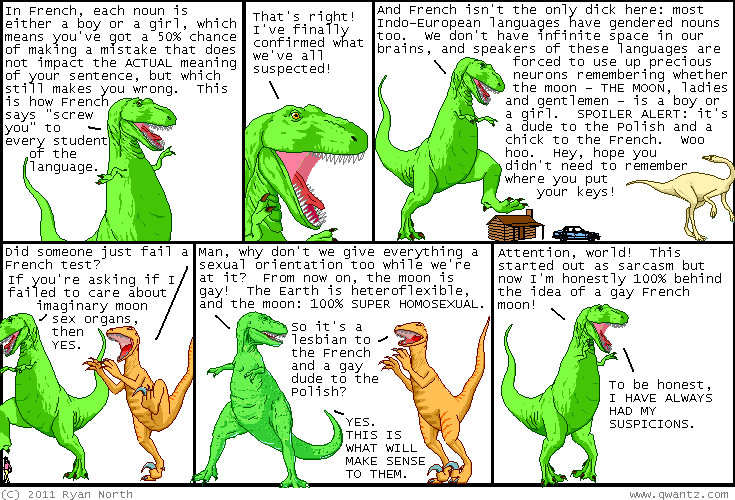
Thanks to the author for permission to post this, and to Prof. Mark Liberman (Language Log) for the pointer.
Eugene Volokh • March 10, 2011 12:02 pm
From Dinosaur Comics:

Thanks to the author for permission to post this, and to Prof. Mark Liberman (Language Log) for the pointer.
Laura(southernxyl) says:
The dinosaur is correct, but somehow the genders stick anyway. I had French in high school a thousand million years ago, but passed a little shop a while back whose sign said “La Papillon” and I thought, that’s not right.
March 10, 2011, 12:12 pmrumpelstiltskin says:
As a regular reader of both volokh.com and qwantz.com, I initially thought I had clicked the wrong bookmark.
By the way, there is a follow-up comic today, in which T-rex softens his stance on gendered words.
March 10, 2011, 12:21 pmPat says:
Everyone knows the Moon is a straight woman, stars are fabulously bi since they twinkle, and outlier hard-flying rocky asteroids are gay. As in Bloodgood, Lui and Hudson.
March 10, 2011, 12:30 pmAnon21 says:
rumpelstiltskin: That was my reaction too. Internet crossover!
March 10, 2011, 12:32 pmMartinned says:
In Dutch the fun is even worse. Our language evolved in much the same way as English, i.e. away from anything resembling organised grammar, so for the last 50-100 years the gender of words hasn’t been relevant anymore, except the distinction between the neuter words and the rest, which affects your choice of article. There’s just one exception: when referring to something, you don’t say “it”, like in English, but “him” or “her”. For example:
- “Check out my new car!”
- “Yes, he’s beautiful!”
(The Dutch word for car is masculine.) The result is that even native Dutch speakers don’t tend to know whether a word is masculine or feminine, meaning that they have to guess. (We guess wrong a lot.) Only the neuter words are easy. They have a different definite article, and are referred to as “it”, like in English. Try explaining this system to a foreigner…
March 10, 2011, 12:32 pmJack A says:
Mark Twain wrote a very similar essay on German.
March 10, 2011, 12:46 pmrb1971 says:
…and of course the Germans also have neuter nouns. At least his allows a non-native speaker to take the rational approach of making every non-personal noun for which you don’t know the gender somewhat neutral. Wrong-but-rational was my approach when I lived in Austria years ago.
March 10, 2011, 12:47 pmgooners says:
At least in an Indo-European language you can try to memorize the gender by learning the definite article as if it is part of the noun. In Arabic the article is not gendered, only the verb is. Plurals are also gendered, so you don’t even get a break there. There is also sometimes a different conjugation for a pair and for three or more…and then it gets complicated.
March 10, 2011, 1:00 pmLiam says:
Because it is substantially worse, with not only a third gender, but a host of rules as to how the gender of a noun governs the form of adjectives describing it; adding to the fun, the form of an adjective can also be changed by the adjective preceding it.
Still doesn’t hold a candle to the insanity that is Russian, though.
March 10, 2011, 1:01 pmMartinned says:
Nope, not Dutch. For us, masuline and feminine words both have the same definite article. Only neuter words have a different one.
March 10, 2011, 1:06 pmU.Va. Grad says:
Today’s comic also includes translations of yesterday’s comic into German, French, and Sanskrit.
March 10, 2011, 1:08 pmChris Travers says:
It’s really amusing when you look at grammatical gender of words for “woman” in Old English…..
March 10, 2011, 1:10 pmMartinned says:
In Dutch and German, the word for “girl” (“meisje” and “Mädchen”, respectively) is neuter, because it is a diminutive.
March 10, 2011, 1:14 pmChris Travers says:
More info:
Two two main words are:
wifman (-> Mod English woman). Grammatically MASCULINE
wif (-> Mod. English wife). Grammatically Neuter.
However….. These words behave as feminine IF AND ONLY IF they refer to a specific person.
Imagine if we did this in Modern English. We’d have sentences like:
A woman can apply for a driver’s license, provided he can meet all qualifications.
However:
Tim went to apply for his driver’s license, and the woman behind the counter said she couldn’t give it to him without more evidence he was who he said he was.
And:
The wife of the household should manage things however it sees fit.
Yet:
Tom’s wife said she didn’t want to go to England for their next vacation.
Fun….
March 10, 2011, 1:17 pmgooners says:
Does the noun gender affect verb conjugation, or does it only come up in pronoun use? In Arabic each person (1st, 2nd, 3rd), gender and number has a conjugation. It makes pronouns unnecessary so they aren’t often used.
March 10, 2011, 1:17 pmChris Travers says:
(As far as I know, this generic/specific gender distinction only affects words for women in Old English.)
March 10, 2011, 1:24 pmMartinned says:
@gooners: That’s a phenomenon that, in Europe, is unique to Latin languages, not Germanic. In a Germanic language like Dutch, verb conjugation is very simple, so you need pronouns to keep track of what is going on.
(A typical example: To walk = lopen. The conjugation for the present tense is: loop/loopt/loopt and lopen/lopen/lopen. The entire plural is the same, and for the singular there’s only that extra “t” in the 2nd and third person.)
March 10, 2011, 1:24 pmChris Travers says:
Nope. Celtic languages also have it. I don’t know about Welsh but Irish Gaelic uses these to conjugate prepositions, making pronouns entirely unnecessary and redundent.
March 10, 2011, 1:27 pmcaptcrisis says:
Thanks very much for this post!
March 10, 2011, 1:30 pmOrenWithAnE says:
As my fluency in hebrew wanes from misuse, I’ve been finding that finding the right gender is among the first to go. This is especially frustrating in a language with gendered numbers.
March 10, 2011, 1:34 pmChris Travers says:
(I think Gaelic also has three grammatical numbers, being singular, dual, and plural too.)
March 10, 2011, 1:39 pmMartinned says:
That’s true, but I (implicitly) limited my statement to the mainstream Germanic and Latin languages. Irish Gaelic is just too weird. They start pretty much every sentence with a form of “to be”. (“I have X” translates literally into Gaelic as “Is X at me” or, IIRC, “Ta X agam”.)
March 10, 2011, 1:41 pmMartinned says:
It’s been a few years, but that doesn’t sound familiar.
March 10, 2011, 1:44 pmgreat unknown says:
In hebrew, at least, the feminine and masculine nouns can be [usually] distinguished by the ending of the noun. The gendering of the numbers is somewhat strange in that “one” and “two” are easily recognized properly as to whether masculine or feminine, whereas from three and on, the system reverses and the masculine numbers start using the feminine suffix, while the feminine do not.
And as one might anticipate for hebrew, some nouns can change gender according to context. Transexualism on demand.
March 10, 2011, 1:45 pmLaura(southernxyl) says:
Not unlike some people of today, for whom there are three genders: men, hot chicks, and other. Some things never change.
March 10, 2011, 1:46 pmJames Fulford says:
An apposite quote:
March 10, 2011, 1:59 pmChris Travers says:
Martinned: I just looked it up. Dual exists in Old Irish and some variants of Scottish Gaelic. Modern Irish Gaelic has lost it.
March 10, 2011, 2:00 pmChris Travers says:
Well, I’m interested in trying to figure out how this developed. One theory I have heard is that originally there were two grammatical genders (active/inactive) and that the inactive became neuter and the active split into masculine and feminine. I am not sure though.
It’s also interested to me how this addresses language and gender. Wifman is masculine because all nouns ending in -man are masculine (man means “human” in Old English and the definitive male counterpart to wifman is wapman). Wif is a more interesting one, and I don’t have an answer there as to how it arises from within Old English. (The male counterpart to wif is wer, which survives in werewolf, which is why I joke that werewolves are by definition male). Wif is just used the way we use “woman” in modern English.
But one thing I think it does show is a distinction in the language between physical gender and grammatical gender, but why this distinction only affects words for women is a more interesting question. It’s one that I suspect doctoral dissertations could be written on….
March 10, 2011, 2:07 pmgooners says:
Reminds me of a friend who was learning Arabic, and for some reason in class were discussing the word “virgin”, which is feminine. So this friend took a stab at creating a masculine form of the word, which completely confused the (native Arabic speaking) teacher.
“Perhaps you don’t understand what this word means?” he asked.
March 10, 2011, 2:08 pmMartinned says:
Good to know that my Socrates/Erasmus year at least lead to me learning something useful… (Other than the awesome onus of proof/causation argument in Hanrahan v. Merck, Sharpe & Dohme (par. 16-26.). Constitutional torts are a wonderful thing, but they do stop somewhat short of being the gift that keeps on giving.)
March 10, 2011, 2:10 pmMartinned says:
Isn’t it simply a matter of etymology? AFAIK, usually when a word has a weird gender, it can be understood by looking at the origins of the word.
March 10, 2011, 2:12 pmgooners says:
Here you go:
March 10, 2011, 2:21 pmGender Shifts in the History of English
Chris Travers says:
Doesn’t help you in this case. It looks like the Common Germanic root is neuter (weib is neuter in German too, as is vif in Old Norse), but it is of uncertain origin.
March 10, 2011, 2:23 pmAJK says:
I can see the utility of gender in inflected languages, but what purpose does it serve in uninflected ones? Is the continued usage vestigial, or is there something I’m missing?
March 10, 2011, 2:30 pmunlawyer says:
In Hebrew, different numbers can have different genders?
March 10, 2011, 2:38 pmgooners says:
I think native English speakers get too caught up in equating the “gender” of a word with real life biological “gender”. It happens because that’s the only way we think of gender until confronted with a new language, and because we are trying to find a pattern that will make learning the foreign language easier. I don’t think there is a purpose, any more than there is a purpose to irregular verb conjugations. It’s just the way some languages are.
March 10, 2011, 2:49 pmgooners says:
I think by number he means plurals – multiple “hes” is conjugated differently than multiple “shes”.
March 10, 2011, 2:51 pmerp says:
All the more reason everyone should speak English.
March 10, 2011, 2:57 pmSbard says:
Stuff like this is why I actually found Japanese easier to learn than German: no gendered nouns, no plural forms, no cases, and only two irregular verbs in the entire language.
March 10, 2011, 3:04 pmunlawyer says:
Oh, okay. I was thinking that perhaps 10 and 100 might have different genders.
March 10, 2011, 3:05 pmLaura(southernxyl) says:
If you have synesthesia, they might.
My daughter told me, when she was quite small, that 4 is a little girl with pigtails, and 7 is her mommy.
March 10, 2011, 3:13 pmChris Travers says:
OrenWithAnE:
So long as you don’t go to a burger stand in Mexico and order “Papas Fritos”
(Papas fritas are french fries, papas fritos are “fried popes” and papás fritos are fried fathers)
March 10, 2011, 3:15 pmByung Kyu Park says:
I blame all those lazy (French) people doing away with endings in noun declensions. If the French kept the endings as in Latin, as they ought to have, the grammatical genders (not to be confused with sexual genders) would be fairly obvious for most nouns, just from their endings.
March 10, 2011, 3:35 pmJR says:
Apparently there’s an Australian Aboriginal language that has 16 noun classes.
When learning Spanish, dealing with two genders, or noun classes, was hard enough.
That must be an absolute nightmare to learn.
March 10, 2011, 3:35 pmChris Travers says:
JR: There are at least six (besides irregular) noun classes in Old English (division by gender and strength).
March 10, 2011, 3:44 pmys says:
No. Each number has two forms: one for feminine objects and one for masculine (or mixed groups) . Confusingly, the number forms for feminine objects resemble masculine forms and vice versa.
March 10, 2011, 3:57 pmMark says:
Having redundant information in grammar helps people understand what is being said. Spoken language is always imprecise as to exactly what sound means what word. Context and redundancy help us cope.
I remember French in high school and dealing with this. I found the gendered nouns made it easier for me to understand what I was hearing but harder to speak correctly.
March 10, 2011, 4:03 pmys says:
This type of construct exists pretty widely – e.g., the German “es gefällt mir.” More directly in Slavic languages “u menya est…” and even more directly in Hebrew “yesh li …”
March 10, 2011, 4:10 pmDual is also not as rare. It’s still fully preserved in Slovene, and is used in Semitic languages, to name a few. All Slavic languages had it in the past.
Going further afield, much more interesting categories exist in Polynesian languages, e.g. Hawaiian. The two categories there are alienable and inalienable objects. For instance, kids are alienable, because they are optional, but parents are inalienable. More interestingly, “chief” is inalienable (you can’t be without a chief), and so is canoe. The category affects articles, pronouns, etc. All this makes for interesting discoveries while studying Hawaiian.
Chris Travers says:
Gaelic is different though because the word order is different. It uses a verb-subject-object verb order which is not common elsewhere.
March 10, 2011, 4:24 pmptt says:
I got the same reaction back in college when I would refer to a romantic friend using the masculine form. It sometimes took a few go-rounds before the light dawned. In one case, I eventually resorted to “Perhaps you don’t understand what I’m saying”. This was back in the 70s, so the teacher’s confusion was quite understandable.
March 10, 2011, 4:24 pmys says:
I am not sure what you mean by this (example?) but you can easily say in Russian – “est u menya X” or “est X u menya” etc.
March 10, 2011, 4:53 pmJim says:
JR, I don’t know about any Australian lnaguage like that, but that kind of thig is common in African languages. Most Bantu languages have about ten noun classes – male things, abstract nouns, small things, and so on. Fulani (non-Bantu) has the most with 17 in some dialects. These noun clases are not very stable over a period of centuries, as it turns out.
Proto-Indo-European originally had two noun-classes, animate and inanimate. Inaminate nouns couldn’t be the subject of transitive verbs, so a sentence like “The ax cut him” would be ungrammatical. For some concepts there were two roots, one animate and one inamimate – so for instance there were two for water, one that gives us all the ‘aqua’ related words and one that gives us all the ‘water’ related words (hydro- etc.) to acknowledge the difference between (still) water as a substance vs. moving water as in a river.
The animate gender split into masculine and feminine, and eventually in most IE languages in India this distinctions is observed on verbs too.
But since noun gender is generally below the horizon of cognition, sound changes tend to matter more than the semantics of noun gender (since they influence it rarely if at all sicne PIE times, 6-8K BP), so in Scandinavian languages masculine and feminine happen to have fallen together, with the result that after 5,000 years the PIE situation obtains again.
As it happens, this was already going on in Norse, so that meant that its system no longer aligned with the rest of Germanic, specifically with Anglo-Saxon. And since most people in the Englsh areas were bilingual in both, and since so much vocabulary is the same in both languages, people gave up on trying to keep these conflicting gender systems straight and just gave up, and that’s the real reason English lost noun gender.
Chinese, like any civilized language, has never bothered with this nonsense.
March 10, 2011, 4:57 pmAJK says:
No, that’s not the problem. In inflected languages, gender (and case/number) agreement serves the useful purpose of determining which adjectives modify which nouns (indeed, it’s often the only way to tell). That is rarely an issue in uninflected languages (at least the ones with which I am familiar). So I’m wondering if there is in fact a purpose that I’m missing, or not. I appreciate your condescension, though.
March 10, 2011, 5:13 pmys says:
However, Chinese has oodles of different counting words that are mandatory to use with numbers when referring to different types of objects (flat objects, long objects, generic objects, members of family, etc., etc., etc.) That more than makes up for the absence of a couple of genders.
March 10, 2011, 5:14 pmrequired says:
While VSO order can be used in some sentences in many languages, it is only the standard form in a few languages (notably Classic Hebrew, Classic Arabic & Island (British islands) Celtic but also some others like Tagalog). Russian (like English, Modern Arabic & Modern Hebrew) uses SVO as the standard sentence order. Standard form should not be taken to mean exclusive, merely the most common and typical form of sentence construction.
March 10, 2011, 5:17 pmChris Travers says:
Virtually every sentence in Gaelic begins with either a preposition or a verb.
Also the sematics are very different. Compare sematics in three languages for the same sentence:
“He plays the guitar.” (English)
“He touches the guitar.” (Spanish)
“There is guitar music at him.” (Irish)
Similarly:
“I am hungry” (English)
“I have hunger” (Spanish)
“There is hunger on me” (Irish)
The VSO word order in combination with the very location-oriented sematics leads to a surprising number of sentences starting with the same verb.
March 10, 2011, 5:28 pmJim says:
“However, Chinese has oodles of different counting words that are mandatory to use with numbers when referring to different types of objects (flat objects, long objects, generic objects, members of family, etc., etc., etc.) That more than makes up for the absence of a couple of genders. ”
It’s mandatory to use a count word, but which one you use is not strictly defined, and you can always use the default count word 个/個 ge4. You may sound a little less idiomatic, but which count word applies to which noun varies across Chinese, or between Chinese languages, so even a foreigner stands a good chance of being right as often as a non-(native)Mandarin speaker. And remember that Mandarin grammar does not have the same prestige or cultural weight as say French grammar does, so a “mistake” like this is going to be considered a variation rather than a mistake.
AJK,
“I think native English speakers get too caught up in equating the “gender” of a word with real life biological “gender”.
No, that’s not the problem.”
It’s not the problem within those languages, as you go on to explain. However that has nothing to do with the that comment, which suggests a reason that English-speakers misintepret the feature.
And in fact there is evidence that English-speakers do in fact make that very mistake. For a period there was a flurry of feminist articles indulging in half-baked Whorfian theorizing based on superficial understandings of noun gender, all exhibiting exactly this error.
“I appreciate your condescension, though.”
What could be condescending about that comment?
March 10, 2011, 5:37 pmgooners says:
@AJK
March 10, 2011, 5:50 pmLighten up, Noam. Just having a conversation here, didn’t mean to offend you.
Chris Travers says:
So I did a little re-reading of some of the books in my library.
It looks like early Proto-Indo-European had two “genders,” but they weren’t male and female. They were animate and inanimate. the inanimate gender becomes neuter, while the animate gender splits into masculine and feminine sometime after proto-Hittite split off.
It would be interesting, however, to look at mythological personifications of things and the biological genders involved, and compare with grammatical genders.
For example, in Germanic languages, the moon is masculine and the sun is feminine. In Norse myth, the moon is a male figure who is replaced after Ragnarok by his son, and the sun is a female figure who is replaced after Ragnarok by her daughter. There are also complex poetic rules which address which trees can be used to refer in kennings to males and which ones can refer to females. The apple-tree for example is male-specific (hence rogapaldr refering to Helgi and brynthing apaldr refering to Sigurd). It is in this semantic level where there could be some interesting work to be done.
March 10, 2011, 6:16 pmAJK says:
The suggestion that my question could be answered by explaining the difference between biological and grammatical gender, which of course it cannot.
March 10, 2011, 6:17 pmCornellian says:
I always thought it remarkable that English has no gender even though it’s basically a merger of German and French, both of which do have gender. It’s probably our language’s greatest grammatical achievement though it was purchased at the cost of being left with completely nonsensical spelling.
Also re the comic, there are a few words in French for which gender does change the meaning.
March 10, 2011, 6:21 pmys says:
Fair enough. Indeed, it is common to Malayo-Polynesian languages to which both Tagalog and the already mentioned Hawaiian belong. Tagalog, however, does not have the alienable-inalianable categories that Polynesian languages (like Hawaiian, Rapanui, etc.) have. Those languages also have dual, to mention another subtopic of this thread.
March 10, 2011, 6:26 pmChris Travers says:
(What would be interesting to see is how closely mythological and poetic references to physical gender overlap with grammatical gender.)
March 10, 2011, 6:26 pmbravestarr says:
Not sure I buy this. The evolution and form of a particular language say things about the culture in which it arose. I can’t imagine groups of people learning to communicate with one another verbally purposely tried to make things more difficult on themselves–you almost have to assume there was some function, be it common idioms leading to irregular forms or gendered nouns helping to distinguish one type of an object from a similar type or something else. I was a linguistics major once upon a time. Posts/threads like this make me want to go back and finish that off…
March 10, 2011, 6:33 pmbravestarr says:
So funny, so true. I spent some time in Africa and attempted to learn (outside of rote memorization) a bit of a couple major Bantu languages of the country I was in and I have a notebook with a couple pages of notes and then, clearly, I gave up. I honestly wondered if there were any structure at all to the languages or if they were simply a bunch of random words native speakers memorized as they grew up around them.
Makes me totally skeptical of anything resembling a universal translator or babelfish ever being a reality.
March 10, 2011, 6:42 pmSbard says:
Japanese, thanks to the importation of large amounts of Chinese vocabulary, has the same issue. While in many cases you can just use the “default” 個 or つ, in some cases changing the counter can change the meaning of your speech, like referring to a bottle of beer (ビール一本) instead of a glass of beer (ビール一杯) or a loaf of bread (パン一斤) vs. a slice of bread (パン一枚).
March 10, 2011, 6:44 pmChris Travers says:
The next language I intend to learn is Indonesian which is in this family.
But when you say Malayo-Polynesian, is this coterminous with Austronesian? Or is it a subcategory?
March 10, 2011, 6:49 pmys says:
It is apparently a subcategory of Astronesian languages which also include Formosan languages. The latter are apparently natively VSO or the like, but some have also SVO under the influence of Chinese. I admit I don’t have deep knowledge of this classification and its features. I have only studied Hawaiian and a little Rapanui (while doing Mandarin now). My Tagalog textbook has been lying around unused for a long time.
March 10, 2011, 7:13 pmGraham says:
The moon is the origin of heterosexuality, as Hedwig reminded us:
The children of the moon looked like a fork shoved on a spoon,
They was part sun part Earth part daughter part son.
See http://www.youtube.com/watch?v=mRol4ByOh6g
March 10, 2011, 7:26 pmByung Kyu Park says:
I guess you never heard of slangs, jargons, insider jokes, or, at least to my untrained ears, ebonics.
Some people do purposefully try to make the language difficult for themselves. Well, maybe it’s to make it difficult for the outsiders, but the side effect is that it doesn’t make it easier for the insiders, either.
In the one linguistics course I took in college, there were all sorts of ridiculous assumptions about, I think, intention/efforts of speakers in a society (communicate an idea clearly, etc.) which were very frequently violated in real life. I guess that explains why that was the only linguistics course I took …
March 10, 2011, 7:40 pmByung Kyu Park says:
I don’t see how this is so different from English (or any other Indo-European languages I know, of which there are few).
You just used counting words in English, too, and using different counting word changes your meaning. i.e. When you use “glass” to count your beer (and “glass” being your counting word), it’s different from when you use “bottle” to count your beer. Same with using “loaf” to count your bread and “slice” to count your bread.
It’s true these strange little Asian languages developed rather formalized notion of “counting words”, in their obsession to count things like money (which is not countable in English), but in substance and actual usage, what’s the difference?
March 10, 2011, 7:46 pmChris Travers says:
I think you have to separate dialects and slangs from the others.
However, if clear communication is the goal, why do judges use “supra” and “infra” in opinions when plain English words would work just as well and not use up a significant amount of extra ink/paper? I think jargons often do act with the intention of cloaking communications from outsiders.
March 10, 2011, 7:48 pmys says:
In Chinese, the character consisting of Sun and Moon (ri + yue) means “bright” (ming) and also stands for Ming Dynasty.
March 10, 2011, 7:59 pmByung Kyu Park says:
I assumed they just loved italicizing words. You can’t italicize “above” or “below” without making it look like you are emphasizing them.
March 10, 2011, 8:01 pmrhhardin says:
Two great sexes animate the world.
- Milton
March 10, 2011, 9:32 pmPatty Shundynide says:
And that is different from English, how? You don’t say “two bread.” You say “two slices of bread.”
March 10, 2011, 10:00 pmByung Kyu Park says:
The difference would be … English considers some words inherently countable. i.e. You would say “two books”, not “two pieces of book”. Based on what little I know of these funny Eastern Asian languages, I think the Chinese have a counting word for books that applies to … published bound objects.
But as I said above, in the contexts where change of counting words could alter the meaning of the sentence (rather than simply saying something very rude by using a counting word for inanimate objects to count people), I think the English equivalents are more or less the same.
March 10, 2011, 11:10 pmJim says:
“It would be interesting, however, to look at mythological personifications of things and the biological genders involved, and compare with grammatical genders.”
That would be a big study. There’s probably some interplay, but it isn’t going to be a one-to-one correspondence. For instance, Thor derives from the etymon for thunder and that happens to be masculine. OK. But on the mythic level Thor is cognate with Indra. Indra is masculine, but I don’t know about the etymon his name is based on. Then there are other cognate gods – Perkunas/Perkun/Perun. Etc.
“For example, in Germanic languages, …. There are also complex poetic rules which address which trees can be used to refer in kennings to males and which ones can refer to females.”
The same holds in Celtic poetry. Various trees have various associations alders are royal, ash is male, for obvious reasons, for instance – and of course the names for those trees, but there isn’t always a grammatical gender match. The beech is the “queen of the forest” and they do have a quite feminine grace, but “fea” is masculine. OTOH “die Linde” is feminine and linden trees are also rather feminine in feeling and more than that, there seems to eb some connection with the name “Linda”.
March 11, 2011, 1:31 pmChris Travers says:
It would be a big study. And note too that while Thorr and Indra are close matches, they are an exception in the sense that there is a clear 1:1 match here. Odin does not match 1:1 with any Vedic god (equivalences have been proposed with Shiva/Rudra and with Varuna and both of these are partially supported).
So even if we don’t hold with a complete Whorfian view here, doesn’t it seem likely that on this level, that a great deal can be determined culturally by looking at semantic as opposed to grammatical gender?
March 11, 2011, 1:52 pmSbard says:
Because in English, you’d say “one slice of bread”, “two slices of bread”, etc. Where the word “slice” changes depending on whether the noun is singular or plural. In Chinese, Japanese, or Korean, what you say would come across more like “bread, one slice”, “bread, two slice (not slices)” where the counter or noun doesn’t change regardless of the number of units (it may change due to other phonetic rules but that’s a separate issue). Also, the counter that you’d use to describe a slice of bread can be used for any thin flat object, like sheets of paper, and the one you’d use for bottles of beer is the same as for any other long round object, like pencils or iron rods.
March 13, 2011, 8:02 pmByung Kyu Park says:
I can’t speak for other funny languages from that region, but at least in Korean, plural marker is essentially ad-hoc and optional. I wouldn’t read too much into the lack of plural marker on the counting word … as the plural marker is also optional for non-counting words.
I speak only as a native speaker, not someone who actually studied Korean in detail, though.
March 13, 2011, 8:39 pm