Vice President Cheney's hunting accident led me to wonder — how dangerous (to humans) is hunting, compared to other recreational activities? Here are some statistics from the 1999 edition of National Safety Council's Injury Facts:
| Sport | Fatalities | Injuries |
| Hunting | 92 | 880 |
| Swimming | 1500 | not specified |
| Recreational boating | 821 | 4555 |
| Parachuting | 47 | not specified |
| Skiing and snowboarding | 26 (22 skiing and 4 snowboarding) | not specified |
| Football | 7 | 334,420 |
Note that all the numbers (especially the injuries) probably involve some underreporting, so these are just rough cuts. The numbers also aren't normalized by the number of participants; for instance, hunting, swimming, and boating, for instance, are much more popular than parachuting, so parachuting may well have a higher fatality-per-participant (or fatality-per-episode) rate than those other activities.
I used the 1999 edition because that's the one on my shelf; I'll see if I can get some more recent numbers, and perhaps ones that cover more kinds of sports.
Here's 1996-98 data for Colorado alone; again, I point to it just because I could find it easily online — I suspect it's at least roughly representative of the country more generally, though of course it would have a higher skiing fatality count than most other areas would.
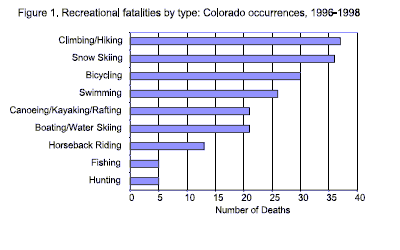
UPDATE: As I noted above, the numbers I gave aren't normalized by the number of participants; I was hoping people might fill that gap in some measure. (I also hope that it's obvious to our readers that without this denominator data, the numerators I give are useful only as a start to answering the question, or at best as a very rough estimate given your rough sense of the order of magnitude of popularity of each activity.)
In the meantime, I did a bit of searching to try to get this information myself; so far, all I've discovered is that in the late 1990s, the U.S. Fish and Wildlife Service reported that about 15 million hunting licenses were sold each year. I'd love to hear what people who know more about hunting licenses can say about how overinclusive (do you often need to buy more than one hunting license to hunt more than one kind of game, or more than once?) or underinclusive (is there lots of hunting that doesn't require such a license?) these numbers might be.
FURTHER UPDATE: A reader who identifies himself as Talon Karrde pointed me (thanking Alphecca) to a Texas Parks & Wildlife Report that reports about 30 accidents per million hunting licenses per year in Texas over 2003-05, including under 3 fatal accidents per million hunting licenses. If this information is complete, and each hunter gets one hunting license per year, then we have a rate of 3 deaths per million per year. If every single American swam (obviously an overestimate), then the 1500 swimming fatalities per year would translate into 5 deaths per million per year; if every American boated (obviously even more of an overestimate), then the 800 swimming fatalities per year would translate into under 3 fatal accidents per million swimmers.
So, if my assumptions about completeness of the Texas records and the hunter-hunting license correspondents are correct, and if the Texas data is generalizable to the country as a whole, then hunting would be less dangerous on a per-participant basis than swimming and boating. We still don't know the relationship, though, on a per-hour-spent basis. If people have statistics on number of participants in swimming and boating, or more accurate information on housing, I'd love to hear them.
Also don't know if backcountry ski/snowboard fatalities are in your numbers. Pulling the avalanche data, I see 2 skiers and 12 snowboarders in 1998/1999, and 9 skiers and 1 boarder in 1999/2000. More recent data is similar - 10-15 per year. (It's lumpy because of fatality patterns - often you have a group of 3-5 get buried together.)
Can you find more Charts? Also representative of more areas of the Country? (In CAL, AZ, and FLA, for example, people do outside sports year round, thus, more activity=more risk to more people. Just curious.
Can you find more Charts? Also representative of more areas of the Country? (In CAL, AZ, and FLA, for example, people do outside sports year round, thus, more activity=more risk to more people). Just curious.
Which is not to say we should avoid things like recreational swimming, but it doesn't surprise me that a lot of Americans kill themselves every year because of their failure to take water seriously.
Note that the difference between a sport and a recreational activity is frequently blurry but has real-world applications. When a state tried to outlaw bungee jumping a while ago, Jacob Sullum wrote an article in Reason magazine drawing attention to this fact - When bungee jumping was viewed as an extreme sport it was allowed a free pass on the grounds that its participants knew it was a dangerous sport (It actually wasn't, but that's a different story). When it suddenly became popular among large segments of the population, it was treated differently - more of a recreational activity than a sport - The difference being that participants in the latter are more likely to know more about the activity, understand the risks involved. As I said, this is largely arbitrary - hangliding and rock climbing are more generally recreational activities than sports in the traditional sense (a contest with clear rules and a winner or loser each game).
Of course, driving a motorcycle is one of the most dangerous recreational activities around, aside from dating my ex-girlfriend.
I'm guessing you should feel free to draw your own. :-)
Sometimes data can be useful: for example, given the doubtlessly enormous numbers of people who play football, we can safely conclude that football is not very likely to kill you. But these data are pretty much useful for comparison purposes.
Just like Butter Lover and Arthur, who take the same post and see it as a skewering either the "Liberals and MSM" or the (my summation) "Right Wing Blogosphere." God I love politics.
For example, it appears POTUS 41 would not consider horse activities risky:
POTUS 41 (look beyond horrible comments and go to the picture)
Whereas, it appears POTUS 43 is afraid of the risky activity, but he is at least giving it a try:
POTUS 43 (again look beyond commetns and go to the pictures, #1 petting a horse  attempting to mount a horse).
But all in all, other POTUSES did not see as much risk as POTUS 43, and were in apparent agreement on the subject of risk with POTUS 43:
Teddy JUMPING!!!!!(scroll down)
Ronnie (my favorite, scroll down more)
And, William Jefferson ... looking pretty good, but ... OOOPS, he forgot, can't JUMP in a western saddle! (scroll near the bottom)
On balance, perhaps riding &jumping horses is not as risky as, say, jumping out of an airplane with a parachute?
Think of the children! Won't someone please think of the children?
Thanks, I'll never look at a faucet in the same way again.
As to the danger, I'm not a hunter, but I have to wonder if more alcohol wasn't involved than Cheney admits. With three people out hunting, as I believe he said it was, I don't see how you leave one guy behind and then turn around and shoot in that direction without even thinking about it. It's just a strange amount of recklesness for someone of Cheney's age and position.
Then, not going to the hospital, not talking to the police, not telling the President or anyone else until the next day, him admitting that he did in fact drink; I don't see how that doesn't raise questions.
I guess it all could have happened totally sober, just like I guess Ted Kennedy could have driven off a bridge sober. Cheney's explanation of how it happened, though, seems to me to suggest a very strange lack of judgment for a Vice President.
1999 must have been a slow year for skier deaths. The average is around 40 a year for North America (including Canada). What I find interesting is how much higher the death rate is in Europe. About the same number of skiers die at the Chamonix ski area in France each year as do in the entire North American Continent. If you've ever skiied in Europe, the differences are obvious. Nobody cares if you ski out of bounds or in closed areas. Nobody is going to yank your ski pass for skiing where you're not supposed to and the ski patrol isn't going to stop you. But if you kill or seriously hurt yourself, even in bounds, there is absolutely no one to blame or sue. The responsibility and expense is entirely yours. The ski areas accept no liability. As a consequence, lift tickets are dirt cheap.
One beer at lunch, and alcohol is a factor?
The guy has had three heart attacks and has a med team follow him around everywhere. It seems very unlikely he was getting hammered before the hunt, during the hunt, or at any time in the last five years.
The local police were informed within the hour, and the medical team immediately. This is not remotely like Ted Kennedy, who had a known drinking problem, going to his lawyers first and waiting four hours to notify anyone, including anyone who might have rescued Mary Jo.
Oh yeah, like anyone is going to tell Dick Cheney, "Sir, don't you think you've had enough to drink". I think they would get the same response that Pat Leahy got.
You don't think Cheney's doctors would have mentioned heavy drinking might not be a good idea for someone with a serious heart condition?
Marcus,
You're basing that on what exactly? Is there any evidence Cheney was ever a binge drinker?
(1) Drunk Hunting
(2) Most Dangerous Game hunting
(3) Lawyer hunting
(4) Paint Ball Office Picnics gone horribly wrong
What I find amusing is that this story is being spun from contradictory angles by various members of the right and left:
(1) Gun Nuts/Cheney-haters want to argue that these incidents are rare and that hunting is safe, (and therefore something else must have been going on).
(2) Cheney-worshippers/Gun Control Nuts want to argue that these incidents actually happen all the time and are not a big deal (and that they go unreported by hunters because they don't want to expose the real dangers of hunting).
Please, make it all stop.
1. It's not that he was a binge drinker; you hardly have to be a binge drinker to act recklessly under the influence.
2. I've seen it reported that Cheney flunked out of Yale because he was more interested in drinking than studying, but it could be wrong, but it's also not the point.
3. There were three of them out hunting. Two of them left one behind, and then Cheney turns around and shoots in his general direction without thinking. How does that happen? Either Cheney is just extremelely reckless, or he was under the influence.
Hey, I'm not saying accidents can't happen while sober. We all have accidents. The explanation of this one, though, is just bizarre. When I think of how I could turn around and accidentally shoot my friend in the face without considering that we just left him behind, I can only think of one way that would happen: I must have been drunk. Guns, let's not forget, are not toys.
4. Cheney admitted he drank that day. He said one beer. But how believable is that? He's out hunting all day, and the beverage of choice is beer, and he only has one? And then he accidentally shoots his friend?
I'm not being particularly cynical here. If I get pulled over by a cop, whether or not I just shot somebody, and when asked I say "well, I had a beer a few hours ago," I think he's going to be skeptical. I think he has a right to be. And if I then refuse to take a breathalyzer test, I think he has an even stronger reason to be skeptical. Which leads to point 5:
5. After the accident, Cheney stayed out of view for 18 hours, and didn't even accompany Whittington to the hospital. He just shot a guy, and he doesnt' even go with to the hospital, for no explained reason (he said the ambulance was crowded). And then he turns away police who want to interview him, and then doesn't inform anyone outside his circle until the next day.
Is it the same as Chappaquiddick? No, not really. If Whittington actually died, though, I'm not sure it would be that different. While the death involved in Kennedy's action puts it in another league, the fact is that he was also much younger and in less important of a position. And he did not have a group with him that forced him to immediately take some responsibility. So, yes, Cheney could have been worse, but he could have been a lot better too. I'm not sure he earned the right to be let off the hook.
Are you testing us?
2. OK, stipulated. But is there anything more recent than college? That was several decades ago.
3. He was thirty feet away from him, facing the sun, and the guy was in a low place behind weeds. It happens.
4. He had a beer at lunch. It's very believable, as I doubt beer is the "drink of choice" while hunting with a VPOTUS who has a heart condition. And he didn't refuse a breathalyzer, that's just bizarre.
5. Now you're getting to the point of tinfoil conspiracy theories. He wasn't "out of view," he was doing normal VPOTUS stuff. The only sense in which he was "out of view" was that he didn't immediately hold a press conference to demostrate his sobriety to a press corps that loathes him. He had contact with lots of people, none of whom have said he was noticeably inebriated.
"If Whittington actually died, though, I'm not sure it would be that different."
Huh? The problem wasn't the drinking, it was that Mary Jo was left to die while Ted went to his lawyers. Cheney immediately called the medical team.
Probably by getting hooked with the fishook. Ask someone who is clumsy around fish hooks. I can't believe the razors on some of them that tourists cast onto our sailboat. We have to watch where we're walking.
He says he's "fine," but have people noticed how his eye is swelled partially shut and the big red marks on his neck in today's photos? Ouch!
unless you use the handgun to shoot the person who falls into the pool. And then it is the call of the Coroner.
It happens to people who violate the safety rules.
Those rules are what make shooting sports as safe as they are.
Drunk or sober, Cheney violated a basic one.
I guess we all come with a different perspective. I bet Kennedy was pretty sure, though, when he got out of there, that there wasn't going to be any saving his companion. I doubt very much that he cynically decided that it didn't matter. It didn't matter if he was drinking? I disagree.
But boating accidents are covered elsewhere in the list, so I assumed the fishing fatalities exculded those involving boats.
As for Cheney. In my opinion (of course I am an avowed Cheney hater, pro-gun control, but have nothing against people shooting furry and feathered animals if that's what they enjoy), his actions beyond his expected reluctance to speak to the press say to me that he was probably drunk off his ass, as were the rest of the party, when he shot Whittington.
Consider: Cheney didn't go to the hospital. Why not if not to make sure the Sherriff didn't corner him and request a BAC test? Whittington's doctors abruptly ended a press conference earlier in the week when they were asked if a BAC test had been performed on Whittington (which of course it would have as routine if there was the least chance that anethesia, painkillers or sedation was going to be administered) and what the results are. Since I'm not on a jury I will draw conclusions from that silence. Cheney had the Secret Service keep local law enforcement at bay until the next day. If he wasn't drunk and didn't need to get his story straight with everyone else in the party (we had one beer at lunch, nothing thereafter), why the delay. Nope, they needed time to sober up. Not only did he admit to the "one beer" (as noted above, that's always what you tell the cops, no matter how many you've had), he also admitted to having a cocktail after the incident. Again, if the sherriff insisted and got past the Secret Service: "Well, I had a beer at lunch, but nothing else until after the incident, but I've had a couple since I got back so I don't know what good a BAC will do now."
You know what must be the easiest job in the world? Being Dick Cheney's press secretary. You get up every morning and release a statement that says: "The Vice President has no public appearances today and will release no public statements". The rest of your day is free.
You're being a little melodramatic, aren't you? Kennedy drove off a bridge late at night. The car was completely submerged and he managed to get out while she drowned. He claims he tried to save her but couldn't get her out. Maybe he is lying, maybe he isn't. Probably only he and God know the truth. But one thing is certain. By the time Kennedy got to anyone who could have helped him rescue her, she was already dead.
What he did in the aftermath of the accident and the attempt to cover it up was quite despicable. But as to what actually happened between the time the car went in the creek and when Mary Jo died, there is probably not a soul on this earth other than Ted Kennedy who knows what really happened.
I think it's also worth noting that even if Kennedy were the least caring person in the world, he still would have tried to save her if only to protect himself.
It's not uncommon for Republicans to say things like, "Oh, Kennedy? One word: Chappaquiddick." As long as Democrats stop short of that kind of smearing, I think they're at least being more reasonable than their counterparts.
I shoot pistols competitively (United States Practical Shooting -- www.uspsa.org) and am a certified Range Officer trained to run a safe range. Frankly, if this occured at a match I don't believe we'd DQ (disqualify) the shooter (cheney) since he didn't break the 180 and didn't knowingly shoot in an unsafe manner, ie at someone strolling downrange.
But in any event, the numerators can be useful, as a very rough measure, if you have a rough sense of the denominator. Hunting, as best I can tell, is a very popular sport; so are boating and swimming. It looks unlikely that hunting is much more dangerous (at least on a per-participant basis, as opposed to, say, a per-hour basis, where the matter is clear) than those other sports, unless we think that boating and swimming are ten times more popular than hunting (which I doubt). Of course, that is indeed a very rough guess.
More seriously, I spent some time looking at injury and fatality statistics for various sports while I was trying to convince my family that they shouldn't worry so much about my love of scuba diving, and it was actually pretty difficult finding meaningful numbers I could compare across sports. The number of injuries and fatalities was easy enough to locate, but the number of total person-hours spent in each of those sports -- which would make for the most logical denominator -- was hard to come by. I imagine many more person-hours are spent hunting than scuba diving, and that more person-hours are spent scuba diving than skydiving, but even rough estimates of how many proved wildly inconsistent.
I do remember, from looking at the numbers I could find, that hangliding was more a method of suicide than a, uh, sport. So at minimum I was able tell my family about how scuba diving was a whole lot safer than that.
State practices vary, but I'd guess that the net effect is overinclusion. In Texas, there are separate licenses for hunting and fishing (and separate stamps for archery, freshwater fishing, saltwater fishing with a red drum tag, upland game bird, and migratory game bird), but no further distinctions are made. Contrast with my native Minnesota, where there are separate licenses for bear, deer, elk, moose, small game, turkey, waterfowl, and fish.
On the other hand, there is some underinclusion. Most states sell lifetime licenses in addition to the usual annual licenses, and some individuals are exempt for requiring a hunting licenses (e.g., children and the elderly).
Also,hunting-related injuries and deaths are not limited to shootings. They also include falls from tree stands, or on rough terrain; drownings from falling into water in pursuit of living or dead game; exposure or hypothermia from becoming lost in the woods; heart attacks caused by overexertion; and even attacks by animals.
As the owner of a bait shop adjacent to a state-owned lake, I am acutely conscious of water safety. Many of our customers are unaware of the depth of the water close to shore, and allow their very young children to play on a dock floating in 15 feet of murky, weed-filled water. During the summer, I am constantly running out of the store with small life vests in hand, admonishing the parents to please, please be careful. They just aren't thinking, and not thinking can lead to tragedy.
Oh, and as regards Cheney's missing bird stamp - in Nebraska, to hunt birds legally, you must purchase a state hunting permit, a "habitat stamp", a federal stamp, and register with the federal "HIP" program, a system devised to track the harvesting of migratory birds. This requires at least three separate actions on the part of the hunter. It is pretty easy to understand how an out-of-state hunter might overlook some part of the process. Plus, the laws can be different if you are hunting on private versus public lands.
1) Mr. Whittington was avoer 50yrds away. Later it was changed to about 30 yrds.
That is, the distance was cut from an original report of over 150ft away to about 60ft. That is a BIG change in the reported facts.
2) A 28 guge shotgun was used. Later I heard that it was a 20 gauge, then back to 28 guage. What was it?
3) That #5 shot was used. Is this correct?
=====================================================
I think that this accident is not being reported accurately by the people involved.
=====================================================
I was at my wife’s uncle’s house. The cousins and some friends (all teenagers at the time) were in a bedroom when a friend got shot, point blank, with a pellet rifle. He came out in shock, pale. I just though that he was scared and that it was probably no big deal. All we had to do is just get the pellet out from under the skin. My wife’s uncle came into the house and immediately took the teenager to Emergency Room where the kid was then taken into emergency surgery. The pellet had lodged in the pericardium. I was told that the doctors said that the boy almost died in the OR. I almost cost that boy his life had it not been for someone else’s proper response. I still shudder to remember.
- Inattentively letting your boat go over a spillway
- Deliberately driving your boat too close to the base of a dam (in quest of monster striped bass)
- Capsizing or falling out of the boat; extra points if alcohol is involved/no flotation device used/cranial trauma renders victim unconscious
- Lightning strikes"
Catching a fish big enought to eat you (Jaws).
But in any event, the numerators can be useful, as a very rough measure, if you have a rough sense of the denominator. Hunting, as best I can tell, is a very popular sport; so are boating and swimming."
Point #1: Some of us tried to fill in the gaps. No equestrians among the elite (as Article II Groupie defines) it seems.
Point #2: Equestrian sports are extremely popular as well ... a $40 B impact on U.S. Economy. Click here for study
1) Dick Cheney told the truth in his interview with Brit Hume (one beer with lunch and therefore not intoxicated).
2) The distance was approximately 30 yards (but it may have been a little closer or farther away). Probably nobody measured the distance precisely because it wasn't essential to determining what happened.
3) The gun being used was a 28 gauge (and any stories to the contrary were either speculation or misquoting).
4) It was an accident resulting from Mr. Whittington not following procedure by announcing his return to the line of hunters, and Mr. Cheney making a mistake in firing at the far edge of what he mistakenly thought was a safe direction to fire.
5) The VP didn't consider holding a press conference to announce the incident 15 minutes after it happened because he doesn't think that the Washington press corp is as important as they think they are.
In Minnesota you buy a small game license and then tags and or stamps for the game you wish to harvest (Deer tag, pheasant stamp, etc). The number in the link provided by prof Volkh does not double dip for multiple tags/stamps. Compare the number of deer tags (only) sold in ’04 of nearly 700,000 and I would think that its highly unlikely that they are counting every license, tag and stamp as an unique license.
This is consistent with the states I’ve hunted in.
Where the number is/may be overstated (slightly) is a hunter buying hunting license in multiple states though I would think that this would be fairly small.
It is too bad the methods available for editing posts as one is posting them are so limited. A barrier for the disabled.
That sounds like skeet shooting to me.
Imagine what the Republicans would say if John Kerry went "hunting" like this.
If this is "hunting," it's "hunting" for wimps.
*I've read several places that the quayle were stocked, not no place in the MSM, so it may be incorrect. The rest of the scenerio is enough to deserve to be called "skeet shooting" or "'hunting' for wimps."
HIPPA has had an effect on what medical professionals and hospitals can say about patients.
Even in a public event, such as this one, Medical professionals can not reveal certain kinds of information without patient approval. As a normal rule, the hospital can't even tell someone if you are a patient, much less what is wrong with you, without specific instructions from you.
Some people speculate that the hospital's refusal to discuss Mr. Whittington's BAC was to protect Mr. Cheney. I would argue that without specific guidance from Mr Whittington, the hospital spokesman couldn't mention the results from most of his blood tests.
In otherwords, Mr Whittington gave them permission to talk about his injuries, but not about his blood tests, therefore they couldn't. It isn't a grand conspiracy, just an unintended side effect of a Federal Law, authored by a Democrat (T. Kennedy, MA)