The Housing Market and the Economy:
Liz Ann Sonders, Chief Investment Strategist, at Schwab, has an excellent summary, complete with neat charts, of the state of the housing market, the current outlook, and the potential ramifications for the economy as a whole. In short: not a pretty picture. This chart (click for larger view), in particular, is worrisome if one is invested in equities.
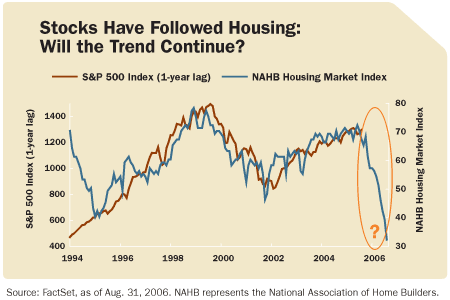
Look at 1994 to 1995 (Which is actually 1995-1996 for the S&P). Why should I expect 2005-2006 (Actually 2006-2007 for S&P) to be different? She even says "As cited by many a homebuilder CEO lately, there is something very unique about this cycle: It’s the first time in American history that a severe housing downturn has been led not by rising unemployment or falling incomes, but by too much inventory and speculation."
So, why should I not expect that investors will dump houses and rush to equities. I'm not predicting anything, just saying that plotting this short-term correlation is next-to-useless in predicting equity prices.
I'll opine that we simply had a housing speculative bubble, and it will take time for fundamentals to reassert. Meantime, as commented here and elsewhere, builders are going to continue to build even as prices come down, past the point where they break even - i.e. they will overbuild as they have in the past, trying to make money as fast as possible in the downturn. When prices reach the point where builders lose money on new homes, they will stop saturating the market.
Josh - if you look at the statistics on how much cash-out refis have contributed to American's spending over the last five years, you might rethink that premise.
Not to minimize Prof. Bernstein's contributions on this topic, but the blog I read for perspective on the real estate market is calculatedrisk.blogspot.com
Three month LIBOR (London Interbank Offer Rate) was 1% in mid 2003; it is now 5.36%. That is likely to present a significant problem for people who overleveraged themselves to buy houses using 3/1 or 5/1 ARMS, on which the interest rates will step up significantly.
My comment exactly. The interest rate is probably the "outside economic factor" alluded to in some of the other comments.
Many people stretched themselves to buy homes they could not really afford, but since the monthly payments at the teaser rates were so low, it created the illusion that they could. Have mortgage rates doubled? No. Have they increased to the point that there are a lot of people who will have difficulty making payments. Just look at the delinquency data, which will be followed soon by the foreclosure data.
There was a nice article in today's Journal (Wall Street) about a fairly sophisticated mortgage fraud scheme as well....
It's entirely possible that housing and stock are linked sometimes. But they don't look like they're linked ALL the time by any means. So unless she wants to ALSO address how you can tell an upcoming "linked year" from an upcoming "unliked year" then the statustics are worthless. Will next year look like 1994 in reverse? Who knows?
Comparing apples-to-apples, the rate increase on a 1-yr. ARM has increased less than 2% in the past 3 years, which is the point I'm making. Sure, the APR is slightly higher than the rate because of those points and fees, but it hasn't gone up any more than the rate, since fees have remained flat.
Looking elsewhere on the site, I see that 30 yr. Fixed rates have increased a grand total of 26 basis points (0.26%) from August 2003 to August 2006. The fact is, short term rates mean almost nothing with regard to first mortgage pricing. It's the people who took out giant 2nd mortgages based on prime in the past few years who are seeing their rates and payments go up dramatically.
However, thanks partially to the increased value in their homes from appreciation during that time, many of those borrowers are able to wrap their old 1st and 2nd into a new 1st mortgage and actually reduce their current blended rate.
Sorry to rain on the parade of negativity, but them's the facts...
I made no reference to any change in up front fees (points) charged in connection with ARMS. It does not surprise me that fees on ARMS have remained constant over time, as lenders are typically willing to trade off up-front fees for rate to accommodate the desire of the borrower.
What I said is that originators of ARMS offer artificially low teaser rates for the initial fixed rate periods of the loans as an inducement. In other words, if the rate will reset to the one year treasury + 275bps, they set the initial rate at T+125. This creates the illusion that interest rates have to increase in order for the mortgage rate to increase, which is unfortunately not the truth. If you don't believe me, read a standard ARM mortgage disclosure statement -- it's right there.
As it relates to mortgage pricing, 30 year fixed rate mortgages are based of the ten year treasury rate, so you are correct in saying that they are not affected by short term rates. Unfortunately, to pick a recent month, say March 2006, 41% of residential mortgages originated were ARMs. They are not second mortgages, they are first mortgages. The average fixed period on them is about 2 years. These borrowers will have a rude awakening arriving in their mailbox rather soon.
Don't worry about raining on my parade -- I got tons of grief from relatives when I told them the NASDAQ was overvalued in '99 and '00.
A "50%" increase is NOT more pertinent. If rates went from .25% to .5%, that would be a 100% increase, right? But the actual DOLLARS that a $100,000 loan would go up would be a whopping $250 a year.
In the current 1-yr. ARM case, a $250,000 loan has seen monthly payments (fully amortized) go from around $1,190/mo. @ 3.98% to $1,425/mo @ 5.54%, for a $235/mo. increase on a $250,000 loan.
Is $235 a "50% increase" on $1190? Not even close. Try less than 20%. Sure, there will be some people who can't make the increased payment, but the way you choose your numbers overstates the case.
Note that none of this has to do with property VALUES, just what it costs to borrow money. If values go down sharply, then many borrowers will have loan-to-value ratios at dangerously high levels, and will have a hard time qualifing for good rates.
But the rise in interest rates is not severe enough itself to be the cause of any precipitous drop in property values, in my opinion. If unemployment creeps up, then we'd have a different story.
HAFFENREFFER: The Nasdaq certainly had a very impressive -- continuing to run up here. Blue chips seemingly two days in a row out of the woods. Any insights?
SMITH: Well, you know, your -- Christine, just a moment ago, talked about how the seasonals or the -- what we've usually seen is the market rally in the first days of the month. That will probably continue to be here. I think we're in the midst, actually, of a reflex rally in the Dow, which will carry us higher over the next few days. But when you've got rising interest rates, it's very difficult for the old economy, represented by the Dow, to move higher because it's a very interest-rate sensitive index, unlike the Nasdaq which, in current market conditions, is not interest-rate sensitive. So, to mean, "the great divide," as you called it a few moments ago, is going to -- is set to continue.
MARCHINI: The Nasdaq is not interest-rate sensitive. That does seem to be some of the wisdom about the new economy. But do you think the Fed is going to keep raising rates until it becomes interest-rate sensitive?
SMITH: At some level, everything is interest-rate sensitive, and I do think that they're going to raise it. I don't know if it's going to be enough to really hurt the Nasdaq; I think enough to slow the advance or maybe even cause it to dribble lower.
I'm looking more for something like 50 to 100 more basis points or a half to a full percent rise by the Fed from here, and that's going to continue to win in the broad market, and I think it will blunt the advance of the Nasdaq.
The specter of rising interest rates has proved to be a formidable headwind for many of the stocks in the Dow and S&P, while the Nasdaq seems oblivious, said Bill Meehan, chief market analyst at Cantor Fitzgerald &Co.
The Federal Reserve board has raised short-term interest rates four times over the past year as a pre-emptive move against inflation. Since July, the federal funds rate -- a key indicator of the direction of interest rates -- has moved from 4.75 percent to 5.75 percent.
"A lot of people think higher interest rates don't affect technology stocks," Mr. Meehan said, "but if the Fed raises rates enough there is no question that the economy will slow, and obviously these tech companies will sell less of their products."
Some analysts are expecting the Fed to raise rates at least two more times this year, including at its next meeting, March 21. But some Wall Street analysts argue that many of the "New Economy" companies of the Nasdaq don't have debt on their books, and because of that they aren't affected by rising interest rates.
Just about everybody knew both markets were overvalued at least 18 months before they started to decline. It may well have been interest rate hikes that triggered the actual decline in both markets, but the stock market is not going to follow the housing market down unless there is a perception that it has become significantly over valued. And I don't see any such perception is becoming widespread.
Come on, this is supposed to be at least a quasi-libertarian site. Have some respect for efficiant markets. If that statement was true there would have been massive shorting and the NASDAQ would have crashed, well, 18 months earlier, or right about when "everybody knew" it was overvalued. That's just sloppy reasoning. I'll grant you it is an inapt analogy to the housing market, mostly because no one has come up with a way for me to short a 1BR in Clarendon 1021 yet...
I disagree with you on that point. Not everybody knew the market was overvalued, but a hell of a lot did, and a lot of those who did short it got their a55es handed to them as the valuations became increasingly absurd. If you know the market is overvalued, but you don't know what catalyst will crack the bubble, it is exceptionally difficult to short the market. Sure, you can buy puts as opposed to taking a naked short position, but while that strategy mitigates your downside, it increases your need to have the timing correct.
Unfortunately, from what I hear from friends in the technology M&A business, the morons who do valuations based on "page views" are coming back into vogue.... That does not bode well.
Every cycle is different, and I don't think there is necessarily a strict correlation between the housing market and the S&P. However, there are a number of reasons to be cautious:
(i) slowdowns in the housing market ARE pretty well correlated with recessions since the early 1970s;
(ii) the construction industry has accounted for a large portion of the jobs created since 2001; a decrease in the amount of construction is likely to lead to layoffs in that sector (as well as ancillary businesses like mortgage brokers, furniture salespeople, etc);
(iii) there is no question that a significant portion of consumer spending has been driven by cash-out refis, as opposed to earned income.
I am not an economist, and I don't have a crystal ball; but, there are a lot of smart people out there, including many who were ahead of the curve on the stock market bubble, who have raised red flags that are at least worth paying attention to.
I believe that someone actually has developed a real-estate market hedging product, so you very well may be able to hedge your risk. Another way would be to short the equities of the subprime mortgage originators....
The CME Housing products are much too thinly traded and short-term to be of value at this point, though eventually they may be more useful. For what it is worth, they appear to be predicting a 6% nominal decline in housing prices in D.C. by next August, which is certainly less than Professor Bernstein and others would have you believe but, as I said, I don't think they are of much value at this point.
I remain convinced that the best hedge againt NoVa real estate declines, particularly in the SFH Arlington/McLean/Fairfax market, would be some kind of constructed put on government contractors and the like. I've more or less become convinced that as long the the DHS and DOD money keeps flowing, nothing's really going to happen to the upper end of the NoVa housing market.
I suppose if I wanted to pay enough for it I could get some derivatives desk to write me a collar on north Arlington single family home prices, but it would probably cost me half my gains to buy it!
My sense is that the fed has two choices - (a) leave rates at a level that stems inflation, which will most likely create an issue for the housing market as well as those people who are overleveraged; or (b) cut rates to allow nominal house prices to hold, so as to avoid a wave of defaults, but thereby allowing a much higher level of inflation.
Given that the federal government is the biggest debtor of all, my bet is on option (b).
Move that 50% down to 45%, because we are all doomed, DOOMED!
If all you are really expecting is a 6% nominal decline, then I think a correction from you is in order.
These folks really need to scale their data to returns instead of levels, work with excess returns by removing interest rate changes, use a larger sample size that includes more recessions, and finally (assuming the hypothesis still holds) perform a test for cointegration.
The main problem is that the two lines represent totally different kinds of indices: the S&P has no maximum possible value, while the NAHB is a diffusion index that by defition will have a value between 0 and 100. If we take the graph at face value, it would imply that the S&P would have a maximum value of around 2,000, a 50% or so increase from current levels. That's clearly nonsensical.
It would also mean that with the NAHB housing index at 30, the S&P 500 would have to fall to 354 by next year, a drop of 74% from current levels, or 10.5% a month, every month for the next year.
If you look at the longer history of these timeseries, you see that the purported relationship breaks down completely.
The housing market is deflating from its bubbly state, but this kind of graphic superposition does not make too much sense.