Professor Jerry Lembcke asserts that it would have been highly unlikely that soldiers or veterans were spat upon because relations between soldiers and the antiwar movement were generally very friendly.
This post raises some serious problems with Lembcke's use of one 1995 study by Beamish et al. to support this claim. In particular, Lembcke somehow falsely reports a 56% incidence of anti-troop behavior as a 6% incidence of anti-troop behavior, a mistake that he has repeated in several publications.
This reflects a rather unsophisticated view of human nature. The fact that most people don’t hate African-Americans doesn’t mean that stories of people using racial epithets against them are untrue. To explain spitting, there need be only a non-trivial minority who loathed the military during the Vietnam War (I’ll have more on this in future reports).
Lembcke may also be reflecting his own experience as an activist for Vietnam Veterans Against the War, a group that was always genuinely open to veterans who wanted to give up support for the US government’s position in the war and join its efforts. It is not at all a contradiction that most antiwar activists were welcoming to individual servicemen while a minority of those who opposed the war were quite hostile to them. The flaw in Lembcke’s logic can be illustrated by observing that, during the Cold War, the US welcomed Russian spies who wanted to change their orientation to the Cold War and join the CIA or the US side; yet Russian and US spies who had not had a change of heart were working hard against each other.
To support Lembcke’s view of very little anti-troop behavior by the antiwar movement, he cites a 1995 study by Beamish, Molotch, and Flacks, which counted 495 instances of pro-troop or anti-troop behavior in 380 New York Times and L.A. Times news stories accompanying major antiwar demonstrations.
They counted as an anti-troop stance "any portrayal that implied, even indirectly, a troop-blaming orientation" (Beamish, Molotch, and Flacks 1995).
The researchers used an extremely liberal interpretation of what counted as a report of anti-troop behavior. Many of the reports they counted were actually reports of confrontations between activists and uniformed authorities, such as National Guard reservists or military police, who were policing the demonstrations or peace marches. Even by counting such reports as "anti-troop," the researchers reported finding only thirty-two instances, or 6 percent of all the stories over the six-year period, that could be construed as antagonistic behavior by the anti-war movement against GIs or veterans. (Lembcke, 1998, pp. 74-75)
It is true that the Beamish study used broad definitions: if antiwar demonstrators were rooting for the troops to lose on the battlefield, such as by waving Viet Cong flags, chanting for Ho Chi Minh to win the war, or holding up a sign saying “Beat Army,” that would apparently be coded as anti-troops. And if after chanting “End the war in Vietnam, we support the Viet Cong,” the demonstrators chanted “Support our boys in Vietnam, bring them home alive” (NY Times, April 17, 1966), Beamish et al. would code the latter chant as pro-troops, if this demonstration were to fall within their sample.
Here is the chart from Beamish et al. reporting their results (click the chart to enlarge it):
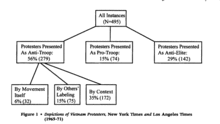
Note that in 380 stories from two major papers, Beamish et al. classified 279 instances of anti-troop behavior, which constituted 56% of the total of 495 coded instances. Counting 279 instances of anti-troop behavior in 380 stories sounds like a lot to me. They found 172 instances in which the demonstrators took some sort of action opposed to the troops (such as presumably waving the Viet Cong flag or cheering for a victory for Ho Chi Minh) and 27 instances in which the demonstrators themselves characterized their actions as anti-troops. They also found 75 instances in which others accused the demonstrators of being anti-troops, 74 instances in which the protesters were coded as pro-troops (such as protesters arguing to bring the troops “home alive”), and 142 instances of the demonstrators being against military elites (anti-brass).
Yet Lembcke falsely claims that only 6% of the 495 instances “could be construed as antagonistic behavior by the anti-war movement against GIs or veterans.” If you look at Beamish et al.’s chart (above), you can see what Lembcke did. He took the 6% of cases in which the demonstrators openly declared their opposition to the rank-and-file troops and falsely described this narrow subset of cases as if it were the numbers for the larger, “extremely liberal interpretation of what counted as a report of anti-troop behavior.”
I’ll be generous and call Lembcke’s sleight of hand extraordinarily sloppy. However it occurred, it is a very serious error to report (as Lembcke has repeatedly done) a 56% incidence of anti-troop behavior as a 6% incidence of anti-troop behavior, especially when Lembcke goes out of his way to quote Beamish et al.’s description (of the 56% figure) as representing "any portrayal that implied, even indirectly, a troop-blaming orientation."
LIMITATIONS OF THE BEAMISH STUDY
The Beamish study is a serious piece of scholarship, but like any empirical study (including my own work) it has some limitations, most of which are no fault of Beamish et al.
First, as Beamish et al. note, the kind of spitting story that most people fixate on (a veteran returning through an airport) is not likely to be captured by looking at big street and campus demonstrations, which after all did not take place at airports. Although Lembcke claims, “No researchers cited reports that veterans were spat on (Beamish, Molotch, and Flacks, 1995),” Beamish et al. do indeed cite Bob Greene’s reports of many such stories (Beamish et al., p. 344, n. 2).
While Beamish et al. seem highly skeptical of these spitting stories, they note that these stories typically involve hostility “not from organized protesters, but from random bystanders.” Since their study covered only organized protests, they make clear that “We have no evidence to test the veracity of Greene’s accounts.” Id. Disturbingly, Lembcke uses Beamish et al. as evidence against stories of spat-upon returning veterans (such as many of Bob Greene’s stories), when the Beamish study explicitly says that they have NO EVIDENCE to test these accounts.
Second, as exhaustive as the 1995 Beamish study may have been for its day, it was done before the New York Times and the LA Times were searchable back to 1965 (the New York Times appeared online for the Vietnam era in 2002). Thus, the authors first determined which demonstrations to examine, and then looked at news reports in the few days before and after the event (a wider window was used for the NYT than for the LAT).
This approach causes them to miss some important behavior they would want to code. For example, Beamish’s article says that only a “smattering” of stories mentioned the presence of Viet Cong flags. I found that odd because Viet Cong flags were present at all of the few antiwar demonstrations I attended in the early 1970s. (I occasionally helped my Trotskyite roommate on some of his tamer activist projects when they were consistent with my McGovern-style liberalism of the day. Even my roommate, who favored a socialist revolution, opposed the presence of such flags.)
Using Proquest, I found references to Viet Cong flags in stories in either or both of the two newspapers Beamish sampled for the great majority of demonstration periods they selected between mid-1965 and mid-1971. When I started to dig deeper into a few demonstrations for which no Vietnam flags were mentioned in the NYT or LAT, I usually found references in other newspapers to such flags—or I found problems with Beamish’s sampling.
For example, a questionable set of demonstrations were those over the People’s Park in Berkeley, which Beamish et al. list for the entire month of May 1969. I skimmed roughly 40-70 articles in the NYT and LAT about those demonstrations during that period, and I didn’t see one that mentioned that they were antiwar or against the war, though again I might have missed one. Yet calling these antiwar demonstrations and (if I read their criteria correctly) including a month’s worth of stories on them might skew the results in one direction or another. I wonder what their results would be without these stories.
The reason that another demonstration (July 10, 1969 in Seattle) might have included no Viet Cong flags is that there were only 50 antiwar demonstrators present, too small to reflect a cross-section of the antiwar community. So beyond the great majority of mid-1965 to mid-1971 demonstration periods where Viet Cong flags were present, perhaps many of the other instances where they aren’t mentioned were either very small demonstrations or were not really concerned much with the war.
The limitations of the Beamish study’s approach are significant in another way: they report no instances of spitting on soldiers, a finding that Lembcke widely trumpets. But at least one of the spitting on troops stories I found started on the front page of the New York Times during their date window: James Reston’s story from the Pentagon on October 23, 1967.
Also, it would also have been better (in the interest of full disclosure) if they had mentioned the story of spitting on police officers (not soldiers) in the January 21, 1969 NYT, though since it involved police, it would not have been coded in their statistical counts. Beamish et al. also strangely limit the Saturday and Sunday, Oct. 21-22, 1967 Pentagon demonstrations, which ended early on the morning of Monday, Oct. 23, 1967, with the arrests of more than 200 people, as having occurred on only one day, Oct. 21, even though the main New York Times account of it is headlined on the carry-over page as a “two-day protest.” Coincidentally, limiting the event to only one of its two days meant that the Tuesday, October 24 LAT story mentioning soldiers being spat upon fell just outside their sampling window.
Further, if the Chicago Tribune had been included, another spitting on troops story would have surfaced, one at the Democratic convention (Sep. 1, 1968).
But there is another problem: not only do Beamish et al. report no instances of spitting (even though there were was at least one instance in the days of their samples), they also claim that there was no evidence of taunting troops. This suggests a possible breakdown by their coders or some problems with their sampling practices. (Did they use students who were influenced by the desired conclusion?) I wonder how they coded taunting, since there are some examples of what I would call taunting of troops in NYT and LAT stories for demonstrations that they examined. And there are more examples of taunting in stories about demonstrations that they did not cover.
This raises a more serious problem. Since nearly all demonstrations were handled by the police, not the military, there would ordinarily be little occasion for antiwar demonstrators to taunt military people directly except for veteran counter-protesters. (Especially in the earlier years of the war, almost all of the taunting appears to have been initiated by the pro-war people against the anti-war people.) Given the level of taunting of police by antiwar protesters, is there any reason to suppose that many of the antiwar protesters wouldn’t consider the national guardsmen or regular army troops as just another kind of “pig.” Again, the evidence is much more complex than that. Some protesters treated the military differently from the police, some treated them the same.
If one reads the newspaper accounts of the Chicago convention, there is very little mention of protesters taunting police, though enough was mentioned that it should have shown up in the Beamish study. When one reads the Walker Report, which on balances excoriates the police, one can see an incredible amount of abuse heaped on both police and guardsmen by activists over long periods of time. One can only speculate about the reasons for leaving it out of most stories: the relative triviality of repeated spitting given all else that went on, press hostility to the police because the police actually targeted the press for beatings (63 of the 300 press working the street were beaten by police), press sympathy for the activists, or the unprintable nature of the taunts.
One should not discount this last reason for not printing taunts in news stories more generally. For example, here are some of the taunts used against police or guardsmen that the Walker Report appeared to find credible:
Some abuse of guardsmen:
As Guardsmen arrive for the first time at the Hilton: chant of “Pigs, pigs, fascist pigs!” 212
Then chant of “Oink, oink, oink.” 212
Then jeers of “Pigs ... sons-a-bitches ... f--king pigs ... f--king son-of-a-bitching pigs”
Then “Sieg-HEIL! Sieg-HEIL! Sieg-HEIL!” 212
African-American guardsman lt. taunted “mercilessly” as a “tool” of the “bad guys” 213
Calling several Jewish-named guardsmen “Kike” 213
Walking down the line and spitting in guardsmen’s faces 213
Flicking lighted cigarettes at guardsmen 213
Guard subjected to unbelievable abuse without any significant response. 214
To troops: “F--king draft dodgers, too chicken to serve your time in the regular army.” (Walker Report: “Though such taunts went on for about 20 minutes at a time, no response by the Guard was reported.”) 338
Other abuse, mostly of police:
“Pig! ...Pig! ... Pig!”
“Who’s your wife with now?” 247
“Where’s your wife tonight?” 247
“We’re f--king your wives and daughters while you guys are protecting your city.” 209
Young female pulls up her skirt and says to cop: “You haven’t had a piece in a long time.” 248
To citizens in cars on the street: “How would you like me to f--k your wife?” 276
Chants of “F--k, f--k, f--k.”
“F--k you, pig.”
“Co-k s--kers.”
“Mother f--kers.”
“Fascist Pigs!” 210
“Pig f--kers.” 154
“Shitheads.” 155
“Police are pigs.” 164
“Kill the pigs.” 173
“F--k the pigs.” 173
“Sieg heil, schwein!” 174
“Pigs, Oink, Oink!” 179
“Kill the pig, flush him out, bring him in!” [apparently from Lord of the Flies] 144
“F--k you.” 166
“F--k the pigs.” 224
“Dirty pigs.” 224
“You dirty son-of-a-bitch.” 166
Spitting and screaming insults at the police 235
Spitting on a policeman 338
Police bombarded by Pepsi cans “filled with urine”
Plastic bags full of urine and feces dropped from a 15th floor Hilton suite rented out to some of Eugene McCarthy’s staff and supporters
If you think this sounds pretty shocking, you should read some of the stuff I left out. And the Walker Report is justifiably much harder on the police’s behavior. Much of this stuff is not “fit to print” in the New York Times.
My point here is that there was a lot of taunting going on in the Chicago demonstrations that was never mentioned or even hinted at in most of the first-person newspaper accounts of the demonstrations. Most newspapers made no mention of taunting of guardsmen, and many made little or no mention of the taunting of police in their first accounts of the demonstrations.
What this means is that the Beamish study is not a report on what the antiwar demonstrations were like, but rather a report on how they were covered by the press. I also found it odd that the Beamish study included NYT stories from the two days before the demonstration, as well as the five days after a demonstration. This decision would seem to bias the results toward pro-troop behavior, with organizers seldom indicating their aspirations to abuse the troops.
In the days before the Chicago demonstrations, for example, would organizers have said to the press: “If the National Guard is called in, we plan to spit in their faces and taunt them mercilessly to try to get them to commit violent acts against us, which we would then photograph and use against the government”? I doubt that many activists were even thinking along those lines, yet (as the Walker Report makes clear) that is what happened with the taunters standing in front of the Guard at the Hilton. Note that the fact that most demonstrators were probably decent, nonaggressive sorts does not preclude viciously nasty behavior by a significant minority in a crowd.
Breaking down Beamish’s results by the day of the newspaper article (i.e., before or after the demonstration) would make it clear whether their results were biased by the inclusion of pre-demonstration stories. Along similar lines, I would be very curious to see the results broken down by newspaper. I get the impression that the LAT infrequently described negative behavior by antiwar activists at the same demonstrations where the NYT did describe such behavior.
++++
More to come tomorrow . . . .
No, anti-war was not pro-troop, and furthermore, directly harassed soldiers. The interesting fact from his observation was how little the media of that decade was interested in reporting the excesses of the anti-war. The spitting and harassment occurred. The finger in the face screaming rants occurred. I was too young to see clearly, but I have heard many first-person accounts of those actions, they feature strongly in Alcoholics Anonymous meetings.
No, the initial charge is ridiculous. The important study is not the charge, but the false history created when the media refuses to do its job, because of political affiliations and emotional distortion.
A similar bias was displayed last year during the mass demonstrations that supported amnesty for illegal immigrants. Mexican flags were prevalent, even predominant, in the first wave of demonstrations, before the organizers made a concentrated effort to discourage demonstrators from carrying them, or to carry American flags instead. (Mexican flags remained popular in the later demonstrations even despite organizers' efforts to discourage them.) Yet the mainstream press, print and electronic, played down the Mexican flags, rarely mentioned them and instead used photographs and film clips that featured the far less numerous American flags.
One of the great things about the internet is that future historians will not have to rely on the NYT and LAT to determine the scope of demonstrations.
I recall not only your example, but the failure of most press to report on the background and ties of the anti-war group ANSWER, who organized some of the major demonstrations against the Iraq War. Reporters quite understandably may not have wanted to tar the bulk of people demonstrating with the views of leaders with whom they differed fundamentally on the virtues of capitalism.
If there were an internet like today's in 1969, we would have a much better idea of what sorts of abuse were suffered by protesters, police, and natl. guard.
Because IMO very few people today are really, at bottom, more than casually anti-troops in attitude, I think that many young people today find it hard to imagine that there was a time when there was real disdain for troops by a non-trivial minority of college students.
The place Midge Decter had been where everyone loved the soldiers was the USA, during the Second World War. The place where college kids despised the soldiers was the USA, circa 1969.
From my experience, the "anti-troop" view was quite widespread at one campus anyway!
I can't imagine that Professor Lembcke looked any further once he found something to support his "assumptions."
Why this, and why now? The L/L tempest in a teapot is interesting in an academic way (and I mean that in the sense that it is an open academic question to be researched), but I think it is far more interesting in the comments that it has generated regarding the current conflict.
Does the left/Dems care about the troops?
Does the right/Republicans care about the troops?
Or are the troops just a convenient shield for members of both parties? Does the answer to the L/L debate shed any light on this question, or does it simply give credence to the proposition that each side needs to establish their bona fides in the 'caring about troops' debate that is currently being played out, and this debate is a proxy for the one that we need to be having?
Assuming, a priori, that Mr. Lindgren is 100% factually correct... does this do anything more than change a perception about history? Assuming Mr. Lembcke is 100% correct, does this do the same? Or are they using this debate about who the heroes and villains today, when our conflict is not in indochina, but in the Middle East?
If the anti-war contingent spit on troops in Vietnam, does that mean that they hate troops in Iraq now? If they didn't, does that mean they love the troops? Aren't both propositions absurd, given that the times are different and the deference and respect placed upon the military is different?
Again, these are questions I am not sure that I have the answers to. I do think that both the Republican and Democratic leadership don't really 'care' about the troops, per se, other than as photo ops and as a hammer to attack the opposition with.
I am sure that most responsible people, and surely all of our political leadership of both parties, "cares" about the troops. There are some people who do not, or did not in the past.
We can rarely agree on, and never "prove," the "correctness" of ideological viewpoints but sometimes we can assess the correctness of factual assertions. It turns out Lembcke's factual assertion is incorrect and poorly researched to boot. That is at least interesting. Especially since many others have expressed sentiments similar to Lembcke's.
Of these, the girl expectorating on the recently de-planed vet, usually at San Francisco airport, is among the most enduring. (Either that, or Gaylord Perry, a gob of Slippery Elm at the ready, was cruising SFO in hippie-chick drag between starts for the Giants.)
I wouldn't be so sanguine. Digital data is so ephemeral these days, especially data on the internet with its archival weaknesses. The NYT and LAT at least have microfilm to fall back on, and one worries that future historians will look that far and no further. Just take private correspondence for instance: once an important and easily accessible source of information (usually contained amongst the effects of the deceased), now relatively inaccessible due to its ephemeral and/or unreadable and/or easily degradable nature.
Maybe it's a good thing services like Google Mail have taken over archival duties.
Lembcke's could be, looks like, a method of cleaning up, possibly in advance, today's anti-war lefties by retroactively whitewashing their earlier brethren. It would be difficult to be wrong in so many ways by accident.
Lindgren is either doing scholarship for scholarship's sake, or he is making sure the truth is not torqued for current purposes, see previous paragraph, or he is preparing to smirch the current anti-war folks. The difference between Lindgren and Lembcke is that the former can achieve one, two, or three of his goals by the same technique, which is finding out the truth. Lembcke needs to make errors to accomplish his goal.
All you have to do is look at the people who showed up for the anti-war protests in DC a couple of weeks ago. These were the same people who were protesting the Vietnam war a generation ago and now they are doing the same thing with regard to the Iraq War. One of the videos even had the folk singers with their guitars out there protesting with the same songs. Do you think that this time they are supporting the troops? Do the troops think that they are being supported by this group? One of the wounded men was there in a wheelchair and the people spat on him as he sat there wtching - right on his amputated foot. That is what the LLL anti-war protesters are like then and now. What wonderful people. So caring and considerate in their actions. So cultured. Such wonderful role models.
I believe the majority of people against the war support the troops, and feel the best way to help them is to get them out of an unwinnable war where they will die or be injured for no reason.
I believe the majority of people for the war support the troops, and feel the best way to support them is to support their mission so the troops do not believe their actions are in vain.
And I believe that those who, like Mr. Thompson, needlessly attack the motives of either side do no more than deflect attention from the issues and probelms at hand. To set up a false dichotomy (either for the war or against the troops sounds suspiciously like 'America- love it or leave it') does a disservice to the majority of Americans who have sloowly come to realize that Iraq was a horrible mistake, and would like their leader to both stop posturing and doubling their bets and find a solution that will get us out of this mess with a modicum of dignity and a minimum of casualties.
Because it's better to support a living troop than a dead ideal.
Jack at Slate on spitting
Mr. Lembcke's Response
I do find it *interesting* that some of the things that were corrected and challenged were not addressed by Mr. Lindgren. I happen to think that Mr. Lindgren has raised good points which require further refutation by Mr. Lembcke.... I'm just saying.
In any event, they certainly don't do much to discredit Lindgren's points, which is Loki's implication they should.
Loki. You think the people who support the war want to get the troops out alive. Have you checked out Murtha's scheme? It is to have US troops die and make certain they fail. He wants us to fail, but knows that being too assertive about it, like cutting the funding today, would be politically disastrous. So he's planning on hamstringing the effort. Troops will die and gradually the hamstringing is to bring failure and the fact that it was done by a thousand cuts is presumed to be too complicated for the voters to understand. Yup, your kind of folks.
And I think you're too smart to believe it's a "mess". The difficulties of war are grist for the mill, but you know better. You, like so many, hope others don't.
As it happens, I think Mr. Lindgren has made some more solid points, but without understanding the substance of the refutations (his link was to Shaffer's old column) the reader may be misled. I don't think the refutations will change the opinions of many- but it may help frame the debate, and show that there are, in fact, two sides contesting the issue. It will also illuminate that the debate is not over whether *any* spitting occured, but over the meme of --soldiers returning to airports and being met by spit--
To sum: I currently believe Mr. Lindgren has the best of the argument, but I believe it is an argument, and I think that his accidental oversight in not linking to his opponents previous rebuttals gives a false impression to the reader.
Also---
I do believe there is a difference between the difficulties of war and 'the mess' we are currently involved in. Moreover, from day one, we have not had a realistic plan for what we are doing, nor have we had a compelling rationale for the wasting of blood and treasure in Iraq (Afghanistan? sure... not Iraq). But that's me. If I felt our leaders could come up with a good solution for rectifying the problem they created, I would support it. Pouring more troops (which would *still* not be enough) is not my idea of a good solution.
But that's me.
It is nearly impossible to smear the left on this matter, because there is almost no despicable position that the left hasn't been willing to take. The left has never defended cannibalism by America's enemies, but that's about the only defense that they haven't been willing to make.
Richard Aubrey: You think the people who support the war want to get the troops out alive. Have you checked out Murtha's scheme? It is to have US troops die and make certain they fail.
I wrote a couple of comments, trying to find some way to express how nasty, false, and inane these comments are. I deleted them, though. I don't think that I can do any more to highlight the insanity in these remarks than to set them out and make sure they don't get lost in the rush.
The other point, why lefties are always on the other side, has three possibilities. One is, as the French lefties say, "pas d'ennemies dans la gauche", or words to that effect. Or, they really like those other people, nasty,tyrannical and vicious and the fact that those other people oppose the US is not a bug, but a feature, or at least irrelevant. Or, as Cramer says, they simply find where the US is and reflexively take the opposite view. The second and third would explain why the left is on the side which, as Kevin Drum said, is against everything they stand for. Drum was asking himself why he didn't speak up about human rights in Iran. He answered himself that doing so might make Bush look good. So he'll keep his mouth shut. I haven't checked back, but I expect he's been good to his word. It is astonishing to people who were absolutely stupid enough to think the left was ever honest when they see the left favoring theocratic, misogynistic, homophobic, violent,expanisionist groups who use the laws of war as a shield and favor civilians as targets.
Perhaps you can think of some reason other than the three I mentioned to explain it.
If you start with the a priori worldview that 'leftists' (whatever that means to you) are bad, then it should come as no surprise when all evidence will seem to confirm the view that you already have.
I could explain that what is going on between the Congress and the Executive is a much more complicated dance involving both Separation of Powers AND electoral politics, but I don't believe that would impact much on your wworldview. Everything that fits, fits... everything that doesn't (Reagan and Iran, Regan retreating from Lebanon, Bush cutting Clinton-like deals with the worst of the Axis of Evil etc.) is simply discarded.
I know nuance is discredited in some circles today, but it can be a useful tool in analyzing complicated situations.
Remember- only you have the power to be a uniter, not a divider.
On the one hand, there are people on the Left that are radically against the U.S. and virtually everything it stands for. On the other hand, there are people on the Left that love the U.S. and support virtually everything it stands for.
The Vietnam Vet spitters would have been closer to the former. Those anti-war protestors that actually supported the troops would have been closer to the latter.
In my opinion, the opinions of the former should largely be ignored and/or rebutted while the latter are an important part of the larger debate in society.
It took experience to teach me what was actually going on.
So, in one sense, I didn't start there, I ended up there.
Murtha is not a felon because, in Abscam, he rolled on his colleagues. His work to end the war could be done as the dems did in 1975. Why is he choosing a different path? Likely because he remembers it was, politically, a bad idea. This current technique can get the dems where they want to go without the baggage they collected the last time they wanted the US to lose. Remember Jim Webb's interview with McGovern? We can still win this thing, he said. George said, you have to understand. I want to lose. Since George was running for president, we have to assume he wasn't the only one.
Getting old is a bitch, but it does allow for a good deal of experience. And knowledge gained in real time. Which makes things kind of difficult for your kind of argumentation.
I have a bit of older wisdom, too. "I have seen the enemy, and he is us."
I find it hard to credit the arguments of anyone who blames all the ills of society on a monolithic political side (i.e. the 'left' or the 'right'). All of these years with Republican control of the Legislature and the Executive branch, and you place the blame for Iraq squarely on the shoulder's of... Murtha?
Self-examination is a wonderful thing. Perhaps the Republicans would be better served looking for what went wrong in the last six years and fixing &coming back stronger than continuing to stew angrily at this silliness. Your arguments that this Dem congress is the same as 1975 is no more productive than a leftist arguing that W. is the same as Nixon. Those who learn from history are doomed to make stupid analogies, after all.
I do not "blame all the ills". That was a lie. Once caught lying, don't expect to be taken seriously in the future.
Nobody is stupid enough to have gotten that from what I said. Nobody.
You lied.
I'm sorry I mischaracterized your position. Clearly, you simply hate Murtha and hope to hang all future problems in Iraq on him.
This is obvious because, as all people realize, the current blame for Iraq lies with the administration and legislature who took us there.
Umm... oh, nevermind.
They did that in 1975 ref. SEA and people managed to put two and two together. The dems were so insistent about it that they gave some senior officers a hard time about funding for POW retrieval on the grounds that it might be a way to get back into the fighting.
Murtha's way is more subtle. As with overly restrictive ROE, we have more casualties and less success. Eventually, the ability of the military to do the job is hamstrung and we fail and leave. But, the difference is, Americans die until that point. The dems' plan doesn't seem to mind that, or they'd defund right now. It appears their idea is that, by the time the thing fails, if it does, the details of the situation will be too finicky for the voters and we won't know why it happened or who willed it. That way, they get to undermine us in a war without paying the post-1975 price.
Sounds to me like that would be a political winner--why dont they do it tomorrow?
Here's why... you defund, and suddenly you can be attacked mercilessly for not supporting the troops. Let me give you an example...
1972 (prior to the Presidential election)-
Nixon reduces troop level in Veitnam from 150k to 30k
1/1973 Nixon, without prior Congressional approval, signs accord with Vietnam to withdraw ALL troops from Vietnam.
9/1974 Congress refuses to fund SVietnam army
1975 Congress refuses further funding.
2007-
So, uh.... Congress in 1975 caused us to lose Vietnam... and they didn't support the troops. Do you see how it works now? BTW, the political price paid by Congress for refusing to get us back into the quagmire *Nixon* had lost? Dem control until Gingrich.
Loki, for some reason, left out a couple of items.
The ARVN had, by that time, become more capable and, in conjunction with US air power, thrown back a major NVA offensive several years after US ground troops were largely gone. In other words, sort of like we hope to see the Iraqis doing shortly.
Congress defunded the support to the government of SVN. Not another bullet, gallon of fuel, or spare part.
Naturally, that put them at a disadvantage in the next NVA offensive. This disadvantage was taken to prove that the Vietnamese never had a chance. Which was true, but not for the ostensible reason. They never had a chance with Congress. The NVA they could, and had, handled. The US congress is a different matter.
Nixon's withdrawal of troops--Congressional permission is not necessary--was not the reason SVN fell. Withdrawing the troops as the ARVN could take over was part of the plan. I don't think anybody but Hanoi foresaw Congress' role in this.
I was commissioned in the Infantry in late '69. I have since discovered that surprisingly few of the guys from this point on, if not from earlier, went to US forces as platoon leaders. Many of us were trained further to be advisers to ARVN units. Several were assigned to Transportation--complicated, but it worked. Point is, the changeover was underway much earlier. Tough, but had a chance. Except for Congress.