The Volokh Conspiracy

Brewing Academic Controversy:

This poster, and the event it describes, appears to be causing a ruckus. The poster advertises the 2007 Veroni Memorial Lecture in Philosophy and the Humanities, to be delivered by Peter French, Lincoln Chair in Ethics, and Director, Lincoln Center for Applied Ethics at Arizona State University. The talk's title is On Being Morally Challenged by Collective Memories, and the paragraph-long description reads:
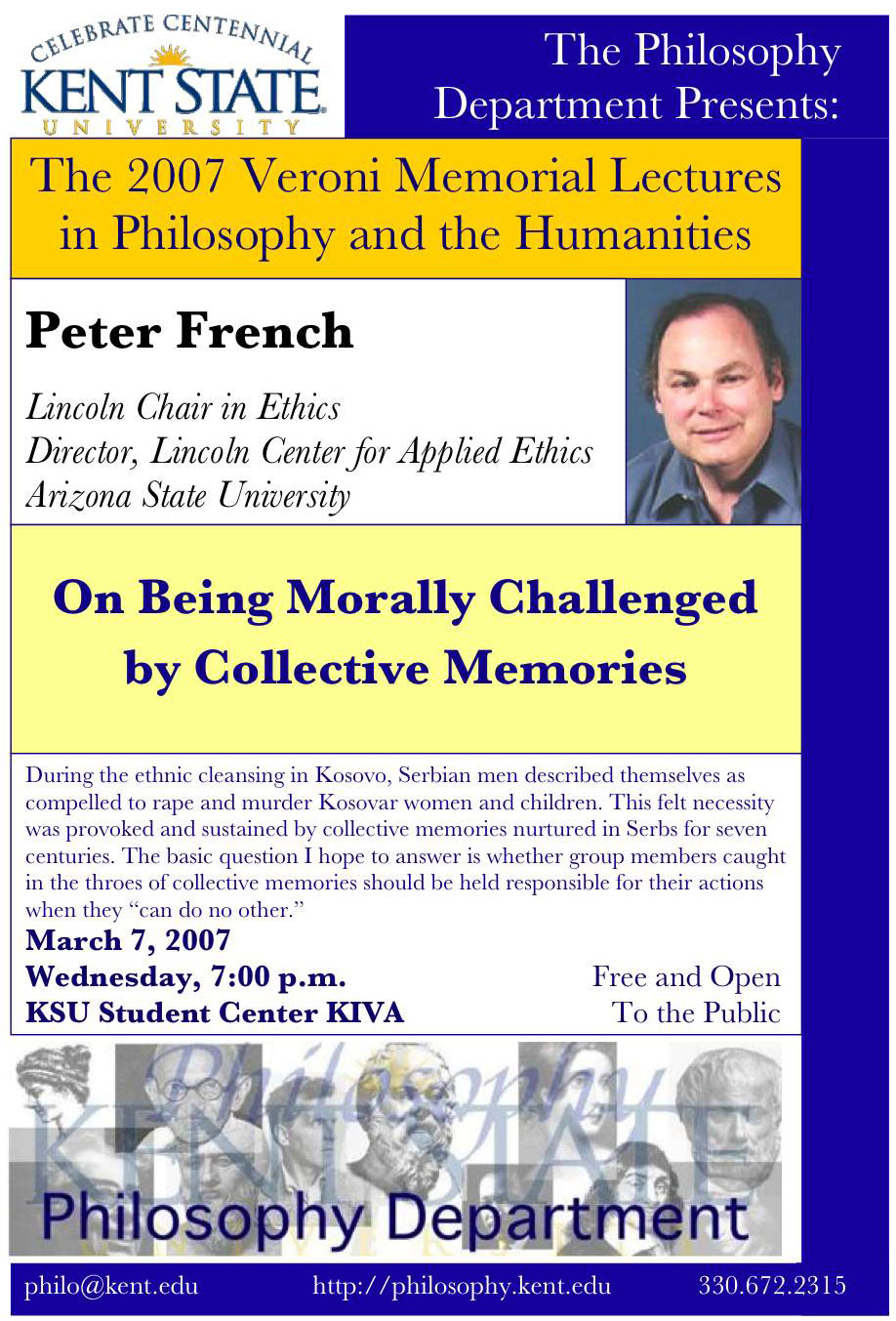
During the ethnic cleansing in Kosovo, Serbian men described themselves as compelled to rape and murder Kosovar women and children. This felt necessity was provoked and sustained by collective memories nurtured in Serbs for seven centuries. The basic question I hope to answer is whether group members caught in the throes of collective memories should be held responsible for their actions when they "can do no other."
One person e-mailed me asking how this may create a legally actionable "hostile work environment" for people of Serbian extraction; a serbianna.com "activism" Web page reasons that "Peter French starts from a premise that Serbs are rapists and killers because, according to French, Serbian morality is handicapped by collective memory that was nurtured in Serbs. In other words, French believes that Serbs are morally deviant people because of a false collective memory of their past in Kosovo and as a result of their own delusion have collectively accepted morality of a rapist and a killer."

As I read the poster, French is not arguing that all Serbian men feel compelled to rape and murder, or even that most do. Rather, he is discussing a particular set of Serbian men who did rape and murder, and who supposedly gave "collective memories nurtured in Serbs for seven centuries" as an explanation for that argument. This is reinforced by the fact that the next sentence is hardly an anti-Serb rant, but a question about whether group members should be held responsible for their actions, which is obviously a question about those group members who actually acted.

This is much like, if we wrote, "During the L.A. riots, Korean shopkeepers armed themselves to defend their stores against rioters; this felt necessity was provoked and sustained by their sense of being embattled and victimized by crime," we likely wouldn't be talking about all Korean shopkeepers or even most, but about those Korean shopkeepers who did arm themselves. I think arming oneself to defend oneself and one store during a riot is generally more proper, and rape and murder of course is not, but my point here is that the term "Serbian men" or "Korean shopkeepers" may in some situations refer to those particular Serbian men or Korean shopkeepers that the rest of the paragraph describes.

Perhaps given the bad acts being described, the poster author should have put things more carefully, to avoid the risk of misunderstanding. But while philosophers have a reputation for being very precise writers, a reputation especially easy to nurture when you have a whole paper — nursed over months or years — in which to be precise, quickly boiling things down to three sentences (something that may well have been done not by Prof. French but by someone else) may indeed sometimes produce misunderstandings.

I anticipate that the speech will indeed go as I conjecture, and I hope the controversy will then fizzle. Still, it does seem like a brewing academic controversy, so I thought I'd note it. And of course I naturally think that even if Peter French is a raving anti-Serb bigot, his speech should be constitutionally protected, including against a "hostile work environment" lawsuit. (If the speech were raving anti-Serb bigotry, the university would have the power not to invite him to give a special university-promoted lecture on the subject, and should exercise that power; but that's a separate matter.)

FantasiaWHT:
I'll admit, my first thought was "collective memories" meant the memories of an entire people. My second thought was, are these people some kind of species of bee with a hive memory?
3.2.2007 6:46pm
OrinKerr:
My first thought when I read the post title: "Now that's what this blog needs -- academic controversy about beer!" Maybe that's just me.
3.2.2007 6:58pm
NickM (mail) (www):
I will only agree to let my collective memories take over and absolve me of responsibility for my actions if I get to meld with Seven.

Nick
3.2.2007 6:59pm
JB:
I thought the brouhaha would be the other way around, with feminists accusing him of excusing gang rape.
3.2.2007 7:04pm
Anthony Sanders:
I must say, I am in the same boat with Orin, as when I first read the title I thought something hokey was going on down at the "brewing academy." Good to hear all is fine over there at least.
3.2.2007 7:34pm
Kazinski:
I can see where this collective memory stuff is going:

They are still at fault for their actions even if their actions were triggered by a "collective memory".
All cultures have a CM which must be dealt with in order for the culture to heal and progress
American White Males need to address their CM as oppressors


Pretty typical in the academy.
3.2.2007 7:35pm
Jeremy Pierce (mail) (www):
As I read French's summary, what he is arguing is even less extreme that how you describe it. He isn't arguing that anyone is actually compelled by group collective consciousness. He simply cites that as his starting point. What he's discussing is what would follow from the claim that some people might be compelled by group collective consciousness. As far as I can tell, he isn't necessarily endorsing the view that this ever happens to anyone but is simply thinking through the ethical consequences of such a claim.

The writeup also doesn't say what view he is going to defend. As far as the writeup says, he is probably arguing that people in such circumstances are indeed responsible for their actions. French is committed to the idea of collective responsibility. But he is also a proponent of rehabilitating vengeance as sometimes a good thing, because of that collective responsibility. So I'm not sure where he'd take this particular issue. But it's not clear at all from the description of this talk that he's going to be endorsing the self-description of these rapists. He may well just be seeing what follows from such a claim.
3.2.2007 7:43pm
The Original TS (mail):
Yeah, I, too, read this poster as being absurdly pro-Serb. Ooh! Look! The Serbs were victims, too! They couldn't help it!

This is but the latest and most ridiculous essay in victimology. The lecture itself assumes an unproven and, at least on its face, blatantly stupid premise.

"The basic question I hope to answer is whether group members caught in the throes of collective memories should be held responsible for their actions when they 'can do no other.'"

First for those who may be blessedly unaware, "collective memories" is an academicese longhand for what anyone else would likely call "shared culture." Before Prof. French starts trying to figure out whether raping/killing/looting Serbs ought to be held morally blameless, he needs to establish that popular culture really did turn them into mindless automatons, bereft of free will and incapable of moral reasoning.
3.2.2007 7:52pm
John (mail):
I can make this simple:

1. whether rape & murder is justified by the standards of any particular culture depends on what the standards in that culture are.

2. Rape and murder may or may not be justified in some aspect of Serbian culture, but are not justified in our culture.

3. Hence, the Serbs who raped and murdered were not justified in what they did.

4. If you say, "well they were justified in their culture," then the obvious reply is that that standard of their culture is wrong.

5. If you say, "well, you say that standard of their culture is wrong, but by the higher standards of their culture that standard is right," then the obvious reply is that this higher standard, that says the lower standard approving murder and rape is OK, is wrong, since it leads to an erroneous conclusion (that rape and murder is OK).

6. Etc., up the chain.

7. The only way to end this is to agree on the relevant culture. If we agree, the argument will end. If we fail to agree, the argument will also end as there is nothing to discuss.

There. That wasn't so hard.
3.2.2007 9:49pm
Tracy W (mail):
On the question of whether someone can be held responsible for what they do in the throes of their collective memories, then it strikes me that there are two possibilities:

1. Yes, of course they can be held responsible. We want to deter anyone else motivated by their collective memories from committing murder and rape, so we should punish anyone who commits murder and rape. Of course it is a bit unfair to punish someone for a crime they cannot help, but it is necessary to stop far more crimes being done in the future. It's like sending a soldier to his death to protect the enemy breaking through.

2. If Serbians cannot be held responsible due to collect memories for committing murder and rape, then surely any person who comes from a country that draws on a legal tradiition like England's has more than seven centuries of collective memories of punishing murder and rape and holding murderers and rapists accountable for their actions, and therefore equally cannot be held responsible for holding murderers and rapists responsible. (Or to put it another way, if criminals don't have free will, then surely no one else has it either).

(I include Canada, the USA, Australia, NZ, etc as countries that draw on England's legal tradition).
3.2.2007 10:38pm
Duffy Pratt (mail):
Isn't it also possible that he might be examining whether a memory, collective or otherwise, can compel an action? And the whole Serb thing is just a dramatic illustration?
3.2.2007 11:16pm
Elliot123 (mail):
This is the first step in making victimology available to everyone. The oppressed are victims, and the oppressors are victims. This idea can become a collective memory. But think of the opportunity available for the folks who don't buy into it.
3.2.2007 11:33pm
Michelle Dulak Thomson (mail):
I am puzzled by the deliberate echo (for surely that's what it is) of Martin Luther's "Ich kann nicht anders." What on earth is he doing in there?
3.3.2007 12:02am
dearieme:
Would it be poor form to recall that the ethnic cleansing - the hordes of Kosovar Albanians pouring out of Kosovo - began after Mr Clinton's bombers started work? Does that make Clinton party to the rapes?
3.3.2007 2:33am
Ron Hardin (mail) (www):
It sounds like a standard philosophy lecture to me, but then I haven't gone to one in a few years.

It's to gather audience, which audience will be sorely disappointed.

It's the alternative to actually requiring student attendance.

(Though lectures were always much better when the ``all invited'' meant the philsophy dept staff and me, and zero students. Then one year instead of five attendees, there were seventy, and I stopped going.)

I imagine it's the new form of free will vs determinism.

I'd refute this one with Levinas, but who has the time, and nobody wants to hear it anyway
3.3.2007 5:18am
markm (mail):
Tracy W: Nice logical analysis. An earlier version of this was a British governor of India's response to complaints that he was violating their customs by forbidding suttee. He said that it was English custom to hang men who burned women to death, and if they followed their custom, he would follow his custom.
3.3.2007 5:24am
Brett Bellmore:
My first thought was, "Why in the world would anyone think that rape and murder were "much like" armed self defense against looters? My second thought, on reading the next line, was that you were just being deliberately provocative with that.
3.3.2007 6:41am
John Jenkins (mail):
You know, without going to the lecture, it's possible that his answer to the question is "yes." I haven't read any of his writings, but there seem to be a lot of assumptions being taken here with what the answer will be.

It's also perfectly legitimate to assume things in argument. Assuming that proposition X is true (the collective memory thing), then the members of the group should still be held responsible because . . .

There's nothing illegitimate about that, or about it's opposite, so long as you aren't saying that your argument is to prove that X is true or false.
3.3.2007 9:14am
Cornellian (mail):
Didn't Seinfeld have an episode where he made an off hand remark about Serbians being, shall we say, not overly fond of taking showers? Wonder if he got flack over that.
3.3.2007 9:15pm
neurodoc:
EV, you write, "And of course I naturally think that even if Peter French is a raving anti-Serb bigot, his speech should be constitutionally protected, including against a 'hostile work environment' lawsuit."
I'm not sure about the implications of "should" there, whether it means that is the way you would have it or that is the way courts would find. But can you find many who know anything at all about the First Amendment would think otherwise, that such speech is not or should not be absolutely protected by the First Amendment? This is so far from a close question that I see no reason to even pause to consider it. Things get more interesting when one considers what "academic freedom" (AF) does and/or should mean, maybe not in this case, but in others involving "scholar activists."

Recently, you posted about an essay by Romirowsky that appeared in the Washington Times, but gave it remarkably short shrift, skipping over its first eight paragraphs and launching into an impassioned defense of "free speech." That missed the main point of Romirowsky's essay, which was about how "activism" did or not warrant the protection of AF. The Peter French matter doesn't entail "activism," so would easily fall within what most would accept as the proper bounds of AF as well as protected First Amendment speech. But when "activism" is distinguishable from activities bound up with "scholarship," ought academics be protected by AF? For example, a biology professor has a religious experience and insists on teaching Creationish rather than evolution in his classes - protected by AF. Faculty member seeks to "indocrinate," refusing to deal with and allow other points of view in classroom - protected by AF? Some in academic community conspire to damage other scholar by throwing them off editorial boards, blocking publication of their work, denying them tenure, etc. -their perogative to do so if they see it as the right thing to do - protected by AF?

I will go back to read what you posted recently about the First Amendment as it applies to academia, since I only glanced quickly at it before. You ought to go back to re-read Romirowsky and engage with the question about "scholar activists," which he didn't fully develop, but which isn't too hard to flesh out. No need to ask self-evident questions like whether Peter French's lecture should enjoy First Amendment protection whatever its merits, or if a "hostile workplace" claim would go anywhere in other than an idiot court. (BTW, does he think the individual responsibility of Nazis was less because there was a "group think" going on and it drew on what could be seen as "collective memory"?)


(If the speech were raving anti-Serb bigotry, the university would have the power not to invite him to give a special university-promoted lecture on the subject, and should exercise that power; but that's a separate matter.)
3.4.2007 12:57am
neurodoc:
About the "power not to invite him to give a special university-promoted lecture" - Stanley Fish agrees about that power prospectively, but says that once the invitation is extended it cannot be withdrawn even if the school belatedly discovers the invitee is disreputable a la Ward Churchill. I think you can deny such individuals in the first place and with good cause withdraw invitations that have alreay been extended.
3.4.2007 1:20am
Michael Benson (mail) (www):
I really enjoy the bevy of posters accusing the speaker of various evils, and (in their minds) shooting down his arguments all from the thorough perspective of reading a one page flier. It is quite amazing that y'all feel no embarrassment of simultaneously scoffing at the perceived intellectual deficiencies of the speaker, while being willing to so high handedly judge a book by its cover.
3.4.2007 1:23am