The Volokh Conspiracy

[Paul Ohm (guest-blogging), April 15, 2007 at 12:55am] Trackbacks
Do Blogs Influence SSRN Downloads?

Yes. In fact, yes, they do.

Today is my last day as a guest blogger, and I wanted to start by thanking my hosts and also you, the VC reader. This is an amazing place to workshop a paper having to do with computer security.

Last Monday, immediately after posting for the first time to the VC, I decided to conduct a little experiment. I wrote a quick computer program (for the more technically minded, a perl script and a cronjob) which downloaded and saved the SSRN statistics relating to my Superuser and Analog Hole papers every fifteen minutes, for the entire week.

I started picking through the data Friday afternoon, and as I am too often wont to do, I took a fun little exercise a bit too far and turned it into a 22 page article you can download, naturally, from SSRN.

I'll summarize some of the high points below, but I hope you read the paper. It's a quick 22 pages, complete with 10 charts and 7 tables.

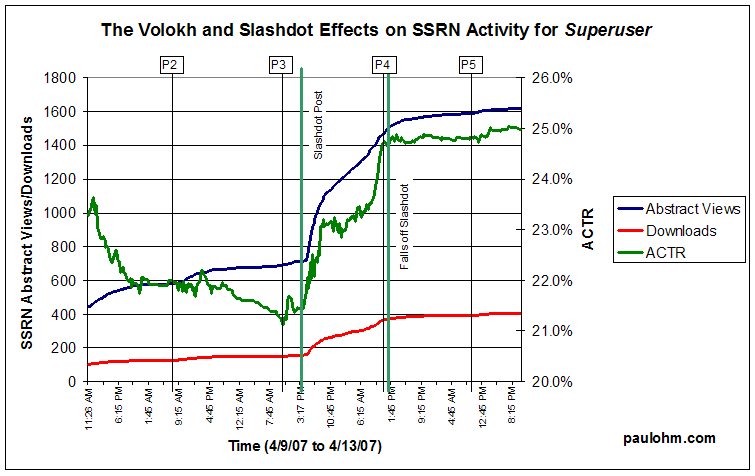
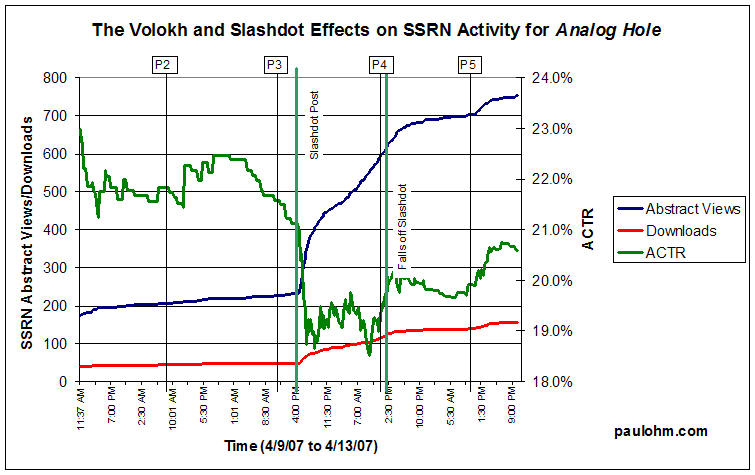
The best way to summarize the study is to show two (admittedly overly busy) charts. Click a chart to enlarge:
Here are some observations from the paper about the effects of blogging on SSRN statistics:

  • Blogging about an article at the Volokh Conspiracy appears to be a good way to increase SSRN "Abstract Views" and "Downloads"
  • These statistics grow much more quickly when your Volokh Conspiracy posts are picked up by Slashdot.
  • Interesting comparisons can be made between the SSRN habits of Slashdot readers and Volokh Conspiracy Readers.
  • The ratio of Downloads to Abstract Views (which I call, Abstract Click-through Rate or ACTR) is a very interesting number which deserves much more scrutiny.
  • VC readers tended to cause the ACTR for my articles to plummet. In other words, VC readers tended to visit my abstracts without downloading the articles more often than the people who had visited my abstracts prior to this week. I'd love to hear your theories about why this may be.
  • If you stare hard enough at the trends in these graphs, you can begin to make out the effects of people waking up, getting to work, and leaving work. Based on my data, I'm willing to bet that a lot of people read the VC and download from SSRN while at work.

Thanks again for a very stimulating week!

Stentor (mail) (www):
VC readers tended to visit my abstracts without downloading the articles more often than the people who had visited my abstracts prior to this week. I'd love to hear your theories about why this may be.

I would guess that this is because the people who find your articles through other channels are more likely to be specialists in your field, whereas VC readers contain a higher proportion of interested laypeople. Interested laypeople would be more likely to read just the abstract for several reasons -- the abstract alone is more likely to sate their curiosity, they have less time to plow through academic articles and hence are more selective in their downloading, or they are more likely to discover from the abstract that the article wasn't as interesting as they'd thought it might be.
4.15.2007 1:34pm
L. Rev. Editor:
I admit to being a little puzzled by the obsession some law profs have with tracking their SSRN downloads. If a prof e-mails us to say that an article he has submitted (invariably, the SSRN-obsessed profs are men) has been downloaded a lot on SSRN, we usually just delete the e-mail and move on unless it contains other, actually substantive info. Intuitively, doesn't the number of downloads an article gets on SSRN stem primarily from where you're guest-blogging and how well you're able to game the system? Why should anyone use SSRN downloads as a signifier of ANYTHING, let alone article quality?
4.15.2007 2:00pm
Paul Ohm (mail) (www):
L. Rev. Editor,

I'm not sure there is a lot of value to a high download count. I'm especially skeptical about the idea that we should care who is #50 versus #150 on the "Top Authors" list. But let me tell you why we professors may think that you editors would care.

Insofar as you believe that people read what they download (which is hard to measure and probably not true to a large extent), download counts can measure the exposure of others to your ideas.

As a Law Review Editor, doesn't pre-publication exposure matter? Isn't it reasonable to assume that high download counts may signify broad awareness of the article, which may translate to post-publication citations? (I guess this is only important if you care about how well your articles are cited.)

I'm not trying to take sides here. I hope my article gives people, pro or con, another set of data points with which to weigh the relative merits of download counting.
4.15.2007 3:22pm
L. Rev. Editor:
Prof. Ohm: I agree that, despite the 6+ month delay between submission and publication, pre-publication exposure has a good chance of influencing post-publication citation -- but the effectiveness of that exposure would vary greatly depending on the audience. If you guest-blog about the article here on Volokh or one of the other popular blawgs, or workshop the article at another law school, then you'll be reaching a law prof-heavy audience (and, depending on the situation, you may be reaching judges and practicing lawyers as well). But in that situation, isn't the best measure of your reach within the relevant audience (lawyers, judges, and legal academics) going to be the forum you've picked, not the number of downloads the article receives on SSRN? What extra informational value, if any, does the SSRN download count add to this? And if it doesn't add much, why bother treating SSRN download counts as anything other than a way to amuse yourself on a Sunday afternoon?
4.15.2007 4:15pm
L. Rev. Editor:
Just to follow up with one further point: One could argue that SSRN download counts help measure one's influence outside the legal academy, e.g., for articles like yours, within the community of tech professionals. But again, it seems to me that SSRN download counts are a poor measure of that. Much as being cited by other legal scholars suggests your ideas have become influential within the legal academy, being slashdotted or blogged about on other non-legal blogs, it seems, would be the real sign of your influence outside the academy. SSRN download counts just measure a secondary effect of those "citations" -- and they are a measure that is notoriously subject to being gamed. Perhaps it would make sense to rely on SSRN download counts if there was no way to find out who is blogging about your article. But Google makes it pretty easy to find that information directly. So, again, what further informational value could SSRN download counts add that would justify taking those counts seriously?
4.15.2007 4:27pm
Paul Ohm (mail) (www):
LRE: I can't disagree with your logic. SSRN stats hide a lot of important detail about the spread of ideas that can be teased out in other ways. It seems to make sense to privilege what Google will tell you about the spread of exposure of a particular article over what SSRN will tell you.

Let me continue by playing Devil's Advocate: by completely ignoring SSRN stats, you are privileging two types of proof-of-exposure: discussions in "public" fora (ie, websites spidered by Google) and official discussions at conferences, workshops, colloquia, and other fora that can be crammed into a first footnote or cover letter. It fails to recognize people who go about sharing their ideas in more private ways--one-to-one e-mail messages to scholars in their field; one-to-many e-mail messages to lawprof listservs (most of which don't have world-readable archives); private conversations while mingling at conferences. These "private" methods of gaining exposure may be reflected in SSRN stats and nowhere else.

Lastly, you've raised the spectre of "gaming" SSRN several times. I know that SSRN works hard to combat gaming, and I wonder how easy it is to game the system. I suppose Bernie Black can tell us, but he probably won't. Maybe I'll spend some of my non-research downtime this summer working on this.
4.15.2007 6:25pm