Can anyone who knows something about modern Greece tell me what (if anything) the inhabitants of Lesbos — Lesvos in modern Greek, I believe — think about the term "lesbian"? Do they perceive it as annoying? Offensive? Amusing? Is there no dominant view on the subject?
Relatedly, my quick searches suggest that the term "lesbian" is also present in other European languages, such as French and Greek. Is it identical to those languages' terms for inhabitants of Lesbos (or perhaps just the terms for female inhabitants of Lesbos, in languages that distinguish gender in such proper names)? Is it similar?
I ask these questions not to make some point, but just because I'm curious about how people react to historical accidents such as this one. (A different, though perhaps indirectly related, question: Do the inhabitants of Lesbos view Sappho as a heroine, the way many places view local girls/boys who made it big, or do they view her askance? [UPDATE: See below.])
A separate question, which might make some point, but which I stress is analytically distinct from the empirical questions I ask above: Say that the inhabitants of Lesbos find the term offensive. Should others, including lesbians, try to shift to a different term? Or should they go ahead with the term that they've used for a long time?
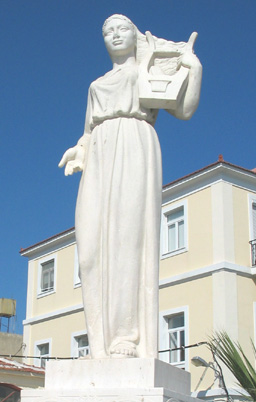
UPDATE: Thanks to Dr. Weevil, and Lesbian Fiction Herstory (which I found through a search inspired by Dr. Weevil's comment), I can illustrate this post with this statute of Sappho that is apparently in the town square of Mytilini, the main city of Lesbos:
Related Posts (on one page):
(1) Lesbos is pronounced "Lesvos" in Modern Greek, because "beta" is pronounced "veeta."
(2) As for the Greek word for "lesbian" and "Lesbian," they are, of course, different. For "Lesbian," we say: Λέσβιος ("Lesvios") (male) and Λέσβια ("Lesvia")(female). For "lesbian," we say: "ομοφυλόφιλη" ("omophilophili") ("homosexual" in the feminine form); λεσβιάδα ("lesviada"); and sometimes "τριβαδικός" (trivadikos), but that is more of an adjective (whose root I am not sure I understand or know). We also say: λεσβιασμός (lesviasmos) and τριβαδισμός (trivadismos) for "lesbianism."
(3) I don't know that people from Lesbos are really offended by their name being used to describe Lesbians, but I do know that they are kind of "traditional" or "conservative" people who seem on the whole to dislike the influx of lesbian tourism they get in the summer months. Indeed, unlike Mykonos, which has happily capitalized off of gay travel, Lesbos doesn't really do that. Nonetheless, the lesbians come to visit Eressos, the home of the poet Sappho. A quick search shows that someone has even done a study on these visits, as well as their impact on the locals, but I read it and it looks more like a synopsis and doesn't really say much...it also clearly has a "pro-gay" bias, so might not reflect genuine local feelings.
(4) I don't think that we should avoid using a term because it offends the locals. Greek people don't really care what non-Greek people call them anyway. My parents are from Crete and are "Cretans", but they had no idea (until moving to the states) that this sounded like an insult in English. I guess the Lesbos thing is different. Anyway, I think, and not to be majoritarian, but there are probably more "lesbians" in the word than "Lesbians", so at the very least the term has gathered secondary meaning.
(5) Finally, this issue is quite interesting. Greeks in general, I feel, try to "hide" their "homosexual past", as that so many gays and lesbians try to unsurface in order to find support for their lifestyle. It's an interesting study on changing concepts of morality and the influence of religion. Indeed, going to school in the states (high school at least) we never heard about Shakespeare's bisexuality or Plato's homosexuality.
I remember the in-class discussion when a student was amazed that lesbians had their own country back then - after all the story told of the lesbians' revolt from Athenian domination and their subsequently having to pay tribute to Athens, so the hapless student figured it had to do with the rifeness of homosexuality in ancient Greece.
Most of the class burst out laughing, and the Professor barely managed to avoid falling over laughing.
Kantsa, Venetia, "Certain Places Have Different Energy": Spatial Transformations in Eresos, Lesvos, GLQ: A Journal of Lesbian and Gay Studies - Volume 8, Number 1-2, 2002, pp. 35-55.
The author goes on with a somewhat more nuanced description. Anyway, this is not a rigorous study, just a perspective.
Don't use that dictionary for Greek, it is horribly flawed. It doesn't even use the right "sigma" (we have one that is used at the end of words and one that is used in the beginning and middle of words, in the lower case). Also, as I pointed out, it is not accurate. You should use:
http://www.in.gr/dictionary/lookup.asp?word
It is in Greek, but you can put either English or Greek in that spot and it translates it to the other.
[Secret: It's what I used to reproduce the Greek font above, i.e., through cutting and pasting, though I knew the words, I don't have the Greek keyboard function on this computer and knew that cutting and pasting woudl be easiest...]
I've never been to Lesbos, but a Classics professor who has once told me that there's a statue of Sappho in (I think) Mytilene. I think he said it is life-sized and bronze. I know he said that it's right in front of a warehouse with the Greek word for 'moving and storage' in big letters, which makes for amusing snapshots: the word is METAPHORA, which is very appropriate for a poet like Sappho.
Just to confuse things, in Sappho's time Lesbos was known for its fine wines, beauty contests, womens' fashions, and the local girls' (alleged) propensity for fellatio. In other words, the same stereotype as France today. (I don't know whether ancient Lesbian cheese was famours or not.) Of course, fellatio seems entirely incompatible with Lesbianism in the modern sense.
Given the relative embarrassments, I am sure that helps the residents of Intercourse accept their lot in life.
I'd echo much of what Giannis said. Eressos is a small village and the local residents--at least the old-timers--seem very traditional and old-fashioned. I've heard people in the village grumble about the lesbian tourists, but I recall most of the complaints involving the fact that the lesbians who visit are young and poor, and I don't recall objections framed in moral or religious terms.
That said, my impression is that the Eressians are very, very proud of their connection to Sappho, in the same way that many Greeks are proud of their connection to ancient history.
Isn't it true that if you stop a few miles short of Intercourse you end up in Blue Ball?
My neighbor across the street happens to come from Lesbos. This is essentially identical to what he has told me.
Yeah, I figured it was from that word, but didn't want to "go there", as it were.
eck, you must speak Greek (you knew to remove my "s" for the vocative case!). Mpravo sou!!!
JB, Greek first my friend, Latin always second. ;-)
Perhaps they feel the same way the Dixie Chicks feel about having the President referred to as a Texan.
Personal favorite:
Macabebe (Philippines) Bustin' Trojans
First (respectfully disagreeing with Giannis) the Greek words for lesbian and Lesbian are very much the same: λεσβία / lesvia. The only difference (apart from the capital L) is (sometimes) the word stress: in lesbian it´s always the i that gets stressed, in Lesbian it may be the e (more modern) or the i (a bit more traditionalist, but still in use). The only actual alternative for lesbian is omophilophili (but it is too long and formal to be used as widely as lesbian), whereas lesviada and trivadikos are absolutely never used; Gianni, maybe you can find them in a dictionary, but they are totally unknown in modern Greece.
Second, the island has nowadays an alternative name as well, i.e. Μυτιλήνη / Mytilini (which is also, as mentioned above, the name of its capital). This leads to a sort of practical solution to the possible confusion between lesbian and Lesbian: the female resident is also called Μυτιληνιά / Mytilinia (and they may also tend to say that they "come from Lesbos"). So residents do try to avoid the confusion in my experience by exploring the possibilities offeren by the Greek language to alter the way they refer to themselves.
Also, "lesBIa" and "LESbia" are completely different words. Just, as you I am sure you would agree, "douLEIa" (slavery) and "douleiA" are different. The stress is VERY VERY important, kale mou. ;-)
The stress is important indeed. But, as I mentioned, in a at least equally used form of Lesbian (the resident) even the stress is the same, which makes them feel like the same word anyway. That alternatives for Lesbian are in use also suggests that people do sense some confusion and try to avoid it.
Truth in advertising.
Incredible stamina.
(1) I definitely yield to you on the language point; I didn't mean to imply that you were wrong. I was just saying that I wasn't getting mine from a dictionary. I was stupid for forgetting "lesbia" which as you say is a more common way of saying "lesbian." At the same time, I'd point out that I have never heard or read the other version of "Lesbia" (i.e., the one with the stress on the "wrong" syllable). I think the Greek language distinguishes, BUT this could be because I am too young to have heard the "traditional." But you raise an interesting point and the Greek linguistics does answer EV's question I think in part: If Greeks have shied away from calling themselves lesbIa because it sounds like lesbian, then maybe that's a sign that they are disturbed by the connection.
(2) I will say that I think the comment you made about getting around it by saying I am from Lesbos is an overstatement somewhat and involves unwarranted speculation on your part (are you sure this is why they say that). I only question this because ALL Greek people ask the question "Where are you from" and the answer, in my experience, is 90% of the time, "from x or y place." People rarely say "I'm Athenian" or "I'm Spartan." See what I mean? I think that is just a function of the language in general.
(3) We don't "disagree." I was wrong; you were right. There, I conceded, how NOT Greek of me is THAT. :-P
The announcement received some reactions that one might expect ("For them to have had descendants,these women's dedication to lesbianism must have wavered..."). However, the monograph was about Lesbians, not lesbians, as the title implied. It can be found here.
So, I hope we can jointly answer EV’s empirical question as follows:
a. the principal Greek words for Lesbian and lesbian at least sound very similar (in my view they are almost identical, but let us leave that aside)
b. Lesbians (maybe Greeks generally) seem to dislike that linguistic connection
c. and hence they try to get around it, interestingly not (or at least not so much) by using another word for lesbian, but by going a bit out of their way to find an alternative for Lesbian.
Now, why is it Lesbian rather than lesbian that gets changed? A theory (with some speculation) could be that Lesbians are more motivated than other Greeks to undo the connection. Since they “control” the use of Lesbian and its synonyms (they refer to themselves more often than other Greeks refer to them) and they do not control the use of lesbian (equally used by all Greeks), it was easier for them to introduce alternatives to Lesbian rather than lesbian. Of course, this was caused by no deliberate concerted effort, rather it emerged gradually from language use and its underpinnings.