The Fed, Part I: Avoiding Recession?

I confess to being puzzled by the Federal Reserve’s actions in recent weeks, as well as by the assumptions of even most of the Fed’s public critics that we are not likely to go into a recession. Without an economics degree, I may well be misunderstanding the evidence or the Fed's duties. I had begun writing a series of long posts on the Fed two weeks ago, but decided to wait to publish them to see if the Federal Reserve would lower interest rates before I waded into such a difficult policy thicket.

I had always thought that part of what turned financial hardships into recessions and recessions into depressions was severe restrictions in the willingness of financial institutions to lend and borrow money. For example, after the 1929 stock market crash, banks and brokerage houses reformed their excessively easy lending practices, leading to a massive contraction in the supply of money and its velocity.

Over the last year, we have had four straight quarters of lower prices on the sale of existing single-family homes. While price declines so far have been modest, the rising inventory, tighter lending standards, increasing foreclosures, and substantial non-price seller concessions suggest that nominal prices may not fully reflect the extent of the price decline and that things could get much worse in the housing market before they get better.

Since World War II, there have been three sharp housing price declines (in real dollars):

the 1947-48 housing price drop, preceding the Nov. 1948 – Oct. 1949 recession,
the 1979-82 housing price drop, preceding the July 1981 – Nov. 1982 recession (and also coincident with the Jan.-July 1980 recession), and
the 1989-91 drop, associated with the July 1990 - March 1991 recession.

With the ridiculously easy lending standards of the housing boom in the 2000s, an impending housing crisis was almost unavoidable, as Robert Schiller argued in March 2006.

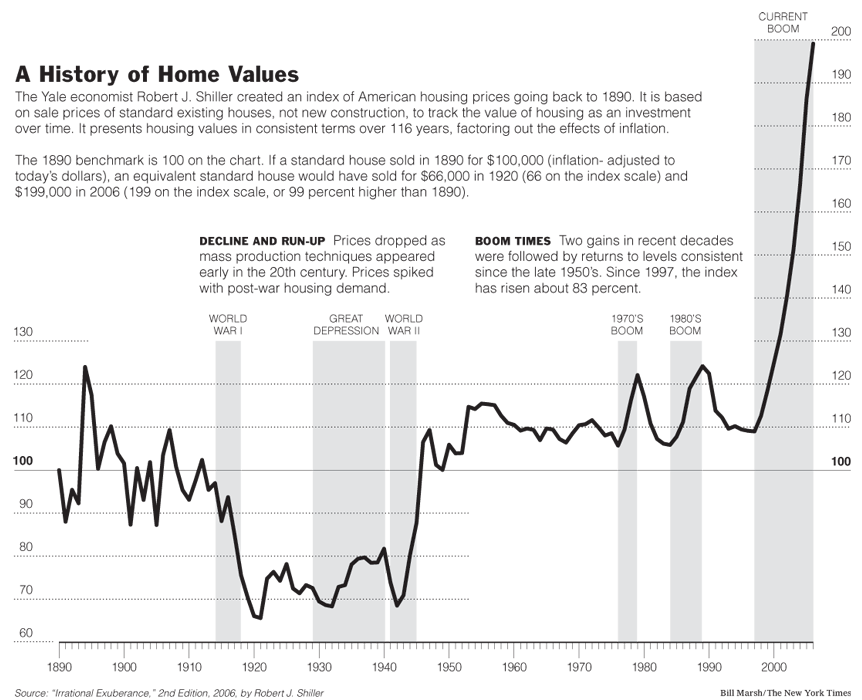
Schiller presents housing price data through 2005 in real, inflation-adjusted dollars:

(click twice to enlarge)

The Federal Reserve, therefore, was and is faced with an extremely difficult challenge: to prevent a severe housing crunch from having its usual effect: driving the US economy into a recession, as the three biggest housing crunches since World War II have done.

For more on Federal Reserve policy, go to The Fed: Part II: What’s Goin’ On?

dearieme:
"Without an economics degree,....": please don't allow that to inhibit you. After all, Schiller's Unique Selling Proposition would seem to be that he's got economics degrees by the bucketload and still insists on talking sense.
8.17.2007 5:50am
dearieme:
Oh, and while it's Amateur Hour, let me recommend J K Galbraith's "The Great Crash". He was a lousy economist but a sizzling economic journalist.
8.17.2007 5:55am
James968 (mail):
About 2 (or 3 or 4) years ago when Greenspan was still in charge I saw him speaking before congress and he was saying "People should switch to adjustable Rate mortgages" and I was like.... What????

The Fed seems out of touch with who demographics and the idea that some people should be careful with credit.
8.17.2007 6:57am
Norseman:
substitute "housing prices" with internet stocks and replay the outcome of the last bubble. Blogs still worked, Amazon stock continued to go up, but those who speculated, whether sophisticated, lol hedge funds today, or early stage venture in 2001, lose.

Some people will be hurt, just as a lot of nice people were hurt by the internet stocks. Today, folks will lose their homes and have to rent again (and probably learned they need more savings before becoming a homeowner). in the tech bubble, many a person had to put off retirement another year or two or three, and probably learned the meanings of risk and diversification better.
8.17.2007 7:45am
martinned (mail) (www):
L.S.,

I think the misunderstanding is in the Fed's duties. The relative importance of combating inflation and promoting economic growth differs across Central Banks. The ECB, like the Bundesbank before it, only cares about economic growth to the extent that growth promoting actions do not cause inflation. The Bank of England has a more balanced approach. Especially since the 1980s, the Fed cares first and foremost about combating inflation. Since inflation in the US is still in the 2% - 3% range, instead of 1% - 2% where they would like it to be, there will be no reduction in interest rates, so the only remaining instrument available is the quick fix of the money market intervention.
8.17.2007 9:26am
Gaius Marius:
We're not anywhere close to a recession. I was enjoying an afternoon out of the office yesterday with some bankers from smaller banks (in relative terms) and they were ecstatic about how the commercial loan business has boomed for them over the last couple of weeks. Apparently, these smaller banks are moving in to extend credit to credit worthy commercial borrowers who are unable to obtain credit from the larger institutional banks at this time. There are lenders still willing to extend credit to credit worthy borrowers. It's just that these smaller lenders don't have offices on Wall Street.
8.17.2007 10:17am
J. F. Thomas (mail):
Some people will be hurt, just as a lot of nice people were hurt by the internet stocks. Today, folks will lose their homes and have to rent again (and probably learned they need more savings before becoming a homeowner).

The difference is is that this time people who had no interest in playing the game (i.e., frugal hardworking homeowners who saved and bought houses they could afford with traditional mortgages) are going to be hurt because of the greed, ignorance and stupidity of the borrowers, lenders, and yes even the Fed (especially Alan Greenspan) who created this artificial bubble. As housing prices collapse and homes are foreclosed upon and abandoned, it will hurt responsible and innocent homeowners who will see the value of their investments suffer. They will find it difficult to sell their houses, which may be an inconvenience, but for some people (e.g., if they are relocating for a job) might be a real hardship.
8.17.2007 10:22am
Paddy O. (mail):
Definitely not an economist, just interested and have questions maybe an economist can answer.

Doesn't it depend on the reason for the housing decline? If the housing market is part of a larger trend and is itself more of a symptom than a independent reality than I could see the recession argument as valid. However, from my perspective the housing bubble and burst isn't dependent on broader economic signs, but is, in this case, part of a huge spree of overbuilding. Construction over the last years has been nonstop in my neck of the woods (literally in the woods) and even more in the more open parts of Southern California.

There is an oversupply of high scale housing. In urban centers this is represented by luxury condos. In suburban by mcMansions.

Can we see the housing market, then, not as representative of the broader economic realities, as in times past, but as in this case experiencing its own rightful market balancing of supply and demand?

There are just too many homes to expect prices to be sustained at a under supply rate. Why should the Fed step in?

Sorry for my lack of economic terminology and knowledge.
8.17.2007 10:38am
liberty (mail) (www):
"For example, after the 1929 stock market crash, banks and brokerage houses reformed their excessively easy lending practices, leading to a massive contraction in the supply of money and its velocity."

It wasn't just banks and brokerages doing it on their own. The Fed doubled the reserve requirements for banks, to try to maintain control over them. Prices were controlled through fiscal policy, unions' political powers were growing exponentially and they maintained control over wages. Tight monetary policy combined with rigid prices, and that is what deepened and lengthened the downturn into a full-blown depression.
8.17.2007 11:03am
liberty (mail) (www):
"The Federal Reserve, therefore, was and is faced with an extremely difficult challenge: to prevent a severe housing crunch from having its usual effect: driving the US economy into a recession"

First, do no harm.

If the Fed can manage not to turn this into a recession, that would be a start.
8.17.2007 11:04am
A.S.:
Without an economics degree, I may well be misunderstanding

You can hardly be blamed for that in predicting a recession. After all, as Paul Samuelson famously said, economists have correctly predicted nine of the last five recessions. You can feel free to have that same rate of correct recession predictions.
8.17.2007 11:14am
Tony Tutins (mail):
I'm going to agree about the 79-82 recession. Absurdly high interest rates meant few people could qualify for a mortgage, no matter how secure their jobs or respectable their credit. Friends of mine bought houses on land sale contracts, where one missed payment could have meant forfeiture. Money market funds were the most attractive investment, and the price of gold hit a historic high. Interest rate drops during the Reagan administration made home-buying affordable again.

But in the absence of high interest rates, I believe people buy houses if they feel that they are financially secure. For example, the drop in bay area housing prices circa 93 was triggered by Clinton's peace dividend, which threw hundreds of local government contractors (Lockheed, Loral, etc.) out of work. In contrast, area housing prices held up and even increased after the dotcom recession. But apartments went vacant, even after rents decreased and "move-in bonuses" increased. I believe that survivors who had kept their jobs, or who had cashed in their dotcom gains, felt secure enough to stop renting and buy a place of their own.
8.17.2007 12:17pm
SenatorX (mail):
We are already in a recession!
8.17.2007 12:56pm
stormy (mail):
Why would we want inflation at all. What is inflation? It is the devaluation of our money(term used loosely).
8.17.2007 1:50pm
glangston (mail):
I would hope this study takes into account the generally larger homes being built today on the generally smaller lots. This could be somwhat of a factor in how high the index is today. Then again, maybe homes have always trended in this way, larger, and on smaller lots. There I go, talking like an economist....sorry.
8.17.2007 2:39pm
Laura S.:
I'm wondering why my post pointing out that the Fed has run a loose monetary policy for all but one of the past 25 years (1989) was deleted.

Under the assumption that it was deleted out of ignorance, here is the actual data:

http://www.newyorkfed.org/markets/omo/omo98.pdf, pg 7. covering 1981-1998

http://www.newyorkfed.org/markets/omo/omo2006.pdf, pg 21.

Let me explain what these graphs mean: when the Fed Funds Rate target is below the 'natural-rate', the Fed must continually inject money through Open Market Operations to hold the interest rate-down.

When the Fed Funds Rate target is above the 'natural-rate', the Fed must continually sell the bonds held in the SOMA, to maintain an artificially higher-rate of interest.

We can thus conclude from the balance sheet of the SOMA that the Fed has been pretty much continually holding the short-term interest rate below the natural-rate.

Now, I have to tell you that the Fed describes the SOMA activity as (merely) covering the reserve requirements of the banks. Anyone with a good background in control theory (the engineering of feedback systems) will tell you that this does not contradict the explanation I gave. The reserve balances are merely a way of observing whether more or less money needs to be injected.
8.17.2007 3:11pm
James Lindgren (mail):
Laura S:

I have deleted no comments on any VC threads in the last few months and I doubt that another VC contributor would have deleted anything from another blogger's thread (except for an extremely outrageous comment by a racist troll).

Rest assured that it must have been a computer glitch.

Jim Lindgren
8.17.2007 3:39pm
Laura S.:
Too little liquidity?

The following is a graph of the fraction of excess reserves. This reflects the money that banks could lend but have not.

Graph of Excess Reserves
8.17.2007 4:46pm
CB:
Does anyone else think it is strange, looking at the graph, that aside from the "boom periods" (most notably the current one), real housing prices have not increased AT ALL since the post-war period? Remarkable considering the increase in population. Population-based demand increases must have been offset by decreasing costs of building (it does seem that they are making them cheaper these days).
8.17.2007 6:00pm
James Lindgren (mail):
CB:

That was Schiller's point in the interview linked in the post--that in real dollars home values did not climb much until the 2000-2005 boom.

Jim Lindgen
8.17.2007 6:05pm
nunzio:
Unfortuantely property taxes are not going down even though home values are decreasing, at least in my back neck of the woods.

Say what you will about the Fed, but they are more responsive than my county assessor's office.
8.17.2007 6:58pm
JBL:
Paddy O. -

You are largely correct, in that the bust is the result of people making bad investments during the boom, and is therefore just a case of market economics working exactly as it should.

To clarify, though, the boom was driven not by overbuilding, so much as a combination of low interest rates and increasingly lax underwriting standards - interest only mortgages, 100% financing, etc. This easy financing made it possible for more people to buy more house, often under terms that would not be sustainable in the long run, and this artificially high demand drove a lot of speculative building.

The problem that most people are worried about, and what the Fed is addressing, isn't the supply of housing per se, it's the question of just how much money people sank into investments that will crash in value as a result of the drop in housing prices, and what that will mean for the broader economy. We're concerned about the ripple effect (which may be more of a wave than a ripple). If some banks lose their shirt in the subprime mortgage market, that's fine, except that if the banking system as a whole loses enough, they won't have any money left over for other sorts of loans, and that makes business difficult for everybody else.

The general uncertainty about exactly what will happen is making investors reluctant to invest in any kind of debt, even in sectors where the underlying fundamentals are relatively good.

The question, then, is how to let the necessary corrections happen without killing the rest of the economy. Not an easy task.
8.17.2007 7:15pm
wooga:
nunzio,
I live in San Diego, and I got a notice of an emergency downwards reassessment about a month ago. It'll save me a ton on property taxes. The "temporary" part is a loophole to allow the county to jack the assessment back up faster than would be ordinarily be allowed under CA law.
8.17.2007 10:22pm
Elmer (mail):
To some extent, I know how Bernanke feels. Last year I dreamed that I was the Fed chair, probably on my first day of the job. Since I'm not an economist, I had a lot to learn. In addition, I was a zombie. I controlled the money supply by adjusting the number of people I ate. If I wanted to increase the money supply, I ate another person ahead of my usual meal schedule, or at least that's what I thought at first. Later, I started to suspect that I was wrong, and that eating people actually decreased the money supply, but I wasn't sure. Trying to learn econ fast is hard enough, but with that kind of pressure it's awful. I was exhausted when I woke up.

Now, Bernanke has had the job for some time, and I hear he knew a lot about econ even before he started, so he's probably better prepared than I was. Also, I've never heard anything about his personal life or lack thereof, but the Fed chair is treated like a movie star to some extent, so if he was a zombie we'd probably hear of it. That said, we all have our limitations, and this has got to be a stressful time for him.
8.18.2007 2:48am
Kurt9 (mail):
I saw the Shiller graph in Forbes several years ago. I see no reason to doubt its validity. It makes clear what should have been obvious to anyone with a room temperature or above IQ: That the housing market was in an artificial bubble, just like stocks from 1996-2000. Its simple law of gravity. What goes up must come down. And all of the idiots and parasites who participated in this farce, either because they thought it was real or because they are fraudsters, MUST suffer and disappear. As long as these kind of people exist in our economy and society, REAL economic productivity and progress cannot occur. If we have any kind of recession, this is the lesson I think we will all learn.

All of the shreiking you see on CNN, Fox News, etc. about how the decline of the housing bubble will bring about a recession are simply all of the weasels trying to get the FED to bail them out by lowering the interest rates.

Is it not ironic that the "supersmart" people running these hedge funds (like Jim Cramer), who claim that their huge compensations are justified by their ability to "create wealth" are now the people crying the loudest for a bail out? That the rest of us should have to pay the price of inflation so that they can have their funds rescued? Can anyone honestly think that this is justifiable?

The rate of growth in the money supply should NEVER, EVER be different than the natural economic growth rate. If the money supply is allowed to increase faster than the economic growth rate, the result is inflation (either price inflation like the 1970's or asset inflation like 1995 until now). Regardless of what anyone says, inflation is actually the debasement of the currency, which is never acceptable under any circumstances, what so ever.

Greenspan was a parasite who increased the money supply (credit bubble) way beyond anything that was rational, given the economic growth rate, since 1993 simply to make his job easier. He is almost as bad as Arthur Burns, who did much the same thing in the 1970s.

The 60's and 70's was the time of kaynesian fiscal policy and the 1994 to now period was the time of keynesian monetary policy. When are we going to learn to bury the ghost of Keynes once and for all? Keynes was one of the worst economists to ever walk this planet (Krugman is getting up there as well) and we need to ditch him once and for all.
8.18.2007 3:04am
SenatorX (mail):
Great comments! Please keep posting economic themed blogs Mr. Lindgren.
8.19.2007 11:09am