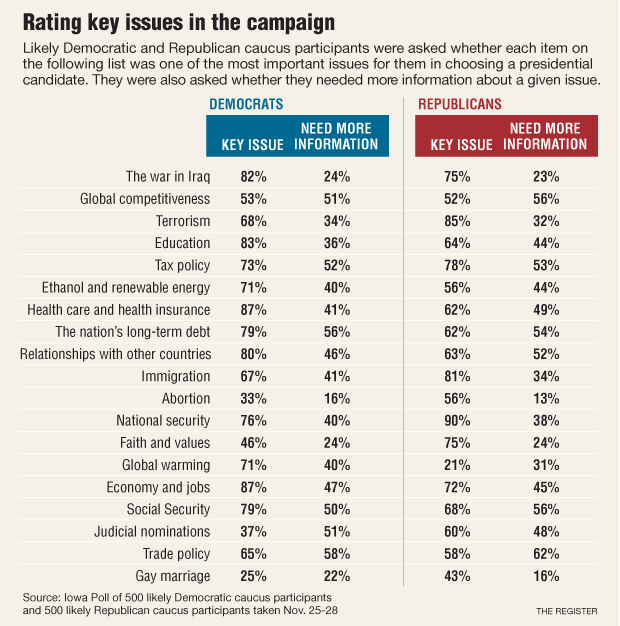
One of the underanalyzed questions in the current presidential election is the extent to which the results are likely to be influenced by political ignorance. In general, primary voters are likely to be better-informed than the average citizen, and caucus goers even more so (because attendance at a caucus requires a much higher investment of time and effort and therefore tends to draw more committed voters with a higher level of interest in politics). Nonetheless, this recent Des Moines Register poll of likely Iowa caucus voters suggests that ignorance may well have a major impact even in the election with perhaps the country's best-informed voters. The poll asked "likely" participants in the Republican and Democratic Iowa Caucuses whether they believe they need more information about 19 major issues in the campaign (click on the image to get a clearer picture):
It is striking that large numbers of likely voters admitted that they need "more information" on a variety of major issues. For example, 56 percent of Republican voters and 50% of Democrats admitted that tney need more information about Social Security - despite the fact that this issue has been extensively debated for years. Similarly, 52% of Republicans and 46% of Democrats admitted they need more information on American's "relationship with other countries" - even though foreign policy has been perhaps the most important issue on the political agenda since 9/11. Forty percent or more of Iowa voters in both parties admitted to lacking information on eight of the other issues surveyed, including major ones such as judicial nominations, trade policy, and taxes.
These figures very likely understate the true degree of ignorance among likely Iowa voters for three reasons. First, as I point out in this article, surveys show that many respondents are unwilling to admit ignorance. For example, 20-30% will express opinions on nonexistent laws made up by pollsters rather than admit that they haven't heard of them. Second, the more ignorant you are, the more likely you are to be unaware of the full depth of that ignorance and to underestimate the amount of information you need to be a better voter. Third and finally, Iowa caucus voters - unlike most of the rest of us - have a great deal of personal exposure to candidates. While this personal experience might itself be a source of useful information, it is also likely to lead voters to underestimate the degree of their residual ignorance, because cognitive biases lead people to overstate the signficance of information derived personal experience and underestimate the importance of more remote sources of knowledge.
It's also worth noting that Iowa caucus voters are perhaps the best-informed in the entire country, given the amount of exposure they have to campaign information and the fact (noted above) that caucus voters are likely to be better-informed than primary voters. If Iowa caucus voters - by their own admission - lack adequate information on numerous major issues, the rest of the electorate is likely to be even worse.

I understand somebody taking that position on "black and white" moral issues such as abortion or gay marriage, but the others? How could you say that you know all there is to know?
I don't think that that reflects ignorance at all, but wisdom.
I can imagine people who know volumes about an issue saying they need more information, because there's some nuance they don't know that they think is important, perhaps even a bit of knowledge that isn't definitively available to anyone yet, like "will we win in Iraq". And I can imagine someone who knows almost nothing about an issue honestly believing that they know all they need to know about it.
The two are not mutually exclusive. One can be wise enough to recognize one's ignorance.
I can imagine people who know volumes about an issue saying they need more information, because there's some nuance they don't know that they think is important, perhaps even a bit of knowledge that isn't definitively available to anyone yet, like "will we win in Iraq". And I can imagine someone who knows almost nothing about an issue honestly believing that they know all they need to know about it.
Both are possible. Indeed, I point out that self-reporting of ignorance on surveys tends to underestimate it's true level. However, it's not likely that highly knowledgeable people would say they need more info on this survey, given that it merely asks whether they need more information for voting purposes. Few people believe you have to have in-depth expertise to decide who to vote for.
You can have a sufficient amount of information for voting purposes without knowing "all there is to know."
Sure. All depends on how the question was asked. You don't provide a link to the main article, and I was unable to find it after a few simple searches. So I went with the description on top of the table you link to. Maybe the actual question provided the qualification you suggest.
Even then, a few weeks before the caucus, it would be very hard for me to affirm that no new information could surface on most of these issues that would cause me to change my mind.
Of course, I'm the kind of person that can't choose from a restaurant menu until the waiter starts tapping his foot.
In fact, your own reasoning goes against your point. If the Iowa caucus goers are generally MORE informed than the average voter, and if the LESS INFORMED voters are so ignorant they don't even recognize they need more information, then the results of this poll CONFIRM these respondents ARE more informed than most voters, not that they are ignorant, because they are AWARE they need more information.
Your error is thinking "needing more information" is the same thing as "being ignorant". You can, of course, define "ignorance" as simply "absence of knowledge", but I think the sense it which it is used in discussion of voter ignorance is not simply non-omniscience on a topic but "severe or significant lack of basic knowledge, to the point where it is concerning or paradoxical that democracy can function." But this poll doesn't show that of these Iowa caucus voters. It merely shows that many desire (even) more information. Scientists often seek more information. This is not because they are ignorant (in the sense discussed). Lawyers read lots of legal blogs. Is this in part to get more information? Is that done because they are ignorant of the law?
On the other hand, I have no idea where any number of the candidates stand on the majority of those issues, because of deliberate evasiveness and obfuscation on the part of the candidates and their campaigns. So, if asked if I needed more information on the <i>candidate</i>'s position on the topics, I would assuredly answer in the affirmative.
Its not clear to me what was exact question asked in the poll survey, and whether people answered regarding their knowledge or their knowledge of candidate's positions.
We need about 4 more debates (real ones, not like IA) where people can have at least a real chance at seeing all the candiates positions.
There are about 1000 questions I still have as a voter about many of the candidates.
We are letting people who have NO IDEA what they are doing pick our next president, and that really pisses me off because I happen to live in a state that by the time it gets here its too late the press will already have 'anointed' one by then.
We need to have NO PRIMARIES before Jun 1 if you want a really educated public.
If I asked you whether you know enough about the safety of the bridges in your town, or the current rules regarding your medical insurance, or the status of environmental protection in your community, or anything whatsover outside of your own professional or personal interest, would you respond that you 'know enough about it?' You drive over bridges every day; you belong to a medical insurance group; and so on.
The fact that social security has been debated for years is irrelevant; in my job, environmental policy has been debated for years. That doesn't mean you have participated in those debates for years.
Not everybody loves to debate social security policy the way pundits do (and not all pundits love to debate environmental policy the way I do, or bridge building policy the way engineers do, or health insurance policy the way insurance adjusters do, etc etc).
Give people a break. Politics is a hobby for some, but not everybody. Most of us have better things to do with our time. Rational ignorance and all that.
Sk
"So, does my checking "Needs more information" on the Social Security issue reflect political ignorance, or just frustration with the fact that political candidates almost never offer concrete proposals, since that would expose them to more criticism &risk offending voters who agree that a problem exists but favor other courses of action?"
I think you hit the nail as far as the candidates go. The next question is where do the news media fall into this?
Finding good and accurate info through internet is good but requires work and time. Not everybody has both.
First, it's nice to see that the more technical the subject, the more people felt they needed more information.
Second, it was striking that the results in the two parties were so similar.
Finally, paucity of information is not a disqualification for making a wise selection. Someone who knows little about law or medicine may reasonably choose a lawyer or doctor based on what he knows about the proffesional's qualifications and background, and on what he sees of the person's congnitive abilities and personality when meeting him or her.
Similarly, with minimal knowledge of the issues, a voter can reasonably select a candidate based on background, general philosophy, and the like. Yes-- these are subject to manipulation, and voters may have been able to do a better job before the introduction of modern campaign advertising. But you don't need to be expert on a laundry list of issues to be able to vote responsibly.
Republicans care about Terrorism, Immigration, Abortion, National Security, Faith &Values, Judicial Nominations and Gay Marriage much more than Democrats.
Democrats care about Education, Ethanol &Renewable Energy, Health Care/Insurance, National Debt, Relationships With Other Countries, Global Warming (by a long shot), Economy &Jobs, and Social Security much more than Republicans.
(with "much" defined as > 10%)
Anybody want to explain what this means?
A real way to find out the knowledge of persons on these issues would be to ask a series of questions with objectively correct answers, e.g., "What countries border Iraq? What party controls the government of Syria and used to control the government of Iraq? Who is the chief of state of Iran? What percent of US GDP is spent on medical care? What percent of the US budget is spent on defense, social security, medicare and medicaid, interest on the national debt? etc. and build an index of actual knowledge. It would be a fascinating study to compare actual knowledge of voters with their choice of candidate.
I basically know how I feel about social security and consider myself reasonably well-informed, but I could not tell you how each candidate feels about it.
I'd say the above is mostly an indictment of the press.
There may have been a large quantity of reporting on these subjects, but what was the quality like? I'd say Mostly soundbites, horse-race analyses of how a particular twist affects a particular candidate rather than how it fits into the bigger picture, important information ommitted for reasons of bias or twisted beyond recognition for reasons of ignorance and incompetence.
Voters have always had to act with limited and partially incorrect information - it's just that thanks to the internet fact-checking the MSM's @$$ they're somewhat more aware of that fact than they used to be.
Especially since chances are good some issue not even on the list is likely to become important during the tenure of whoever wins. (Where was terrorism on the 2000 voters' priority list?)
I'd much rather choose a candidate based on general political philosophy, general good judgement, and general managerial ability. My primary interest in the "laundry list" is as a way of inferring the first two.
Perhaps misinformation--e.g., thinking that Saddam Hussein was behind 9/11--is more of a problem.
As with most newspaper polls, merely noting its existence would so qualify.
Meaningful social science is really hard to do, and is not particularly successful at delivering eyeballs to advertisers.
As to the questions:
(DeMoines Register May 20, 2007, article by Jonathan Roos.)
Note that this poll was taken some months ago, so voters in Iowa may well have enough and more than enough info on candidates stands on these issues by this time.
What I think it means is that neither party is nearly as homogenous on issues or views as many political commentators would like to believe. For example, the larger percentages of Republicans who think abortion, gay marriage, or Faith &Values are important issues simply reflects that the Religious Right is an important constituency group for the Republicans, while the larger percentage of Democrats who care about Renewable Energy and Global Warming reflects that environmentalists are an important constituency for the Democrats. However, I strongly suspect (and I think the poll numbers reflect) that there are many voters in BOTH parties who do not necessarily share the concerns of these constituencies, and make their decision on which party they choose to affiliate with on other issues, based on a level of trust on those issues which are most important to them.
Personally, as a "Goldwater Republican", I couldn't care less about abortion or gay marriage; I wish the Republican Party still stood for personal freedom, and let people make their own decisions about abortion or gay marriage without Government interference. And while faith and values might be an important indicator of a candidate's character, my own belief is that government has no place telling anyone how or what to believe on matters of religion or moral values, with the exception of those moral values having a utilitarian impact on society (i.e., thou shalt not kill, or steal, and matters like teenage pregnancy, which adversely impacts the development of children, etc.). On the issue of Immigration, I'm often ashamed of the stance taken by the Republican Party - I would be much more open to an open border policy with no limits or quotas on immigration, except to keep hard core criminals &crazies out. But none of those issues are important enough to me to drive me out of the Republican Party. The issues important to me, like Social Security (I'm nearing retirement &resent the incredible inter-generational transfers caused by the Ponzi-Scheme setup of Social Security under FDR), Health Care, Education, the Economy, and Judicial Selection, are not exclusively "Republican" or "Democrat" issues, but, for various reasons, I do not trust the Democrats on any of those issues.
I strongly suspect that a great many Democrats are in a similar situation - they don't necessarily agree with the Democrats on all of the so-called "Democrat" issues, nor do they disagree with the Republicans on all of the so-called "Republican" issues, they simply do not trust the Republicans on the issues which are most important to them.
It ain't what you don't know that gets you into trouble. It's what you know for sure that just ain't so.
More than that, this poll is almost a month old, according to the date on the bottom of the graphic. No wonder we can't find the article on the Register's website.
Of course all the issues on this list are important, but not equally so to everyone. I think the ignorance here is because, for various reasons, nobody cares about everything. I'm a fairly well informed voter, and I would say that I "needed more information" for about a third of the issues on this list. That said, if you gave me the additional information, I wouldn't read it or care, because those issues are really low on my list of priorities. I make my choice of candidates off of, at most, a half-dozen issues. The "needs more information" category probably reflects ambivalence more than anything worth fretting about.
When the candidates meet with small enough groups so that individuals can ask questions the questions are vastly superior to those asked by the press and there are often follow up questions (which the press have been taught not to ask). The best solution would be for the press to reduce coverage of the Iowa caucus and New Hampshire primary so things can return to normal.
That is a great concept, sure to win many arguments for me.
In California, we have a situation where over half of
high school students (primarily Latino) are eligible
for Affirmative Action under various Federal programs,
and implicitly in state programs despite Prop. 209.
One would think the intersection of preferences with
immigration would be a significant campaign issue.
"It ain't what you don't know that gets you into trouble. It's what you know for sure that just ain't so."
--
And as a perfect example of this, I always thought it was a quote from Will Rogers...
And I will second (or third/fourth/whatever) that in the chart and even the original questions, it is not clear whether they are asking if you are knowledgeable on the issues, or knowledgeable on the candidates’ positions on the issues, making the results rather useless.
I would have expected it to be the other way; why would I want more information about something I don't care about?
Eyeballing the data I saw no obvious correlation either way.
Can anyone tell me what the various candidates positions are on the structure and operation of social social security in the future?
Is there anyone here who does not need more information on social security? If so, do you believe in the lockbox?
I assume you mean more in total, not more in proportion, right?
Once again, we're seeing the interpretation that people may be dissatisfied with the quality of the information they're getting.
Now you've got me wondering what kind of trouble a minor and understandable misattribution of that quote could cause. A disapproving stare from a Twain scholar?
But I'm probably too ignorant.
Knowledge of issues is impossible. There's too much conflicting information for anyone to be fully informed on, say, global warming or NAFTA.
Basic political knowledge, like "who was the last president?" "Who is the current vice president" "Which country is directly south of America?" are things that voters should be required to know.
It would be nice if people could just frame the debate on any political issue, rather than know factoids and be a wonk on the subject.
For the last time, what got you "flamed" in the previous thread was your repeated, serious argument that women as a class were inferior to men as a class as voters.
Well I guess someone has all of the information he needs.
Personally, I am looking forward to seeing a beer commercial again.
1. Help push this proposal. Rather than having MSM hacks asking questions at debates, the questions would come from people who are actually familiar with the issues being discussed, and they could ask a series of questions designed to reveal the flaws in the candidates' arguments.
2. Go to campaign appearances and ask questions like those described above, then upload the responses to video sharing sites.
3. Help discredit those in the MSM (pretty much all of them) who concentrate on horserace rather than asking the candidates real questions. See the comments at Time's Swampland for examples.
As others here have already suggested, science has already spoken on the issue and it is VERY clear that the more someone knows the more they realize what they don't know and so are MORE likely to rate themselves as needing more information. Again, the most informed among us are most aware of what they don't know.
Yes, it also works out the other way round, too: The least informed are most likely to believe they know all there is to know on any given subject. So, the questions is really a good barometer of how informed one is, and the author of this article got the conclusions EXACTLY BACKWARDS!
RTIII
As for the public not wanting to learn about the details, in this case it doesn't really matter. These could be direct-to-Youtube debates that would be "loss leaders" for whoever produces them. They'd spend maybe 10 or 20 grand tops and they'd get a good amount of valuable mindshare.