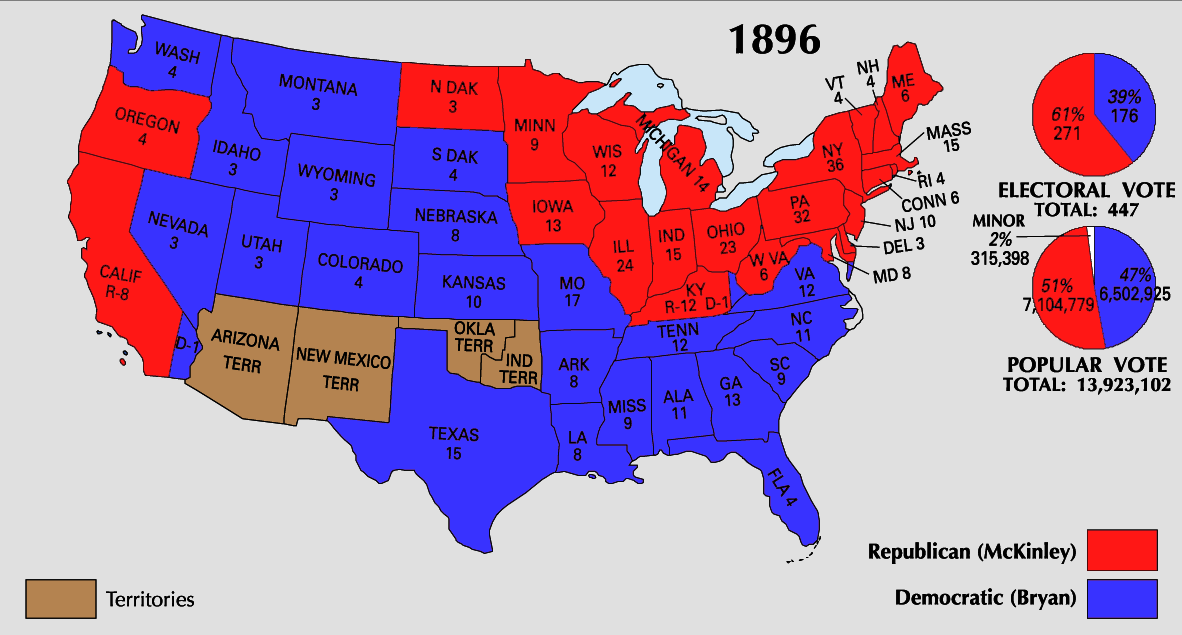
You can look at the electoral maps for all previous presidential elections at sites like this and this. The electoral map that bears the closest resemblance to the predictions for 2008 is 1896. And it is a pretty close resemblance. There is one small difference, though: the parties have flipped. The core of the Democratic party in 1896 was the South and the Interior West (the plains states west to Nevada, but not including California and Oregon). The rest of the country went to the Republicans. I'm not the first to note this inversion, and political scientists have competing arguments about its significance, but it is striking that the core of the Republican party is now the same area (South and Interior West) that once were the core of the Democrats.
Features
Stuff from us
Academic Legal Writing: personalized bookplates
Sources on the Second Amendment
What's interesting is that the demographics have shifted so little.
http://uselectionatlas.org/RESULTS/index.html
"The relative patterns in 1896 and 2008 and their partisan inversion can be predominantly explained on the basis of race."
Also 6 and 8 are even numbers.
Ugh. Moronic comments. Neither the Republican or Democratic parties of 1896 could be considered "pro-black" in any extent. The Republicans were not "world-oriented cosmopolitans"; they believed in tariffs and isolationism (much like Democrats today.)
I urge you to go back and read some history about the Democratic party in the 1890s and its strong anti-black, anti-semitic, anti-indian, and anti-urban sentiments. The parties switched places over the 1964 &1968 elections and have been there ever since.
But I won't stop you from trumpeting the limits of your historical understanding in public.
That doesn't explain the shift in the Great Plains and Rocky Mountain states.
The shift in the Great Plains and Rockies is the byproduct of anti-urban prejudice, which the more Populist Democrats of 1896 had in abundance, and which today is one of the hallmarks of the Republican party.
If you have a comment about spelling, typos, or format errors, please e-mail the poster directly rather than posting a comment.
Comment Policy: We reserve the right to edit or delete comments, and in extreme cases to ban commenters, at our discretion. Comments must be relevant and civil (and, especially, free of name-calling). We think of comment threads like dinner parties at our homes. If you make the party unpleasant for us or for others, we'd rather you went elsewhere. We're happy to see a wide range of viewpoints, but we want all of them to be expressed as politely as possible.
We realize that such a comment policy can never be evenly enforced, because we can't possibly monitor every comment equally well. Hundreds of comments are posted every day here, and we don't read them all. Those we read, we read with different degrees of attention, and in different moods. We try to be fair, but we make no promises.
And remember, it's a big Internet. If you think we were mistaken in removing your post (or, in extreme cases, in removing you) -- or if you prefer a more free-for-all approach -- there are surely plenty of ways you can still get your views out.