Thanks Eugene, for inviting me to join the conspiracy – and thanks to those who welcomed me in advance of my actually doing anything to deserve such treatment. To be sure, as a former employee of the Federal Trade Commission, the whole conspiracy thing is a bit disconcerting. Thankfully, this particular conspiracy is to promote (rather than restrain) trade – this time, of ideas.
Yesterday’s Wall Street Journal had an op-ed on the virtues of caps on non-economic damages in medical malpractice cases. Non-econ caps are ground zero in the debate over medical malpractice reform.
To proponents, non-econ caps are a silver bullet, simultaneously targeting frivolous lawsuits, excessive damage awards, run-away juries, and high medical malpractice premiums. To critics, non-econ caps are both ineffective (since they will not lower malpractice premiums or the cost of health insurance coverage) and unfair (since they reduce damage awards to the most severely injured, and disproportionately affect women, children, and the elderly).
I’ve spent the past few years doing a series of empirical papers on medical malpractice, with several co-authors from the University of Texas (Charlie Silver, Bernie Black, and Bill Sage), and Georgetown (Kathy Zeiler), including a forthcoming paper in the Journal of Legal Analysis estimating the impact of such caps. So, I thought I’d join the Conspiracy by highlighting some of our findings, in this and other works, which call into question/complicate some of the claims in the WSJ editorial.
Today, I'll provide general background on damages caps. Tomorrow, I'll address the impact of damages caps on verdicts and payouts in tried cases, and payouts in settled cases. After that, I'll address the issue of damages caps and access to medical services. Finally, I'll turn to the larger social policy issues raised by damages caps.
Let me start with some general background. In malpractice cases, one can recover two types of compensatory damages: economic, and non-economic. Economic damages are things like lost wages and medical expenses. Non-economic damages are less concrete, and include things like pain and suffering, loss of enjoyment of life, loss of consortium, and the like.
Non-economic damages have been a frequent target of tort reformers, beginning with the successful campaign to adopt a cap on such damages as part of the Medical Injury Compensation Reform Act (“MICRA”) enacted by California in 1975. Over the intervening years, campaigns have been fought to enact damages caps in numerous states. The campaign to enact such caps is usually triggered by a malpractice "crisis,” marked by sudden and dramatic increase in malpractice premiums.
Several states have enacted non-econ caps only to see them struck down by the state Supreme Court. This is what happened in Illinois twice in the past several decades, and we are waiting to see whether it will happen again — although I wouldn't bet on it this time around.
Although it is common to speak of non-econ caps as a unitary entity, they actually come in numerous varieties, reflecting the design choices of each individual state legislature. Consider a couple of the moving parts:
What should the dollar level of the cap be set at?
Should the dollar level of the cap be indexed for inflation?
Should the cap vary by the number and type of defendants? For example, should doctors have a lower cap than hospitals? What about a case in which there are both types of defendants? Should separate caps apply to each?
Should the cap cover non-economic damages, total damages, or both?
Should there be a separate cap on punitive damages (which are rare in malpractice cases against doctors and hospitals, but less so in cases against nursing homes)?
Should the cap only cover medical malpractice, or should it apply more broadly?
Should cases in which the plaintiff is deceased have a different cap level than those in which the plaintiff is not?
At present, 31 states have caps on non-economic damages or total damages or both. (I exclude caps on punitive damages to keep things simpler). The Table below provides a brief summary of the cap that is in effect in each state, sorted by cap type and level.
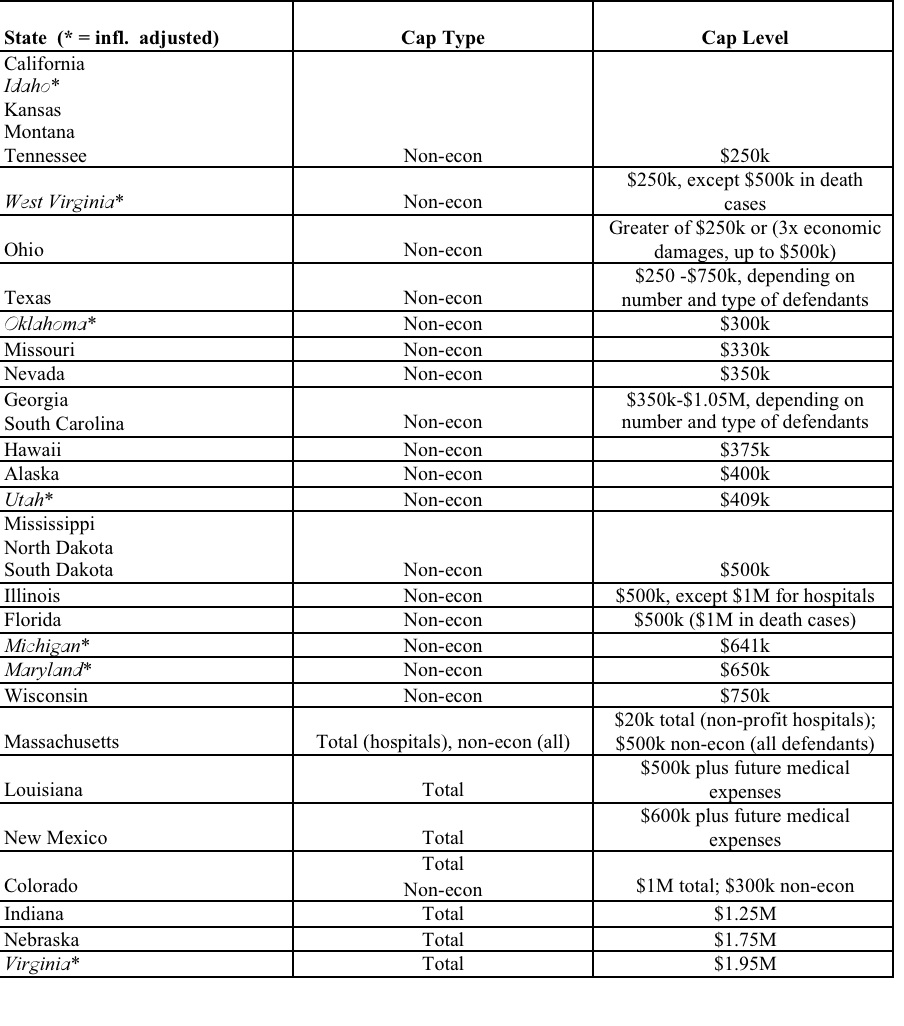
Thus, there are 24 different variations among the 31 states that have adopted a damages cap. The most popular cap is the flat $250,000 cap chosen by California, and since copied by four other states. Those looking for a deep principle of justice explaining the logic of this cap level should prepare themselves for disappointment: as this first-rate student note carefully documents, the level of the California cap was quite arbitrary. As part of her research, the author emailed the principal legislative sponsor, and asked him why they settled on $250,000, and received the following response:
The theory was that you could never really and adequately compensate for pain and suffering, no matter how much money you provided. Money just doesn’t do it. But $250,000 (in addition to meeting the medical and other needs of the patient), properly invested to the extent that it elevated the quality of life over and above the post-injury status, was thought to be enough to do that job.
That’s enough for my first-ever blog posting. Tomorrow, I'll address how damages caps affect payouts, including their interaction with plaintiff demographics.
Related Posts (on one page):
- Damage Caps and Medical Malpractice VII
- Damage Caps and Medical Malpractice Litigation: VI
- Damage Caps and Medical Malpractice Litigation: V
- Damage Caps and Medical Malpractice Litigation: IV
- Damage Caps and Medical Malpractice Litigation: III
- Damage Caps and Medical Malpractice Litigation: II
- Damage Caps and Medical Malpractice Litigation
One quick question that you may want to consider addressing in either in an update or a follow-up post: why had several State supreme courts, including Illinois, struck down their State’s caps on non-economic damages?
I thought I saw somewhere what states were not entirely consistent in the division between economic and non-economic damages. Specifically, I thought that some states consider future loss of wages to be non-economic damages. Does anyone know if this is true in some states?
To what extent does Colorado's "breakable" cap (on economic damages) impact payouts?
In Colorado, there is a $1,000,000 cap on medmal verdicts, but that cap can be "broken through" where the Plaintiff can show good cause and economic losses in excess of $1,000,000. Sadly, our doctors generally only carry $1,000,000 in insurance, leading to the result that excess judgments are often perceived as uncollectable due to a lack of sufficient assets.
--PtM
A request: in the social policy discussion, how's about some statistics and analysis re: how tort reform, in some states, is killing business for lawyers, plaintiff's and defense alike. It's a tough time to be a young lawyer.
Oh, and good post.
The Louisiana Supreme Court has upheld the scheme in large part because of the benefit provided to plaintiffs of unlimited recovery of future medical expenses. Unlike private malpractice insurance, there is no policy limit for such damages, which is a significant boon to those with the most severe injuries.
So the question for medmal, as it was at one point anyway for auto insurance, will a uniform national law better serve the goals? This seems a likely part of the discussion of any nationalization of health under the new administration. Assuming there is a consensus of course. That is the question, is there a consensus that caps on medmal are beneficial to society? In auto it seems a consensus was easier to arrive at - even though it was state by state- because essentially everyone buys auto insurance. But medmal, I don't think that lower premiums for doctors carries much policy weight. Is it part of the rationale or marketing of a national health plan?
Of course I assume this is at least in part what you are blogging about here. Welcome aboard.
Interestingly, California did not enact a damages cap on lawyer malpractice claims despite the widely documented legal malpractice insurance crisis of the mid-1970s that saw premiums rise from 100% to 400% in a single year. Instead, the legislative response to this problem was to shorten the statute of limitations for attorney malpractice.
The key question is: Do insurance premium rates decline when damage caps are enacted? If not, then there is not even a hint of a societal benefit. I'd like to see a comparison of the premium rate increases for doctors and lawyers in California since the late 1960s, with a comparison of how successful MICRA was at controlling premium increases for doctors versus the shortened statute of limitations for attorney malpractice.
Here is my take: The medical costs in the US are worryingly high. We spend more as a percentage of our GDP compared to other developed nation even though we don't tend to live longer or in better health. That means either we are somehow a "sicker" nation than the rest of the developed world or our medical industry is inefficient. Besides, we have millions of people without health insurance or will be left without one if they ever lose their job.
This high cost low satisfaction situation leads the public tp demand answers. A solution needs to be proposed or at least somebody who is responsible for this mess needs to be found. Nobody in the medical industry comes out and says "We are overpaid", so somehow medical malpractice insurance became the scapegoat.
And welcome!
The issue is not whether there is anything wrong with "society choosing a number," the issue is how. It used to be that decision was made by the juries and judges that listened to the evidence, evaluated the demeanor of the witnesses, and exercised their judgment in awarding damages. Damage caps are a BIG GOVERNMENT solution which substitutes the "one size fits all" determination of legislators for the judgment of a jury in a position to do justice based on its evaluation of the evidence in the particular case. It is really a policy decision that favors doctors who commit malpractice and the insurers paid premiums to cover them, over the innocent injured victims of that malpractice.
If, like me, you have been in the position of deposing two parents whose 12 year old son died after six hours in a waiting room, vomiting blood due to his necrotic bowell, because the admitting nurse failed to triage him due to her incorrect snap judgment he "just had a flu," and seen their tears, anguish and the story of how the event ruined their lives and their marriage, you might think that a cookie cutter approach to non-economic damages is not necessarily an idea that promotes good values, like personal responsibility and just compensation.
My father is a physician, and I have litigators in my extended family. In general, I think there are problems with medical malpractice law but they require careful and structural approach and damage caps probably aren't the way to go (we need to focus on getting cases which are as routine as possible out of the court system first, leaving the courts to deal with the more egregious ones). One option would be a standard no-fault settlement for certain problems at a fee schedule set by the state but in exchange for a promise not to litigate.
Of course it is. But so what? Any tort law that affects all parties is going to be 'Big Government.' Putting it in all caps doesn't alter the analysis.
By nature any jury award for pain and suffering is arbitrary. And here the abitrariness is a binary function: it doesn't matter how much "evidence" the jury hears, it won't be any less arbitrary. So what is the problem with the legislature setting an arbitrary cap on the amount juries can arbitrarily award?
And it doesn't just "favor[] doctors who commit malpractice." It also favors those who don't. The issue in the post above, it would seem, is how much it benefits *consumers.*
Question (to any and all): Do we have any data on the extent to which damage caps "distort" the distribution of medical care? For instance, my father once lamented that because of caps on nonecon damage (but econ damages were unlimited) the death of an elderly patient (which causes smaller economic loss) was considerably less costly than the death of a child (where there is potentially millions in lost wages and future care). Consequently (and perfectly logically), there was a huge disparity in the level of care and number of nurses available.
I put scare quotes around "distort" because maybe this is the proper allocation of scarce medical resources. IOW, I don't want to take any normative stance on the distribution of care but I just want to see if there is any data on how tort law (specifically damage caps) effect that allocation.
When EV tells you you're Mr. Pink, that's the end of discussion.
I'd love you to extend your comments to the issue of punitive damages, too, if that's within your expertise.
To the extent that non-economic damage caps are arbitrary, this circumstance reflects the arbitrariness of non-economic damage awards themselves. In Texas, for example, juries in practice wield nearly unfettered discretion in the award of non-economic damages. See, e.g., Texarkana Mem'l Hosp., Inc. v. Murdock, 946 S.W.2d 836, 841 (Tex. 1997) (characterizing pain and suffering as a "nebulous" measure of damages when compared with economic damages and stating that the jury has "broad discretion" in determining the amount of such non-economic damages); Casas v. Paradez, __ S.W.3d __, 2008 WL 2517135, at *11 (Tex. App.--San Antonio 2008, pet. denied) ("There are no objective guidelines available by which we may measure the monetary equivalent of pain and suffering resulting from physical injury; thus, the jury is given broad discretion in awarding amounts appropriate for such damages.").
So the criticism that a particular state's non-economic damages cap is not based on "a deep principle of justice" does not strike me as a very effective one.
I'd also note that it is useful to consider such caps in historical context. For example, Cityduck contends that a cap of $250,000 renders would-be plaintiffs suing for the wrongful death of a child "little to no remedy for the wrong done them because few plaintiffs counsel are willing to take cases that have little upside." Leaving to one side whether this is true as an empircal matter, until recently (historically speaking) it was true in many jurisdictions that one could not obtain any non-economic damages for the death of a child. See, e.g., Sanchez v. Schindler, 651 S.W.2d 249, 251-54 (Tex. 1983) (abandoning the pecuniary loss rule).
So placing some limit on the amount of recovery obtainable in such cases strikes me as a sensible, middle-of-the-road approach.
Such a case is presently before my court.
It would be interesting to study if the filings involving med mal and child victims have in fact gone down in California as the value of $250,000 has also gone down.
Similarly it would be interesting to study if the cap on med mal cases means that more plaintiff's attorneys are looking for alternate defendants such as medical device or pharmaceutical manufacturers (where a case can be made) to make up the difference.
It would be interesting to study if the filings involving med mal and child victims have in fact gone down in California as the value of $250,000 has also gone down.
Similarly it would be interesting to study if the cap on med mal cases means that more plaintiff's attorneys are looking for alternate defendants such as medical device or pharmaceutical manufacturers (where a case can be made) to make up the difference.
If someone walked in my door and said "my child died when the doctor [admittedly gave him the wrong medicine or other slam-dunk reason]," well sure I'd take that case (and associate counsel with someone versed in the field). If the cap was 250, or 500 (as in my state), that would not be a deterrent. But practicing law doesn't usually work like that; it's not a string of slam-dunk cases lining outside your door. Most of the prospective clients who contact you have cases that are ambiguous at best, at first blush anyway. You could have a busy legal practice for 10 years and not have a case like that come to you.
I am a plaintiff's lawyer; one reason we don't do med-mal is that the cap makes it a poor business model-- your occasional 'homerun case' is not all that large. Also, you have to retain experts in virtually all cases, which also eats into your returns. So if you've heard plaintiff's lawyers say they would not take cases involving the death of children, perhaps what they meant was they would not take such a case if liability is questionable since they would have to spend thousands on experts, given the cap.
I'd rather market myself for cases that are not capped at relatively low levels especially compared to the outlay. That said, I have friends who make good money at med-mal.
what i'd like to hear is this author's opinion on the role of declining stock market returns on the sudden rise in medmal premiums.
You probably just meant that they don't represent themselves. Otherwise, there is no reason why not.
These analyses of the rates and size of medmal lawsuits are useful for studying the impact on the legal system, but not so much for the intended downstream effects; i.e. reducing the arbitrary nature of the US medical malpractice system. It is this unpredictability and "zero tolerance" for things that "might" have been preventable that helps to make the US health care system so much more expensive and less efficient. Whether caps are a good way to address this is debatable but they appear to have been adopted for lack of political will to do anything more effective.
And when they get that sum, will they split it with the parents of the kid who will die while waiting for the now-chastened admitting nurse, who will be busy very carefully triaging a whole bunch of other people who really do have the flu?
The first two sent it to their experts, who read the radiology reports but didn't look at the images, and said there was no liability. The third fellow's expert looked at the images and said there was clear liability, so they went ahead and ultimately settled.
The guy had had a spinal operation at a teaching hospital. Instead of the SOP (put eyes on the back side of his spine and rods thru them) the surgeon got experimental and went in thru his chest, screwed metal braces into the spine. Unfortunately, two of the bolts securing them missed the spine and went into the disks. Apparently nobody bothered checking it by radiology before closing him up. And then everybody ignored minor problems of agonizing pain.
A 65 year old man with no significant medical history stumbles and hits his head hard on the countertop. He has a big visible bump on his head but no other symptoms. In short, there is no reason to think his brain is bleeding internally.
In the US he receives a CT scan at a cost of several hundred dollars.
In the UK he is told to return if his symptoms worsen at a cost of 0 pounds.
There's a reason we spend 2-3 times as much on health care.
Seven years after my (unnecessary) c-section, I was casually informed that the minor abdominal pain that I was having was just a side effect of the surgery that sometimes happens. A little research, and I discovered that the pain can be excruciating, constant, life-long, and the only treatments worsen the pain. I've decided that if I ever get to the point that the pain is unbearable, the legal system is useless, so I'm going to go the traditional aggrieved American route -- automatic weapons and as much ammo as I can carry, and I'm going to take out as many surgeons and DEA agents as I can on my way out of this life...
This structure substantially reduces the incentive for attorneys to represent those who are most grievously injured by medical malpractice unless they have substantial lost-earning claims. Between the fee cap (which limits how big a slice of the total pie the attorney can collect) and the damages cap (which limits the size of the pie), the constraints are very difficult to work within.
Malpractice litigation is very labor-intensive, and sensible attorneys won't commit to a case which will require many hours of labor unless they can anticipate a reasonable return on their investment of time. Malpractice insurance carriers know this, and they systematically drag out most cases so that the lawyers have to work more hours. (Unlike other tort cases, which might settle at any stage of the litigation, medical malpractice settlements are typically reached just before -- or even during -- trial, after the lawyer has done virtually all of the work.) These tactics further dissuade attorneys from taking on such cases. As a result, they further tilt the playing field in favor of the defense and made it harder for victims of malpractice to get their day in court.
All of this is in response to a problem which is nowhere near as serious as the public believes it to be. Few contingent-fee lawyers file meritless cases. Why? Because meritless cases are hard to win. Many won't even get to trial, and those which do will seldom fool the judge or jury. Even when they succeed, meritless claims seldom result in very large damage awards. The small awards that they might yield are well within MICRA's limits, so the damage cap really doesn't do much to deter such lawsuits. (The limits on attorney fees are more effective in this regard, but they are still overkill given how minor the underlying problem really is.)
Instead of reducing the number of meritless malpractice lawsuits, what MICRA actually does is to reduce the number of meritorious claims by people who are in the most pain and/or have suffered the largest reduction in quality of life or the most emotional distress. These are the plaintiffs who might otherwise have recovered more than $250,000 in non-economic damages, and the large majority of them deserve such large awards.
If lawmakers are really trying to reduce the cost of malpractice litigation, it would seem more sensible to put an identical cap on the attorney fees which can be earned by defense counsel. Of course, lawmakers have never seriously considered doing anything of the sort. Med-mal defense lawyers are paid by the hour, and their bills -- sometimes in the millions of dollars in very serious cases -- are typically paid by an insurance carrier. Limiting their fees would dissuade the sort of scorched-earth tactics malpractice defense attorneys often employ. As it is, though, defense attorneys can often earn many times the maximum fee which the plaintiff's attorney can earn in the same case, and have every incentive to put more hours into a given case in order to wear down their opponents. If this doesn't qualify as preferential treatment for the defense, I don't know what would.
MICRA is essentially a sledgehammer wielded against a fly. The collateral damage it causes substantially outweighs any social benefit it might create.
i'd wager quit a bit that you made this up.
your conclusion is false because it is based on the false assumption that these are the only two options. they are not.
If that nurse was still practicing in the ER, I would have serious doubts about the hospital's internal review mechanisms. Someone with such horrendously poor judgment should be changing bed pans in recovery, not making triage decisions.
The expectation of perfection / guaranteed perfect satisfaction from all medicla treatment, or else 'someone is gonna pay' ? Ludicrous, unsustainable.
But at the same time, limiting non-ec damages is utterly unfair. For instance - take a person 20 years old, he/she goes in for a routine ( whatever ), the hospital 'accidently' uses hydraulic fluid from the elevator to wash instruments in ( Duke case ), or 'accidently' amputates a leg instead of cutting out a lesion, etc etc - causing that 20 year old person, with a life expectancy of another 50 + years, to spend those years in intense pain, where their medical condition is the dominant / controlling factor of their entire existence and that of their family for the rest of their lives. Or in a wheelchair, or a coma.
$ 250,000 to compensate for that is insulting, very simply. $ 5,000 / year ( OR LESS ) to endure THAT ???? Instead of a ( potentially ) normal fulfilling life ? How could ANYONE suggest that $ 5,000 / year compensates anyone for being in pain 24 hours a day every day of their life ? Or in a wheelchair ? Being fed strained peas every day instead of going out for chili-dogs or steak ? Having someone come in and wipe your personal mess from between your legs xx times a day whiel you can only watch ? $ 5,000 is supposed to be compensation for THAT SUFFERING ????
Come on.
What we have, at root, is a larger societal problem - a set of them in fact. On the one side, we as a society are conditioned to think that we are somehow 'entitled' to perfect comfort, perfect health, perfect houses, perfect children, etc, etc. On another vector, we are conditioined to believe that there is no such thing as 'personal responsibility' ( shit, I spilled my coffee - maybe I better pay some F'ing attention next time, that hurt !' has been replaced by 'Damn it, they made this coffee too hot! I want to be a millionare ! ) And more ' sense of entitlement / rights' ad infinitum.
These are often abused by the legal system, the 'legal lottery', the land-sharks looking for a 'retirement case', a 'jackpot case'. They play the system like it was a slot machine in Vegas, figuring 'if I spin the wheel enough times, maybe I'll hit the big payoff'.
One thing that would be a BIG help would be if LAWYER'S FEES WERE CAPPED ! It is disgusting, a total disgrace, when someone who was severly wronged gets a $ 1,000,000 verdict or settlement, and the land-sharks take $ 700,000 of it just for rolling the dice and having their temporary office help file a few pro-forma papers.
I shall now duck the anticipated return fire from this legal community :-)
Wasn't this more than a decade ago? So what if the jury system makes a ridiculous mistake once a decade?
On the other hand, it must be very difficult to differentiate between honest mistakes and egregiously obvious blunders that could be avoided if the medical personnel paid any attention. If this system makes attorneys refuse to take on cases unless the liability is obvious, maybe it is not that bad. In the end, I doubt liability insurance premiums are the root cause of our high cost of medical care.
How does developed countries with "socialized medicine" handle this issue? I've read that punitive damages are a rare concept outside of the US to begin with? I hope somebody who is more knowledgeable about non-US systems can comment.
Young lawyers be damned. The purpose of medical malpractice liability is to compensate injured patients, not provide employment for lawyers.
Attitudes like this are why many people would like to see lawyers hunted with dogs.
Standard of care, buddy. Just wait until the Great Depression v. 2.0 has shaken out the budget of your local hospital.
It might also be interesting to correlate premium hikes to market busts due to sketchy investment practices:
1970s: Real Estate
1980s: Junk Bonds
1990s: Dot Coms
2000s: Mortgage Backed Securities
I wonder how closely the calls for tort reform follow insurance companies reaping the fruit of poor investment strategies as compared to "runaway juries."
Edward A. Hoffman--
Well said.
Paul Milligan--
I realize it varies from state to state, but with contingency fees in most states, there are already caps on what lawyers can charge. Generally speaking, 33 1/3% is considered the upward bound of reasonableness, though in my home state, we can go as high as 40%. In our firm, the only cases where we go to 40% are . . . you guessed it, med mal cases. The costs and labor involved in these cases is so exorbitant, and the odds so firmly stacked against plaintiffs, that the risk to the firm is substantially greater than in other cases.
Funny story: there is an associate at our firm who started as a paralegal at an insurance defense firm (captive to the local med mal insurer). He left that firm after they tried, unsuccessfully, eighteen times to find an expert who would support what the defendant doctor had done. Rather than settle a case where eighteen professional experts told them that the doctor's conduct was indefensible, they kept searching for anyone who would validate his conduct. But hey, it's the plaintiff's bar that's the problem in med mal cases.
Another funny story: every time our legislature votes on any issue that relates to medical malpractice, the big med mal insurers call all the doctors and ask them to attend the hearings while dressed in their white coats. They've gone so far as to identify which OB/GYNs treat which female legislators and asked the doctors to call the legislators to ask them to vote certain ways on legislation.
Re: Spilled coffee--
The $3,000,000 verdict you're referring to has been well documented, as has the logic applied by the jury in imposing its punitive damages award. But here are the quick facts: McDonald's served its coffee 20 degrees hotter than anyone else in the business to discourage elderly customers from having a second cup. They had received over 700 complaints of people burned by their coffee and refused to lower the temperature. At trial, their risk manager acknowledged awareness of the number of burns and that McDonalds would not lower the temperature of their coffee. Had they followed the industry standard, it would have taken 30-40 seconds for the coffee to cause third degree burns. As it was, the coffee caused third degree burns in 2-3 seconds. The plaintiff in the case had third degree burns over her genitals. Before suing, the plaintiff sought compensation for her medical bills (and none for pain and suffering). It was in light of all of the above facts that the jury decided to award punitive damages equal to McDonald's national profits from coffee sales for the three days the plaintiff was hospitalized. Contrary to what people believe, there was a logical rationale for the award. Even so, the trial court judge reduced the verdict immediately after the trial. Just because you don't understand the verdict, doesn't make it irrational.
--PtM
I would add "minorities" to the list of disproportionately affected groups, to round things out.
Bullshit. The lawyers are the only ones giving the doctors any incentive not to destroy their patients with substandard or negligent care. As it stands, they are an integral part of a functioning medical system.
Actually, even with the current grotesque system of tort, hospitals make huge revenue out of their mistakes. Open heart surgery -- $100k. Open heart surgery that results in MRSA infection, two more emergency surgeries and a two week stint -- $2M. It would be utterly perverse to think that the hospital would take any initiative at eradicating MRSA (of course, it's also very expensive and time-consuming in and of itself to do so, but that's another matter).
I'm perfectly willing to let the lawyers go when you propose a system that delivers a consistent standard of care and is accountable for errors.
In relation to problematic cases, John Edwards career seems emblematic. There is some impression that he made money off of cerbral palsy cases claiming that C-sections would have led to a better outcme but the medical literature evidences the contrary. His impact has been to drive up malpractive rates by some $35,000 per year for OBs in Carolina. Noneconomic caps have led to lower malpractice rates in Texas.
"He left that firm after they tried, unsuccessfully, eighteen times to find an expert who would support what the defendant doctor had done."
I've only ever been personally involved in one case - a patent law case, in fact the biggest one on record ( > $ 1 B ) at the time. My role was as an expert witness, on a point so trivial and tangential that I won't even mention the case here. The pressure put on me to 'say what they wanted to hear' by one of the biggest patent law firms in the world was huge. They even brought in a senior partner half-way through the afternoon session to join lead counsel to push it harder. The issue was over whether a certain very old document represented a 'technical white paper' or an 'engineering diagram' in my opinion. On the opposite side of the question was one of the biggest names in computers ( that I shall also not 'drop' here, as I am unworthy of that level of comparison. Think 'some 1-l arguing with prof's EV or OK etc :-) ) ).
They had no interest in what I REALLY thought, only in persuading me to think what THEY thought ( within the limits of ethical persuasion ).
"Just because you don't understand the verdict, doesn't make it irrational"
This is true - and neither does some insane rational invented by plaintiffs and spoon-fed to a ignorant jury make it rational.
Even accepting your statement as to WHY Mc'Ds made it so hot ( I assume you got that from the record ), the simple fact remains - coffee is made by running very very hot water over coffee grounds. In fact, your typical home coffee maker does it by running boiling water over them ( steam being the motive force to move water from the sump ), and this has been the case even 50 - 100 years ago with the old stove-top type 'percolators'. Any 'reasonable person' knows that fresh hot coffee is going to hurt a LOT if you pour it on yourself, and takes appropriate precautions.
Tell me - if the IDENTICAL facts had been in place, but the store was 'Bill's Corner Coffee Shop', would the value of the injury have been different ? What if it were Walmart ? Do you propose that the 'fair worth of compensation' depends on 'how much money do the defendents have' ? That would seem to be the argument. We all know it often is, in real life. Is that 'right and 'fair' ?
Overall, I am willing to bet that we only file a lawsuit for about 1 in 20 clients who bring in a potential med-mal case. Those cases we decline range from cases with clear negligence (gave him pill A instead of pill B) with too little damages to cases with catestrophic damages and questionable neligence to cases where the doctor was perfectly competent but just a jerk to the patient or family.
For a med-mal case you can actually prosecute, you need fairly clear liability and big damages.
Seems that the clear liability cases mostly come from the ghastly confines of nursing homes and other care facilities.
I don't know about that. Most folks like to see the dogs have a sporting chance.
Though probably outside the scope of the excellent entry that begins this discussion, I don't understand why lawyers fees aren't limited to being based on the economic damages and paid out of any punitive awards (at least until they're exhausted).
I don't quite understand a hard cap: if the damages truly exceed the cap it seems an injustice. But I also don't understand why the plaintiffs (and plaintiffs attorneys) collect the punitive award instead of the state.
I don't know if tort reform is really needed, whether we're talking medmal or other cases. But it seems to me that the object should be to strike a careful balance between preventing abuse of the system and keeping the courthouse available as a remedy for those truly wronged. Increasing the caps on damages (or allowing them to be exceeded where warranted), but preventing "windfall" punitive awards by making them the property of the state and using them to cover the attorney fees would seem to preserve the compensation for the plaintiff (who may not have to pay their lawyers out of their compensation) while not creating the incentive to look for that "homerun."
There was a series of very insightful posts about the lamentable state of expert testimony in our courts. Even post-Daubert, dubious scientific evidence gets into the Federal courts (and doubtless the state ones as well).
Those discussions have special importance in medmal when there are folks like Edwards that make a fortune peddling theories to the jury that are either weakly supported or sometimes even outright discredited.
Coffee is supposed to be hot enough to burn. In fact, it's supposed to be at 185 degrees, per ANSI standard.
The lady shouldn't have gotten a cent, it was a miscarriage of justice that she did.
Yours, TDP, ml, msl, &pfpp
Because of the capricious and non-market fashion in which the award amounts are arrived at.
Yours, TDP, ml, msl, &pfpp
If you don't include those caps when looking at the effect on rates, you will not have very meaningful results. Insurance covers risk. Shifting more or less the same risk with one name (non-economic) to another (punitive) will have little impact on total risk.
Except many states prohibit insurance companies from paying punitive damages (and most policies exclude punitives damages). The theory is that insurance covers the risks of negligent behavior. Punitive damages are punishment, rather than the results of negligent conduct, and therefore uninsurable.
Mr. Milligan--
You've seized on punitive damages as a focus on why the McDonald's case is a travesty. However, juries are instructed to award punitive damages in a manner quite different from awards of compensatory (including noneconomic) damages.
When awarding punitive damages, the jury is to take into account the conduct of the defendant to determine an appropriate punishment for its conduct. When awarding compensatory damages, the jury is to take into account the extent to which the plaintiff has been injured and award compensation for that amount. In the McDonald's case, had the facts been the same but had the defendant been "Bill's Corner Coffee Shop," I think a similar punitive damages award would have been appropriate. By similar, I mean that Bill's Corner Coffee Shop should have paid an amount equal to three days worth of coffee profits, whatever that amount may be.
Mr. Perkins--
If you know that your selling your coffee twenty degrees hotter than anyone else in the industry; and you know that it causes severe burns when it gets spilled on people; and you also know, to a high degree of probability, that people will drink your coffee in the car, where spills are more common; and in fact you sell it to them for that purpose, you bear a share of the responsibility for the injuries it causes.
The law imposes a duty on all people to act reasonably under the circumstances. If it isn't reasonable to sell your hot coffee to drivers, it's tortious to do so.
--PtM
Some do and some don't. The point remains. It is not possible to determine the full effect of non-economic caps on risk reduction without considering if part of that risk has merely shifted to a new classification.
I'm not understanding your logic here. As others have said, what on earth would "just compensation" be in this case? Unless you advocate executing the nurse, there's going to be a massive disparity between the death of the 12 year old and any punishment.
As for promoting personal responsibility, how many nurses are so rich that they wouldn't care about losing $250,000? As for the hospital, triaging a patient presumably costs far less than $250,000 (otherwise how could any hospital with an emergency department stay in business?), so at first glance $250,000 provides an adequate economic incentive to fix the problem. There are of course other mechanisms as well to enforce personal responsibility, eg disciplinary proceedings against the nurse.
You must frequent different circles than I do. I know very few nurses worth $250,000.
You're also ducking the main point, which is that the sum of $250,000 doesn't adequately compensate the victims for their loss.
After all, the question is asked, what would you be doing with the money? Same question for the Defendant, what are they really doing with the money that they deserve it any more.
I am very important to society and am thinking about quitting being me if the threat of frivolous lawsuits against me isn't removed.
But in med mal cases, that cascade of additional lawsuits rarely happens. Each case is individual. The carrier is always interested in saving money and will settle a questionable case if the defense costs are going to be high.
The other factor is this is that the doctor in California has to report high verdicts/settlements to the medical board. (I don't recall what the limit is). So the doctor may want to litigate, but his insurance carrier wants to settle.
I think that the med mal cap shifts cases from doctors to other defendants.
Consider a case like the Dennis Quaid babies case in which a nurse gave the newborns an overdose of Heparin. Without the cap, it's easier (and remunerative) to sue the hospital. Quaid, however, did what other parents in his situation would do, particularly if the babies had died and the cap is about all one would get. He sued the manufacturer of Heparin on a theory that the warning label on the different dosages wasn't adequate.
The costs of the inadequate care just get shifted to those not covered by the cap.
That's not poor judgement and the nurse should not be derided for the decisions. The error is expected as triage is always imperfect. Hindsight has a way of establishing clarity where none existed previously. The practice of medicine is a continual fog, where the state of the art is imperfect, the patient is imperfect historian, the clinician is an imperfect history taker, physical exam is notoriously challenging and produces often only vague supporting information, labs have ranges of normal that overlap ranges of abnormal, x-rays are shades of grey... and today I've made a dozen decisions based on best interpretation of what there is, some of those decisions will not be optimal, and we revise plans as new information evolves. Perfect medicine is only practiced by the pathologist in the morgue; he knows all the answers, but, alas, always too late.
The problem is emergency care is paid only for work (and then only if the patient has insurance or sufficient money). Such services are staffed so that the ER can maintain a reasonable efficiency of capacity of at least 80%. This means that there will often be times when demand exceeds capacity, waits ensue, and triage happens. If society wants to avoid triage, then businesses like emergency care need to be subsidized to increase staff, lower average utilization of capacity so that there is always excess capacity and someone (and some place) to start a patient encounter without triage. So who is going to pay for an ER to maintain idle staff in order to meet the ebb and flow of patient demand?
A $10,000 judgement would be enough to change the behavior of "Bill's Corner Coffee Shop", but not for McDonalds. Thus, it is perfectly reasonable to award higher punitive damages for wealthier defendants.
That's an interesting concept. My brother is a cancer doctor. At least half of his patients with lung cancer die. All he can do for them is try to ameliorate the symptoms and the pain. But he saves a lot of lives. My late father was a cancer doctor, too. The practice of medicine was not as advanced in those days, but he saved a lot of lives as well. I guess you think cancer doctors shouldn't get paid because they can't save everyone.
Oh well, maybe the Obamamessiah can save them all.
Make the losing lawyer pay seems like a good idea. Of course, it also reflects an abysmal understanding of how our civil justice system works. Perhaps you've forgotten since law school, but in order to prevail at trial you only need a preponderance of the evidence. That, of course, means the greater weight of the evidence. Consider also that more than 95% of civil cases settle prior to a verdict.
That means that the only cases that go to trial are the close ones. If a case is a sure winner (for either side), it will probably settle. The ones that are closest to the preponderance standard are the ones that need to be tried. That means making the losing side pay does little to eliminate frivolous suits and a lot to economically elevate the burden of proof.
--PtM
There is no epidemic of frivolous litigation. There is an epidemic of malpractice.
How come do you hear so often about the legal system not working in tort cases, and almost never about the legal system not working when overcharging coerces poor black kids to unjust pleas? Let's see, one "problem" costs powerful people money, the other problem doesn't.
I'd have no problems with making the Government reimburse the legal expenses of criminal defendants who are acquited. That would restore some balance between the accused and the Government.
Frivolous cases? My father was once sued by a woman whom he cured of breast cancer because, she alleged, he had failed to disclose how painful the treatment would be.
How about the so-called "slavery reparations" cases? Why shouldn't the plaintiffs have to reimburse the defendants for the expense of defending these cases, whose sole purpose is either to extort nuisance settlements or to influence the political debate over black grievances? Or the recent case in California where some foreign plaintiffs sued an American company for the injuries the plaintiffs suffered at the hands of some foreign military force that had responded to the defendant's request for police assistance? The jury didn't buy it, and that case should never have gone to a jury. Who's going to make the defendant whole for being dragged into court on a ridiculous theory?
The absence of a fee shifting rule allows plaintiffs to impose huge costs on innocent defendants. Why is that just? Why is it just that plaintiffs with legitimate claims cannot recover their legal fees?
Now it is probably true that garden variety med-mal cases don't go to trial unless the facts are close. So what? Why shouldn't the winning party be made whole?
I think lawyers are the right party to bear this risk because placing it on the litigants would run too high a risk of discouraging meritorious claims and defenses. Furthermore, the lawyers can spread the risk over numerous cases, and I have no doubt that insurance companies would offer policies to cover it. Individual plaintiffs, on the other hand, would not have the ability to spread the risk. Moreover, the lawyers are in by far the best position to understand the strengths and weaknesses of claims and defenses and thus to weed out the non-meritorious ones. Isn't it a bedrock principle of tort law to impose liability on the party best able to avoid the loss and spread the risk?
Seriously, stay the hell away from my family. I cannot imagine how a 12-year-old with bloody vomit should not be near the top of the list, right below people with acute trauma/heart attacks/strokes. Moreover, basic triage requires revisiting each case numerous times to make sure the original judgment is correct and the condition of the patient is stable. So maybe we give her a pass the first few times but either she didn't revisit the patient (big no-no) or she repeatedly failed to see that he was losing blood (usually a bad sign, if I recall my medicine correctly).
The fact that the level of staffing required a 6 hour wait is a sign of serious dysfunction or outright neglect on the part of hospital staffing as well.
[Of course, an admitting nurse can get frustrated by every helicopter parent that bring in their kid with a cold/flu when they should be at home in bed with ibuprofen and chicken soup. Part of being a professional, however, is not letting that cloud your independent judgment of each case.]
Agreed entirely. I think we ought to subsidize emergency care to some particular standard. Let's say 90% of patients within 30 minutes, 98% of patients within 60 (we can negotiate the exact figure if you like.
Firefighters spend more than 80% of their time idle -- we don't try to cut their staffing levels to increase utilization. If you want, you should volunteer to have your local fire station be the first to be decommissioned.
After losing job, savings, home, etc and then being diagnosed with pre-existing depression, I was turned down for temporary benefits because the last thing I owned, a car, was worth more than the amount specified in law - an amount for which one could not purchase an adult-size [new] bicycle. Curious, I tried to find out about this via several avenues, including State Archives and the State Attorney General's office, without success. By accident, an employee at the Archives learned of my enquiries and contacted a lawyer who had been in the legislature: the response was that the figure had been set ten years earlier as an emergency measure to bring State law into correspondence with Federal guidelines and retain Federal aid.
Actually, lawsuits are a Big Government solution. Caps are a limitation on the power of big government.
Redo your research. Infections and surgical complications cost hospitals much more than they make. Hospitals have a tremendous financial incentive to reduce these, ignoring any legal issues.
The plaintiff's experts in a McDonald's hot coffee case I handled said McD's coffee was hotter than the fast food industry safety standards recommended because McD's coffee is generally consumed off the premises, i.e., on the road, and so usually there is 5-10 minutes beetween pouring and starting to drink.
This would eliminate the huge non economic awards, and we could use arbitration for the economic damages.
since all drugs and procedures involved known (and unknown) side effects and risks, this would essentially end medicine as we know. as a future physician, it would be far better for me to stop practicing medicine than to face a not insignificant risk of significant jail time.
This is certainly untrue. It impacts all cases which settle, and reduces the interest of jackpot-seekers.
My apologies, I should have been clearer. When I said: "how many nurses are so rich that they wouldn't care about losing $250,000? " I was using a tactic known as a rhetorical question. I thought it was amply well-known that nursing does not pay that well. I should have spelled this out.
Okay, now I am starting to wonder about your reading ability. It's one thing to misread a rhetorical question, but how did you miss the paragraph where I wrote: As others have said, what on earth would "just compensation" be in this case? Unless you advocate executing the nurse, there's going to be a massive disparity between the death of the 12 year old and any punishment.
I will spell this out for you in simple words. I do not believe that any amount of money could compensate for the death of the 12 year old boy. The only theory of just compensation I know that could apply in this case is executing the nurse - "an eye for an eye, a tooth for a tooth". Money can't provide just compensation for the victims' loss.
I however do not have children. Perhaps I am wrong. Perhaps there is an amount of money that most parents would regard as just compensation for losing their child. Would you please do me the kindness of telling me what this amount of money is, and how you arrived at this figure?