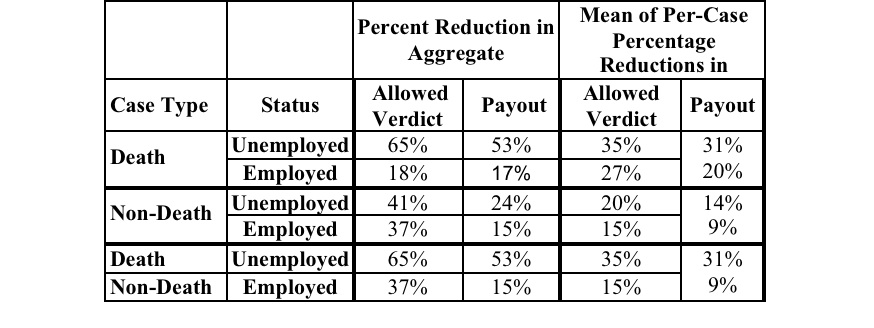
Today, I want to focus on cap design. But first, one clarification from yesterday. Of course, we should expect caps on non-economic damages to hit those with large non-economic damages harder. How much harder is a different question – particularly when past studies that have addressed that issue have used verdicts (and not payouts) to study that point. The problem with using verdicts is that even without a damages cap, defendants in our dataset don't pay what juries award. So, using verdicts instead of payouts gives you a inflated/misleading answer about the effect of the cap (both in the aggregate, and on specific plaintiff categories). That's why the aggregate figures for cap effect (37% reduction in verdict dollars v. 27% reduction in payout dollars on a far-smaller base) look the way they do. In dollar terms, the damages cap "takes away" $156M in verdict dollars, but only $60M in actual payout dollars.
To make it easier to see that point, I’ve re-done the tables from my last posting, to include the impact on both verdict and payout.
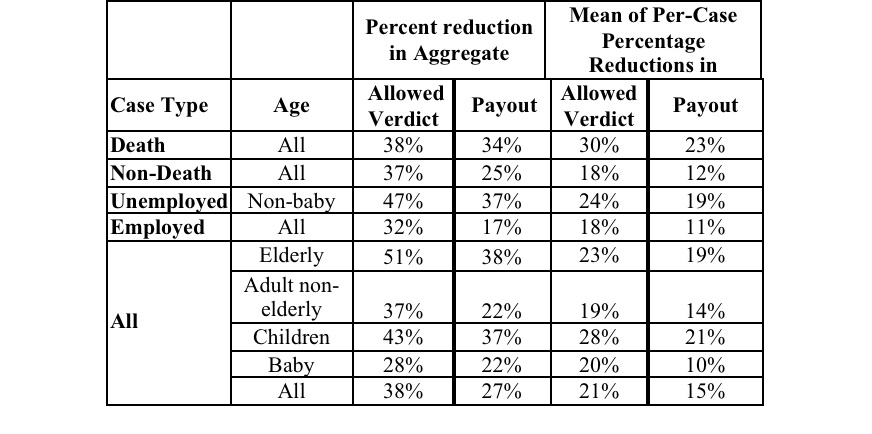

In each instance, the cap has a larger impact – sometimes much larger – on verdicts than on payouts. So, those who are basing their hopes (or fears) regarding the overall impact of a non-econ cap on their perception of what will happen to the largest/most salient verdicts should moderate their expectations.
I'll post later on cap design.
Related Posts (on one page):
- Damage Caps and Medical Malpractice VII
- Damage Caps and Medical Malpractice Litigation: VI
- Damage Caps and Medical Malpractice Litigation: V
- Damage Caps and Medical Malpractice Litigation: IV
- Damage Caps and Medical Malpractice Litigation: III
- Damage Caps and Medical Malpractice Litigation: II
- Damage Caps and Medical Malpractice Litigation
how does this happen? is the plaintiff voluntarily accepting a smaller amount of money than he was awarded? how can the defendant pay less than the award?
1. Litigation: Are there more suits or less suits; are there more settlements? Is the a greater incentive to litigate rather than settle?
2. Patients/plaintiffs: are their medical expenses due to the malpractice (past and future) being covered 100%?
3. Medical Practice: Is there better care due to caps? Are physicians more or less likely to commit malpractice? Is there a lower cost of health care due to less "defensive medicine"?
(My personal observation is that physicians live in greater fear of lawsuits than necessary.)
I think as our economy goes into recession, we will see a large increase in Medical malpractice premium to once again be called a crisis. This is in many way unrelated to lawsuit pay out, but related to lower returns on investment and thus greater pressure from stockholders.
The defendant offers the smaller amount, and the plaintiff can either take it or wait two or three years for the appeals string to run out before getting a dime, I'd imagine.
If I'm right, then uncapping non-economic damage awards would be yet another bait-and-switch social program, sold as a protection for the poor and weak and then feasted on by the comfortably-off.
If you have a comment about spelling, typos, or format errors, please e-mail the poster directly rather than posting a comment.
Comment Policy: We reserve the right to edit or delete comments, and in extreme cases to ban commenters, at our discretion. Comments must be relevant and civil (and, especially, free of name-calling). We think of comment threads like dinner parties at our homes. If you make the party unpleasant for us or for others, we'd rather you went elsewhere. We're happy to see a wide range of viewpoints, but we want all of them to be expressed as politely as possible.
We realize that such a comment policy can never be evenly enforced, because we can't possibly monitor every comment equally well. Hundreds of comments are posted every day here, and we don't read them all. Those we read, we read with different degrees of attention, and in different moods. We try to be fair, but we make no promises.
And remember, it's a big Internet. If you think we were mistaken in removing your post (or, in extreme cases, in removing you) -- or if you prefer a more free-for-all approach -- there are surely plenty of ways you can still get your views out.