Monday Bear Blogging:
I've been in Montana the past several days for a conference and some talks. Over the weekened, my wife and I hit Yellowstone National Park, and got quite a few wildlife photos. One of my favorites -- more for the subject than the picture quality -- is this picture of grizzly bear taken between Madison Junction and Norris.
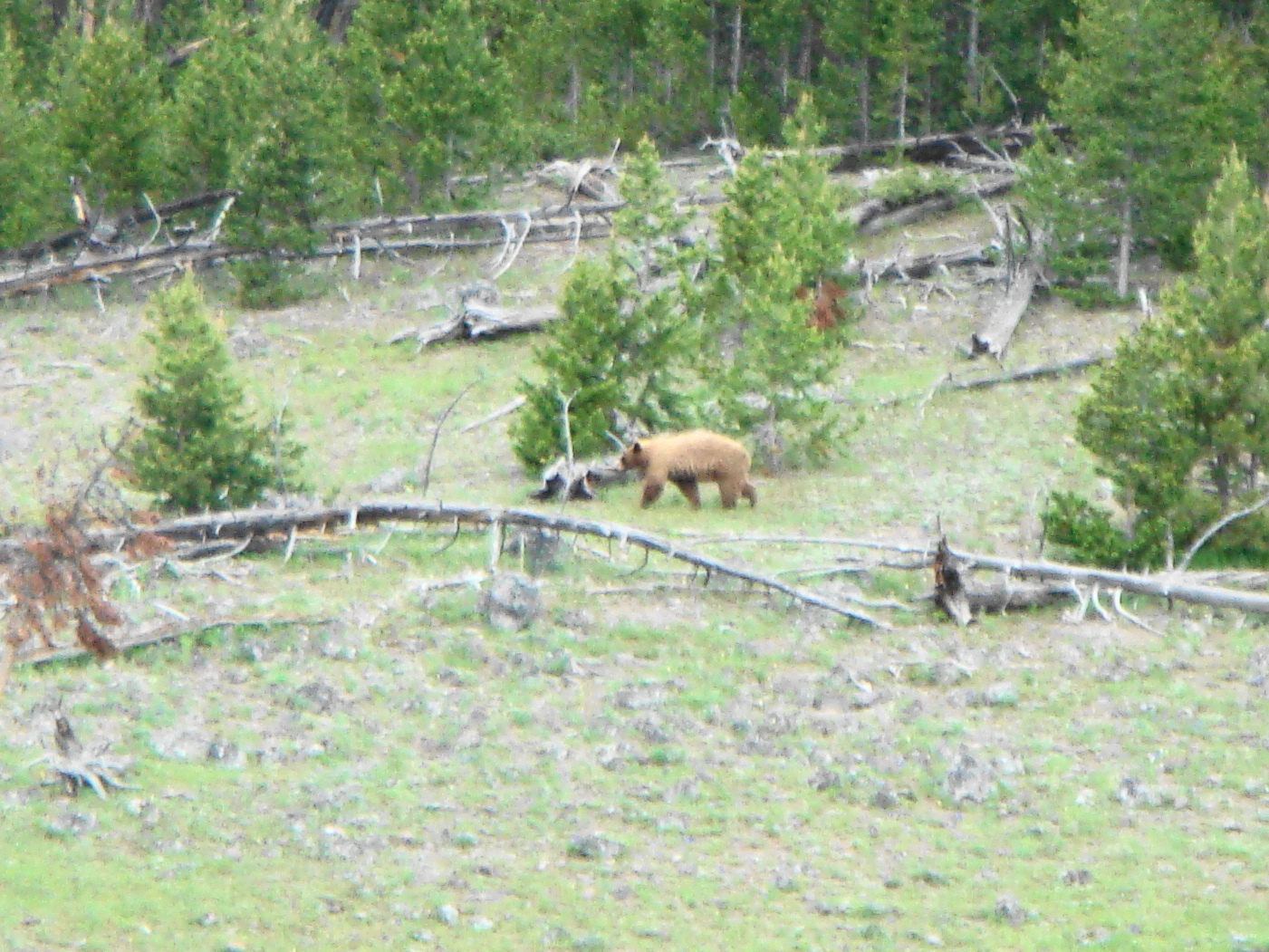
My wife got a picture of a black bear that's much better that I might upload later in the week.
[Note to self: Get a digital camera with a better zoom.]
Related Posts (on one page):
- Monday Sloth Bear Blogging:
- Monday Bear Blogging:
Pretty color on that one.
Good thinking.
Lewis and Clarke's account of their first serious run-in with a grizzly -- "the blonde bear", as they called it -- is a classic.
Take this bear test and you will see what I mean.
http://www.bearinfo.org/id.htm
Not to mention all the annoying post-attack paperwork that would be waiting for you (or your next of kin) to fill out back at the ranger station!
Hilarious!.. This is a quote from the site "Another pinhead" posted. I'd think if any animal starts eating you, it would be time to take some action.
Another vote for a black bear. No hump, and a downturned snout.
Not quite true. It is true that unless you are very good or very lucky and manage to shoot through the eye, only a very powerful weapon is likely to penetrate the rib cage and do serious damage. However, a kill shot is not necessary to defend yourself. Although a grizzly will stand up to threaten you, he will get down on all fours to charge you. You want to aim at the shoulders. Even a .30-.30 shell will typically damage the shoulder badly enough to make it unusable. Once you've hit one shoulder, fire on the other. The bear is now crippled and you should be able to escape or to approach carefully and make a kill shot.
OK, I don't mind shark being so close to me. But it has to be on a plate and well grilled.
OK, so I'm a lousy photographer. But I was taking pictures quickly, through the living room window. :-)
uh, huh... Given a choice between repelling a grizzly attack with a puny little deer rifle like a .30-30 versus a large canister of bear spray, I've heard the experts say it's better to go with the bear spray. At least the bear will pause long enough to wipe its eyes that you can probably make your escape.
I once read a story (must be true, it was on the Internet!) that in the 1950s a single grizzly killed 5 USAF MPs armed with M1 Carbines at a checkpoint outside a base in Alaska, before the bear itself eventually bled out. Admittedly, the .30 Carbine round is a little less powerful than a .30-30, but we're still talking about a round that's got foot/pounds punch roughly halfway between a .357 magnum and a .44 magnum, with either 15 or 30 rounds per magazine available to each MP.
With apologies to regular readers, I encourage bear spray users to test fire it in varied conditions. In my experience, even barely detectable breezes have a dramatic effect on it, and much of grizzly country is fairly prone to wind.
It's a great tool to have in the kitbag, I recommend it highly, and I carry it myself. It just occupies a different part of the bear defense arena than firearms (short range, no wind, little skill required, low threshold for use vs. longer range, weather indifferent, practice required, high threshold for use).
When you're talking dangerous game, bullet design matters more than muzzle energy, IMHO.
Most importantly, when in bear country, walk like a coyote, keep a clean camp, and give bears a wide berth. And to avoid the greatest danger of your trip, be very careful when driving to and from the trailhead :-)
Which entrance did you come in? We came in via the Beartooth highway, which was scary but fun...
Image stabilization might be more important. If you have a clear image you can do a lot by cropping. If you do not have a clear image there is no way to fix it.
Never heard that simile before. Could we get a translation? Don't suppose you actually meant 'egyptian' ?
Of course if you want to be 100 percent sure, you have to *carefully* measure the length of its front claws.
That is not a black bear!
For much of the past century, and perhaps now, coyotes were considered vermin and shot on sight in much of the Rocky Mtn west. The survivors are extremely skittish - if you saw one 300 yds away and even slowed down, they were gone in a flash.
"Walk like a coyote" thus means to have your head up, scanning and alert, and not go into the weary backpacker's head down stupor, to know the wind direction and what it implies about surprising a bear, to watch the upcoming terrain and notice that you're leaving the open meadow for the stream side thickets, etc.
Given how brazen suburban coyotes are getting to be, I suppose I will have to retire the phrase :-).
That should be "some experts", not "the experts". I live in grizzly bear country. The mistake that many people make when carrying a rifle like a .30-.30 is to aim at the chest or head in hope of a kill shot. It is quite correct that you aren't likely to do much damage to a grizzly that way. A .30-.30 shell fired at point blank range into an adult grizzly very likely won't even penetrate the rib cage. But damaging the shoulder enough to stop a charge is a lot easier than making a kill shot. A .30-.30 shell can do a lot of damage to a shoulder. It doesn't have to get through it to something vital - it just has to muck it up enough to make it difficult or painful to walk on that leg.
Bear spray is a good thing to carry, but it doesn't always work, and it isn't effective at much of a distance. The best thing is of course to avoid surprising grizzlies, don't get anywhere near their cubs, kills, or food caches, and avoid attracting them or confronting them. But if you do get into a situation in which a grizzly charges you for real, shooting at the shoulder can be a good idea.
We took one on safari and loved it.
Roger that.
Last time our Scouts did a trip in the Porcupine Mountains of UP Michigan, it was a bad year for bears. Absolutely every party we met had had an encounter with bears.
Our camp drill was to never eat in camp and never camp where anyone had eaten. We would have dinner, walk another 20 minutes, bear bag everything smellable, and hang-cache that another 200 yards down the trail. We never saw a bear. The only way a bear was likely to get us would be to trip over us by accident.
There is no such thing as a small bear when it is in your camp.
I used to live near an RV park in Texas, near some dunes where a pack of coyotes ran. The more foolish snowbirds would put little FiFi the poodle out on a chain sometimes at night. Poor FiFi.
"Little Cameras With Big Eyes" by John Biggs in the NYTimes on Thursday, June 24, 2009.
There are a lot of options, depending on your budget, your photographic expertise, how much stuff you are willing to schlep, how often you do it, und so wieter.
If you are willing to spend $1,000 and carry something that may be a bit bulky, but want absolutely the best pictures, buy an SLR. I helped my friend buy a Nikon D80 with the 70-300 lens before she went on safari to Africa. She was very glad she did.
I hate bulky gadgets and I would go for the smaller Canon SX200 described in the review that weighs less than 8 oz. The SX110, seems to have the same optics and electronics as the 200, but it is a little heavier, $120 cheaper, and uses AA batteries which may be a bug or a feature.
If you want to dialog on this offline. Please e-mail me.
And be vigorous about smellables in the tents. Ban use of deodorant, scented soap, and even scented sunscreen or lip balm. The last bear attack at Philmont Scout Ranch in New Mexico (several years ago), where they generally require rigorous adherence to anti-bear procedures, occurred when a Scout with sunburned lips put on scented lip balm before he crawled into his tent.
If you have a comment about spelling, typos, or format errors, please e-mail the poster directly rather than posting a comment.
Comment Policy: We reserve the right to edit or delete comments, and in extreme cases to ban commenters, at our discretion. Comments must be relevant and civil (and, especially, free of name-calling). We think of comment threads like dinner parties at our homes. If you make the party unpleasant for us or for others, we'd rather you went elsewhere. We're happy to see a wide range of viewpoints, but we want all of them to be expressed as politely as possible.
We realize that such a comment policy can never be evenly enforced, because we can't possibly monitor every comment equally well. Hundreds of comments are posted every day here, and we don't read them all. Those we read, we read with different degrees of attention, and in different moods. We try to be fair, but we make no promises.
And remember, it's a big Internet. If you think we were mistaken in removing your post (or, in extreme cases, in removing you) -- or if you prefer a more free-for-all approach -- there are surely plenty of ways you can still get your views out.