(Update.)  Thanks, Glenn, for the Instalanche!  Let’s add this front page article in the Financial Times today, Tuesday, February 9, 2010, “Traders in Record Bet Against the Euro.”

(You might also want to see my more general discussion in a post above on the directions of the EU regarding the unstable position of currency union without political/fiscal union.  Some people have raised some objections particularly to that post’s closing paragraphs regarding how the Obama administration views Western Europe — essentially losers in the globalized world, and no one worth paying attention to because anything of value that might have been learned from the internal European social democratic model has already been absorbed and priced into Obamism.  But I think it’s right — and I think that is the conclusion that European leaders have been drawing about what, not just Obama, but his senior cadre of intellectuals and elites think about Europe.

That’s quite apart from thinking that the Obama administration has so thoroughly absorbed the European lesson that a massive internal democratic socialist welfare state means geopolitical decline, that Obama is not just a weak leader in foreign policy — personally weak, as Sarkozy clearly thinks — but structurally weak as well, meaning that the foreign policy weakness is built into the structure of domestic policy shifts to a massive social democratic state.  These European leaders know better than anyone on the planet how the shift to their domestic social model implies geopolitical decline.  So they have no doubt as to where Obama is taking the US in foreign affairs.  As I said in the later post, we Atlanticists should have read Aron more recently.)

From the FT:

Traders and hedge funds have bet nearly $8bn (€5.9bn) against the euro, amassing the biggest ever short position in the single currency on fears of a eurozone debt crisis ...  The build-up in net short positions represents more than 40,000 contracts traded against the euro, equivalent to $7.6bn. It suggests investors are losing confidence in the single currency’s ability to withstand any contagion from Greece’s budget problems to other European countries.

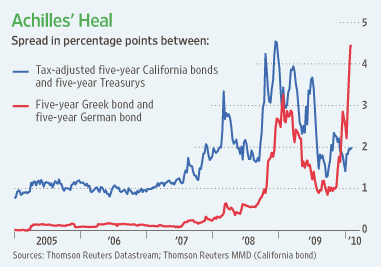
The WSJ’s ‘Heard on the Street’ has an interesting item today comparing California and Greece from the standpoint of the bond markets.  Bottom line is that California fares far better than Greece in investors’ minds.  It’s a question, of course, how much of that is attributable to how investors see the underlying economies of each place and, instead, how investors are pricing the sugar daddi, er, the US government and EU-Eurozone institutions that might be called upon to offer a bailout.  But in terms of spreads, take a look at this chart from the story:
MI-BB326_CALHEA_NS_20100208190824

It is important to bear in mind that these kind of spreads can turn very quickly — indicators of short term sentiment concerning something that is basically a political and so, these days at least, a volatile issue.  These spreads for California could turn tomorrow, depending upon how investors read signals from Washington DC, or several other places.  Thus the WSJ article notes with respect to Greece’s dire situation:

Adoption of the euro, by removing the threat of currency fluctuations, encouraged yield-hungry investors to bid up Greek bonds. Leverage allowed Greece to run big current account deficits, despite low productivity growth. The result, once the credit bubble burst, is today’s crisis. There is no easy European fix.

Greece has two main options to restore competitiveness and narrow its current-account deficit: Withdraw from the euro and devalue, or win large and ongoing transfers from European states with surpluses like Germany.

Leaving the euro looks unpalatable. Bilateral transfers to Greece, even dressed up as loans, would be hard to sell to German voters. And such aid wouldn’t address Greece’s lack of competitiveness. Only grinding domestic deflation, with the risk of social unrest, or withdrawal from the euro could do that.

The imposition of EU “discipline” on Greece in return for transfers would represent creeping political union of an undesirable kind – one forced by Germany for fiscal reasons rather than one negotiated by member states. But Greece’s saving grace may be a default there would likely drag down Spain and Portugal. Such a risk will concentrate minds in Europe to find a solution, even if a bailout would not answer the question of the euro’s suitability for uncompetitive Mediterranean economies.

I’ll take up separately the question of California.  Likewise the question of political economy in the Eurozone — currency union without political or fiscal union?  But the article essentially thinks that California is saved not by a better internal structural economy, but instead because of its place deep in the heart of its guarantor.  California has better political hold-up.  It’s got better positioning to be able to force the US as a whole to internalize its difficulties, in ways (according to the article) that Greece will likely not be able to do with German voters.

One last quote from the FT quoted in the update:

Thomas Stolper, economist at Goldman Sachs, said: “ Behind this intense focus on Greece obviously is the long-standing unresolved issue of how to enforce fiscal discipline in a currency union of sovereign states.”

Categories: California, Finance, Financial Crisis    

    41 Comments

    1. Greek Geek says:

      So is it time to officially have equivalent low expectations from the California political machine as we all do from the Mediterranean? Arguably, we are already there, eh?

      Quote

    2. Federal Farmer says:

      Looks like some arbitragers might have gotten slammed.

      Quote

    3. Randy says:

      How do Greek and California compare? The islands are much better in Greece. Although both have a very laid back atmosphere, the edge goes to Greece where no one ever seems to work. Family is more important than jobs or anything else. The cappucinos are much better in Greece than anyplace in CA, and I suspect it’s because they have better milk and cream.

      Both are quite gay friendly (Mykonos is the hot spot for euro-homos). Woman are more bound by traditions in Greece, so for women, CA is the better place. 

      Greece has much better architecture, at least the old stuff. When it isn’t in ruins.

      Quote

    4. Perseus says:

      Sacramento Bee headline in Jan. 2013:

      “President Palin to California: DROP DEAD” 

      (and it would be deserved)

      Quote

    5. Anon21 says:

      Perseus: President Palin 

      How precious.

      Quote

    6. LarryA says:

      California has better political hold-up. 

      As in they’re better able to commit a holdup?

      Quote

    7. Gideon7 says:

      Until California gets serious about reigning in its runaway spending they won’t get any help from DC.

      It was only after New York City began serious structural reforms that the feds finally decided to bail them out.

      Quote

    8. Walter says:

      I think California has a mix of problems — run away spending and fear of raising taxes on the wealthy. The housing bubble has really hurt Cali & I think the only way out of it’s fiscal hell is to cut spending and raise taxes (a decision that manages to alienate liberals & conservatives & everyone in between).

      –Walter

      Quote

    9. How Do California and Greece Compare? | Liberal Whoppers says:

      [...] posted here: How Do California and Greece Compare? [...]

    10. m says:

      WSJ prints “Achilles’ Heal” for “Achilles’ Heel”?

      Quote

    11. Instapundit » Blog Archive » BUDGET FOLLIES: How do California and Greece compare?… says:

      [...] BUDGET FOLLIES: How do California and Greece compare? [...]

    12. DarkHelmet says:

      I don’t think raising taxes on ‘the wealthy’ in California will work. State tax rates are already very high, and affluent folks are pretty mobile. N.B.: Nevada has no income tax.

      Quote

    13. Robert says:

      Does Greece have a burgeoning class of folks from the neighboring states crossing their border illegally and soaking up social services? No one has mentioned that. Plus the ruling political class– the public service unions have cut themselves a huge chunk of pension funds out of the state revenues...it that also a problem in Greece?

      Greece has suffered environmental devastation, being completely deforested and loosing most of its topsoil in the last 1K years. California in slightly better shape.

      Quote

    14. EconRob says:

      In the USA as a whole the number of Americans out of work and the number of illegal aliens and H-1B visas is pretty much equal. I wonder what it is in California.

      The other solution is to drill for oil and natural gas. There is plenty of black gold under ground and off shore for Californians to live like Norwegians.

      Quote

    15. Cousin Dave says:

      So is California too big to fail? If so, does it need to be subject to strict federal regulation? Just askin’.

      Quote

    16. B Smith says:

      is interest on those bonds tax-free for California residents? I guess not or they would be closer to treasuries...

      Quote

    17. Mark Field says:

      is interest on those bonds tax-free for California residents? I guess not or they would be closer to treasuries...

      You guess wrong.

      Quote

    18. Sandy MacHoots says:

      Randy: Family is more important than jobs or anything else. 

      Really? The average Greek woman has 1.33 children, or fewer than women in any Western European country — fewer even than mainland China and far fewer than in the U.S.

      Quote

    19. TCO says:

      Why can’t Greece default AND keep using the EU currency? Just stiff the creditors. Let Goldman Sachs bring the troops. HA!

      Quote

    20. lgm says:

      The lesson of California is the lesson we’re learning in Washington — supermajority rules are impractical if the minority party has perfect party discipline. 

      We’re getting into Arrow’s theorem territory: any perfect democracy in fact is a dictatorship.

      Quote

    21. G. May says:

      Would giving California to the Chinese suffice as adequate debt servicing?

      Quote

    22. Mr L says:

      The lesson of California is the lesson we’re learning in Washington — supermajority rules are impractical if the minority party has perfect party discipline. 

      Yes, with one of the highest state tax burdens in the country and a budget that’s nearly tripled since 1990 obviously the problem is that those durn dirty Rethuglicans thwarting the demands of imaginary throngs for yet more and higher taxes. Maybe California should consider cutting back on 90% pensions and other goodies instead of further raising the tax burden or closing homeless shelters.

      Quote

    23. DanInAustin says:

      The only surprising thing is that the Euro has lasted as long as it has. Many of the members have never had much (any) fiscal discipline.

      Quote

    24. Russtovich says:

      Thomas Stolper, economist at Goldman Sachs, said: “ Behind this intense focus on Greece obviously is the long-standing unresolved issue of how to enforce fiscal discipline in a currency union of sovereign states.”

      Goldman Sachs? This is a tad ironic considering how Goldman Sachs has helped Greece (for a *cough* small fee) do some creative booking to hide some of their debt from the other EU countries.

      Quote

    25. Mark Field says:

      Yes, with one of the highest state tax burdens in the country and a budget that’s nearly tripled since 1990

      Let’s at least get the facts straight:

      1. CA’s tax burden puts it 18th in the nation relative to income (based on 2005 data). Cite.

      2. It makes no sense to say that the budget has “tripled” unless you account for inflation and population growth. Here is a chart which shows state spending as a percentage of Gross State Product. CA is right in the middle, identical to Nebraska.

      Quote

    26. james says:

      Robert: Does Greece have a burgeoning class of folks from the neighboring states crossing their border illegally and soaking up social services? No one has mentioned that. Plus the ruling political class– the public service unions have cut themselves a huge chunk of pension funds out of the state revenues...it that also a problem in Greece?Greece has suffered environmental devastation, being completely deforested and loosing most of its topsoil in the last 1K years. California in slightly better shape. 

      According to the Greeks, there is a significant influx of poor, illegal Turkish immigrants into Greece. Since the Greeks and the Turks dont like each other this may be nothing, but it is an issue that Greece has raised with the EU.

      Quote

    27. Mark Field says:

      The second point in my 12:32 comment is wrong. Ignore it.

      Quote

    28. Martinned says:

      james: According to the Greeks, there is a significant influx of poor, illegal Turkish immigrants into Greece. Since the Greeks and the Turks dont like each other this may be nothing, but it is an issue that Greece has raised with the EU. 

      Not just Turks, but refugees from all over the Middle East (cough — Iraq — cough), and further away still. Greece is the easiest place to get into the EU (= promised land) these days, just a short boat ride away from Turkey. (Link)

      Quote

    29. Randy says:

      Sandy: ” The average Greek woman has 1.33 children, or fewer than women in any Western European country — fewer even than mainland China and far fewer than in the U.S.”

      I was referring to the amount of time that they spend with family, not how many children they have — two very different issues, in my book. Having known several Greek families here in the US, and having been to Greece, I can certainly verify that Greeks love spending time with their family, both nuclear and extended, far more than the average American.

      One special memory: While watching the gorgeous sunset near the windmills on Mykonos, perched on a cliff, we saw this gorgeous young greek man take his little son by the hand and walked over to the rocks near the water. They spent almost an hour together, doing nothing by watching the sunset, and his kid played on the rocks. When the sun went down, they strolled back to town. The next day, we say father and son, again hand in hand, walking through town, greeting the locals and sitting with friends at the cafe. 

      My friend and I commented that this father probably spent more time with his son in just those two days than most American fathers spend in a whole year. 

      BTW, we after many drinks with some locals, we finally got up the courage to ask, what’s up with all the guys hanging at the cafes. Doesn’t anyone have work here? He took a long drag on his cigarette and said laconically, “in Greece, we work when we have to....”

      Quote

    30. Tom Grey says:

      the long-standing unresolved issue of how to enforce fiscal discipline 

      In fact, the first and primary ‘rule of law’ is enforcement.
      Lawyers and academics tend to forget this; tho bullies on every playground in the world learn it fast.
      Bullies enforce their rules, first, and what they enforce becomes ‘real law’. Until some bigger group or person enforces some other real law; like teachers, or the police.

      Agreements without a credible enforcement mechanism are, perhaps, worse than useless — allowing the cheaters to do the bad behaviour but making the (future) cheated think that the cheating is less likely, or impossible.

      What if many GREEKS in the Greek government are shorting Greece bonds, and planning on continuing to spend until ... who exactly? ... kicks them out?
      What are the enforcement mechanisms in that Growth and Stability Pact again?

      Quote

    31. Mark Field says:

      Ok, here’s a chart which shows how CA spending grew relative to state GDP from 1992–2009. Short answer: spending was roughly 19.5% of GDP in 1992 and is roughly 23% today. Not good, but far from tripling.

      Quote

    32. Martinned says:

      Tom Grey: What are the enforcement mechanisms in that Growth and Stability Pact again? 

      Fines. :-)

      Quote

    33. TCO says:

      Quit screwing up that class of yours. Teach the M and A lawyers M and A law. And the M and A process. You keep wanting to indulge in these remote econ discussions with kids that can’t even read Brealey and Myers.

      Quote

    34. Fat Man says:

      California ... got better positioning to be able to force the US as a whole to internalize its difficulties ...

      Wanna bet? I think I could get 45 states to vote against that.

      Quote

    35. Martinned says:

      Fat Man: Wanna bet? I think I could get 45 states to vote against that. 

      I think the point is that it won’t be up to a vote. What prof. Anderson is talking about is sticking the other states with the bill, thus forcing their hand.

      Quote

    36. Tweets that mention The Volokh Conspiracy » Blog Archive » How Do California and Greece Compare? -- Topsy.com says:

      [...] This post was mentioned on Twitter by Josh Barro, Vasilis Dimos and brianweiner, kicauan. kicauan said: How Do California and Greece Compare? — http://su.pr/6M7RDy [...]

    37. petB says:

      Tom Grey: likely, or impossible.What if many GREEKS in the Greek government are shorting Greece bonds, and planning on continuing to spend until ... who exactly? ... kicks them out?
      What are the enforcement mechanisms in that Growth and Stability Pact again?

      Bond market will kick tem out.

      As a citizen of Eurozone, here is my unqualified opinion: If Greek government will go bust, this will weaken Euro and be basically good news to everybody, even other PIIGS countries — except banks holding Greek obligations.

      However, I do not await this will happen. What is more probable is big EU countries will force Greece to accept IMF loan with IMF conditions. The big guys will provide the funds to IMF, but this will face much less public outcry then lending directly to Greece, and in Greece, the ‘bad guy’ will be IMF, not EU.

      Quote

    38. TCO says:

      I still don’t see why Greece can’t just welsh on their debts. Perhaps that would put them in violation of some EUzone criteria, but there have been violations before that got papered over. Seriously, why can’t the debt-worthiness and the monetary unit used be separated? I mean there are private entities that go bankrupt. Of course, here the counterparties would get stiffed and assets would not be sold, but so what. That’s a risk people take, lending to states.

      Quote

    39. TCO says:

      Something about the settings for comments for the M&A thread makes it impossible for us to leave comments.

      Quote

    40. What is our National Debt Limit? « Wacki’s blog says:

      [...] reading: Volokh, How Do California and Greece Compare?, Kenneth Anderson , February 8, 2010 10:25 [...]

    41. blue monkey says:

      Greece and Spain won’t pay back. This was a calculated Risk, and a Lesson for the Banking System. What is happening in Greece, is a very well orchestrated show, to get granted €110bn aid, to avert meltdown. A new deception compared with the old Trojan Horse. The only thing Germans can do is:
      REPOSSESS 170 Leopard 2AEX Battle Tanks from Greece, and 190 Leopard 2A6E Battle Tanks from Spain.
      U.S.A must REPOSSESS 170 F-16 Jet Fighters from Greece, … the rest is gone with the wind …forever …
      Greece must stop paying lucrative pensions with borrowed money, reform the free health care system, and cut down, 4 times the military budged.
      Greece’s problem is too much debt. Greece has a budget deficit of 12.7% of GDP – meaning that the country is spending 12.7% more than the value of one year’s economic output.
      Greece is no different to a serial credit card borrower who can’t pay back his loans. But just like a serial credit card borrower, as long as Greece keeps relying on borrowed money to fund itself, the problem won’t go away. It will just get worse.
      http://www.defenseindustrydaily.com/Greece-in-Default-on-U-214-Submarine-Order-05801/
      But don’t worry; the ECB, the Fed or both will print the money.
      And all of us will share the pain, with our hard-earned money.
      Bad is never good until worse happens.

      Quote

    Leave a Reply