In Madness and Civilization, Michel Foucault documented a remarkable continuity of confinement through different stages of Western European history, from the lazar houses for lepers on the outskirts of Medieval cities, to the Ships of Fools navigating down rivers of Renaissance Europe, to the establishment in the seventeenth century of the Hôpital Général in Paris — an enormous house of confinement for the poor, the unemployed, the homeless, the vagabond, the criminal, and the insane.
“Leprosy disappeared,” Foucault writes, “the leper vanished, or almost, from memory; these structures remained. Often, in these same places, the formulas of exclusion would be repeated, strangely similar two or three centuries later. Poor vagabonds, criminals, and “deranged minds” would take the part played by the leper . . . . With an altogether new meaning and in a very different culture, the forms would remain—essentially that major form of a rigorous division which is social exclusion but spiritual reintegration.”
Social exclusion unites the asylum and the prison. The question that I ask in my research is whether we should think of the two populations as somehow linked. Is it possible that today’s category of the “criminally deviant” is tied to yesterday’s category of the “mentally defective”? In our social research, should we think of the two populations as a whole, rather than as two separate parts?
I am by no means suggesting that the same people have been moved from one institution (the asylum) to another (the prison). That is far too simplistic – for at least three important reasons.
Mental Illness: First, although the rate of mental illness among prison inmates is probably higher than among the general population and although the problems surrounding mental illness in jails and prisons have reached crisis proportions, it’s not the case that our prisons today are overwhelmingly housing persons with mental illness. For one thing, the war on drugs has taken an enormous toll on African-American communities, and has contributed to an unconscionable increase in black male incarceration that has nothing to do with mental illness. Bruce Western at Princeton documents this better than anyone in his new book, Punishment and Inequality in America.
Estimates of the number of mentally ill inmates vary. According to a 1999 report by the DOJ, about 283,800 inmates in prisons and jails suffered from mental illness at the time – which represented about 16% of jail and state prison inmates. A more recent 2006 DOJ study reported that 56% of inmates in state prisons and 64% of jail inmates across the country reported mental health problems within the past year. Steven Raphael at Berkeley has a fascinating paper and he finds that deinstitutionalization from 1971 to 1996 resulted in between 48,000 and 148,000 additional state prisoners in 1996, which according to him, accounted “for roughly 28 to 86 percent of prison inmates suffering from mental illness.”
A new paper by Steven Erickson and his colleagues reviews the literature on prison mental illness and shows that the estimates for mental illnesses, broadly defined, range from 16% to 90% and for severe mental illness from 6.4% to 39%. “These rates,” they suggest, “are well above those found in the general population of approximately 30% for mental illness and 6% for severe mental illness.” The paper is extremely skeptical of these estimates and casts doubt on the surveys based on methodological shortcomings.
For sure, it is exceptionally difficult to compare mental hospital residents of the 1950s to prison populations of the 1990s because the definitions, diagnoses, and medical routines have changed so much. Remember, the whole infrastructure of our mental health system has collapsed – making it unrealistic to measure the key attribute of “prior mental health contacts.” Moreover, drug use and psychotropic medications have changed enormously. But despite all that, the two populations must differ along somewhat-objective criteria of mental illness.
Race, Sex and Age: Second, the demographics of the two populations are different, as I discuss here in the Texas Law Review at pages 1781-1784. The prison population today is, overall, younger, much more male, and more African-American than the mental hospital populations at mid-century. In 1966, for example, there were 560,548 first-time admissions to mental hospitals, of which 310,810 (55.4%) were male and 249,738 (or 44.6%) were female. In contrast, new admittees to state and federal prison were consistently 95% male throughout the twentieth century. In 1978, African Americans represented 44% of newly admitted inmates in state prisons. That same year, minorities represented 31.7% of newly admitted patients in mental hospitals.
(But note that those populations were also changing internally. Henry Steadman and John Monahan report in a 1984 study that, in their sample, “the mean age at hospital admission decreased from 39.1 in 1968 to 33.3 by 1978. The percentage of whites among admitted patients also decreased, from 81.7% in 1968 to 68.3% in 1978.” There was a similar shift in the prison admissions data: “the mean age of prison admittees was 29.0 in 1968 and 28.1 in 1978" and the percentage of whites among prison admittees decreased from "from 57.6% in 1968 to 52.3% in 1978").
The War on Drugs: Third, a large portion of our current prison population consists of non-violent drug offenders. The war on drugs has helped fill our prison populations, especially our federal prisons. The following graph, from a forthcoming book with Frank Zimring at Berkeley on the Criminal Law and Regulation of Vice, traces the total sentenced population of the federal prison system and the number of federal prisoners for whom the most serious offense was a drug offense:
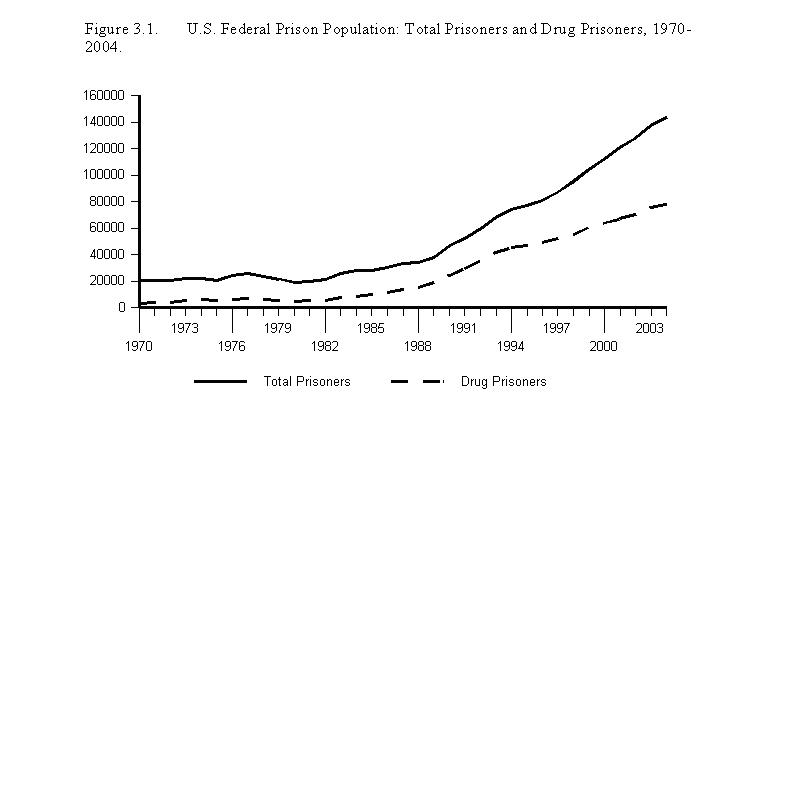
As I noted before, drug use may intersect in complicated ways with mental health issues, and some users may well be self-medicating. But the numbers associated with the war on drugs clearly transcend these possible connections.
As a result, the story is not simple trans-institutionalization. It is not simply substitution from one institution to another. But that does not mean that the populations are not sufficiently connected or similar in more important ways to be thought of as one – or counted as one. Could it be that we use the categories to socially exclude people we perceive as marginal, disorderly, abnormal? Do we use the categories to sift out those who offend our sensibilities and who we perceive as dangerous? Michel Foucault observed in Madness and Civilization that “There must have formed, silently and doubtless over the course of many years, a social sensibility, common to European culture, . . . that suddenly isolated the category destined to populate the places of confinement. To inhabit the reaches long since abandoned by the lepers, they chose a group that to our eyes is strangely mixed and confused. But what is for us merely an undifferentiated sensibility must have been, for those living in the classical age, a clearly articulated perception.”
Today, the categories of “mental illness” and “criminal deviance” seem very distinct. With the exception of those inmates who are diagnosed as suffering from mental illness, it seems wrong or confused to lump together the insane and the criminal, to mix the two categories. But is it? Will later generations question our own inability to see the continuity of social exclusion and confinement?
One place where the categories seem to be melding together is in the prediction instruments that we use to identify future dangerousness. We are now profiling the criminally dangerous, the mentally instable, and future sexual offenders in very similar ways. I trace the history of our profiling instruments in a new book, Against Prediction: Profiling, Policing, and Punishing in an Actuarial Age.
We’ve seen a rash of new actuarial instruments intended to predict future violent behavior. In terms of sexual violence, these include the Static-99, the Violence Risk Appraisal Guide (VRAG), the Hare Psychopathy Checklist-Revised (PCL-R), the Minnesota Sex Offender Screening Tool (MnSOST-R), the Sex Offender Risk Appraisal Guide (SORAG), the Sexual Violence Risk-20 (SVR-20) and the HCR-20 — as well as, for the very first time, released in 2005, violence risk-assessment software, called the Classification of Violence Risk (COVR).
How accurate are these prediction instruments and how will they affect the profiled populations? John Monahan, a leading authority on prediction instruments, a proponent of these instruments (in fact co-author of the new COVR software), and the director of the MacArthur Violence Risk Assessment project, offers a nuanced assessment. Writing in The Observer, Monahan asks: “How good are psychiatrists and psychologists at distinguishing which people with a mental illness will be violent? Research shows professionals are better than pure chance, but not much. Predicting harmful behaviour is like predicting bad weather. An inaccurate prediction doesn't necessarily mean the clinician or the meteorologist has 'missed something'; it may just mean the science of forecasting has a long way to go.”
Not much better than pure chance. Virginia just adopted a Sexually Violent Predators Act (“SVPA”) in April 2003 that provides for the civil commitment of sex offenders identified based on the Rapid Risk Assessment for Sex Offense Recidivism (RRASOR) – an actuarial instrument. The RRASOR consists of four items (prior sexual offenses, age at release, victim gender, and relationship to victim) and scores as a sum these four items. A score of 4 or more on the RRASOR (the higher scores) is associated with a 5-year sex offense recidivism rate of 37% and a 10-year sex offense recidivism rate of 55%.
Fifty-five percent — and remember, these are persons who have previously been convicted (rightly or wrongly) of a sexually violent offense. That leaves almost half the relevant population misidentified, at least for that 10-year span. Accuracy and inaccuracy may be in the eye of the beholder. (I discuss the reliability of other actuarial instruments in Against Prediction, reviewing studies like these here and here). The question is, how will these new actuarial methods and predictions of future dangerousness shape the people in our total institutions?
UPDATE MAY 4, 2007: John Monahan tells me that Virginia last year changed it's Sexually Violent Predators statute to require not the RRASOR but the Static-99. The Static-99 has slightly different cut-off scores depending on the age of the victim.
Related Posts (on one page):
- Carceral Notebooks, Volume 2: Exploring the Carceral Zone with Nussbaum, Sunstein, Stone, Leitzel, McAdams, and Others.
- Concluding Thoughts on Total Institutions: Future Directions and Critical Reflections.
- Asylums and Prisons: Race, Sex, Age, and Profiling Future Dangerousness.
- Institutionalization vs. Imprisonment: Are There Massive Implications for Existing Research?
- Mental Hospital, Prison, and Homicide Rates: Some More Analyses.
- Mental Hospitalization and Prison Rates in Western Europe:
- On Mental Health Commitments and the Virginia Tech Shooting:
- Bernard Harcourt Guest-Blogging:
And exactly what experience would that be? Listening to rap and watching Law and Order? The sheer ignorance of this statement is astounding.
I'm not so sure about that. I'd need to see some data. My experience as a criminal defense attorney made me wonder if it's not man's normal state to go around selling drugs, stealing cars, and committing armed robbery. How exactly do you define mentally ill, among a bunch of people who are generally willing to risk imprisonment for a short high, for not-much-money (as in the drug trade), or who are willing to kill, maim, or rape to get their way?
Isn't this the basic definition of what a prison is? A place where you are locked up and excluded from participating in society?
I worked as the pardon attorney for our last governor here (Louisiana, which has, tragically, one of the highest incarceration rates in the country), as well as serving as a point man on a variety of penal reform projects, and I saw a LOT of individual files of particular inmates. Most of the people in prison here BELONG in prison, at least for some period of time. The charges which resulted in the current stint of incarceration often do not reflect the totality of the person's criminal activity. A guy might get 30 years for a drug charge, putting him on the "non-violent drug offender" list... but what that list doesn't reflect is the 3 prior convictions he had, maybe 1 or 2 for some violence, or a burglary or an assault, for which he was given probation (the first offense) and short stints in the local jail.
Drug offenses are relatively easy convictions. They don't require much in the way of cooperation and testimony from local neighbors, who might be terrified of cooperating with police by pointing out the individual as the guy driving the car when that rival drug dealer was shot last week. So there are plenty of times when, as with Al Capone, the prosecutors decide to go with the easy conviction, even if it's not reflective of all of the criminal's bad acts.
I'm sorry, but I don't put much stock in those "non-violent drug offenders" graphs unless the researcher breaks it down into a WHOLE lot more detail, that looks at all the past bad actions by those criminals.
...who, we are to suppose, are innocent of wrongdoing? That seems a bit hasty, especially if recidivism rate is wholly or in large part a measure of those caught and convicted of subsequent offenses. If only about 40% of rapes are reported, and only a fraction of those result in apprehension and conviction of the rapist, do the math. 55% is a HUGE number of confirmed repeat offenders given what is implied about undetected repeaters. Sloppy reasoning in the article.
Prisons, asylums, poor houses, sanitariums etc all look like very similar institutions because they have rather similar missions and form follows function. That doesn't mean, however, that the same motive drives the society of different eras to create each institution.
Foucault et al lacked any kind of multicultural, historical perspective. For example, the Chinese arrived at pretty much the same solutions to the problems of criminality, mental illness and medical quarantine as did their Western contemporaries. To me, that strongly suggest that our confinement institutions evolve to meet real needs and not out of defects in any particular culture's philosophical outlook.
All human cultures make a sharp distinction between the criminal (those who do not conform due to selfishness) and the insane (those who cannot chose to conform). All major civilizations have sought to segregate the two.
Despite the imprecision and highly subjective nature of mental health diagnoses I remain highly skeptical that any significant over lap exist between the mentally ill and the criminal.
For example: a drug dealer decides to stop a competitor by having him murdered. We can be all horrified by it, but there's nothing insane about it. Mr. X decides that he can increase his profits by $2000 a day if Mr. Y isn't driving down the price of crack in the neighborhood. There's some risk to Mr. X of retaliation or prosecution, but the risk isn't huge, and the benefit is well worth the small risk.
The notion that certain things sane people don't do simply reflects your thorough absorption of very middle class values. (On many college campuses, there would be all sorts of things said about how messed up you are for that.) There are subcultures in America where murder, rape, robbery, aren't things that you would want done to you, but if they happen to someone outside your social circle, that's just too bad. Quite a number of primitive cultures have a notion that "murder" is wrong--but if you kill someone outside your tribe, that's not murder, because they aren't part of your social compact.
At one point, everyone in it was informed they'd have to move out in 60 days. My mother asked why, and it turned out that the current fad was to fund such facilities for alcoholics rather than mental cases, and since that's where the grant money was, it was going to become a halfway house for alcoholics.
As she pointed out to them, the uncle at least had her to watch out for him and in this case find him a new place. What was going to happen to any patients that didn't have living family? How were they going to find a new facility? Not their problem.
Isn't that, plus his death from AIDS, the reason that he has been canonized by the academy?
Huh? How many paranoid schizophrenics have to murder people because of their delusions before you see a connection? Joshua Rudiger, diagnosed as schizophrenic at age 4, attacks a former friend with bow and arrow, gets sentenced to a halfway house. He never shows up. Instead, he starts roaming the streets, slitting the throats of homeless people, killing at least one. When arrested, he tells the police that they can't do anything to him, because he is a 2600 year old vampire.
Russell Eugene Weston, Jr., long history of mental illness problems. He kills two Capitol police officers trying to get to the "ruby satellite" that reverses time so that he stop the cannibals who are running America. (Okay, he sounds a little like have the Kossacks and Democratic Underground commenters, but they don't shoot cops in front of witnesses.)
Richard Baumhammers, immigration attorney spirals down into paranoid schizophrenia, goes on a shooting rampage, murdering five people because they were minorities.
Buford Furrow, wife talks him into going to a mental hospital in Washington State because of his rage and dangerous fantasies. Part way through admitting himself, he pulls a knife. In court, he tells the judge about his fantasies of mass murder. The judge refuses to involuntarily commit him. He then buys an Uzi, and drives to Los Angeles to shoot up a Jewish community center and murder an Asian-American mail carrier.
Laurie Dann: over a two year period, she sinks into an uncertain but clearly mentally ill state. The day that she is supposed to be indicted on federal charges for harrassing and threatening phone calls, she provides poisoned baked goods to two fraternities, and goes on a shooting rampage at an elementary school.
Virginia Tech.
Kansas City shooting spree last weekend. The killer was hospitalized for being suicidal in October. For six hours. That was useful.
My brother. He never killed anyone, but I've seen him attack complete strangers because he was hearing these peoples say things that no one else could hear. I don't know how many times he has been arrested, and as is usually the case, not held for long. You have to pretty much kill someone to get involuntarily committed for any length of time.
I could go on and on and on. And you don't think there's much of an overlap?
For most such people, their new living facility will fluctuate between a park bench and a homeless shelter, until they die of malnutrition, exposure, or pneumonia. A very small number may become a local or national headline because they decide to kill all the Martians that see around them.
covers 8 studies that are published..andc 2 that are not (including the DOJ study he mentions here)
(the conclusion is that he is wrong about there being a epidemic of mental illness in the prision system)
http://papers.ssrn.com/sol3/papers.cfm?abstract_id=982986
So this is just to highlight how easily the mental health system can be used as a tool for abuse and the violation of civil and human rights. Granted, this case is a lot more unusual than the usual fraud cases - relatives or spouses trying to steal money, gain the upper hand in litigation, ruin the target's life, etc. but it is certainly striking. No due process, no defense - just one person easily and near-undetectably destroying the life of another.
Regardless of the amount of horror stories that are bandied about, I don't think it should be made any easier to violate someone's human, civil, and Constitutional rights. (Which reminds me the Supreme Court decisions in this area are a joke. If memory serves a "right to treatment" has been found to exist. So if you are being abused via the mental health system the remedy is - a "right to treatment" which specifies more of the exact same abuse. It's like saying the remedy for false imprisonment is - more false imprisonment.)
Limit it to Psychotic and Delusional Disorders and the dispute becomes interesting. Most "insiders" seem to have a subjective sense that there is a significant overlap (or it is my subjective sense that most do). The literature seems to be inconclusive.
And why do people with unquestionable brain illness, like a brain tumor, not have high rates of criminality? And why does mental illness "cause" you to murder, but not to, say, donate your money to Save the Children?
Sometimes it does. But those cases don't make the headlines.
That one hit close to home, both literally and figuratively. My wife worked at the Chatsworth post office where Joseph Ileto was shot, merely as a target of opportunity. (Very nice guy, by the way. It's a damn shame that Brad Sherman and the rest of the local politicos decided to turn his funeral into a forum for their career advancement.) The drummer of our church band had his daughter in the Jewish community center.
The center was not Furrow's original target. Before he shot up a bunch of five-year-olds, he planned to attack the Museum of Tolerance, but alas, the security was too tight.
Don't even get me started on "gun free zones".
I agree that involuntary commitment has not only real potential for abuse, but a history of it as well. The procedures were informal (to say the least) until the 1840s, when a few highly publicized (and apparently quite atypical) cases received significant attention.
Involuntary commitment also has a long history of helping people who were mentally ill, and of providing protection to the society from those mentally ill persons who were violent. I'm not quite sure how to draw the line correctly on this, but I'm afraid the pendulum swing from 1955 to 1995 was a bit too far, and a bit of a swing back is in order.
There are all sorts of physical illnesses that don't kill you--chronic and annoying conditions that impair the quality of life. Let me introduce you to my chronic vasomotor rhinitis.
People don't die directly of depression, but they do commit suicide.
It rather depends what part of the brain has the tumor, I suppose. Charles Whitman had been seeing a psychiatrist for more than a year, without much luck on resolving his emotional problems. After his little shooting spree from the tower at the University of Texas, they found a pretty sizeable brain tumor at autopsy.
And yes, mental illness causes some people to become killers, and some people to be harmless kooks. This doesn't mean that the problem isn't real. You obviously haven't spent much time learning about the very real problems of mental illness, or you wouldn't make such dumb remarks.
This is the hazard of relaxing the commitment rules too much. The Soviet Union shared your view, and regularly hospitalized people for not believing in socialism.
I side with the founding fathers on this, better to err on the side of freedom. Especially with something so subjective, arbitrary, and easily abused.
Clayton E. Cramer:
George wrote:
(the conclusion is that he is wrong about there being a epidemic of mental illness in the prision system)
http://papers.ssrn.com/sol3/papers.cfm?abstract_id=982986
My reading of the paper is that it argues that the high rates of mental illness being thrown about are questionable in their methodology, and that the rates of severe mental illness (as distinguished from substance abuse and depression), while perhaps somewhat higher than the general population, are not as dramatic as the 64% number that one study found. I think that a more accurate description is that the authors don't consider the evidence persuasive for extraordinarily high rates of severe mental illness.
equivalent to expressing a view that it is not as rampant.
the study repeatedly criticizes advocates who tote extraordinarily high rates in prisions that are way higher than those in the general population.
my description is but a perhaps a slight exaggeration...but its an understatement to describe the paper as just saying that there are a few methodological problems and the rate is not 64%
speaking of exaggerations
...so is this guys 3 or four posts on the subject...completely ignoring the idea of correlation and causation...and any other causes of the VA tech shooting.
How many paranoid schizophrenics have to murder people because of their delusions before you see a connection?
At least a magnitude of order higher than the rate today. Dramatic anecdotes do not statistical significance make. The mentally ill do commit crimes but not at the rates necessary to make a dent in the murder rate.(<2%) If all, the murders committed by the mentally ill stopped tomorrow, we wouldn't even notice the fact in our statistics.
The greatest predictor for person both committing murder or being murder is conviction for a felony crime because the vast majority of murders are committed by feuding criminals. Non-crime related interpersonal quarrels account for most of the rest. The vast majority of murders are quite capable of conforming their behavior if they chose to. Most people commit murder to fulfill an immediate selfish desire not because they think their neighbor is a pod person.
As far as the mental illness rates in prison go, I would be highly skeptical. I'm not saying there aren't crazy people in prison, but the symptom sets used in mental illness diagnosis are so vague and open-ended that if you sit someone in front of a mental health professional nine times out of ten they can find something wrong with them. (Incidentally, this is why the proposed initiatives to do mental health screening on every single kid in school in this country are a nightmare. You can see the mental health industry and the pharmaceutical industry getting their pick-axes and lighted miner's helmets ready, because they're going mining for patients in a big way.)
The founding fathers set up all these hurdles to protect our freedom - habeas corpus, right to counsel, adversary process, public trial, etc, etc, etc... To say that you're going to set up an alternate system and replace all those important things with one guy in a white coat is ill-advised. To go even further and say that you want to make it even easier for that one guy to act unilaterally seems downright foolish.