The blog post on which I relied for a copy of the icon appears to have been incorrect. The correct photo, according to AP and Yahoo! News Photos, is this:
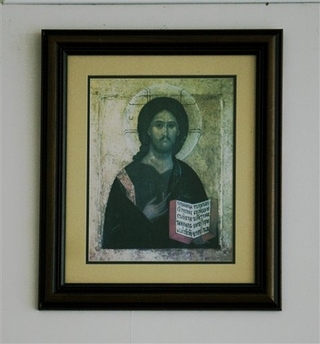
![]()
I can't read the text, but this site, which discusses what appears to be this icon, independently of the Slidell controversy, reports that the text corresponds to John 7:24 ("Judge not according to the appearance, but judge with righteous judgement") and Matthew 7:2 ("For with what judgement you judge, you shall be judged"). This is indeed more courthouse-related text than what I understood the quote to be earlier. [UPDATE: The ACLU of Louisiana was kind enough to send me a more readable version, and Sasha, who knows how to read Old Church Slavonic -- which differs enough from standard, even pre-1918 standard, Cyrillic Russian that it requires special skill in reading -- was kind enough to transliterate it into Russian. With this, he and I can confirm that the text is a combination of John 7:24 and Matthew 7:2.]
Still, the bottom line seems to me to remain: To the extent the text matters, it's New Testament text; to the extent the text should be ignored, since the overwhelming majority of observers won't understand it, it's apparently a depiction of Jesus. In either case, it seems unconstitutional even under Justice Scalia's proposed test for a court to display the work in this context, as a standalone work in a court house with the caption "To know peace, obey these laws."
UPDATE: Thanks to commenter Paul Lukasiak for a pointer to the picture as it appears in context:
Related Posts (on one page):
- ACLU of Louisiana:
- Correction Regarding the Courthouse Russian Jesus Icon:
That goes to wm13's comment, too:
But "With God, all things are possible" is a New Testament text, and it was upheld as the motto of Ohio.
The motto isn't on a sign around Jesus's neck, is it? I suspect there's a second material difference, in that you can't transact legal business in this parish without seeing the government's acknowledgment for the religious establishment this icon represents. I imagine that one could live his whole life in Ohio without knowing what the motto of the state is.
Heck, that's pretty much the same as MLK's 'content of charachter' speech.
Maybe the ACLU should file suit against civil rights do-gooders.
This photograph provide a good sense of the context in which the painting in question is displayed. When viewed within its context, to me it looks pretty much like an endorsement of Christianity.
Funny, the Constitution says nothing about a prohibition on "promoting" religion. It only says that there's a prohibition on writing a law to establish a religion. Hanging a picture with Jesus on it, even with a halo (the horror!) does not establish a religion. Is the Governor of Louisiana the head of the Louisiana-Church of the Courthouse Picture of Christ with a Halo?
"Help! I'm being oppressed"
The icon in Slidell has an areligious message summarized, "Judge fairly" For that matter, the scales of justice are 'religious' as is almost all the Greek-inspired early American symbolism.
Seems to me that there's a vast difference between what the Constitution provided and the secularism being attempted here.
The question of understanding is an interesting one -- what if the picture was of the ohm (a Hindi Sacred Symbol, with many levels of meaning) which very few people can understand and many people just see as a design at Indian restaurants? Just how understood does an object need to be to be a problem?
As an absurd aside: what if an elected judge had this icon tattooed on his/her face? Would they be violating the EOR clause?
Say if all the folks filing into the courthouse got to walk unde a picture of Shiva or something.
Ten Years (which IIRC is the age of the building)
(I also read in a comments thread somewhere that a judge picked it up at a garage sale to decorate the new courthouse...However, I have no idea if that is reliable information or not.)
I have. I prefer the Constitution, myself.
tbaugh and Redman have the right approach.
Personally, I think the best way to resolve the issue is to look what the ratifiers of the Bill of Rights said and what they did. Was religious iconography in federal courthouses viewed as being prohibited shortly after the Bill of Rights was approved? Was religious iconography viewed as being prohibited in state and local courthouses when the 14th Amendment was passed?
I think the answer is no. The "separation of church and state" line of juriprudence is a 20th Century invention which conflicts with earlier practice (including the practice of Thomas Jefferson, who coined the phrase). Accordingly, I don't believe the Establishment Clause contemplated the expansive "nothing involving faith or religion whatsoever" test that liberals want to apply.
Bingo. We have a winner.
Greek actualy. The fingers are shaped to create an ICXC (EE-sus HRI-stos).
I: Straight index finger
C: bent middle finger
X: Ring finger and thumb crossed
C: bent little finger
This whole thing demonstrates some excellent aesthetic tastes (though I suppose I'm a little miffed about a religious object being used as art) and really poor legal and political tastes.
I've always taken the view that I want no government in my religion because they'll screw it up like they do everything else.
Yes, that might be a little difficult to get around.
Hmmm... (1) condemn the obvious as an "overly-simplistic reading of the facts," (2) insert ten pages of convoluted and barely comprehensible argument that it is otherwise, and (3) hope the judge rules on standing and never gets to the merits.
Let's see. "To know peace, obey these laws" with the blatantly implied "see above" referring to Jesus holding a bible open. That is just pretty damn obviously a religious statement, and specifically an exclusionary Christian one. I don't see how much more obvious it can get unless you put up a Decalogue that says "I'm the Lord thy God. You shall have no other gods before me..."
1) The last century or so of precedent pretty solidly directs the Establishment Clause in the direction of showing preference for religion. In order to overrule these precedents, you'll need a lot of help, and you won't find it on the current court.
2) Any argument that the Establishment Clause doesn't apply to the states is pretty solidly grounded in the incorporation doctrine. Only Justice Thomas wants to change that - and I doubt he'll get four more votes in the future.
3) It doesn't matter if Thomas Jefferson coined the phrase, the fact is that it's not only what HE thought, but also what everyone who adopted it thought. This is why Justice Scalia constantly says that it's dangerous to look at legislative intent, because we have no idea who to look at. If someone proposes a bill, thinks it means one thing, but everyone else thinks it means something else, does he/she have the right to dictate what it means?
This is pretty clearly an Establishment Clause violation. A portrait of Jesus in a public location seems more obviously religious than many displays struck down in the past.
If the state wanted to make a non religious statement they'd have put a state seal or other secular image above the "obey these laws" text, but instead they put Jesus there. The message is clear and unambiguous to anyone who is honestly arguing the issue.
1) True, but the precedent is mistaken.
2) I agree that the 14th Amendment intended incorporation of the 1st Amendment. It doesn't change my point of view regarding the Establishment Clause.
3) The phrase is misleading. Even Jefferson didn't believe in complete neutrality between religion and irreligion, or in preventing nativity scenes, religious iconography, etc., from being displayed on public property with very limited exceptions. The best evidence shows that the founders and the ratifiers in the states believed that the Establishment Clause was designed to prevent 1) the creation of a national religion, and 2) laws that would discriminate against various religious sects. They had no problem with displays of the ten commandments and so forth in public buildings. Even today, you have a Congressional chaplain, and in the early days of the republic you actually had mass in the capitol.
I really want to know, from the Christians that support this sort of thing, why stuff like this is so important to them.
Why is it that the GOVERNMENT has be specially marked up to endorse your beliefs and only your beliefs? Why is that a role of government at all? Are you really too lazy as believers that you need government assistance to remember your own beliefs and teachings? Or is this more just a matter of marking territory, like a dog peeing on a fence? Seriously, I want to know.
Actually, its' only the last 45 years or so. This stuff pretty much came out of nowhere in the 1960s. Before that, the establishment clause, on the rare occasions when it came up, was thought to address government aid to religious organizations, not government speech that explicitly or implicitly endorsed one religious viewpoint over another.
None of this bothers me but I always thought that if it were a Christian theme the ACLU would scream.
Although you may be right, the point is that this precedent has become entrenched. Justice Thomas would be the only one willing to overturn the entire line, while the other more conservative Justices would go along with it.
As for the remnants of the days where government and religion were more connected, Justice Breyer has stated that he allows those things as something along the lines of purely historical and ceremonial acts and remnants.
Whatever your personal feelings are, it seems a 100% guarantee that this would be struck down as a violation as soon as it gets to court.
The founders weren't gods or prophets; there's no reason to treat them as such.
Well, it's about 60 years since Everson, which applied it to the states, so sure, you're more on than I am. It has been refined since then, true. When even non-denominational benedictions at graduations are Establishment Clause violations, though, it seems absurd to think this wouldn't be struck down similarly.
For better or worse, people want public affirmation. Many people don't think that they should have to wear two faces, a public one that is always secular, asexual, impersonal etc. and a private one that is religious, intimate etc.
Thanks for the correction. It's a beautiful piece, isn't it? I can't believe someone bought it at a garage sale.
Because the fairest way to deal with endorsement problems is to make some space into a truly public forum where all expression is welcome, and not just some government-favored one.
"Why do many gays want the state to valorize their relationships with civil marriage?"
So that their families are treated equally under the law instead of given second-class.
"Why don't those groups just confine their religion and their intimate life to private circles?"
You aren't making any sense. We're talking here about things the GOVERNMENT does, not individuals do. Why do people seem so hellbent on confusing the two?
"For better or worse, people want public affirmation. Many people don't think that they should have to wear two faces, a public one that is always secular, asexual, impersonal etc. and a private one that is religious, intimate etc."
I'm not sure who is asking them to: what does a picture on a wall have to do with that? Again, I think you are playing into the basic confusion between "government" and "public."
Well, I was going with the Establishment Clause being applied to the states, even if not in the way I was talking about. Engel is a better indication of endorsement cases, and Douglas' concurrence cites a nice quote:
Sustenance and interference cannot only apply to direct monetary funding, but also general institutional support. It seems to me that I wouldn't really call this "out of nowhere," even if maybe unexpected by court watchers at the time.
This design is not originally Russian, but Byzantine and dates from at least 1,000 years earlier than the original post indicated. In fact, it predates Russia itself by hundreds of years. The Greek letters in the halo, 'ho on,' translate as He who Is.
Christ, in this pose, can be seen as ruler, teacher or savior.
It does raise the question of what kind of people we are, whether believers or not, that we are willing to throw so many centuries of who we are in the crapper to make such a puny point. Does civilization coerce and intimidate? Perhaps, a little. However, each one of us is formed by the reality of those who went before. If our ideas of justice, mercy, compassion and self-control are to be displayed in court --it is just sensible to let the origin of the best parts of ourselves be acknowledged where so much is at stake.
Yet icons for the Orthodox, have become like bagels for the Jews or pizza from Italy. It is the part of their culture that has become universalized in world culture as a generic way of depicting the holy. Would a thoughtful person really want to banish the idea of the holy from the administration of justice? Even an atheist should be made uncomfortable by the thought of unholy justice. --and of any precedent that might banish bagels from the courthouse cafeteria.
How silly we all are about this is also shown that no one has commented on how few Eastern Orthodox are likely to appear in a Louisiana courthouse, and how many other Christians for whom this might be a forbidden 'graven image' have not bothered to take offense.
I think you are equivocating the word "public" with "government."
It isn't a matter of people having to wear two faces, its a matter of not dressing government institutions in the trappings and and dogma of your pet religion. Be doing that and keeping government out of religion entirely we easily and fairly insure that the government doesn't favor one religion over another. Simple.
The only reason people disagree with this obvious and fair position is that they want their religion promoted (with the bizarre exception of Joe Liberman and Dennis Prager who favor government sponsored Christianity to, I think, the detriment of their own and other religions and free thought.)
It seems to follow that religions not believing in Jesus must not have the same ideas of justice, mercy, compassion and self-control. If you disagree with that, then you can't claim that Jesus, or Christianity is the origin of these ideals and, thus, they should be displayed in some way without reference to religion.
Religion should not be banned throughout the United States, but it should be for the house, not for the school, court, or government office.
That's actually a really good explanation.
But returning to state endorsement, while I do believe that the separation might be interpreted a step too far (e.g. when public high schools choirs aren't allowed to sing christmas carols), in this case, we are talking about a courthouse and the justice system. Certainly, we all have opinions - popular or not - that we like to display, but a judge, representing the views of the state, cannot support a religion in that capacity as such. While, yes, he should not pretend to be a-religious, the danger of imposing religion on those over whom he has authority as a judge by endorsing his religion is too great.
That photo, I must agree, objectively represents support for Christianity. And this support is from the courthouse, the judge as a judge, and not from merely a private citizen.
This isn't really a serious argument. I don't think holy is really a good thing in the administration of justice. I really doubt atheists would either.
We are a country of laws made by men. I don't want those laws overruled by people who think they know better and have the arrogance to think they know the wishes of God are God's tool on earth to enforce those wishes. You can't argue or reason with such a person and without argument and rationality our system of laws and justice falls apart completely.
You are confusing religion (holiness) and morality as being equivalent. They are not. Religious people are not necessarily moral. Moral people are not necessarily religious. Neither entails the other.
Second, bagels are not a religious food. Your attempt to argue that the endemic religious iconography of the Greek Orthodox is so pervasive as to represent a generalized iconography for "holiness" is just silly. It is overtly Christian iconography. You won't find anyone using your so-called "generic" holly iconography to represent a Hindu or Buddhist holly man because it isn't "generic."
Translation: We can ignore the Constitution because it's just a dusty old "original text."
"Leave the hard work of law to those of us who respect the great legal minds that have come before us, and understand the role of stare decisis."
Translation: You aren't bowing down before your Robed Masters.
"The founders weren't gods or prophets; there's no reason to treat them as such."
Translation: Another reason to ignore the "original text." Respecting "great legal minds" is ok, but there's "no reason" to respect the Founders.
Sheesh.
Plunge, I'd answer your question [I'm a pastor of a church full of these types of people and although I disagree with them, I do understand where they are coming from] by reminding you that many conservative Christians see themselves and their beliefs as under attack.
Removing these displays is forcibly removing a plausibility structure [sociologically every belief system has them]. Doing so creates a feeling of anomie which the group fights against either by seeking to retrench their structures in society or by withdrawing from society (which I predict will be the next step for many).
We are dealing with people caught in the midst of a major paradigm shift who are watching the world change around them. Most anyone would react like they do. All I can ask is that you try and have an open mind and some patience with them and remember that, at the end of the day, it really is just picture and no one has forced you to do or believe anything because of it.
No they would not. The interpretation that you attribute to "liberals" does not account, e.g., for federal holidays based on Christian holy days, which have always been, and still are, perfectly lawful.
I also don't think I said anything about "robed masters." My whole point is you can't go into these conversations waving around your copy of The Unabridged Constitution and slamming your hands over your ears if anyone dares mention legal scholarship and precedent. That's not how lawyers in our country do things. Remember John Marshall? The debate is over; the judicial review side won.
You can be a stubborn polemicist if you want (hey! there's even one on the Supreme Court!) but you have to9 admit you're not really engaging on the issue.
Let's see. You think we should respect precedent, but not the Constitution. You think we should respect the "great legal minds" on the Court, but not the Founders. You complain that I mistranslate your words by using phrases like "robed masters," but you probably have no problem translating the 1st Amendment into a "separation of church &state" (which, I should note for the record in case it's not patently obvious, that phrase isn't in there). I think that covers it, so far.
Look, there's nothing wrong in pointing out that the past 50 or so years of precedent on cases like these has about as much persuasive value as a hill of beans. Error has no rights. And I think on this issue the Court has gotten it completely wrong, "great legal minds" notwithstanding. This sort of thing has become a farce, along with a lot of other stuff the court does these days.
Anyway, I do apologize for disturbing those who want to play around with precedents. Go ahead, I won't kick over your sandcastle any more today.
"We are a country of laws made by men. I don't want those laws overruled by people who think they know better and have the arrogance to think they know the wishes of God are God's tool on earth to enforce those wishes. You can't argue or reason with such a person and without argument and rationality our system of laws and justice falls apart completely.
You are confusing religion (holiness) and morality as being equivalent. They are not. Religious people are not necessarily moral. Moral people are not necessarily religious. Neither entails the other."
This kind of reasoning is a good argument for more religious education, including religious display, in this country.
The idea of holiness and justice that prevails in the U.S. does not solely come from Christianity. It has religious roots that are both Jewish and pagan as well. My argument is that only a very shallow man would object to quotes, or artwork, from Christian, Jewish, Roman, Greek or Babylonian sources.
Laws come from men, but the vast majority of men who have thought about justice have thought that justice partakes of the transcendent, of that which allows man to become more fully human by reference to something beyond self. Otherwise we would rapidly be Nifonged into barbarism by self-interest.
Of course morality comes from religion historically, as a statement of fact. Nonetheless, that doesn't mean that atheists can't be moral beings --or even unwitting partakers of holiness.
I agree that I don't want laws overruled by liberal supreme court justices who think they are doing God's work by subverting democracy, but I don't see the relevance to the issue at hand.
Why would a religious person *want* government entangled in religion (whatever that means)? Perhaps its just better policy to keep them separate? After all, there's no guarantee that the religious majority will stay the religious majority forever. See all the debates between the Quakers, Baptists, etc. at the time of the founding of this country.
Here's an article -- by a law professor who identifies as a Christian -- arguing that at least in the context of religious marriage, perhaps government should stay away.
So we should abandon our rights because those in power don't want to acknowledge them? Then why did people oppose slavery, women being treated as permanent minors, and Jim Crow?
Jefferson was in France and had nothing to do with the drafting of the Bill of Rights. He coined the term "wall of separation between church and state" in a letter over a decade after the adoption of the Bill of Rights. So why should liberals use that phrase, which is not in the First Amendment, to try and determine the meaning of the Establishment Clause?
The true purpose for looking to Jefferson's actions is not because he had anything to do with the Establishment Clause or had some special insight into its meaning. The purpose is to demonstrate that liberals are misrepresenting his position by taking a small part of a single sentence out of context and trying to use it to rewrite the meaning of the Establishment Clause. Whatever Jefferson meant by "wall of separation between church and state", it didn't keep him from bragging about how four different congregations alternated using the Charlottesville courthouse for their Sunday devotions.
You presume facts not in evidence. You are making an unjustified and false assumption. You merely presume that morality derives from religion and assert it as fact. You are neither the first nor last to do this but this position remains false in spite of the many attempts to wish it into existence.
Evolution shows us that humans predate religion (hint: humans are older than 6,000 years). Humans are social animals and much of our morality comes from our evolved social instincts, not from religion. It doesn't take a religious philosopher to keep humans from randomly killing each other. If that were true, cultures couldn't have survived long enough to develop the religion necessary to create the morality that keeps us from killing each other. Such is not the case.
Even non-human animals have been shown to have a sense of "fairness." Wolf packs have an ordered social structure and they don't go around killing one another off. Even rats don't like seeing other rats in pain, if I recall yet another study correctly.
Humans, it would seem, have a propensity to try and ascribe grand reasons for the existence of simple things. Ascribing morality to religion, I think, is yet another example of this as is the idea that "transcendence" is necessary for humans to come up with ordinary ideas like don't steal and don't rape. Note that rape doesn't even make it in to the Decalogue, whereas covetousness does. So much for the perfect morality of the Bible and the moral distillation of the Ten Commandments.
Morality does not come from religion, though religious texts often codify morality and dictate it. Please do not confuse origination with codification and exhortation.
You'd put this right in line with those? (Let's be specific: this is not the right to religious freedom, this is the right to have a state government display a picture of Jesus in a court house.) Wow, Christians have it much worse than I thought.
When a majority that is so entrenched that it does not even perceive the degree to which it has been having its way all along finally gets challenged, I have difficulty finding pity for those who feel under attack.
It's about d*mn time that athiests develop enough political power and savvy to attack the utterly ridiculous claim that morality and justice must be based on religion.
when we rely on the King James Bible for our morality, we are in essence abandoning our ability to think for ourselves and are instead relying on a series of very old stories that were very poorly translated.
If the christian god is all-powerful, why did he need rest when he was building the universe? Why did he drown almost everyone? Why did he demand a blood sacrifice? Is there a single shred of reliable evidence that an interventionist god exists? Why do so few Americans believe (a terrible word in this context, but the only one that applies) in evolution?
Frankly, I'd rather have a picture of Richard Dawkins holding up the state constitution. Reason, not faith, belongs in a courtroom.
Somebody must have really pissed you off in Sunday School.
Oh, and I really have little objection to religious symbols of any kind in the public square--so yes, I would not object if the picture depicted a meditating Buddha or obvious Muslim symbolism (a picture of Mohammed would be blasphemus) or Native American religion or whatever.
Seeing that picture of Jesus in a courthouse would not make me want to go out and become an Eastern Orthodox any more than seeing a Star of David would make me want to convert to Judaism.
This is pretty disingenuous. Jefferson was principally responsible for convincing Madison of the need for a Bill of Rights. In addition, it was Jefferson who wrote the Virginia Statute for Religious Freedom which Madison pushed through the VA legislature while Jefferson was in France. There's every reason to believe the two shared common beliefs on this subject.
Dave N, I'm guessing that you haven't actually checked Francis circumstances. You don't actually know if someone has tried force him to believe something, or at least pretend he does or risk government-sponsored alienation as in the demand that students cite the post 1954 version of the Pledge of Allegiance.
The attempt to enshrine the icons and beliefs of certain religious sects into the government is the attempt to infuse the government with that religion and, eventually, enforce those beliefs on people--as with the attempts to destroy science by replacing it with religious dogma in public schools, aka Intelligent Design.
The only way for government to stay neutral is to stay out of religion and for religion to stay out of government. Anything less is just a turf war.
Blasphemous? Too bad he's depicted on the North Frieze on the Supreme Court building :-)
I don't really object to the frieze since the sculpture is so inclusive and even has Hammurabi in it. However the frieze is a genuine rarity and almost no other work in a court or public building is as inclusive, so generally I think all mention of religion should be excluded from government with a few rare exceptions.
Do I detect a great deal of hostilty toward not only religion but religious people in some of the comments (not just by Francis, btw)? Yes I do.
Good; everywhere else in the world it is the non-religious who face that same hostility and worse (at the hands of the so-called religious). I'm glad that at least in the comments section on a blog about an ostensibly secular topic, the foie gras-like force feeding of religion down our throats is not tolerated and encouraged as it is everywhere else in this world.
But do I get my panties in a twist over religious symbolism in the public square? No, I do not.
That's either a framed paper print, or a print onto wood. Its certainly not the original-which would be all but priceless-and doesn't look like a new repainting of an old icon.
You can buy prints of famous icons written on to nice wooden bases. For instance, . This is Rublyev's famous Old Testament Trinity. Its a pretty common practice for churches, laity, and collectors who'd like a nice copy of a classic icon.
Your choice. But your decision to let the rest of the US become like Utah doesn't mean others must suffer in silence.
This is Rublyevs...
http://www.monasterygreetings.com/Products.asp?PCID=185
No, I pointed out that your characterization was dishonest. In neither situation you cited was anyone demanding valorization of their beliefs. They are demanding EQUAL treatment under the law, not special endorsement of themselves or their beliefs over anyone elses.
In the case of the Jews, they are generally wisely defusing the endorsement problem by legally forcing the government to turn spaces that were once exclusive endorsements into public forums. That, in fact, is a pretty good example of someone getting the distinction between government endorsement and free-expression in a public space: a distinction you seemed to confuse.
In the case of the civil unions... wait, you thought that had anything to do with religious endorsement... why again?
your choice. I'm tired of people saying the words "Under God" really loud during the recitation of the Pledge of Allegiance at all the various public meetings I attend. I'm tired of people citing the Bible as a basis for prejudice towards homosexuals when somehow the rest of Leviticus no longer matters. I'm tired of the fact that young kids and their parents have to face ostracism and worse in order to keep ID out of the public classroom. I'm appalled at the ranking of US science education compared to the rest of the world. I'm appalled at the level of bigotry aimed towards athiests as demonstrated by polls which show that athiests rank about the same level as pedophiles in terms of electability. I'm embarrassed as a US citizen that any branch of any level of government has a faith-based anything. The notion that the 10 Commandments or the Gospels has anything to do with the administration of justice is ridiculous, not to mention offensive to a substantial minority of the population. (Render Unto Caesar and all that.)
Wasn't the Enlightment about Reason?
Um, yeah right. Because everybody knows how dictatorial and mean those Mormons can be. I mean, look at Ken Jennings: couldn't that guy let anyone else win?!
Seriously, this is maybe the worst argument I've ever heard. "I lived in Utah as a white Christian; don't you lecture me about what it is to be a minority!!!" Unless you were in Juniper Creek, I'm guessing your Utah experience was not so cringe-worthy as to merit putting yourself in a category with Mahatma Ghandi.
Do you mean outside of outside of the West (Eurpe and its opressive ways) or outside your imagination. In my adult life, 1980 until now, the only outright hostility I have seen about religion is against Christianity. See UTEP symbols passing w/o comment. See reflexive support of all aspects of Islam as musunderstood on this Blog and elsewhere. And see unveiled contempt and lack of civility here and elsewhere.
Some of use could give more credibility to the morality of Atheists if we ever knew one who demonstrated humility, or kindness to those who diagreed with them, or tolerance, or...which posts on this thread exhibit those?
"Juniper Creek" is a fictional place in Big Love. If you were looking for its real world equivalent, it would be Hildale, UT and Colorado City, AZ (formerly known as Short Creek).
And then there's Akhil Amar's interesting point that "make no law" meant not only that Congress could not establish a religion ... but that it could not interfere with the existing religious establishments in various states, some of which endured into the 1830s, as I recollect. (I found amusing the state, I forget which, which was divided into several religious groups, largely on a regional basis. It legislated that there was an establishment of religion ... and each township could decide for itself what reliigion it was).
And finally, a subject for rejoicing. A thread has lasted for over 90 comments, without sniping on Bush Administration or the war in Iraq.
You should see the Library of Congress, built in the 1890s. There are mosaics of young men, youths, naked and frolicking in the grass, or lounging against trees, with older men kindly looking upon them. In others, the youthful ladies are at least clothed.
If any religionist saw those, they would shut down the building.
And of course, no Christian has ever shown him or herself to exhibit 'smug self-righteousness and contempt toward people" of other faiths or no faith.
That's why they are so loved the world over....
I was stating my opinion as to why atheists are held in low esteem. If you hear whining that "atheists aren't accepted," you might want someone on the other side to explain why. Ad hominem responses (Christians do it too) are not particularly helpful. I have remained civil throughout--and was responding to certain posters who have decided they would rather not be. Frankly, I have never particularly cared about the religious beliefs of anyone I voted for in any election.
By the way, there are several people who have been posting in a civil manner with whom I have disagreed--Scote comes immediately to mind as a prime example. Jon Rowe has been providing extremely intelligent commentary on both threads though I believe he takes a view opposite mine.
What is holy justice?
History makes me uncomfortable with religious leaders having control over civil affairs. History also makes me uncomfortable with the tendency of religious leaders to send their followers to kill those of different beliefs. I'm also uncomfortable with many of our elected leaders, but at least we can get rid of them much easier than a religion can get rid of its god-appointed leaders.
Keeping religion out of government keeps religion weak, and makes it much less likely that religions will start killing each other again. History does not show relgious leaders practice what they preach.
I have no idea how a religious picture in a courthouse or government building leads to better administration of justice. Does anyone contend justice is better in a courthouse with religious pictures than in a courthouse with out them? What is the incremental value of hanging a picture of Jesus in a courthouse?
And while I'm on the subject, does anyone know what religion is?
My favorite definition of religion is one I came up with myself--
Religion is man's attempt to place limitations on God.
I've never seen an atheist demand that courthouses bear quotes saying that true justice excludes the participation of religious people. Yet somehow non-believers are the intolerant ones? All the vast majority of us ask is that the GOVERNMENT be NEUTRAL and basically stay out of the religion business. In fact, I think plenty of religious people see lots of value in that idea too.
I guess that's too dangerous of an idea though, hence all the lazy "atheists are arrogant and intolerant" memes and lying about what is at stake in the matter of endorsement.
In my church we have elections--and while we ask for divine guidance, nobody where I worship claims to be "god-appointed" and those elected serve for fixed termos of office.
As to your other point, I don't think the picture either adds or detracts from the administration of justice. I honestly don't think anyone even thought about the one at issue that much until someone saw it one day and decided to be offeneded.
This makes all atheists smug and self-righteous? How?
If you don't want ad hominen attacks, then why do you engage in them? Perhaps you truly believe that this statement is not an ad hominem attack: "the reason that atheists are generally held in low esteem has to do with their smug self-righteousness and contempt toward people of faith." But I merely parroted your own words.
"and some of the posters on this blog are what they think of when they think of atheists--that is, atheist = intolerant jerk."
So I guess you can call people on this board intolerant jerks, and that's civil discourse. You can call people smug and self-righteous, and that civil discourse. But when I call people smug and self-righteous, I crossed a line into bad behavior.
Please explain the sublties that I obviously don't understand.
And of course, there are atheists who demonstrate humility and kindness. But you don't hear from them. Why not? Because they are being humble about their thoughts. I certainly know plenty of humble and kind atheists, and I'm sure if you actually looked around you would find them too.
Upon finding them, would you *really* find atheists more credibility? I suspect not.
It's a lot like when people say if gays would only act *normal*, then maybe we would give them their rights. but that short-circuits the argument -- these people have absolutely no intention of giving gays any rights under any circumstances, but it gives them cover for their prejudice. And so the goal post is always moved a few feet back.
Show them a gay person who is acting normal, or an atheist who is humble and kind, then it becomes, well, all gays or atheists have to act normal, kind or humble. Since you can't have millions of people always acting perfectly, that gives them their out.
"The powers not delegated to the United States by the Constitution, nor prohibited by it to the states, are reserved to the states respectively, or to the people."
Is the federal government delegated the power to legislate in matters such as this? No, the Establishment Clause explicitly prohibits it. Are states prohibited from legislating in matters such as this? I don't think a specific injunction applying to Congress makes something an immunity or privilege of citizens of the United States so it seems an unlikely object for incorporation.
To answer your question, yes I do consider retaining the principal that we are a sovereign people and not subjects of a central government to be as important as those other rights. Aren't you angry and worried whenever Bush and Cheney try to increase their executive power? I know I am. And I feel just the same when the federal government tries to increase its power at the expense of the states and the people.
When you stated that you did not hear any atheists complain about not being accepted, you missed this "I'm appalled at the level of bigotry aimed towards athiests as demonstrated by polls which show that athiests rank about the same level as pedophiles in terms of electability."
I made some points and was personally attacked--I have never made generalized attacks against atheists in general. My point had to do with the public perception of atheists--that atheists walk around with chips on their shoulders waiting for something to offend them.
I frankly do not believe that is true. But for every Christopher Hitchens who engages in rational debate, there is a Michael Newdow who makes all atheists look like jerks.
Of course, Christianity has more than its share. But I have no use for Jerry Falwell or Pat Robertson or the very loathesome Fred Phelps. They do not speak for me and I would hope Newdow doesn't speak for you.
Frankly, I am sure there are many, many atheists (the vast, vast majority) who are fine people I would love to have as neighbors and, if I thought them otherwise qualified, would vote for if they ran for office. The problem is that when the average person thinks of atheists, they think of Newdow, O'Hare, and their ilk. Views very similar to those associated with Newdow and O'Hare have been expressed on this thread. Those are the atheists who create the impression of "atheist = intolerant jerk."
By the way, I am sorry if you felt I was attacking you--if you feel my description of post as "ad hominem" was a personal attack, then I apologize.
I think it was the actions of Hamilton and the Federalists to create a strong, active executive that did that. Madison initially accepted the idea of a bill of rights only as a necessary compromise to get support for ratification. During his time in the House, however, he saw that the reality of government was different from what he had predicted and that the anti-Federalists had been right.
Yes, Madison was always in favor of cutting off tax funds being used to pay ministers of the Church of England in Virginia. That's the same kind of activity that the first half of the Establishment Clause prevents Congress (and only Congress) from engaging in. The second half of the clause guarantees that Congress will not interfere in one's freedom of conscience. That's a far cry from the "freedom from religion" that many people claim the First Amendment gives them.
Perhaps governmental entanglement with religion is bad policy but with a very few exceptions it isn't (or shouldn't be) unconstitutional. In case you were wondering, this picture wouldn't violate Jefferson's Statute for Religious Freedom either.
"Be it enacted by the General Assembly, That no man shall be compelled to frequent or support any religious worship, place, or ministry whatsoever, nor shall be enforced, restrained, molested, or burthened in his body or goods, nor shall otherwise suffer on account of his religious opinions or belief; but that all men shall be free to profess, and by argument to maintain, their opinion in matters of religion, and that the same shall in no wise diminish enlarge, or affect their civil capacities."
Also, I think a careful read of my posts will indicate an anti-RELIGIOUS bias, not anti-Christian. And this also helps answer Toby: are you honestly saying that atheists somehow rule over the religious? In this country? In this century? Awesome, I can finally think about running for elective office!
Finally, Nate: I know Juniper Creek is fictional. I was using it as shorthand. Probably a mistake in retrospect.
Gonna go to bed now, but one last jab:
I have no problem with the J-man in general or that painting in particular. I personally prefer the larger than life icons on Orthodox ceilings (like Roy Lichtenstein meets Michaelangelo!), but this one's got some nice texture to it.
I have lived my life as a religious minority, Dave N; it's no fun. I'm not crying in my cereal every morning and I don't mind things like the frieze in SCOTUS. I don't call people out when they talk about our "Christian" nation or the "godless" ACLU. I'm generally easy-going.
But when you put up a picture of Jeezy Chreezy right in a courthouse, with a slogan that essentially amounts to "This good" (with the implied "others bad"), well...that's establishment. Just as much as if the Judge himself were citing Leviticus. (You agree that's not okay, yes?) And I'll be goddamned if I let that be the message sent to every real religious minority child who walks through those hallowed halls.
Jay: You would have no problem with a state Supreme Court Judge citing Leviticus in making a ruling?
The First Amendment protects churches from the government, but that was an afterthought.
Article VI protects the government from religion, and it was in forefront of the Founders' deliberations.
Or it might, if anybody had ever heard of it.
Since you brought it up, I am curious as to your thoughts on how the "no religious test" clause is relevant to the discussion in the thread. I certainly agree it was an important part of the original Constitution.
Uh, have you actually listened to Hitchens lately? I certainly find him as an amusing as a counter-point to pompous populist preeners like O'Reily and Hannity, but let's be honest: he's pretty much turned into a mumbly ramble of pure invective.
You are, of course, ignoring that smug self-righteousness is the general tenor of many religions. Claiming to to be the instrument of the Supreme Being of the Universe who has a special plan just for you and claiming to know his plan for all of humanity is the very pinnacle of smug self-riteousness. For religious people to direct anger at allegedly "smug self-rightious" atheists seems more like projection and is cognitively dissonant hypocrisy of the highest order.
Correct me if I'm wrong, but you seem to think so:
However, [Justice] Thomas would, (correct me if I'm wrong) eliminate ALL such breaks for people based on disadvantaged backgrounds, which in my book makes him a jerk as well as a hypocrite.--Randy R. (6/17/07)
I was responding to Dave N.'s post, whereby he was admonishing me over civil behavior, when in fact I merely mirrored his own language. He apologized for any confusion over the matter, and I find that gracious, and I accept that, as I have also apologized over posts of my own when I felt it was needed.
Where I DO sometimes cross the line is when people start posting false claims about gay people, along the lines of "you can't trust gays as they are all liars,' or ' gay men are only interested in sex' or other such nonsense. When that happens, I have no problems calling a person stupid, ignorant, homophobic, or bigoted, because that's exactly what they are. If you post stupid, ignorant homophobic rants, I have a right to call you on that.
Otherwise, yeah, I love the civil behavior here!
The message of Jefferson and the other Founding Fathers was natural religious rights apply equally to all, to "religion," not the "Christian religion."
Here are Washington's thoughts on the Patrick Henry's Bill which would aid teachers of the Christian Religion and against which Madison Remonstrated and the contents of which Jefferson's statute made illegal.
Your timing is off. Madison gave notice of his intent to introduce the BoR on June 8, 1789, just one month after the First Congress began. Absolutely nothing had happened at that point in time to separate him from Hamilton (or anyone else, for that matter).
This is non-responsive to my point. I've never argued that the VA Statute would preclude this picture; I've never even given it a moment's thought. My only point was that Madison and Jefferson were political allies for 50 years and they shared common views on most subjects. My mention of the VA Statute served merely to show that those common views included religion, at least to that extent.
My post was only intended to respond to the claim that Jefferson had "nothing" to do with the BoR, therefore his views somehow shouldn't count (that's wrong anyway, but hey, one correction at a time). Jefferson relied on Madison to accomplish things and knew he could do so because they agreed.
You quoted my first post but ignored the later one that clarified my position.
Yes, there are many religious leaders who are smug and self-righteous. I don't particularly care for them or try to even think about them. Yes, there are people in the pews who are also self-righteous jerks.
But I don't think it to be projection when the public face of atheism (Newdow now, for years before her death, O'Hare) has been smug, condescending, and intolerant--and projecting all people of faith as illiterate hillbillys who stupidly believe in a supernatural being.
It's not my place to tell any religion how to select its leaders. Some think god does it while others select them by election. However, I would suggest that a religion that elects its leaders is less likely to engage in the type of mischief that we have seen in the past.
I speculate that many of the folks who want government to actively endorse religion by displaying religious symbols and scriptures are seeking a return to the old days when organized religion really did have civil power. I would further suggest they see this need because the religions have failed to persuade their adherents to vote as the organized religion wants them to vote. So, if the people can't be persuaded by preaching and religiously informed voting, they can always be compelled by law.
However, this seems less likely in organizatios where leaders are elected and can be deposed by election.
I am curious about what mischief in the past you are alluding to. The point of the Protestant Reformation was a repudiation of doctrine that all authority flowed from Rome and that Pope's authority extended to civil affairs.
In the early colonies, the churches with the most influence were the Episcopals, Presybyterians, Methodists, and Congregationalists (not necessarily in that order). While the Episcopals most closely followed the rituals of the Catholic Church, to equate the Archbishop of Canterbury with the Pope is simply wrong. Episcopal doctrine does not give Bishops that kind of authority. The other churches even less so.
While there are certain churches today that believe their leadership is directly annointed by God--most do not. And of those that do, even fewer want to create any kind of theocratic state either here or elsewhere.
My apologies for not reading my post before hitting "Post Comment"
There are 3 facts that persuade me that the Framers intended to keep religion out of government and government out of religion.
1. Article VI
2. The First Amendment
3. The complete silence of the Constitution on the subjects of divinity and organized religion.
Nothing could be plainer.
As for Article VI, the 'no test' clause was truly revolutionary. I don't think that today we can appreciate (without some effort of imagination) how weird it was in the 1780s to explicitly separate government from religion. It had never happened before. Anywhere.
For most people, it would have seemed as insane as legislating against the wetness of water. Recall the Paley's 'Natural Theology' was still 20 years in the future then; and that almost none of the most advanced thinkers in Europe or America saw any flaws in Paley's argument.
I'm curious who it is who decides that people like Newdow and O'Hare get to be the "public face" of atheism. I don't recall any vote to elect them as such.
I suspect what happens is that many believers decide on their own to treat the loudest voices as representative of the whole. That isn't entirely unreasonable, but it conveniently reinforces their own beliefs. Non-believers, of course, are pretty quick to do the same thing, treating idiots like Falwell as "the public face" of Christianity. The same holds even more true when it comes to Islam.
This doesn't really reach the problem. State involvement in religion, and vice versa, hardly ended with the Reformation. In many ways, it increased (think Calvin's Geneva). Abuses both of religion on rights and of government on religion were inherent in any Erastian church. It's those abuses which the Constitution was intended to prevent.
As a Byzantine Catholic, I am somewhat familiar with icons. There is at least one icon reproduction house out there that is syncretic, hindus masquerading as christians and sneaking in their designs into what are ostensibly christian messages. I know this because I saw the warning go out in my own diocese to not bu