If I'm reading Ringhand's figures correctly, 8 of the 9 Justices voted to strike down legislation between 57 and 67 times over that period. Chief Justice Rehnquist is the only outlier, with only 46 votes to strike down legislation. I put the numbers up on a chart here:
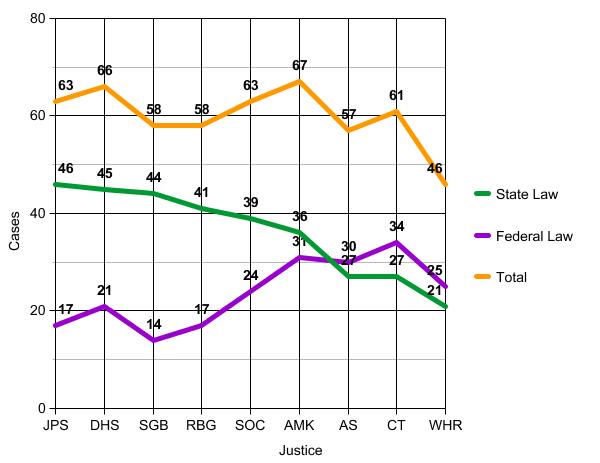
I should add that these sorts of numbers may incorporate a significant degree of subjectivity. For example, the line between a vote to strike down legislation and a vote to invalidate executive action more generally is hard to draw.
Still, I found the combined chart pretty fascinating. We tend to hear primarily about the Justices' votes to strike down federal legislation. It's relatively common for commentators to say that the conservatives vote to strike down federal legislation more often than the liberal Justices do. However, the combined chart suggests a remarkable degree of uniformity in the rate at which the Rehnquist Court Justices voted to strike down legislation if you combine both federal and state cases. Ginsburg, Thomas, Souter, Scalia — they all vote to strike down legislation at almost exactly the same rates. They differ on which statutes should be struck down, but at least based on the docket of the Rehnquist Court did not differ on how often statutes should be invalidated.
Thanks greatly!
Why? Note that many states may have the same law; invalidating a law in one state will often invalidate identical laws in other states, even if it gets counted as only one vote.
IANAL, so I can't put my finger on what that might be. But it might be interesting to know if the numbers are different for votes to grant cert. You'd probably have to break out which cases had the lower court overturning or upholding the laws.
I think the combined numbers are interesting, although I agree with Asher that the combination ultimately may not be that informative: whether one believes that striking state laws is more activist (b/c it often invalidates numerous similar laws in other states) or less activist (b/c it is less aggressive than striking a law of a 'co-equal' Congress) it seems that the two types of strikes are different. Since one of the main objectives of the paper was to illustrate precisely how each justice was using his or her invalidation power, combining the numbers may obscure more than it illuminates. I certainly agree, however, that it is important to talk about both sets of numbers, rather than picking out or or the other.
The more interesting information, I feel, is the issue area numbers reported in the paper. Those numbers make it clear that the main areas of disagreement between the "liberals" and the "conservatives" are First Amendment cases, Federalism cases; and criminal process cases. There also is an underlying difference in the Civil Right cases - the justices vote to strike similar numbers of laws in this issue area, but the types of cases in which they do so are very different.
There are state/federal distinctions within these issue area differences. In the First Amendment area, for example, the conservatives made most of their strikes in re: federal legislation (the First Amendment was in fact the area where conservatives justices cast most of their invalidation votes - topping even the Federalism cases). The liberals also have a lot of First Amendment strikes, but they were more likely to cast such votes in re: state laws.
I do agree with Orin that one of the most interesting things here is the overall low number of invalidation votes cast by Justice Rehnquist. His mode of judicial conservativism seemed genuinely different in this regard than that of his conservative colleagues.
Every now and then I see articles claiming that votes to strike down legislation are "activist" and that certain justices are more "activist" than others. Given the filtering that goes on in the cert process, this seems like a classic case of selection bias.
To be a true wonk, you need to use the right tool. A line graph is intended to demonstrate change, whether over time or some other changing variable. The data presented is static and a bar graph would be the right way to do it.
Another way to think about the relative degree of “activism” of a decision to invalidate legislation - which I did not develop in this paper - is to consider how many other justices agreed with a given justice’s vote to invalidate legislation. It is probably reasonable to assume that the law in cases decided by a 9/0 or 8/1 vote is clearer than that governing cases decided by narrower margins. Vote margin information thus could provide another measure of the 'intensity' of the activism evidenced an invalidation vote. I haven't studied these numbers, but a quick look indicates that Justice Stevens, who cast the most votes to invalidate state law, cast 32 percent of those state invalidation votes in 5/4 decisions. Justice Thomas, who cast the most votes to invalidate federal law, cast 53 percent of those votes in 5/4 decisions. To be clear, I haven’t calculated all of these numbers or thought through all of the arguments regarding what this type of information may show, but the vote margin data is in the paper Appendix if anyone is interesting in doing so.
No. It may be more active (possibly), but it's not more activist. Striking down laws, whether local or federal, is one of the actions that judges are permitted to take. A judge might reveal activism by his or her actions in context, but simply taking action doesn't show activism.
The Federal Government is only supposed to have enumerated powers. If the Constitution doesn't explicitly grant the Federal Government a power, then it's a violation of the Constitution for the Federal Government to exercise that power.
The State's, OTOH, have, under the Federal Constitution, any power that they are not explicitly denied. The primary source of limits on the power of State governments should be coming from the State consitution, not the Federal Constitution.
That, at least, would be the situation if you had a Court, and Justices, that actually valued the Consitution, and Federalism.
The data, therefore, tell a clear story. The "conservative" justices know their job, and focus on keeping the Federal Government in line with the US Constitution.
The "liberal" justices care mainly about forcing their political agenda on the rest of us, and treat the US Constitution as a ink-blot to be read however their desires go that day.
Thanks for making that so clear.