|
Monday, February 7, 2005
Faculty Diversity.--
Professor Bainbridge has an interesting discussion of faculty diversity at UCLA. He cites to a Yale Daily News article covering a talk I gave at Yale in 1996. I well remember the talk, since it was the first time I presented at Yale and the first time I talked publicly about my work on viewpoint diversity. Faculty and student turnout was high, and I later saw a lot of ripples emanating from my then-shocking attempt to quantify who really were the most underrepresented and overrepresented groups in law teaching.
The Yale Daily News story was inaccurate in several details. It is obvious that the reporter was not taping and was inexperienced at taking notes. I considered writing a letter to the editor at the time, but thought that being misquoted in a student newspaper probably didn't merit correction, especially since the misquotations were not that serious. I later learned in the Bellesiles affair that newspaspers and magazines often don't run corrections anyway.
One of the nice things about having a blog is that I can comment and correct them when they come up. [If there were such things then, I could have used it to good effect.]
The headline says "Alum Challenges Affirmative Action . . .," which I didn't. The article itself correctly characterizes the talk as "pro-affirmative action." I did challenge the narrowness of the search for diversity, since political and intellectual diversity is extremely important to viewpoint diversity. I strongly favor affirmative action, and ALWAYS have. At Yale in 1996, I explicitly said that I favored affirmative action for groups that were "still strongly underrepresented" and historically were "traditionally locked out" of the academy, such as Hispanics, women, and African Americans.
The Yale Daily News incorrectly quotes me as saying: "The basic argument for diversity in faculty hiring is incoherent unless there is more hiring of white Republicans and Christians because they are the two groups more underrepresented than women and most minorities." The reporter also incorrectly summarizes my argument with these words: "According to Lindgren, Protestants and Republicans are the most underrepresented among American law professors and Democrats and Jews are the most overrepresented compared to the U.S. population."
I am certain that I didn't quite say either of these things because they are not what my data at the time showed (or now show). Women were represented in law teaching at about the same as proportion of parity with their % in the general population as Christians, so women would have been MORE underrepresented than white Christians. Republicans, on the other hand, were about as underrepresented as Hispanics and more underrepresented than women and Christians, who were in turn more underrepresented than African Americans. So the statements attributed to me are more or less correct about Republicans (and white Republicans), but not about Christians, but even there I was talking about diversity of viewpoint, not other kinds of diversity. Perhaps the reporter was confused by my claims that subgroups such as white female Protestants and white female Republicans were incredibly underrepresented.
Further, I had passed out some of the data tables from my talk (the article incorrectly says that my study itself was passed out). With my tables in front of the audience, I was constantly pointing to data that I was discussing. I couldn't have said what the Yalie Daily attributed to me because I would have been challenged on it using my own data.
I talked about the representation of so many different groups and subgroups that I think that things just ran together in the reporter's mind.
The Yalie Daily quotes then-dean Tony Kronman with some reasonable reservations about my argument, which I don't doubt that he expressed. But Kronman, whom I had never previously met, was so enthusiastic after my talk that he offered to host a conference on ancient law at Yale if I would organize it (in the mid-1990s I had co-organized one at Berkeley). I never took Kronman up on his extremely generous offer (I got too busy with faculty appointments at Northwestern and my Ph.D. at Chicago).
If the Site Looks Weird Later Tonight,
just wait five minutes and then reload. At around 8 pm Pacific, we're rolling in a slight formatting change -- it should fix a few glitches, but for a few minutes it will make the text look odd. Thanks, and please bear with us.
Is This a Record?
Eugene:
Have we set some sort of record for number of blog posts by VC bloggers in a single day? I count 18 posts by 6 of us so far (not including this one), with 11 by you alone. And it isn't even an exam-grading-avoidance period!
Academic Legal Writing Books:
Several people have e-mailed asking whether I still have copies of the book left to sign and send. (Yes, seriously, they have asked this; I'm not just making this up for another chance to plug the book.) I have sold most of the 60 books I got from the publisher, but I do have 12 left, and when I run out, I can get more. So if you're inclined to order a personalized copy, just follow the instructions here. And of course unpersonalized copies are available on amazon.com.
German Literature on Accomplice Liability:
A friend pointed me to this expression by Karl May (1842-1912), a German novelist: "Mitgegangen, mitgefangen, mitgehangen," which basically means "gone with, caught with, hanged with." Naturally, like "trust but verify" (dover'ay no prover'ay) and "forewarned is forearmed" (praemonitus, praemunitus), it works best in the original.
International Law and Darfur:
Lawprof Peggy McGuinness has an interesting post on this at Opinio Juris, "A weblog dedicated to reports, commentary, and debate on current developments and scholarship in the fields of international law and politics." In general, if you're interested in international law, Opinio Juris is much worth reading.
Freedom from Academic Freedom Blogging:
I do hope to blog some more about the academic freedom questions raised by the Churchill case (plus some of the other matters we've recently discussed, such as the LeMoyne and the UNLV controversies), but I'm afraid I've gotten so much e-mail on the subject -- 25 messages that I haven't yet responded to, in addition to others that have already prompted follow-up posts -- that I'm sure I won't be able to get to all the issues. My apologies for not responding to those items, though as I said I hope to have some more general responses in the days to come.
Althouse on Separation of Church and State.--
Ann Althouse takes on the Nation, which is becoming a gross parody of its former greatness. She rightly criticizes the seemingly intentional misrepresentations of Brooke Allen about the framers' views of religion. (Tip to Instapundit.)
In the course of effectively fisking Allen, Althouse several times says that James Madison in the 1780s favored Separation of Church and State. As University of Chicago legal historian, Philip Hamburger, has shown in his history of the Separation of Church and State, none of the major framers favored Separation until about the election of 1800, when the Jeffersonians urged Separation to silence Northern clergy. Indeed, in the 1780s some religious leaders who were accused of wanting Separation denied such a misreading of their position. In the 1780s and early 1790s, a few religious dissenters favored Separation, but none of the insiders--certainly not Madison.
What Madison wanted in the 1780s was disestablishment of religion and equal liberty for different religions, not a "wall of separation."
In second half of the 19th century, the liberal wing of the Republican Party made a failed attempt to add Separation of Church and State as a constitutional amendment to the US Constitution (since it was not there already).
In the early 20th century, Separation became part of the jurisprudence of the KKK and other nativist groups (as well as some mainstream groups), and Hugo Black (ca. 1920) made new members of the Klan pledge to the eternal separation of church and state. Then in 1947, a labor organization with ties to the Klan brought a suit, Everson v. Board of Education, where then-Justice Hugo Black of the US Supreme Court wrote Separation into the US Constitution.
The US Supreme Court has been quietly moving away from Separation as the metaphor in recent cases, with most majority opinions (whether upholding or striking down aid to churches) making no mention of Separation, except in the titles to articles cited in the footnotes.
This fascinating history is told in Hamburger's meticulous book on the subject.
Cool!
Clayton Cramer writes about, among other things, holding Paul Revere's hunting gun and pocket pistol in his hands.
Dutch Schools Ban the Dutch Flag
A Dutch newspaper article explains that many Dutch schools are forbidding the display of the Dutch flag. The Independence Institute's Dutch expert has produced an English translation of the article:
Ban on National Flag is Widespread.
More schools prove to have banned the national flag.
At the Groene Hart Lycee [an elite high school] in the city of Alphen-on-the-Rhine, the three colors that are the Dutch flag have been looked upon as evil for the past year. No symbols that identify specific groups are considered acceptable and any student may be permanently expelled for coming to school with flags on their clothing, shoes or briefcases. Earlier this week readers reacted with fury to another school in IJsselstein, this school forbids any display of flags because this would provoke students of other nationalities.
An angry man reported yesterday that he gets all kinds of verbal abuse from foreigners and leftist intellectuals for driving a dark blue defense department vehicle with a red-white and blue sticker on the back. "I get to hear that I'm a Nationalist and a Fascist. Perhaps they could compose a list of what the Dutch are actually still allowed to do?" he asks sarcastically.
Green Heart High school itself says the regulations and bans are necessary because of the hardened climate in the schools. Not only flags are outlawed, but the wearing of Lonsdale clothes, or shoes with red or white laces, or leather bomber jackets, all of these could, according to the school board, result in discrimination and bad behavior among students. A spokesperson for the school explains: "Sometimes the fat's in the fire all at once and then we must react quickly--this way we show we can weather the problem as well as prevent it." According to the school the students make fewer complaints than the parents. The parents feel the kids are robbed of their own identity. "Everything happens at school after serious discussion only and ban is a big word," say the administrators at the school. The National Bureau of Race Discrimination understands what the schools are trying to do, but they think it makes little sense to ban anything preventively.
The flag of the Netherlands is composed of red, white, and blue stripes, and its roots stretch back to the Dutch war of independence against Spain in the 16th century. At the time, the Dutch Calvinists believed that freedom from Spain's awful dictatatorship and the Spanish Inquisition was worth the fight. The independent Netherlands soon became the first nation in Europe to allow genuine freedom of religion.
If the Dutch cannot even defend their right to display their own flag, it seems questionable whether Dutch liberty and independence will survive the 21st century.
Are Holocaust Victims Tantamount to Bigots?
Eric Alterman has a remarkable post defending Muslim groups' decision not to attend commemorations of the Holocaust. (Thanks to Cathy Young's column, which also criticizes Alterman on similar grounds, for the pointer.) The post is mostly a rant against Andrew Sullivan's condemnation of the groups, but here's the key part:
Look, unlike[ Andrew Sullivan], I'm a Jew, but I don't expect Arabs to pay tribute to my people's suffering while Jews, in the form of Israel and its supporters -— and in this I include myself — are causing much of theirs. Would Andrew want to go to a service in honor of the suffering of gay bashing bigots? . . . Anyway, I'm sure what I'm saying will be twisted beyond recognition, and so I suppose that makes it stupid to do, but I'm sorry. The Palestinians have also suffered because of the Holocaust. They lost their homeland as the world — in the form of the United Nations — reacted to European crimes by awarding half of Palestine to the Zionists. They call this the "Nakba" or the "Catastrophe." To ask Arabs to participate in a ceremony that does not recognize their own suffering but implicitly endorses the view that caused their catastrophe is morally idiotic — which is why, I guess, I'm not surprised Andrew's doing it.
Now let's briefly analyze this: Alterman is not just saying that Muslim groups are not interested in commemorating the harm done to a group that they're now hostile to. (He is partly saying that, which acknowledges that many Muslims are hostile to Jews, and not just to Israel, but that's not all he's saying.) I should say that such a view would be understandable, though not laudable; it's human nature not to much feel the suffering of others, especially if you have some hostility to them.
Rather, he's analogizing the victims of the Holocaust (those who suffering is honored) to "[Muslim]-bashing bigots." It's not the Israelis who are being honored, it's the slaughtered and nearly slaughtered European Jews. Yet somehow they reverse-inherit the supposed guilt of Israelis and other Jews today. Men, women, children butchered in Auschwitz, even ones who had never had much interest in Palestine and who had no opinions at all to Muslims — quite analogous to "[Muslim]-bashing bigots," yes, indeed.
This strikes me as the classic morality of group guilt. Jews of the 1940s are morally tainted by their supposed sins today; we should hate ethnically Japanese because of Pearl Harbor; Jews killed Christ (assume for a moment that this is historically accurate — the hostility to Jews would remain wrong even then) so Jews today are culpable; many Arabs support suicide bombers, so I shouldn't care about wrongs being done to completely innocent Arab-Americans.
As to who suffered from the Holocaust, it seems to me that the U.N. partition of that part of the world — followed shortly by the 1948 war in which the Arabs tried to destroy Israel, and Israel won and obtained the customary spoils of war — is quite a bit different from the Holocaust. (Among other things, there were Jews living there, who had something of a claim to their own state, too.)
But if you really want to take the "who suffered" perspective, well, many innocent Germans surely suffered a great deal from World War II. Some of them may have various grounds for complaint against the Allies, from the Dresden bombings (I'm not an expert on them, but I know there are plausible claims that they went beyond what should be done even in a total war) to what I understand was a massive and largely unpunished wave of rapes of German women by many Soviet soldiers. So I take it that it would be "morally idiotic" to ask those innocent Germans "to participate in a [Holocaust commemoration] ceremony that does not recognize their own suffering but implicitly endorses the view that caused their catastrophe" (i.e., that many Germans were guilty of heinous crimes)?
I would have thought that good people should generally mark with sadness the mass murder of innocents, and set aside for another day the debate about what other wrongs should be commemorated or righted. Now I realize that people (whether Jews, Arabs, Germans, Americans, Russians, or anyone else), even people who are otherwise good, sometimes don't rise to the occasion this way. Again, if Alterman had simply pointed out that this is human nature, and doesn't merit harsh condemnation, I wouldn't be criticizing him.
But instead, Alterman descends into ascribing ethnic guilt, the very moral fallacy that has helped cause so much mindless slaughter. And on top of that, he ascribes the guilt to the slaughtered innocents of the Holocaust. Shameless, and shameful. In the words of Cathy Young, "Alterman frets that his words will be 'twisted beyond recognition,' but it's hard to see how they can be twisted into something more indecent than they already are." Related Posts (on one page): - Eric Alterman Responds:
- Are Holocaust Victims Tantamount to Bigots?
E. Allan Farnsworth R.I.P.:
The preeminant contracts scholar and Columbia law professor E. Allan Farnsworth died a week ago today. The Sunday New York Times has a nice obituary here. Another fine obituary here adds additional details. Allan Farnsworth was the reporter for the Restatement (Second) of Contracts and was the author of the most widely adopted contracts casebook, a highly respected treatise on contracts, a monograph on contracts called Changing Your Mind, and most recently, Alleviating Mistakes: Reversal and Forgiveness For Flawed Perceptions.
My first contact with Allan came in 1984 after I reviewed the first edition of his treatise in the Harvard Law Review. My review was entitled " Contract Scholarship and the Reemergence of Normative Legal Philosophy." My thesis was that developments in jurisprudence away from legal realism made the academic world safer for legal doctrinal scholarship of the sort exemplified by Allan's wonderful new book (After it appeared, I required my students buy it.)
Although my review was a rave, I admit that the bulk of it was about my main thesis. After it appeared, I received a short note from Allan (which so far I have not managed to locate). After graciously thanking me for the kind review, he added--in words far more wry and pithy than I can reconstruct--something like the following: "I know that the price of doing a book review is putting another's work ahead of one's own, but I see that you managed to deal with that problem."
After that, he was always very generous to me, then a junior contracts professor at Chicago-Kent, both in his writings and in person. I fondly recall us getting together years later for drinks in Florida on Longboat Key, where he maintained a condo. In addition to everything else, he was a rather dashing figure.
Fordham law professor Joe Perillo noted on a listserve for contracts professors that "every generation seems to produce a leader in our field of contract law." Yet somehow I doubt that we in contracts will see his like again.
What's Wrong With That Statement?
I just got a mass e-mail from the American Conservative Union that says:
Dear Friend of ACU:
QUESTION: Who made the following statement?
"(The U.S.) military and the insurgents (in Iraq) are fighting for the same thing, the hearts and minds of the people."
A) Terrorist Leader Abu Musab Al-zarqawi
B) Osama Bin-Laden
C) Saddam Hussein
D) Ted Kennedy
The correct answer is D.
I'll be frank. Ted Kennedy he has simply gone too far.
Ted Kennedy should be held to account for his words and actions.
Use the hyperlink below to send your personalized Blast Fax message to Senator Ted Kennedy, Vice-President Dick Cheney and the remaining five Members of the Senate Leadership, all six Members of the Senate Ethics Committee and the remaining twenty-three Members of the Senate Armed Services Committee. Tell them that Senator Kennedy has given aid and comfort to the terrorists and that he is unfit to sit on the Armed Services Committee.
http://www.grasstopsusa.com/acukennedy.html
The trouble is that whatever bad things Kennedy might have said -- and I'm sure he's said plenty -- this isn't one. First, some context from Kennedy's remarks (made Friday, February 4):
Too many Iraqi people do not believe that America intends no long-term military presence in their country. Our reluctance to make that clear has fueled suspicions among Iraqis that our motives are not pure, that we want their oil, and that we will never leave. As long as our presence seems ongoing, America's commitment to their democracy sounds unconvincing.
Other indications of anti-American sentiment are clear. CDs with photographs of the insurgents are spread across the country. Songs glorify combatants. Poems written decades ago during the British occupation after World War I are popular again.
We have the finest military in the world. But we can't defeat the insurgents militarily if we don't effectively address the political context in which the insurgency flourishes. Our military and the insurgents are fighting for the same thing -- the hearts and minds of the people -- and it is a battle we are not winning.
The goal of our military presence should be to allow the creation of a legitimate, functioning Iraqi government, not to dictate it and not to micromanage it.
Kennedy is complaining that the Iraqi insurgents (a fairly neutral term, not as harsh as I might like, but nothing I can complain about) are trying to get the Iraqi population to sympathize with them and to hate us. That seems quite right. Of course, the Iraqi insurgents are also trying to influence the Iraqi people by terror, not just sweet reason; but they surely are trying to win people over as well as frightening them.
Kennedy is also claiming that we aren't winning the public relations battle in Iraq. I don't know if he's right or wrong, but it seems to me like a plausible position. The election suggests that the Iraqi insurgents haven't won over or intimidated all Iraqis. But my sense is that we aren't vastly loved there, either, and that in some areas a considerable chunk of the public (enough to cause serious problems for us and for the new Iraqi government) is indeed on the insurgents' side.
Now Kennedy may well have been wrong in some of the other things he said in that speech. He surely has been wrong in lots of other things. Fault him for that. But this statement is hard to see as "go[ing] too far" (unless one reads it as a claim of moral equivalence between us and the insurgents, which neither the context nor the text supports).
Even if you think Kennedy deserves whatever criticism he gets, the viewpoint expressed in that particular phrase is a plausible and quite possibly correct viewpoint. The viewpoint shouldn't be denounced simply because we might not like the person who conveys it.
Chicago Tribune Censors Political Cartoon Critical of Ted Kennedy.--
The Chicago Tribune (p. 5.9) today censored a "Prickly City" cartoon. The Tribune ran a "Bizarro" strip instead along with this explanation: "Today's Prickly City does not meet the Chicago Tribune's standards of fairness. Please enjoy this substitute."
This is today's strip, which the Tribune censored:
[Click on the strip itself to enlarge]
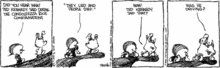
©Universal Press Syndicate.
In trying to figure out why the strip is unfair, I can only guess that the Tribune thought that the Mary Jo Kopechne death in 1969 was too old to be fair to use, though their news stories considered George W. Bush's activities from the late 1960s and early 1970s to be fair to use. Or perhaps they thought that bringing up Kennedy's causing Kopechne's death was unfair because it was unrelated to the Iraq War, but political criticism often is based on charges of inconsistency between two events related only by one or more facts--here that they both involve death and alleged lies, misleading statements, and indifference.
Disclosure: The Chicago Tribune (and many of its subsidiaries) are former clients of mine. [Also, this post was edited very shortly after posting.]
UPDATE: My daughter noticed this in the Tribune this morning and pointed it out to me. She uses part of her allowance and babysitting money to pay for a subscription. She is a Nader supporter.
Grokster Loses Appeal! Peer-to-Peer Technology Struck Down!
OK, it hasn't happened yet, I admit — the MGM v. Grokster case hasn't even been argued before the Supreme Court yet (that comes in March), and the Court won't issue its decision until later in the Spring.
But I've just spent the weekend going through the briefs that have been submitted thus far, and I'm now making book: the Court reverses the Court of Appeals (which held that Grokster was not "secondarily liable" for the copyright infringements of its users), 7-2. (Amazingly enough, this represents both the odds I'm giving and the final vote count). I'm not saying that's the right result, or the best outcome; in fact, the reason I was reading all these briefs is that I've been asked to help out on some of the amicus briefs on Grokster's side. [The EFF, incidentally, has a wonderful collection of the submissions on both sides]
While this outcome could be a disaster for P2P file-sharing technologies (and the record companies will undoubtedly trumpet it as such, with many in the press likely following along), it probably won't be. The Court has an easy "out" here, and my experience has been that when they're presented with an easy out they usually grab it. The Ninth Circuit in this case affirmed the grant of summary judgment to Grokster, holding that on any reasonable version of the facts, Grokster could not be held liable for "contributory copyright infringement" because the software involved is "capable of substantial non-infringing uses" under the Sony v. Betamax case. The record company plaintiffs want the Court to "tighten up" the Sony standard, and to say, in effect, that the non-infringing uses that these P2P networks have are not "substantial" enough under Sony.
That would be a disaster for technology providers — but I don't think that's what the Court will say. Instead, I think the Court will send the case back to the Ninth Circuit and say: you were right that, under Sony, the non-infringing uses here are substantial enough so that, standing alone, providers of these p2p technologies can't be held liable for the copyright infringements of network users. But — and here's the critical part — on these facts, it doesn't stand alone; there's evidence in this record that Grokster and the other defendants actively encouraged and induced its customers to infringe copyrights, and that inducement of this kind is not protected by the Sony safe harbor. The Court will then instruct the Ninth Circuit to re-open the case and evaluate whether or not this evidence is enough to hold the defendants liable on an inducement, or "aiding and abetting," theory of liability.
The record companies will claim victory, but it will be a Pyrrhic one — it will just cause the next generation of P2P providers to be more careful about what they say in their promotional and advertising material, secure in the knowledge that if they just shut up about it, they'll be allowed to go about their business without fear of copyright liability.
Anyway, you heard it here first.
Justice Thomas:
In the past, we've sometimes posted about how various people don't seem to give Justice Thomas a fair shake (see, e.g., here and here). Here's another example, from a panel that I was on a while back. Another panelist, a noted constitutional law scholar and expert on — among other things — the First Amendment and the Supreme Court, said (this is a transcription from an audiotape I have of the panel; emphasis added): Here again I want to make three quick comments. The first concerns the lineup of the Justices. And specifically, I want to talk about Justice Thomas' vote. After all Justice Thomas would be thought of as probably the most conservative or one of the two most conservative Justices on this Court; on any Supreme Court case in history. And yet I think there are two principles that explain Justice Thomas' votes. Not all of the votes, but some of them. First he'll consistently vote in favor of pornography under the First Amendment and second he'll always vote against plaintiffs in sexual harassment cases. As to the former, this case illustrates it, a case from a couple of years ago, Free Speech Coalition v. Ashcroft illustrates it. And to the latter with regard to sexual harassment there's a Supreme Court case this term, Pennsylvania State Police v. Suders, which was an 8-1 with only Justice Thomas voting against the sexual harassment victim. Now if one thinks back to Justice Thomas' confirmation hearing, one might predict an opposite set of votes, but I think this says something very revealing about Justice Thomas' personality, what he's trying to say, with regard to his reaction to his confirmation battle.
As it happens, Justice Thomas does indeed take a narrower view of hostile environment harassment law than do some other Justices; he's mostly with Justice Scalia and Chief Justice Rehnquist on this, though occasionally he does write alone. He has voted for sexual harassment plaintiffs in the unanimous Oncale v. Sundowner Offshore Services (writing a one-line concurrence that didn't disagree with the bottom line) and Harris v. Forklift Systems, so "always" is wrong. But let's set that aside for now.
The trouble is that it's simply false to say that Justice Thomas "consistently vote[s] in favor of pornography under the First Amendment." I give below a list of what I think are all the porn-related cases that Justice Thomas has considered while on the Court, and here they are. When Justice Thomas's vote would clearly protect porn or clearly authorize its restriction, I've just used one word "protect" or "restrict"; when it was based on a more pro-restriction approach than some of the other pro-restriction votes, I've said "restrict+"; when it was based on a less pro-protection approach than some of the pro-protection votes, I've said "protect-":
| Case | Issue | Votes for protection-votes for restriction | Thomas's position |
| Ashcroft v. ACLU II (2004) | Cyberporn | 5-4 | Protect |
| City of Littleton v. Z.J. Gifts D-4 (2004) | Restrictions on porn stores | Unanimous | Part protect, part restrict |
| U.S. v. Am. Library Ass'n (2003) | Porn filtering in libraries | 3-6 | Restrict+ |
| Ashcroft v. ACLU (I) (2002) | Cyberporn | 3-6 | Restrict+ |
| City of Los Angeles v. Aladema Books (2002) | Restrictions on porn stores | 4-5 | Restrict+ |
| Ashcroft v. Free Speech Coalition (2002) | Digital child porn | 6-3 | Protect- |
| City News & Novelty, Inc. v. City of Waukesha (2001) | Restrictions on porn stores | Unanimous | Dismiss on procedural grounds |
| U.S. v. Playboy Entm't Group (2000) | Cable porn | 5-4 | Protect- |
| City of Erie v. Pap's A.M. (2000) | Nude dancing restrictions | 2.5-6.5 | Restrict+ |
| Reno v. ACLU (1997) | Cyberporn | 9-0 / 7-2 | Protect |
| Denver Area Educ. Telcoms. Consortium v. FCC (1996) | Cable porn | 6-3 / 5-4 / 2-7 | Restrict |
| U.S. v. X-Citement Video (1994) | Child porn | 7-2 | Restrict as to constitutional issue, though protect given the particular statutory construction issue involved here. (More details here.)
[To quote the opinion (which Justice Scalia wrote and which Justice Thomas joined), the dissenters' view was that "The Court today saves a single conviction by putting in place a relatively toothless child-pornography law that Congress did not enact, and by rendering congressional strengthening of that new law more difficult." The dissent would have held the law unconstitutional on narrow grounds and thus vacated the conviction, but would have let Congress reenact a slightly narrower but still quite restrictive version of the law.]( hide) |
| Alexander v. U.S. (1993) | Forfeiture of porn | 4-5 | Restrict |
Surely this is not "consistently vot[ing] in favor of pornography" — it's voting for protecting pornography in some situations (though not as often as, say, Justices Kennedy or Ginsburg, or even Stevens or Souter) and against it in others. So I said as much in my exchange with the other professor, though with many fewer details than I give above; I cited X-Citement and Denver Area, pointed out that Justice Thomas's pro-protection votes in Free Speech Coalition and Playboy were quite narrow, and explained that in Playboy Justice Thomas basically took a formalist view that obscenity could be defined broadly and was unprotected, but material outside the obscenity definition was protected.
Here's what the other professor said in response: As to the second point about Justice Thomas, he is not going to position me into rationalizing or defending Justice Thomas' opinions. I do find it curious that Justice Thomas does often, does not always vote in favor of, the pornography position and he consistently votes against plaintiffs in sexual harassment cases. I leave you to draw your own conclusions.
So this professor — who knows the First Amendment caselaw quite well — says that he won't be "position[ed] into rationalizing or defending Justice Thomas' opinions," not even to the extent of squarely acknowledging his error. He seemed happy to insinuate that Justice Thomas's supposed affection for pornography leads him to "consistently" vote to protect pornographers, even though that turns out to be false. But then when confronted with his error, the chief response is that he won't rationalize or defend Justice Thomas's opinions.
Now I suspect that the professor sincerely believed he was right when he made his initial statement. But in fact he was wrong, and as a constitutional scholar who often opines on the First Amendment, he should have known better.
Yet I also suspect that his contempt for Justice Thomas blinded him to this reality: Rather than looking squarely at the facts, the professor selectively ignored those that were inconsistent with his pejorative theory.
The professor's hostility was intense enough that it kept him from thinking straight, as intense hostility often does. And I think this is pretty emblematic of how some on the left react to Justice Thomas.
Say, Aren't Facts Supposed To Be Factual?
A google search for Eugene Volokh Climate Change Skeptics yields as the first item a page with the header "Factsheet: Eugene Volokh." The left sidebar begins with:
EXXONSECRETS.ORG
Documenting Exxon-Mobil's funding of climate change skeptics.
The body of the page points out the apparent reason for my being listed: I'm an Academic Advisory Board Member for the Reason Foundation, and I'm on some similar boards for the Heartland Institute and the Pacific Research Institute for Public Policy.
Except I've never been funded, to my knowledge, either by Exxon-Mobil, the Reason Foundation, the Heartland Institute, and the Pacific Research Institute for Public Policy. My board membership is entirely unpaid. I have been paid for two articles in Reason Magazine, and I spoke once at a Reason Foundation event, for which I must have been paid an honorarium; but in that respect I'm equally funded by the New York Times, Hofstra University Law School, and dozens of others. This is not, I suspect, what "Exxon-Mobil's funding" would normally mean to people.
What's more, I'm not even a climate change skeptic in any significant sense. I don't believe I've ever publicly spoken out about climate change, largely because I know next to nothing about the subject. If "climate change skeptic" means someone who has publicly taken a position skeptical of various climate change theory (which I suspect is the normal meaning of the phrase), I'm not it.
Now if they want to maintain a database of people who are affiliated with various groups that have gotten money from Exxon-Mobil, on the chance that these people may at some time speak out about climate change, that's fine. They should just make sure that the Web pages make that clear. But if the Web page lists my name alongside the phrase "Documenting Exxon-Mobil's funding of climate change skeptics," then facts aren't what the page is conveying.
Appalling, If True:
WTVH reports:
A graduate student at LeMoyne College has been expelled for writing a paper on his opinion that corporal punishment should be allowed in the classroom. Scott McConnell was working on his master's degree in the science education program at LeMoyne. He wrote his "Classroom Management Plan" paper in November. After receiving an A- on the paper from his professor, the college decided to expel McConnell. . . .
LeMoyne released the following statement on the matter: "If we believe a student is not suitable for classroom instruction based on his or her educational philosophy we have an obligation that is consistent with the College's mission and that upholds New York State law and education regulations." . . .
Now it's possible there's something omitted from the story, and LeMoyne's actions were based on something other than just McConnell's opinion about what should be allowed. But if the story is accurate and reasonably complete, this seems just appalling: A student expresses his views that some education policy is changed, and then he's expelled?
Here, in fact, is a powerful criticism of LeMoyne College's actions:
A college or university is a marketplace of ideas, and it cannot fulfill its purposes of transmitting, evaluating, and extending knowledge if it requires conformity with any orthodoxy of content and method. In the words of the United States Supreme Court, "Teachers and students must always remain free to inquire, to study and to evaluate, to gain new maturity and understanding; otherwise our civilization will stagnate and die."
These words come from The LeMoyne College Faculty Handbook — Regulations on Academic Freedom and Tenure.
Thanks to InstaPundit for the pointer.
UPDATE:
This news story provides more data. First, it suggests that the student wasn't expelled as such, but rather that he had been "conditionally accepted last summer and fall and was expecting to be fully accepted this spring," had taken classes at the school (including the one for which he read this paper), but then had his conditional acceptance revoked. I don't think this changes the academic freedom issue, but I thought I'd note it in any case.
The story also quotes the acceptance withdrawal letter, written by the program's director, as saying that "I have grave concerns regarding the mismatch between your personal beliefs regarding teaching and learning and the Le Moyne College program goals." It goes on to say that the student "said he's also been trying to find out what Leogrande meant by 'mismatch.' College administrators have told him, he said, that it stems from the four-page 'Classroom Management Plan' he submitted Nov. 2 for his Planning, Assessing and Managing Inclusive Classrooms class.
"In the opening paragraph of his essay, McConnell wrote: 'I do not feel that multicultural education has a philosophical place or standing in an American classroom, especially one that I will teach. I also feel that corporal punishment has a place in the classroom and should be implemented when needed.' He got an A for the course."
The story goes on to give more details; please read it here. Nonetheless, this suggests to me that the initial press accounts were substantially true: The student expressed a view about the way education ought to be conducted that was contrary to the established orthodoxy; and as a result he was kicked out of the program to which he'd been conditionally admitted. Sounds like the university is "requir[ing] conformity with . . . orthodoxy of content and method."
If they want to insist on such conformity, they are legally free to do so (as a private university, they aren't bound by the First Amendment). But if that's so, then they should make it clear to students, donors, and others, rather than singing paeans to academic freedom and then kicking out students for the very "inquir[y]," "evaluat[ion]," and participation in "a marketplace of ideas" that the university supposedly praises.
Sunday, February 6, 2005
I'm no Randy Barnett,
but VC readers in the Minneapolis/St. Paul region might be interested to know that I will be speaking at William Mitchell College of Law on the USA Patriot Act Monday (today) at 7pm. Details available here.
WAKE FOREST AND DUKE SWITCH TIMES:
I very much enjoyed my visits last week to Northwestern and the Milwaukee Lawyers Chapter of the Federalist Society.
In an earlier post, I inadvertently switched the times of my Duke and Wake Forest speeches and then posted a correction. As it turns out, because of a conflict with another speaker, later in the week Wake Forest switched times with Duke for real. So the final schedule for this week is:
THURSDAY (2/10): Duke (@ 12:15) & Wake Forest (@ 4:00pm)
FRIDAY (2/11): The John Locke Foundation in Raleigh (2/11 noon) (Luncheon details and reservation info here).
At Duke and WF I will be talking about Ashcroft v. Raich. At the Locke Foundation, I will be talking about Restoring the Lost Constitution.
I have also added speeches at NYU and Columbia on Thursday, March 3. (NYU is at noon; final time for Columbia TBA)
OTHER SPEECHES THIS SEMESTER:
in February: Quinnipiac (2/21), Cumberland (2/23) & University of Alabama (2/24)
in March: NYU & Columbia (3/03), University of Toledo (3/17) ( Stranahan Lecture), Princeton (3/24) & Chapman (3/31)
in April: Reason Weekend (4/1)(Laguna Niguel), Texas Tech (4/7) & University of Arizona (4/14)
As I do not have any more open times, I don't think I will be add any more engagements this semester.
Updates on the Evidence in the Hoppe Case.--
My original post on the Hoppe case was already my longest ever, so I am updating it here.
VC reader Gabriel Rossman points me to this article by University of Rochester economist, Steven Landsburg, in Slate, which discusses an NPR story that pointed out that gays in California were 70% more likely to smoke:
I've just learned from NPR's All Things Considered that in California, gay men and lesbians are 70 percent more likely to smoke than the general population. In a sterling example of why I try not to listen to too much NPR, reporter Sarah Varney immediately segued into the perceived need for more anti-smoking ads targeted specifically at gays.
In other words, Varney implicitly assumes that gays are either too stupid to have gotten the message that smoking is bad for you or too irrational to have modified their behavior accordingly. A more inquisitive reporter might instead have raised the obvious question: What good reasons might gays have to smoke more than other people?
In four minutes of air time, the closest Varney came to addressing that question was to suggest that for gays, stepping outside for a cigarette can be a good way to meet people—as if the desire to meet people somehow differentiates gays from straights. At the same time, she managed to overlook the blindingly obvious: Gays are disproportionately childless, and childless people are more likely to smoke.
As a matter of fact, childless households (whether gay or straight) spend, on average, 56 percent more on cigarettes and alcohol than their childbearing neighbors. (Among households where the parents have some education, the discrepancy is even larger.) Nor is there anything mysterious about why. First, parents have extra reasons to live long and stay healthy, both so they can be there when their kids need them and so they can enjoy the company of their grandchildren. Second, parents have extra expenses—starting with diapers and continuing through college tuition—that leave less disposable income for cigarettes. Third, a lot of parents don't like the idea of smoking in front of their children.
As I stated in my original post, this is the way that economists talk. Some people may find it offensive, but it is completely unremarkable in the discipline.
A check of GSS data on smoking shows borderline significance (1-tailed p=.086) for those having same-sex experience in the last 5 years: 38% of gays and bisexuals smoke compared to 30% of others, so any differences nationally are probably less than in California. If I do a logistic regression, controlling for education and region, then the 1-tailed significance equals the .05 threshold, meaning that (with controls) gays do appear to smoke more in the GSS data. When being gay is measured by the gender of sexual partners since age 18, the effect is not significant.
As to driniking, gays and bisexuals (measured by activity since age 18) are more likely (45%) to report ever getting drunk than others (35%), though the effect is not significant for gays measured by activity in the last 5 years.
As to the evidence in this post, it provides some (but far from conclusive) support for Hoppe's claims that gays engage in higher risk behavior and that differences in child-rearing is a related cause. So now, four pieces of evidence provide some support Hoppe's claims: a greater reported number of sex partners (as I linked in my earlier post), a higher rate of smoking in some studies (but not others), a higher rate of getting drunk (by some measures but not others), and some plausible evidence that child-rearing is related to smoking and drinking rates. The direct evidence of less planning for the future is not shown in these studies, but is consistent with some of them. The evidence that I pointed to against Hoppe's thesis is mostly attitudinal, not behavioral, and economists (though not sociologists) tend to discount attitudes.
The caveats that I mentioned in the prior post apply to my analyses here as well, including the absence of adjusting the sample size for a design effect. I'm off to see a movie; I'll probably post more when I get back today--or post tomorrow.
UPDATE:
For more, see David Beito, Ralph Luker, Kenneth Gregg, and Tom G. Palmer. Palmer, a Senior Fellow at the Cato Institute, considers Hoppe a bigot, not for the statements attributed to Hoppe in class (which he finds unobjectionable), but primarily for other comments made elsewhere about Palmer. Nonetheless, Palmer has written to UNLV in support of Hoppe's academic freedom.
I Am Charlotte Simmons:
A couple of interesting reviews of "I Am Charlotte Simmons" by my colleagues, Frank Buckley in Crisis (although I don't get the title of the review) and Peter Berkowitz in Policy Review. Neither of them comment much on the character I found most striking--the weasel professor who is more concerned about politics than the academic principles that he claims to support.
More on NY Same Sex Marriage Decision:
Jack Balkin offers a thoughtful analysis of the opinion. An excerpt: I have no idea whether this case will be affirmed by the New York Court of Appeals. But if it is affirmed, it will have to be for somewhat different reasons than the court gives here. The court has not given the New York Court of Appeals very much to work with. It will pretty much have to start from scratch. Related Posts (on one page): - More on NY Same Sex Marriage Decision:
- NY Trial Court Strikes Down Marriage Law:
Twenty-Something on the Future of Social Security:
Today's Washington Post has an interesting column by Laura Thomas from a Twenty-Something on the future of Social Security.
The opening paragraph:
People my age are as likely to believe in Social Security as they are in Santa Claus. And, if you ask me, it would be equally naive for a twenty-something to believe in either one.
Her views are consistent with comments that I hear from my own students, most of whom are in their mid-twenties, and none of whom are counting on a dime from Social Security when they retire.
"Lost Film" Festival:
Sometimes "lost films" are lost for a reason, as Joe Malchow reports about a campus film festival last night. Check out the second short film on the war on terror in particular, which you can also view directly here, in which the director poses the stimulating question of whether now that the United States has attacked Iraq, might it attack France or Great Britain next? (No, I'm not making this up). Malchow's question is more pragmatic, which is how much of his and his parent's tuition money is going to support this.
UNLV Economist in Trouble.--
INTRODUCTION:
I read about the problems of Professor Hoppe, an economist at the University of Nevada-Las Vegas (tip to Instapundit):
Hoppe, 55, a world-renowned economist, author and speaker, said he was giving a lecture to his money and banking class in March when the incident occurred.
The subject of the lecture was economic planning for the future. Hoppe said he gave several examples to the class of about 30 upper-level undergraduate students on groups who tend to plan for the future and groups who do not.
Very young and very old people, for example, tend not to plan for the future, he said. Couples with children tend to plan more than couples without.
As in all social sciences, he said, he was speaking in generalities.
Another example he gave the class was that homosexuals tend to plan less for the future than heterosexuals.
Reasons for the phenomenon include the fact that homosexuals tend not to have children, he said. They also tend to live riskier lifestyles than heterosexuals, Hoppe said.
He said there is a belief among some economists that one of the 20th century's most influential economists, John Maynard Keynes, was influenced in his beliefs by his homosexuality. Keynes espoused a "spend it now" philosophy to keep an economy strong, much as President Bush did after the Sept. 11, 2001, terrorist attacks.
Hoppe said the portion of the lecture on homosexuals lasted perhaps 90 seconds, while the entire lecture took up his 75-minute class.
As with so many of these stories of supposed academic misconduct, one must be careful not to assume that the whole story has been told, since usually only one side is talking publicly. But if Hoppe indeed said what he says he said and no more, then I think that it is the administrators at UNLV who deserve reprimands. They should have explained to the student that such claims are clearly within academic freedom, whether true or false. I have no doubt that what Hoppe said would be offensive to some students—and indeed, he is probably wrong on the merits of most of his claims—but his claims are empirical ones. The proper response of someone who is angry with Hoppe is to gather evidence tending to show that he is wrong, and to challenge Hoppe to offer his own evidence to support his claims.
Both Eugene Volokh and I have previously contributed to debunking the apparent myth that gay males have a median of 250 sexual partners. But every representative study that I've seen does find substantial differences between straights and gays, so IF on average one can equate having more partners with taking higher risks, then in that very limited sense, one claim of Hoppe may be at least partly true. I have no reason to think that Hoppe is right more generally on risk-taking by gays. [But see evidence supporting Hoppe in an updated later post.]
As someone who has watched Richard Posner, Gary Becker, and others at the University of Chicago Law School Workshop, I have seen lots of generalizations about how groups act. A claim such as Hoppe made would be quite unremarkable in that classroom setting, however correct or incorrect it might be. Post-Gary Becker, it is common for economists to attribute motivations, beliefs, and behavior to people in different family or sexual situations. Some of the claims are based on assumptions of rationality, some are meant as empirical claims to be supported or rejected by evidence from the real world. I shudder to think what students at UNLV would think if Hoppe had read the claims about how gays think, act, and rationally calculate in Posner's 1992 Sex & Reason, which spawned a lot of vigorous criticisms from both straights and gays, but no calls for academic punishment (at least that I heard). The book still has its defenders and detractors.
For example, consider this paragraph from Martha Ertman's review of Posner's 1992 book in the 1993 Stanford Law Review:
Posner apparently believes that lesbianism is a matter of choice rather than genetic predisposition. He recognizes that there are two contrasting viewpoints on the genesis of lesbianism: (1) it "is biologically determined"; or (2) it is "either a second-best choice by 'mannish' women who are unattractive to men or a political choice by angry feminists." Although he states that given the discrimination visited on gay men and lesbians, "the idea that millions of young men and women have chosen it . . . seems preposterous," Posner seems to prefer the choice theory regarding lesbians. He reasons that any genetic basis for "lesbian preference would have tended to be selected out" in the "evolutionary era." Posner states that this era "apparently was characterized by a high degree of interpersonal violence, [and having] additional male protectors may well have done more for a child's chances of survival than to have additional female protectors." Posner also asserts that "[t]he rarity of lesbianism among animals" negates a genetic explanation of lesbianism, supporting his sociobiological theory. Therefore, assuming lesbians are made rather than born, Posner expects "opportunistic homosexuality to be more common among women than among men, at least relative to 'real' homosexuality."
I can't vouch for whether Ertman's account of Posner's arguments is a fully fair one, but I think you can get a feel for how easily Posner's economic journey into sex could generate the sort of offense that the UNLV student experienced with Hoppe.
As someone who works a lot on diversity issues, where people's backgrounds (including specifically their sexual orientation) are supposed to lead them to have different experiences and different viewpoints, I find it strange that people would rule out viewpoint differences without inquiring into the evidence. The line between a generalization and a stereotype is a fine one. The primary problem with stereotyping is in failing to treat someone who could be treated as an individual as an individual, just assuming when you have individual evidence that the person is guided by his race, gender, sexual orientation, or politics. But it should be permissible to describe average differences between groups, such as that African-Americans tend to vote for Democrats.
I have been working a bit on differences in gay views over the last year (I'm director of Northwestern's Demography of Diversity Project). There is very little published work in the field—and it often conflicts. A recent study found no differences in reported happiness between gays and straights, while perhaps the leading study (Laumann et al.) found that gays are somewhat less happy. Would Ed Laumann, former provost and former chair of Sociology at the University of Chicago, be reprimanded if he were to present his data at UNLV? I could imagine some people being offended to hear Laumann's claim that gays in his sample reported being less happy, though one might attribute such a feeling (if true) to discrimination. If Laumann is wrong (or if his findings are not generalizable to more recent years, as more recent data hints), collecting and analyzing additional data is the way to refute him.
Certainly, stereotypes about gays can be used against them. Peg Brinig and I have been kicking around the idea of examining the claim sometimes made in custody cases that gays are more selfish or less altruistic and thus less likely to make good parents. My preliminary exploration of the data suggests that this stereotype of gays and lesbians is probably false.
SOME DATA ON HOPPE'S HYPOTHESIS:
(To read about the results of my data analysis on questions relevant to Hoppe's general planning claim, click here)
Now to the other claims attributed to Hoppe. There may well be a substantial economic literature that supports or rejects his hypotheses of which I am unaware.
I looked instead at evidence in the 1993-2000 NORC General Social Surveys (GSS). There gays and straights do indeed sometimes have different views about the future.
Respondents were asked how much they agreed or disagreed with this statement:
"We worry too much about the future of the environment, and not enough about prices and jobs today." [GRNECON]
24% of gays and bisexuals agreed (n=119; based on gender of sexual partners in last 5 years)
40% of others agreed (n=3527) (p<.0005)
I don't know what to make of these results, even though the differences are moderately large. I suppose they undercut Hoppe's claim because gays and bisexuals are here more future oriented. But they also suggest less gay concern about economic results, though here they are short-term results, not future ones. I get almost the same results if I use the gender of sexual partners since age 18 (rather than over the prior 5 years).
A more relevant question was also asked: how much respondents agreed or disagreed with this statement:
"There's no sense planning a lot — if something good is going to happen, it will." [NOPLAN]
There is no general pattern across the range: strongly agree, agree, neither, disagree, strongly disagree (p>.40), though there are hints that gays may be overrepresented at both extremes.
If, however, you dichotomize the results between those who strongly agree that "There's no sense planning a lot," and others, then those who have had any same gender partners since age 18 are different. Those who have had sex with someone of the same gender are more likely to strongly agree that planning is senseless--20%--compared to only 9% of straights and celibates (p=.02). This result would seem to support Hoppe's claim directly.
Unfortunately for Hoppe's thesis, I have no a priori theoretical reason for dichotomizing the results in the way I did. If one defines gay or bisexual based only on the last 5 years of sexual partners, not all partners since age 18, the relationship is not statistically significant. Thus, I got a significant result only if I dichotomized in an arbitrary place and used reported partners since age 18. The results were not significant for the other three specifications I ran: (1) undichotomized, 5 years of partners; (2) dichotomized, 5 years of partners; and (3) undichotomized, partners since 18.
Hoppe hypothesizes that being married and having children makes people more future-oriented. First, a large number of gays and bisexuals are (or have been) married and have children. Yet to test whether children or marital status explains the supposed gay opposition to planning that appeared in only one specification of the data, I ran a logistic regression adding dummy variables for marital status (MARITAL). The coefficient for strongly agreeing that planning is nonsense moved from significant to insignificant when marital status was added as a control. So if one were to accept the extremely weak evidence for Hoppe's hypothesis that gays plan less, then there is some evidence for Hoppe's secondary hypothesis that marital status helps account for the planning effect.
Yet even this overstates the support for Hoppe's hypothesis, for my analyses above were not adjusted for a design effect that is usually recommended because GSS data collection is clustered by neighborhood. Although most scholars who work with the GSS do not include a design effect, I usually do. If I include a design effect of 1.5 (reducing the effective sample size by one-third), then all of the above results for the NOPLAN variable are not significant.
There are too many caveats to list here regarding the above data analysis. Suffice it to say that it was merely exploratory. In particular, I would refine the weighting procedure if I were to submit this analysis to a scholarly journal. Further, the GSS data are based on reported sexual behavior, not professed sexual orientation, which has both advantages and disadvantages.
(hide)
CONCLUSION ON DATA ANALYSIS:
There is good evidence on one GSS question about the future (GRNECON) that gays and bisexuals on average have different views from straights and celibates. Of course, one of the premises of the diversity rationale is that gays and bisexuals have different views on some issues, so this is hardly surprising. Yet the results on the GRNECON question show gays being relatively more concerned about future environmental issues (not less as the Hoppe hypothesis might suggest).
On a more relevant question about planning for the future, there are no significant results using usual scholarly standards. But if you mine the data fairly aggressively (and without a theoretical justification for doing so), there is one specification in which the data point to gays and bisexuals planning less. And the significance of that model disappears if you control for marital status, which would also fit Hoppe's claims.
On balance, the data that I looked at suggest that there are likely systematic differences between gays and straights on average in some aspects of planning, but the nature of that difference is probably not what was hypothesized by Hoppe. In other words, there is more evidence in the data I examined that Hoppe is wrong than that he is right, but there is some evidence on general planning that he is right, though that evidence does not reach significance using usual scholarly standards for choosing models to test.
From what I have seen, the general Hoppe hypothesis is probably false, though it may be true in some particulars. If it's true beyond the number of sexual partner differences (which are probably substantial, but not huge), the effect is almost certainly too small to explain much. But that should be decided in a scholarly setting, not one that challenges the right of an economist to put forward his economic theories in class.
Saturday, February 5, 2005
NYC Smoking Ban:
The New York Times has an interesting article on New York City's ban on smoking in bars and restaurants. According to the Times, it's working out much better than anyone expected: Back in 2002, when the City Council was weighing Mayor Michael R. Bloomberg's proposal to eliminate smoking from all indoor public places, few opponents were more fiercely outspoken than James McBratney, president of the Staten Island Restaurant and Tavern Association.
. . .
Asked last week what he thought of the now two-year-old ban, Mr. McBratney sounded changed. "I have to admit," he said sheepishly, "I've seen no falloff in business in either establishment." He went on to describe what he once considered unimaginable: Customers actually seem to like it, and so does he.
Who Benefits from Academic Freedom?
Well, if you like this blog — or InstaPundit or ProfessorBainbridge or various other often-right-leaning academic blogs — then you do. Most of us on this blog are academics, and one reason we feel free to express views that differ from our colleagues' and administrators' views (and may even seriously anger some of our colleagues, on questions such as affirmative action, sexual orientation, the war, and so on) is that we know we're protected by academic freedom principles. (By academic freedom principles, I mean First Amendment protection for those of us at state-run schools, but also contractual protection and the protection provided by the profession's social norms.)
Naturally, we like to think that our views are much more sensible and well-defended than those of the Ward Churchills of the world. But we suspect that some of our colleagues may disagree. If it weren't for academic freedom, we might face serious retaliation for speech — even outside-the-classroom, on-blog speech — that our colleagues claims creates a "hostile learning environment" for students, supposedly constitutes "hate speech" (a vague and broad category), supposedly discredits the institution in the eyes of this or that group, and so on.
Now of course there's lots of good and fearless blogging from non-academics; and academics sometimes do avoid certain subjects for a variety of reasons. The world would keep spinning without academic freedom, and somehow public debate will continue. And one can still argue that the costs of academic freedom outweigh the benefits (and one can certainly argue that about tenure).
Still, on balance academic freedom does make it easier for us to speak safely on controversial topics. And if you've found some such speech of ours to be valuable, then you've benefited from academic freedom.
Michael Jackson Is Trying to Get Himself Convicted,
at least if the clothes he wore to the first day of his trial are any guide. Of course, the prosecution isn't making the job easy for itself by planning a case that they say will take about six months to try. Memo to prosecution: celebrity trials that go on for many months tend to give the jury lots of time to ponder doubt, whether reasonable or not. UDPATE: Dahlia Lithwick has more here.
What is Academic Freedom?----
One statement of the meaning of academic freedom is set out in the 1967 Kalven Report, a statement of policy by the University of Chicago explaining why a university should not take political positions on matters of public policy.
Here is part of the Kalven Report:
The mission of the university is the discovery, improvement, and dissemination of knowledge. Its domain of inquiry and scrutiny includes all aspects and all values of society. A university faithful to its mission will provide enduring challenges to social values, policies, practices, and institutions. By design and by effect, it is the institution which creates discontent with the existing social arrangements and proposes new ones. In brief, a good university, like Socrates, will be upsetting.
The instrument of dissent and criticism is the individual faculty member or the individual student. The university is the home and sponsor of critics; it is not itself the critic. It is, to go back once again to the classic phrase, a community of scholars. To perform its mission in the society, a university must sustain an extraordinary environment of freedom of inquiry and maintain an independence from political fashions, passions, and pressures. A university, if it is to be true to its faith in intellectual inquiry, must embrace, be hospitable to, and encourage the widest diversity of views within its own community. It is a community but only for the limited, albeit great, purposes of teaching and research. It is not a club, it is not a trade association, it is not a lobby.
Since the university is a community only for these limited and distinctive purposes, it is a community which cannot take collective action on the issues of the day without endangering the conditions for its existence and effectiveness. There is no mechanism by which it can reach a collective position without inhibiting that full freedom of dissent on which it thrives. It cannot insist that all of its members favor a given view of social policy; if it takes collective action, therefore, it does so at the price of censuring any minority who do not agree with the view adopted. In brief, it is a community which cannot resort to majority vote to reach positions on public issues.
The neutrality of the university as an institution arises then not from a lack of courage nor out of indifference and insensitivity. It arises out of respect for free inquiry and the obligation to cherish a diversity of viewpoints. And this neutrality as an institution has its complement in the fullest freedom for its faculty and students as individuals to participate in political action and social protest. It finds its complement, too, in the obligation of the university to provide a forum for the most searching and candid discussion of public issues.
The members of the committee issuing the report included John Hope Franklin and future Nobel laureate George Stigler, who slightly dissented from a few sentences on the rare instances where the university in its corporate capacity as a property owner, receiver of funds, or member of an organization might take account of politics.
While criticizing the American Sociological Association for taking a public position on Iraq, William Sjostrom called the Kalven Report "the best statement of academic freedom I know of."
Erin O'Connor praised the language of the Kalven Report while discussing an idea I sent her in my pre-blogging days, a proposal that universities adopt an explicit policy that students and faculty have no right not to be offended. My argument then:
Universities should adopt explicit policies rejecting the right not to be offended. As a current graduate student in Sociology at the University of Chicago, I was offended by the way that some of Marx's ideas on economics were taught, particularly the labor theory of value--as if Marx's critique was sound economics, as if we hadn't had fifty million people killed by the collectivism of agriculture alone (a modest estimate not including the tens of millions dying in collectivist wars).
The idea that I had a right not to be offended in class never even occurred to me, and would be one that I would find offensive to be offered.
I was scheduled to have the great Harry Kalven for first-year torts in 1974 at the University of Chicago, but his final illness progressed to the point where he couldn't teach any more, so we had the brilliant young Bob Ellickson (now at Yale) to fill in teaching us torts, a course outside his usual area of expertise (property).
Unfortunately, Don Randel, the current president of the University of Chicago, has given a more confused and confusing statement on academic freedom.
Friday, February 4, 2005
NY Trial Court Strikes Down Marriage Law:
The Associated Press reports:
A judge declared Friday that a law banning same-sex marriage violates the state constitution, a first-of-its-kind ruling in New York that would clear the way for gay couples to wed if it survives on appeal. It's worth noting that this is only the decision of a trial court; it will be up to the New York state appellate courts to figure out whether the decision will stand. (Hat tip: Howard). Are there any experts on the NY state appellate courts who can make some informed guesses about what the appellate judges will do? If so, please enlighten us in the comment section. UPDATE: The opinion is available here. My very quick skim of the opinion suggests that the provisions of the NY Constitution the court relied on are textually identical to the U.S. Constitution's Due Process and Equal Protection clauses, and that the trial court relied on a mix of judicial precedents interpreting the U.S. constitution, the Massachusetts constitution, the Hawaiian constitution, the Washington State constitution, the Vermont constitution, New York law, and Canadian law to justify its result. ANOTHER UPDATE: A bit of background on the judge who decided the case is available here. YET ANOTHER UPDATE: You can find links to recent state court cases on gay marriage here. And Scrappleface chimes in on this judicial trend with a post, " NY Judge Bans Heterosexual Marriage": A day after ruling that New York City must allow homosexual marriages, a state judge today declared traditional heterosexual marriage unconstitutional.
"Homosexual marriage rests on the bedrock of judicial opinion," wrote Justice Doris Ling-Cohan, "But heterosexual marriage finds justification in little more than religious myth, antiquated tradition and a few unconstitutional state and local laws. These are all hollow arguments when compared with the firm foundation provided by a growing number of judges." Link via Howard. Related Posts (on one page): - More on NY Same Sex Marriage Decision:
- NY Trial Court Strikes Down Marriage Law:
Why Are Universities Different?
Several correspondents have argued that university faculty should be treated no differently from other employees. Here's an example:
Personally, I think "academic freedom" is grossly overrated. Anyone working in practically any industry other than academe who said what Churchill said would lose his job yesterday, and few of us would have a problem with that. Perhaps a case can be made that academics are "special" and should be guaranteed a right to speak freely in a consequence-free environment, but if so, I've yet to hear it.
Here's the case, in a nutshell (though it would take volumes to explore all the implications): In most industries, people are hired to do a good job, and part of doing that has to be getting along with people -- supervisors, colleagues, customers, and potential customers. If you do something that offends people enough, you're no longer doing a good job.
But university professors are supposed to do a good job by saying what they think is right, even when that's offensive or alienating to people. Such an ability to express highly controversial views, even views that many people find deeply offensive, is critical for the effective functioning of universities as institutions. If university professors know that expressing controversial views about the war effort, about racial differences, about sex or sexual orientation, and so on will get them fired, then effective scholarship and public debate about these issues would be very much stifled. A "don't offend the customers" or "if it's controversial, don't say it" approach may be perfectly sensible for many kinds of businesses or even government agencies. But it would be awful for universities.
Chemerinsky Filibusted:
This week's Legal Affairs Debate Club featured an exchange between Duke's Erwin Chemerinsky and WashU's Steven Smith. Chemerinsky defended maintenance of the filibuster, including its use for judicial nomiantions, whereas Smith called for modest reforms (though did not endorse the so-called "nuclear" option).
On debate club, Chemerinsky argued that curtailing filibusters would be "unjustified and illegitimate." The filibuster "is a desirable check in a system that is based on checks and balances," Chemerinsky asserted, claiming that his argument "would be the same whether the President is Democratic or Republican." Yet Chemerinsky's support for filibusters is a relatively recent development, as I have noted before. When Republican Senators were using other (non-filibuster) means of obstructing judicial nominees, Chemerinsky argued the filibuster was undemocratic, and its entrenchement in Senate Rules potentially unconstitutional.
In debate club, Chemerinsky suggests: The filibuster has existed since the earliest days of American history. Those who wish to eliminate a practice after 200 years have a heavy burden to meet Yet in 1997 Chemerinsky wrote: The modern filibuster . . . has little to do with deliberation and even less to do with debate. The modern filibuster is simply a minority veto, and a powerful one at that. It is not part of a long Senate tradition and history alone cannot justify it. In his newfound position as defender of the filibuster, Chemerinsky also makes some questionable assertions. For instance, he claims that: Without the filibuster, there is no limit at all on the ability of the President to put anyone he wants on the Supreme Court, no matter how extreme the individual's views. This is clearly false. Senate confirmation is still required of all nominees and majority control of the Senate by the President's political party is no guarantee that a nominee will be confirmed. President Johnson's nomination of Associate Justice Abe Fortas to Chief Justice failed in a Democratic Senate, and Republicans defected from President Reagan's nomination of Robert Bork 1n 1987. The fact is there are many Republican Senators who would consider opposing a truly extreme Supreme court nominee. And as for Bush's lower court nominees, every filibustered nominee to date enjoyed support from multiple Democrats.
Speaking if Justice Fortas, Chemerinsky puts quite a spin on the history of his failed nomination. According to Chemerinsky: In October 1968, Republican Senator Strom Thurmond led a successful filibuster preventing the confirmation of Abe Fortas as Chief Justice and Homer Thornberry as Associate Justice on the grounds that a lame duck President should not fill Supreme Court vacancies. This is misleading on several counts. First, the "filibuster" of Fortas was bipartiasn. Second, Fortas did not even receive a simple majority vote in his favor in the single cloture vote during the debate over his nomination. Third, there were serious ethical allegations against Fortas that formed the basis for some Senators' opposition -- allegations similar to those that eventually forced him from the bench. I've posted more on the Fortas nomination here.
I understand why some liberals are upset at Republican obstruction of juducial nominations during the Clinton Administration. Yet, as I've noted before, blocking judges did not begin in the 1990s (see also here). Just as Republicans defended their obstruction by pointing to the prior bad acts of their Democratic colleagues, Democrats now do the same in return. Alas, it's an unending cycle of political escalation.
In the instant case, if something other than altered political fortunes explains Chemerinsky's change of heart, I have not seen it. Chemerinsky has not, to my knowledge, offered any account for his newfound support of filibusters. Until he does, simple politics will be the best explanation.
Attention, Crooked Timber Readers:
Henry Farrell of Crooked Timber writes to let CT readers know that CT is having server problems; users can view existing posts and comments, but the server isn't letting them put up new posts or view new comments. Henry asks that readers not attempt to add comments until the problem is fixed (which will be clear from CT when it is fixed).
Academic Freedom and Slippery Slopes:
I argued below that professors shouldn't be fired even for expressing views that are downright evil. A big part of my argument was the slippery slope concern: That, in Justice Black's words, First Amendment rights "must be accorded to the ideas we hate or sooner or later they will be denied to the ideas we cherish." Let me speak in some more detail about why this slippery slope is a very serious concern.
Let's start with a standard criticism of slippery slope arguments, as applied here: Churchill said things that were unusually awful. Assume that you and I believe they are much worse than other statements that we think deserve to be explored in the academy, even if we might think they're wrong -- for instance, claims that the U.S. is on the wrong side in Iraq, claims that homosexuality is evil, claims that there are significant innate biological differences between racial groups in intelligence, claims that women are innately worse than men in science, and so on. (I think claims of racial intelligence difference need to be explored; from what I hear, they are factually mistaken, but we can only know that they are factually mistaken if scholars are allowed to seriously investigate the issue, and keep investigating it. Claims that Americans or Jews or blacks deserve to be slaughtered, on the other hand, I can do without.)
So we see a distinction between Churchill's vile views and other views. Why not act on this distinction? Why not say, yes, we'll fire Churchill, but, no, others shouldn't be fired based on other speech, precisely because there is a distinction to be drawn between the two. In the words of Wilbren van der Burg, "Someone who trusts in the checks and balances of a democratic society in which he lives usually will also have confidence in the possibility to correct future developments. If we can stop now, we will be able to stop in the future as well, when necessary; therefore, we need not stop here yet."
My answer is that we may be confident that Churchill's views are different from others' views, but we might doubt that others -- faculty, administrators, legislators, judges -- will draw the line correctly. They might indeed consider Churchill's case analogous to that of some professor who is arguing that homosexuality is evil, or that sex discrimination is sometimes proper, or what have you. And by setting a precedent allowing Churchill's firing, we will have made it easier for them to fire others.
Think how often people argue by precedent and analogy in such situations. Several messages I've gotten disagreeing with my position said that, well, surely a professor would be fired for expressing support for the Nazis during World War II, or for saying today that Jews should be killed, or the like -- and therefore Churchill should be fired, too. My view is that all these people should, loathsome as they are, be protected by academic freedom, precisely because otherwise this would set a precedent for the future. In our legal and political system, analogy and precedent are powerful forces, and we need to think hard about the precedent that we'd be setting.
Let me a bit more explicit, by identifying three particular ways that the slippery slope can work here.
1. The equality slippery slope. People often support equal treatment -- which is to say the same treatment for behavior that they think is similar enough. If there's a flat rule that professors may not be fired for expressing views hostile to certain groups (whether Americans, blacks, Jews, or what have you), then a lot of people may grudgingly tolerate a wide range of offensive speech.
But once speech that offends some groups becomes punishable, other groups (in what I call "censorship envy") would understandably ask: Why aren't we protected against views that we find equally offensive, even if you folks respond with some distinctions that we find unpersuasive? And some people may find it hard to resist such arguments. Once an exception is made for the rule, others will be added for the sake of equal treatment.
2. The attitude-altering slippery slope. People often (not always, but often) take a cue about what's permissible based on what's done. We might see firing Ward Churchill as an unusual event, something that's just barely allowed; and we might therefore plausibly reject firing people whose speech was even a little reprehensible.
But once he's fired, and others who say similar things are fired, those decisions may well become part of people's background assumptions of what's acceptable. "Well, we fired Ward Churchill for these statements; that must mean that it's OK to fire people for such statements; and that must mean that academic freedom isn't that strong a principle."
Of course, some people might adopt the attitude that it's fine to fire people only for the most heinous statements, and that it's still not permissible to fire people for any remotely legitimate commentary. But the danger is that people won't take such a nuanced view -- rather, they'll just conclude that because professors do get fired for their viewpoints, it's OK to fire people for their viewpoints.
3. The small change tolerance slippery slope. Finally, it's harder to mobilize political (or legal) opposition to small changes in degree than to big changes, or changes in kind. If there's a flat rule that tenured professors may not be fired for their political views, then any such firing -- whether of Churchill or of someone who has a thoughtful argument against homosexuality -- would be seen as a Big Deal. But if people are routinely fired for expressing extreme viewpoints, then it becomes that much easier for a university to fire people for expressing slightly less extreme viewpoints.
Sure, critics of the second firing may draw distinctions between one viewpoint and another. But the public will be a lot less interested in such criticisms based on fine differences in degree. "These are complicated judgments by professionals," the public may say. "It's established that it's fine for them to fire people based on viewpoint in some situations. Given that this new situation isn't that different from past situations, we'll give the university the benefit of the doubt."
And then, after someone is fired for expressing a slightly less extreme viewpoint than Churchill's, and that becomes the new standard for what's allowed, someone else will be fired for expressing a still less extreme viewpoint, and so on. Over time, the line may move through small steps -- and the public and courts might not stop the motion: Each step would be seen as too small to be worth fighting over, and small enough that we should defer to the university's judgment rather than making a mountain out of a molehill.
* * *
Now none of these mechanisms -- which are of course just briefly sketched here, since it takes me many pages to go into them in detail -- are sure to operate. We do sometimes draw distinctions that don't lead to much slippage. And sometimes we need to draw distinctions, even despite the risk of slippage. (One example: In the decision whether to hire or to tenure a faculty member, we inevitably have to consider the content of his scholarship, and no matter how we try to focus on the quality of the work regardless of whether we agree with the bottom line, it's inevitable that the person's views will color our judgment of the work's quality. But unless we are just to use content-neutral measures, such as the number of pages the person has written, this content-based evaluation is necessary, in spite of its risks. Deliberately viewpoint-based firings of tenured faculty members, on the other hand, are not necessary.)
Nonetheless, I think that allowing professors to be fired for their reprehensible viewpoints poses very large slippery slope risks. Narrow exceptions to academic freedom protection are especially likely to become broader, for all the reasons I give above. And that's dangerous enough that I think we should protect some evil people like Churchill rather than risk stripping protection from all faculty members who express unorthodox viewpoints.
2004 Movies:
Steve Kurtz at Pajama Guy has a long post -- basically a collection of short essays -- on 2004 movies. A few excerpts:
WORST LINE: Meryl Streep in The Manchurian Candidate: "The assassin always dies, baby, it's necessary for the national healing." This is supposed to sound smart (several critics quoted it) but is incredibly stupid. Sirhan Sirhan is still alive. Squeaky Fromme is still alive. Arthur Bremer is still alive. Mark David Chapman is still alive. John Hinckley is still alive. Charles Manson is still alive. James Earl Ray died of natural causes. The only major assassin in our lifetimes who died was Lee Harvey Oswald, and that's the best case I can think of where national healing was denied. . . .
[About The Day After Tomorrow:] Near the end of The Day After Tomorrow (the day after, I guess), the Vice President, clearly based on Dick Cheney, goes on TV and apologizes for not listening to climatologist Dennis Quaid's warnings. (The well-meaning but stupid President died in a blizzard). Slate Magazine had a contest to write how the real Dick Cheney would have apologized. I didn't enter, but I think the speech would have gone like this:
In the 1960s, there were many significant spokespeople for the environmental movement who claimed the game was already lost and by the mid-70s, we'd have mass starvation in the United States. After being proved comically wrong, they kept predicting apocalypse in very short order, and yet, though disproved time after time, never gave up making terrible predictions, and never apologized for being so frighteningly wrong. By 2004, after more than four decades of being absurdly mistaken, and with the average human on earth better fed, clothed and housed than ever before, you can understand my skepticism when one lone expert predicted outrageous scenarios of disaster, one following upon another, in a matter of weeks. I was not willing at the time to jeopardize the world economy to avoid what sounded like the plot of one of those empty, big-budget hollywood summer movies, full of spectacle at the expense of character. It now turns out after forty years of experts being wrong and not apologizing, one of the experts finally got it right--for not recognizing this, I apologize.
A Little Bit of Analogy Is a Dangerous Thing:
Slate's new Human Nature blog-column reasons:
Cell phones make young people drive as poorly as old people. A simulator study indicates drivers 18 years to 25 years old who use cell phones, even hands-free, react as slowly and overlook things as badly as drivers 65 years to 74 years old who don't use cell phones. Implications: 1) Don't talk on the phone while driving. 2) If phone use by young drivers is dangerous enough to ban, why do we let old folks drive at all?
The columnist may have just been trying to be provocative, but I know lots of people who make similar arguments (in various contexts) sincerely. Behaviors A and B impose the same costs on third parties (which is to say banning them would create similar benefits) -- why do we treat them differently?
Often the answer is very simple: Banning A and B may have similar benefits, but banning them would create very different costs. In most American cities, banning a person from driving usually dramatically interferes with the person's ability to lead a normal life. Sometimes this might be justified, in order to protect others from death and injury. But it should take a lot of risk to justify imposing such a burden (and it might require us to invest some effort in case-by-case decisionmaking, rather than just resting on statistically accurate generalizations about how dangerous most people in an age group are).
On the other hand, banning people from using cell phones while driving is a minor burden on them. It is indeed a burden; it interferes with their liberty, and it may make them less efficient in various ways. But it may rightly take a lot less risk to justify such a comparatively small burden.
(People who prefer to think in rights-based ways may reach similar conclusions: If you believe that people who share what are -- for better or worse -- government-run roads should have a right to do what they please so long as they don't create undue risks to the rights of others, it seems quite plausible to measure the "undue-ness" of a risk by the cost to people's freedom of eliminating the risk as well as by the benefit to others' security of eliminating the risk. I realize some libertarians may disagree, but I suspect that most libertarian-minded people would take something like this view.)
Of course, one could still plausibly argue that (1) the risk posed by old drivers is so high that we should ban them from driving, or (2) the risk posed by cell-phone-using drivers is low enough that we shouldn't ban such behavior. But the analogy given in the Slate column doesn't really get us very far.
Ward Churchill:
Ward Churchill is the University of Colorado professor who wrote the horrific screed praising the murder of the people in the World Trade Center (on the grounds that they were "little Eichmanns"). His article reveals him to be a depraved person, much as people who applaud the butchery of innocent people are generally depraved. (I see no way of reading "If there was a better, more effective, or in fact any other way of visiting some penalty befitting their participation upon the little Eichmanns inhabiting the sterile sanctuary of the twin towers, I'd really be interested in hearing about it" as anything but applauding the deaths.) I realize that he doesn't think they're innocents — but that a Nazi thinks Jews culpable and therefore meriting death, or a Klansman thinks blacks culpable and therefore meriting death, hardly absolves him of charges of depravity.
Firing for his views: Nonetheless, I agree with Glenn Reynolds and Steve Bainbridge that he ought not be fired for this depravity (and there is talk of that happening).
I think Justice Hugo Black was right to say that First Amendment rights "must be accorded to the ideas we hate or sooner or later they will be denied to the ideas we cherish"; and the same is true of academic freedom principles, flowing both from the First Amendment rights of public university employees and from their tenure contracts and professional norms. If the Ward Churchills of the world are fired for their speech, disgusting as it is, that would be a perfect precedent for left-wing faculties and administrations to fire right-wing professors for much less offensive statements. And given the political complexion of universities these days (and the fact that most of the decisions will be made by university administrations and not by elected officials), this will end up happening to conservatives much more often than to liberals. So I think that protecting Churchill from being fired is both good in principle and good in practice.
Stripping him of chairmanship: Nonetheless, there is no reason that the University had to keep him as Chair of his department, had he not resigned that post. The chairmanship of a department is an administrative post; while a professor's job is to publish his own work and his own views, the chair's job is to advance the academic mission of the university. (Teaching is a separate and complicated matter, but as best I can tell none of Churchill's offensive statements were made in class.) See Jeffries v. Harleston (2nd Cir. 1995), which sensibly draws this distinction.
If the University concludes that keeping a person such as this as the administrative face of the department will cast the department and the university into disrepute, it can properly remove him as chair, while retaining his right to say whatever incendiary things he likes as professor. And of course I'd say the same as to department chairs who said things I liked: A university should have fairly broad authority to strip them of their chairmanship, though not of their posts.
Firing him for lying (if he had indeed lied) about being an American Indian: But all this speaks only of whether Churchill could be fired for his views. There is also the question whether he has knowingly falsely claimed to be an American Indian and a member of various tribes (see this story). If indeed it turns out that he lied — and the lies, even if not in his scholarship, were attempts to build credibility as a scholar and public intellectual speaking on behalf of the American Indian community — then I think he ought to be disciplined, and quite possibly fired, for that.
As readers may recall, "Joseph Ellis, historian and Pulitzer Prize-winning writer, admitted [in 2001] that he led his students at Mount Holyoke College to believe that he had served as a paratrooper in Vietnam, when in reality his three years of service had been spent teaching history at the U.S. Military Academy at West Point. He was also accused of embellishing his role in the civil rights and antiwar movements. He was subsequently suspended from Mount Holyoke for one year without pay and stripped of his endowed chair. Ellis won the 2001 Pulitzer Prize for history for Founding Brothers: The Revolutionary Generation." (Quote from infoplease.) As I recall, there was no reason to think that this lie really misinformed Ellis's students about important historical questions; but it is still highly reprehensible, and properly punishable, behavior in a scholar. Ellis was only suspended for a year, but he's a Pulitzer Prize winner and, as I understand, a historian of substantial quality. Had he done less good work, his bad acts may well have led to his being fired, and quite properly so.
Moreover, knowing lies are generally not protected by the First Amendment; and though we usually don't imprison people just because they lied about their own biography, I see no First Amendment problem in firing such people, even tenured academics, based on that. Moreover, as a matter of academic freedom principles, I don't think there's anything especially dangerous in enforcing basic requirements of honesty in one's public statements, particularly about one's own life history. There is some risk of error in adjudicating such controversies, but much less than the risk involved in deciding which viewpoints are so heinous as to be beyond the pale of academic tolerance.
If Churchill actually lied about his racial affiliation in an attempt to get a job — or his chairmanship or similar posts, including temporary ones — then that's outright resume fraud, and may even be criminal (especially if the lie was in the service of getting something of financial value). But even if he knowingly told a falsehood simply to get more credibility, that would be serious professional misconduct.
Of course, all this assumes that he in fact claimed to be an American Indian (or a member of particular tribes), that he knew that he is indeed not an American Indian (or a member of the claimed tribe), and that the statements were unambiguous enough. (There can sometimes be some ambiguity: For instance, if someone who is Jewish only on his father's side claims to be Jewish, I would surely not call him a liar just because the strictest definitions of Jewishness require that one's mother be Jewish, at least unless he was speaking in a context where he knew that his statements would be interpreted using that strict definition.)
But if these charges are true, then they would warrant punishment, including possibly firing. Naturally, whoever fires him for this or supports such a firing must be prepared to apply the same standard regardless of the professor's viewpoints. But I certainly would be prepared to apply such a standard across the board, since academic dishonesty is culpable whether it's done by people with evil political ideologies or good ones.
Thanks to Sabastian Niles for the pointer to the AP story cited above.
Thursday, February 3, 2005
Law Review Lara Poses a Question to You:
A reader asked Lara:
How frequently do law review editors seek guidance from members of their law faculty when they are trying to decide whether or not to accept an article for publication? I am particularly interested in the practices at top schools.
I am told by sources at Harvard and Yale that the general journals at those schools always ask faculty members to review articles. I know that Stanford sometimes does, and that UCLA very rarely does.
I'd love to know what other journals do -- if you have personal knowledge of how this practice operates on a journal, could you please post the name of the journal and its practice in the comments? Please don't include arguments about what's the best approach, complaints about journals, lawyer jokes, suggestions on how I can make money fa$t, or whatever else in the comments; to make the comments useful, they should just include the name of the journal and a brief summary of its practice. Thanks!
Law Review Lara Hears from Yale:
Last week, a reader asked Law Review Lara whether The Little People can ever get to publish in Top 20 journals. Lara answered yes, though it's hard even for well-established lawprofs to get placed there, and there is some discrimination (though not 100% rejection) facing authors who aren't lawprofs, judges, or other notables.
Adam Sofen from the Yale Law Journal reported on that journal's policy, which Lara's contacts say is similar to the one at the Harvard Law Review (though I believe not at most other Top 20 journals):
[H]ere at the Yale Law Journal, article submissions are typically reviewed blind -- meaning that the voting members of the committee usually don't know the name of the author nor his or her institutional affiliations until after the piece is voted on. Moreover, all pieces are sent, blind, to faculty member for review before acceptance. One exception is that if a piece comes from younger, untenured faculty member, the person floating the article will often disclose that fact -- as a point in their favor.
Of the first four issues we've published this year, our non-student authors come from the following schools: Cardozo (3), George Mason (2), Chicago (1), George Washington (1), Iowa (1), NYU (1), Wash U-St. Louis (1), Yale (1). . . . No non-professor authors, but if we got a good piece, we'd be thrilled to publish it. . . .
I think the biggest advantage that brand-name law professors have in the selection process is not that law reviews are dying to publish yet another piece by, say, Cass Sunstein, but that . . . professors who publish time and again come to have a clear idea of how to present their pieces so as to appeal to law review editors. That goes for everything from the organization of ideas to the formatting on the page. Practice, unsurprisingly, helps. . . .
The anonymity is not complete, at least at Yale:
Each member of the [articles or essays] committee gets his or her share of the stack each week, and chooses one or two pieces to float to the whole committee at twice-weekly meetings. They
have discretion about which pieces to float -- it's possible some members could be using name and school to help sort, but . . . it was my experience that most committee members had no preference for established authors, and some preference for novice ones. The only exception is that, by tradition, Yale faculty members get automatic floats. (This is an advantage but not an overwhelming one, and there were many, many Yale pieces we didn't take this year.)
Moreover, the anonymity may be relaxed when an expedite request is submitted; that's what I'm told happens, at least in some measure, at the Harvard Law Review, for instance, I'm told that people do know the author's identity once one sends in a request for an expedited review. Moreover, sometimes an article may reveal the author's identity in various hard-to-obscure ways. Nonetheless, my sense is that both the Yale Law Journal and the Harvard Law Review try hard to make the process as anonymous as possible, and do indeed publish people from relatively low-ranked schools.
Also, some people have theorized that Yale, Harvard, and the like won't even look at an article until they get a request for an expedited review -- i.e., until the article has already been accepted at some other journal. Not so, says Mr. Sofen, and my Harvard contact confirms that this so there, too. Sofen writes:
The committee members try to attend to pieces in approximately the order they come in the door. Expedites do typically get pieces a second look, but by the middle of April or so, virtually every piece of any quality has some kind of expedite attached, so that's not much help. The top-20 journals have shorter expedite periods, of course, so those force themselves on your attention faster. But, really, the only way to deal with the crush is (1) to spend an enormous, enormous amount of time reading submissions, (2) to learn to read quickly, and (3) to begin to figure out what sort of pieces won't clear the bar, period. For example, we get a not-inconsiderable number of submissions that deal with the laws of individual states. It's not plausible that YLJ is going to publish, say, a roundup of recent family-law decisions in Arizona, so the editors don't spend much time with those sorts of pieces. But people persist in sending us reams of them.
Hate Is Not a Family Value,
but apparently it is a Howard Dean value. According to a CNN transcript (Jan. 31, 2005), Howard Dean — front-runner for the Democratic National Committee chairmanship — said this, apparently at a Democratic National Committee forum in New York:
I hate the Republicans and everything they stand for, but I admire their discipline and their organization.
Perhaps it was a slip, and he really meant simply that he disagrees with us (or our leadership), rather than hating us. Or perhaps it wasn't a slip. Just seems worth pointing out; among other things, would a Democrat who hates Republicans, and says so publicly, be really effective helping Democrats reach out to cross-over Republicans, or even moderates who sometimes vote Republican? Or is his view that the DNC should just focus on increasing Democrat turnout, and write off those who are Republicans, or who are uncomfortable with those who like Republicans?
(Thanks to Jeff Jacoby's column for the pointer.)
UPDATE: A reader writes:
As a former Dean staffer (and diligent VC reader), I've heard him use this formulation live and in person -- so I don't doubt the transcript. But, each time (and, oh how I wish he'd not expressed the sentiment this way), I've also heard him immediately move on to refine it, to the tune of "Now I don't really hate them," etc...
Given his record in Vt., where the legislature's Dems. tended to be more frustrated with him than the bodies' Republicans, I chalk it up to an infelicitous -- and undisciplined -- phrasing. I don't believe his view is that cross-over voters should be shunned (viz. his campaigning for John Kerry, which frequently emphasized the liberty issues on which he believed Democrats might appeal to traditionally Republican voters), but accept your questioning as entirely appropriate. Perhaps it'll spur him to a more nuanced rhetoric.
Time for Sauds to Straighten Up:
Count me among those who was pleased to hear President Bush call for political reform in Saudi Arabia last night.
The government of Saudi Arabia can demonstrate its leadership in the region by expanding the role of its people in determining their future.
This was important (even if he had said it before). It would have been even better had he mentioned the fate of American children held hostage in Saudi Arabia, a subject I've posted on for years (see here, here, and here).
Who Is that Masked Blogger?
I am always flattered when folks spend time pondering my identity -- and I am often amused by some of the possibilities some folks throw out. At this point, I am not yet ready to discard my pseudonymity. I will, however, assure curious readers that I am not Eugene posting under a second name (I'm not that smart) nor one of the other Volokh Conspirators (not even Sasha). I am not a federal judge (not even Kozinski), nor a judicial nominee (sorry Sam, but I'm not Miguel Estrada). I am not a bureaucrat in some federal agency or an elected official, nor am I Howard Bashman. I am an untenured academic, and that's all I'll say for now.
Brown President on Ideological Diversity:
The Brown Daily Herald reports that Brown University President Ruth Simmons questioned Brown's ideological conformity in her recent semester Opening Address: Simmons began by telling the audience that one of the questions she receives most frequently when visiting Brown alums and parents around the country is, "What is the University doing about the lack of diversity of opinion on campus?" She said that students on campus of all political stripes have told her of "a chilling effect caused by the dominance of certain voices on the spectrum of moral and political thought."
Such a chilling effect is detrimental to education and intellectual inquiry because "we are often creatures of habit when it comes to learning," Simmons said. "Familiar and appetizing offerings can certainly be a pleasing dimension of learning, but too much repetition of what we desire to hear can become intellectually debilitating," she said.
. . . .
Simmons posed several questions she said should be addressed without hesitation, such as whether Brown is "suppressing expression, limiting debate (and) fostering hostility to particular ideas and different perspectives."
She asked, "Why do so many hold up Brown as an example of the way that universities today circumscribe free expression?"
. . . .
Simmons said a reasoned challenge to a perspective is "the most important obligation of scholarship" and the duty to enter debates lies with students themselves.
"Unchallenged opinion is a dark place that must be exposed to light," she said.In the question-and-answer session following the speech, Danny Doncan '05 asked Simmons about the impact of faculty sharing their opinions and political positions in classes.
Simmons said though freedom of expression must apply to all, including faculty, "there is a relationship of power that exists in the classroom." She said her advice to professors would be "to ensure that every student feels empowered to enter into debate." Link via Inside Higher Ed.
Zywicki for Dartmouth Trustee (Part II):
Thank you to all of you who have filled out and returned a petition to help me to get access the Dartmouth Trustee ballot. I am gratified not only for your support but all of the kind words and well wishes that I have received over the past week from Dartmouth friends and concerned alumni. Of course,I also appreciate the links and endorsements I have received by fellow Dartmouth alumni bloggers, such as Roger L. Simon ('64). Please keep them coming--I have started to receive some, but I have a long way to go to reach the 500 I need!
I have also posted a number of news stories related to my goals for Dartmouth as well as commentary from current Dartmouth students about my effort on my Trustee Election website. After reading my Letter to the Dartmouth Alumni, a number of correspondents have asked for more information regarding several of the concerns I raise in my letter. To provide additional background information, I have added links to several news stories (including one in-depth story from The Dartmouth just this morning on the problem of large class sizes) that provide more information about these issues. So if you haven't visited my website recently, and would like more information about my goals for Dartmouth, I encourage to visit again. You can find these links at the bottom of the page under "Other Dartmouth Items of Interest." Quite plainly, the Internet dramatically increases my ability to access this information and pass it along to you. Related Posts (on one page): - Zywicki for Dartmouth Trustee (Part II):
- Zywicki for Dartmouth Trustee:
Speaking of Rhyming Nations:
I'd quite forgotten about my brother Sasha's The Countries of the World: The Countries of the World
Alexander "Sasha" Volokh
to the tune of "The Mexican Hat Dance," inspired by The Animaniacs; current as of 5/20/97
Russia, Slovenia, Sweden, Armenia, Norway, Great Britain, Ukraine,
Belgium, Andorra, the Vatican, Monaco, Italy, Portugal, Spain.
Ireland, Albania, Greece, Lithuania, Latvia, Finland, Estonia,
Austria, Liechtenstein, Switzerland, Germany, Luxembourg, France, Macedonia.
Czech Republic, Slovakia, Hungary, Belarus, Azerbaijan, San Marino,
Moldova, the Netherlands, Denmark, Bulgaria, Bosnia-Herzegovino.
Yugoslavia, Iceland, Romania, Poland, Croatia, Morocco, Algeria,
Malta, Tunisia, Cyprus, Kuwait, Georgia, Lebanon, Israel, Syria.
Saudi Arabia, Turkey, Iraq, Arab Emirates, Jordan, Qatar,
Chad, Eritrea, Bahrain, Ethiopia, Egypt, Benin, Cote d'Ivoire.
Cameroon, Burkina Faso, Nigeria, Senegal, Yemen, Oman,
Somalia, Togo, Liberia, Guinea-Bissau, Niger, Mali, Gabon.
Tanzania, Namibia, Malawi, Libya, Guinea, Cape Verde, The Gambia,
Equatorial Guinea, Sierra Leone, Sao Tome and Principe, Zambia.
Mauritania, Ghana, Angola, Botswana, Burundi, South Africa, Rwanda,
Mozambique, Central Africa, Congo Republic, Lesotho, Djibouti, Uganda.
Zimbabwe, Maldives, Kenya, Swaziland, Congo, Mauritius, Comoros, Sudan,
Seychelles, Madagascar, Sri Lanka, Cambodia, Thailand, Malaysia, Iran.
Myanmar, Turkmenistan, Laos, Afghanistan, China, Vietnam, Kazakhstan,
Mongolia, Bangladesh, India, Pakistan, Fiji, Nepal, Kyrgyzstan.
Marshall Islands, Tajikistan, Tonga, Uzbekistan, Western Samoa, Bhutan,
The Philippines, Northern and Southern Korea, Papua New Guinea, Taiwan.
Kiribati, Australia, Singapore, Solomon Islands, Brunei, Indonesia,
Tuvalu, Nauru, Japan, Vanuatu, New Zealand, Palau, Micronesia.
Bolivia, Ecuador, Chile, El Salvador, Panama, Suriname, Paraguay,
Venezuela, Guyana, Brazil, Argentina, St. Vincent and Grenadines, Uruguay.
Trinidad and Tobago, Honduras, Barbados, Republic Dominican, Cuba,
Guatemala, Colombia, St. Kitts and Nevis, Jamaica, Antigua-Barbuda.
Nicaragua, Peru, St. Lucia, Bahamas, Grenada, Belize, Costa Rica,
Dominica, Canada, Mexico, Haiti — [pause] — United States of America! NOTE: Please don't e-mail me about the occasional rhyming or spelling glitch (e.g., Bosnia-Herzegovino, or Rica/America) — these are intentional, and are supposed to be mildly amusing (as well as necessary).
UPDATE: Sasha writes: "The problem with the Animaniacs song was that it didn't have all the countries, it had many non-countries, and it had too many filler words. I revised it one weekend in May 1997 when Zaire became Congo."
When People Urge a Timetable, What are They Talking About?—
I frankly admit that I have no expertise in military strategy, yet I have been feeling particularly dense lately. When I read the calls for a timetable for withdrawal from Iraq, I can't for the life of me figure out what the heck they are talking about.
The time to talk about a timetable for withdrawal is when the mission is over. Then you start asking: Why are we still there? Should we set a timetable for withdrawal? But our troops are sorely needed right now. Things are still pretty dodgy, as Harry Reid and Ted Kennedy surely realize.
I was just looking at a 2003 list of US military installations around the world. The list has several pages just listing all the US military facilities still in Germany. There is a long list of facilities in South Korea as well, and a considerable number in Japan and Italy. If we are still providing a major portion of the defense of countries 50 and 60 years after entering them, countries that are among the wealthiest in their regions, why would we set a quick timetable for withdrawal from Iraq? Do Reid and Kennedy really think that things are going so much better than they were in Germany after World War II that we should be planning to leave Iraq in 18 months or two years or whatever timetable they might have in mind? One might talk about withdrawal from Afghanistan because it is going well, but realistically, it would be safer to stay until our recently won victory is more secure and stable. Iraq is not even close to being in the condition that Afghanistan is in. Why would anyone talk about setting a timetable now?
So what are those calling for a timetable talking about? Setting a moderately quick withdrawal date would be surrendering in a war that we are (at the moment at least) on balance winning, though the ultimate outcome is not certain, and it appears that we are still years away from even an Afghanistan-style victory. Most politicians would not openly advocate surrender in the current situation, so I doubt that they mean to suggest this (though Kennedy may be in effect recommending this).
If victory, not surrender, is intended, then surely we need to win the war first before setting a withdrawal timetable. This seems so obvious that I honestly can't figure out what I'm missing. My first impression is to think that any American politician urging a moderately quick timetable is either advocating surrender or is so clueless that they should not be taken seriously in public on defense and military matters. Yet Reid and Kennedy are not dumb (despite some recent gaffes), and they have infinitely more foreign policy experience than I do. If they mean to urge surrender because the price of victory is too high, that is a comprehensible argument (though not one I share).
But in private at least, I hear people saying that now that the elections are over and went pretty well, we need to reveal our exit strategy and set a timetable for getting out of Iraq. Most of these people do not want to surrender. Urging a timetable to those wanting to try to win the war seems like the kind of idea that one would hear from a high-school student, an idea that the MSM would laugh off the public stage if put forward by someone they didn't respect.
When I read calls for a timetable in the current situation, I really can't figure out what the heck are they talking about.
Wednesday, February 2, 2005
Yup, He Figured Me Out:
Monday, I posted this:
The Underreported Dark Side of the Iraqi Elections: BoiFromTroy reports (thanks to Mickey Kaus for the pointer):
Voter Turnout falls 28% in Iraq; country more divided than ever
News out of Iraq should send chills of distress around the world. As voting ended, turnout was estimated at 72%. Although Andrew Sullivan may or may not consider that a success*, it reflects a 28% decline from voting in Iraq'[s] last election. Furthermore, the unity that marked Iraq's 2002 election has been dissolved by the Bush Administration's divisive policies. The consensus which marked the last election has fallen apart to the point that one party may not even gain a majority. . . .
What a disaster! Why isn't the media pointing this out? (Note that the turnout is now being estimated at a more USA-like 60%, rather than at 72%, or at a Worker's-Paradise-USSR-like 100%, but this is beside the point for purposes of this item . . . .)
Yesterday, I got this response from a reader:
Let me guess? Your a bleedy hear Democrap. I am sure the last election in Iraq had a higher turn out because if thet did not vote they were tortured, murdered or put in jail maybe we should try that here in America? Your a JUTZ! GET A LIFE YOU STINKING LIBERAL!
Wow, he really has me dead to rights there. (My apologies if I somehow missed some very deep joke of his.)
UPDATE: To his credit, the reader just e-mailed me a very nice apology.
Great Time at Hofstra:
I had just a great time last week at Hofstra Law School on Long Island, where I was a Visiting Scholar-in-Residence for three days. I gave talks on free speech and child custody, slippery slopes, and academic legal writing; did a talk for the Federalist Society on gun control policy; guest-taught three classes; and had some very pleasant meals with faculty members. It was very kind of Hofstra to invite me. (I'll also be doing a lecture at Creighton on Feb. 17, and a couple of talks at Tulane on Mar. 2-3, which I'm much looking forward to.)
Arrest for Visiting Website:
In late December, I blogged about the on-line California Sexual Offender Registry, and the California criminal law making it a crime for a registered sex offender to "enter" the public web site. It turns out that the California state police have made their first arrest under the new criminal law: a registered sex offender used the website to try to contact other registered sex offenders for dates. The police found out about it when one of the persons he contacted reported the contact to his probation officer, who contacted the police. No word yet on whether the defendant plans to challenge the constitutionality of the law making it a crime to visit the website. (Hat tip: Howard)
OK to Show "The Passion of the Christ" at Community College:
The Foundation for Individual Rights in Education reports (some paragraph breaks added):
In a statement issued yesterday evening, Florida's Indian River Community College (IRCC) overturned its prohibition on a student-organized screening of The Passion of the Christ. IRCC made the decision after the Foundation for Individual Rights in Education (FIRE) took the case of the Christian Student Fellowship (CSF), which wanted to show the film, to the national media.
IRCC's statement confirmed that the college had not enforced its policies on public expression consistently and according to constitutional guidelines. Late last week, CSF also reported that IRCC has rescinded its authoritarian requirement that a faculty advisor monitor all student organization meetings.
"We appreciate IRCC's acknowledgement of its mistakes and its recognition of its duty to allow constitutionally protected expression on campus," remarked FIRE President David French. "While the students never should have been put through this experience, FIRE is very pleased that IRCC ultimately decided to reject oppression and embrace liberty—not just for the Christian Student Fellowship, but for all of its students."
Last fall, IRCC prohibited CSF from hosting a screening of The Passion of the Christ on campus, justifying its actions by claiming to have banned all R-rated movies. Soon afterwards, it enacted a new policy requiring a faculty advisor's presence at all student group events. This Orwellian policy effectively prevented CSF from meeting because its demands on the time of CSF's faculty advisor forced him to resign. When CSF's efforts to resolve the situation proved unsuccessful, the group contacted FIRE for help.
FIRE intervened and quickly discovered and publicized a profound double standard: IRCC had recently allowed the performance of a skit called "F**king for Jesus" and a viewing of the R-rated documentary film Welcome to Sarajevo, but it would not allow the showing of The Passion of the Christ. Under intense media pressure, IRCC conducted a legal review of its policies, leading to yesterday's decision to permit the screening and last week's decision to lift the requirement that a college official attend all student group meetings.
"This is a victory for free speech, students' rights, and common sense," noted FIRE Director of Legal and Public Advocacy Greg Lukianoff. "IRCC had a rule that treated college students like children, but it has shown the courage to admit it was wrong. We are pleased that this case has been successfully resolved and would be happy to advise IRCC administrators if they have any questions about how best to demonstrate their respect for the rights of their students in the future," he concluded.
Related Posts (on one page): - OK to Show "The Passion of the Christ" at Community College:
- Community College Bars R-Rated Movies,
Corrected Speaking Times:
In my previous post, I gave the wrong information concerning my speeches at Wake Forest and Duke. I have now corrected it to read Wake Forest (2/10 @ noon) & Duke (2/10 @ 4:00pm). Sorry for any confusion this may have caused.
Rhyming Nations:
So here's a little puzzle I thought up yesterday — which sets of currently existing countries or dependencies share the same last five letters (but do not share the entire last word)? (Yes, that's an imperfect proxy for rhyming, but that's the question.) So Uruguay / Paraguay and Armenia / Slovenia don't quite work, since they only share the last four letters. Likewise, North Korea / South Korea don't work, since they share the entire last word. If we weren't limited to currently existing countries, or could also use other geographical areas, we could have Syria / Assyria, Russia / Prussia, Liberia / Siberia / Iberia, Saudi Arabia / Bessarabia, and many more.
But what are the sets of country names that fit my criteria? The names must (1) refer to countries or dependencies that now exist, (2) be the standard English-language names for a country or a dependency (an example of the latter would be Guam or Gibraltar — let's use the CIA Factbook as the official reference), (3) share the last five letters, and (4) not share the last word. Also, if you want to make it extra sporting, (5) do this from memory rather than by consulting a map or other printed or electronic resource (except perhaps to check the things you've come up with from memory).
(For the answers found so far click below.)
Here are the six I've found:
Afghanistan / Pakistan / Tajikistan / Turkmenistan / Uzbekistan. Indonesia / Federated States of Micronesia / French Polynesia. Iceland / Ireland. Algeria / Nigeria. Gambia / Zambia (the pair that I saw cited in a court opinion, which led me to think of this problem). Macedonia / New Caledonia.
Here are three more that readers have suggested (and that I should have gotten myself); I've given credit for the one that was contributed just by two readers — the others were suggested by many:
Finland / Greenland. Netherlands / Falkland Islands or other Islands (thanks to my brother Sasha, and to Paul Rubin). Swaziland / Thailand.
(hide)
Vaclav Havel on the New EU Policy Opposing Human Rights Activists in Cuba.-
Incredibly, the European Union has come out against human rights activists in Cuba and in favor of Fidel Castro. Taking the lead from the Socialist government in Spain, the EU has publicly asked its members not to invite dissidents and human rights activists as guests to its embassies in Havana. This reminds me of the British government in late 1939 and very early 1940, when AFTER they had declared war on Germany, they [were still frightened of offending Germany]decided not to give Churchill a portfolio in the government because they were afraid of angering Hitler.
The Diplomad gives the context for the EU action and Vaclav Havel reminds the EU of the consequences of openly siding with evil, remembering the positions of the western countries in inviting (or often not inviting) dissidents to their embassies behind the Iron Curtain:
I cannot recall any occasion at that time when the West or any of its organizations (NATO, the European Community, etc.) issued some public appeal, recommendation or edict stating that some specific group of independently minded people — however defined — were not to be invited to diplomatic parties, celebrations or receptions.
But today this is happening. One of the strongest and most powerful democratic institutions in the world — the European Union — has no qualms in making a public promise to the Cuban dictatorship that it will re-institute diplomatic Apartheid. The EU's embassies in Havana will now craft their guest lists in accordance with the Cuban government's wishes. The shortsightedness of socialist Prime Minister José Zapatero of Spain has prevailed.
Try to imagine what will happen: At each European embassy, someone will be appointed to screen the list, name by name, and assess whether and to what extent the persons in question behave freely or speak out freely in public, to what extent they criticize the regime, or even whether they are former political prisoners. Lists will be shortened and deletions made, and this will frequently entail eliminating even good personal friends of the diplomats in charge of the screening, people whom they have given various forms of intellectual, political or material assistance. It will be even worse if the EU countries try to mask their screening activities by inviting only diplomats to embassy celebrations in Cuba.
I can hardly think of a better way for the EU to dishonor the noble ideals of freedom, equality and human rights that the Union espouses — indeed, principles that it reiterates in its constitutional agreement. To protect European corporations' profits from their Havana hotels, the Union will cease inviting open-minded people to EU embassies, and we will deduce who they are from the expression on the face of the dictator and his associates. It is hard to imagine a more shameful deal.
Cuba's dissidents will, of course, happily do without Western cocktail parties and polite conversation at receptions. This persecution will admittedly aggravate their difficult struggle, but they will naturally survive it. The question is whether the EU will survive it.
Today, the EU is dancing to Fidel Castro's tune. That means that tomorrow it could bid for contracts to build missile bases on the coast of the People's Republic of China. The following day it could allow its decisions on Chechnya to be dictated by Russian President Vladimir Putin's advisors. Then, for some unknown reason, it could make its assistance to Africa conditional on fraternal ties with the worst African dictators.
Where will it end? The release of Milosevic? Denying a visa to Russian human-rights activist Sergey Kovalyov? An apology to Saddam Hussein? The opening of peace talks with al Qaeda?
Coexistence with dictators
It is suicidal for the EU to draw on Europe's worst political traditions, the common denominator of which is the idea that evil must be appeased and that the best way to achieve peace is through indifference to the freedom of others.
Just the opposite is true: Such policies expose an indifference to one's own freedom and pave the way for war. After all, Europe is uniting to defend its freedom and values, not to sacrifice them to the ideal of harmonious coexistence with dictators and thus risk gradual infiltration of its soul by the anti-democratic mind-set.
I firmly believe that the new members of the EU will not forget their experience of totalitarianism and nonviolent opposition to evil, and that that experience will be reflected in how they behave in EU bodies. Indeed, this could be the best contribution that they can make to the common spiritual, moral and political foundations of a united Europe.
As Glenn Reynolds has been saying, Vaclav Havel for UN Secretary.
UPDATE: Two VC readers emailed to correct my error on Winston Churchill. Within days of war breaking out in 1939, Churchill was appointed First Lord of the Admiralty in the war cabinet. Yet the British government was indeed frightened of making Hitler angry even after war was declared. As William Manchester explains in Vol. 2 of his Churchill biography (p. 583), "It was still His Majesty's Government policy to avoid offending Germany." In January 1940, Leslie Hore-Belisha was forced to resign from the cabinet because his desire to see the war aggressively pursued might antagonize others (and perhaps also for his being Jewish). I may have conflated Hore-Belisha being forced out of the cabinet with Churchill's entry into it. Whatever the reason, I am sorry for the error.
Reading Period for Law Professors:
Todd's post cause me to think about how I got into law teaching. The first time I went through the AALS job market as an assistant Cook County State's Attorney I got no job offers. I did not even get any call backs. The next year, I took a leave of absence from the State's Attorney's Office to be a research fellow at the University of Chicago School of Law. This was not a formal program and I had no defined responsibilities. I was just there to study. As a way of transitioning from criminal law to contracts, I spent the year reading the classic contracts scholarship and wrote a draft of what became A Consent Theory of Contract.
What caused me to remember this was Todd's suggestion that law professors first read the classics. This was a year spent reading, as well as acclimating myself to academia. And I made use of the background in the literature that I gained from all this reading for years and years afterwards. And I got a teaching job to boot! (I had many more interviews and several call backs before I even did any work. Merely the change of status from county prosecutor to research fellow at the U of C seemed to have made the difference.)
While I do not think we need PhD's or even M.A.'s to teach law--and I doubt that peer reviewed journals would make that much difference--it is too bad that a year of reading in the field in which you want to teach is not required before becoming a professor. Perhaps one day a law school will decide it can better compete with Harvard, Yale and Stanford (who together produce nearly half of all law professors) in placing their graduates in teaching jobs by creating such a program for its most promising students. Related Posts (on one page): - Reading Period for Law Professors:
- Sound Advice for Aspiring Law Professors:
Tuesday, February 1, 2005
Sound Advice for Aspiring Law Professors:
My former colleague Larry Ribstein offers sound advice to new law professors:
The discussion feels like Groundhog Day not because of some mysterious plot device, but for the more down to earth reason that new people keep arriving [into the profession], and they need to have something to say.
And sometimes they do. The truly new things are new ways of addressing the old problems - empirical research, application of other disciplines (e.g., behavioral psychology, philosophy), finding connections with other areas of the law (contract, choice of law, intellectual property, antitrust).
Just as Phil Connors [of the movie Groundhog Day] eventually learned something, so do participants in the corporate governance debates. But we, like Connors, have to waste some time. The time might be reduced if the new entrants would simply spend some extra time reading the old stuff. I would suggest starting with the short collection of Coase's writings in "The Firm, the Market and the Law," and the works of Henry Manne, which I discuss below.
First, I agree with Larry on the central point--it would be useful to legal scholarship if everyone would get the basics of a given area down first before they move on to more exotic bells, whistles, and anomalies. I believe that one major cost of the lack of peer review by law journals is a lack of institutional memory--the life-cycle for reinventing wheels over and over again seems to be much shorter in legal scholarship than in other disciplines, and the booms and busts more rapid. In part, I think this has to do with the fact that a fair amount of "new" scholarship is a repackaging of older ideas, often simply under a different name.
Without rehashing the whole peer review v. non-peer review debate yet again, to my mind one benefit of peer review is that it tends to prevent errors of omission--i.e., completely ignoring a relevant article or argument that is related to the subject under examination. This means that old ideas can be passed off as new--and often, not even intentionally, just unintentionally because of a lack of knowledge of what came before. Of course, the process of graduate school training, including mandatory courses and field exams also goes a long way to insuring that you have a basic grasp of the foundational material. Nothing like that exists in law, that I can see. This process argument is distinct from the substantive argument about whether peer-review reduces the amount of junk in law reviews. (One cost of peer-review, on the other hand, is that it may generate more errors of comission, of the Bellilles type, where at least the daunting law review editing process would have required him to produce his full stack of "research" for some sort of review.)
But Larry's observation triggers a second thought that I have long held--that incoming law professors would do well to dedicating themselves to mining the "classics" for ideas, especially if it is someone who is doing interdisciplinary work, but is not formally trained in an interdisciplinary field. I know economics best, and so for example, I constantly turn to Buchanan & Tullock, Alchian, Coase, Hayek, and others to stimulate and organize my thoughts. Another colleague of mine spent some fruitful time working with Frank Knight's Risk, Uncertainty, and Profit. Larry suggests revisiting Henry Manne, a point with which I agree. I am constantly coming across old chestnuts of articles that could be fruitfully mined for insights, especially those that predate modern law & economics, but which could easily be mined for law & economics. Instead, many young legal thinkers just glom onto odds and ends of contemporary works, looking especially for gimmicky products that can generate the "new ideas" Larry describes. I suspect that there is a similar canon in political science, philosophy, or history, that would be equally fruitful. I have often thought that revisiting the classics might provide a sounder foundation for new ideas than some of the more trendy stuff with a short shelf life. In addition, many of the classic works in law & economics are better written, more intuitive, and less formal than current professional scholarship, and thus will often be more accessible and useful to those lacking formal training. Related Posts (on one page): - Reading Period for Law Professors:
- Sound Advice for Aspiring Law Professors:
How to Stop the Darfur Genocide:
The indispensible Strategy Page provides an excellent idea for stopping the Sudanese government's genocide in Darfur:
If international political pressure fails to stop the air attacks in Darfur, how can they be countered? Post 9/11, the US isn't about to pass out Stinger missiles like it did in Afghanistan. The risk that the missiles could end up in terrorist hands is simply too great. If the UN and EU really are outraged by the Sudanese air attacks, they could declare a "no fly zone" in Sudan's Darfur region. The no-fly zone in Darfur would operate like the no-fly zones the US and Britain enforced over northern and southern Iraq after 1991. A dozen French and German fighter aircraft based in Chad could protect the defenseless Darfurian villages from air attack. Is this a likely scenario? Of course it isn't--at the moment the political will does not exist in the UN and EU to take such a decisive military action. Imposing a no-fly zone, however, would save lives.
As I've previously written, the Sudanese genocide has been facilitated by the disarmament of the non-Arab black population, using the types of gun laws promoted by the United Nations, which now refuses to take meaningful action to protect the disarmed victims.
Inside Higher Ed:
The beta version of Inside Higher Ed is now online; it promises to be a less-stodgy, web-based alternative to the Chronicle of Higher Education. I'm with Henry; this may turn into a great resource. Check it out.
Speeches This Week
I am about to hit the road again for a series of speaking engagements. Mostly I will be speaking about "Medical Marijuana, the Commerce Clause, and Arguing in the Supreme Court." As always, say hello if you are a VC reader. Here is my schedule for this week:
THURSDAY (2/3): Northwestern University School of Law (noon - Rubloff 150)
FRIDAY (2/4): Milwaukee Lawyers Chapter of the Federalist Society. (noon) (Luncheon details and registration info are here ($15 in advance/$20 at the door)
NEXT WEEK: Wake Forest (2/10 @ noon), Duke (2/10 @ 4:00pm) & the John Locke Foundation in Raleigh (2/11 noon) (Luncheon details and reservation info here).
LATER THIS SEMESTER:
in February: Quinnipiac (2/21), Cumberland (2/23) & University of Alabama (2/24)
in March: University of Toledo (3/17) ( Stranahan Lecture), Princeton (3/24) & Chapman (3/31)
in April: Reason Weekend (4/1)(Laguna Niguel), Texas Tech (4/7) & University of Arizona (4/14)
Spam and Anti-Spam:
Has federal anti-Spam legislation actually led to more spam, not less? The New York Times takes a look. Among the interesting findings: Spam now accounts for about 80% of all e-mail sent, up from about 20% just two years ago. An excerpt from the article: [S]ome specialists have also suggested that the overall success of identifying and weeding out junk e-mail from in-boxes [via spam filters] may actually help explain the current surge in spam.
"The more effective the filtering technology," Ms. Mitchell said, "the more spam they have to send to get the same dollar rate of return."
Those rates of return can be staggeringly high (and the costs of entry into the market relatively low).
A spammer can often expect to receive anywhere from a 25 percent to a 50 percent commission on any sales of a product that result from a spam campaign, according to a calculus developed by Richi Jennings, an Internet security analyst with Ferris Research, a technology industry consulting firm.
Even if only 2,000 of 200 million recipients of a spam campaign - a single day's response rate for some spammers - actually go to a merchant's Web site to purchase a $50 bottle of an herbal supplement, a spammer working at a 25 percent commission will take in $25,000. If a spammer makes use of anonymous virus-enslaved computers to spread the campaign, expenses like bandwidth payments to Internet service providers are low - as is the likelihood of anyone's tracking down who pushed the "send" button.
Monday, January 31, 2005
Bill Moyers and the Politics of Delusion
Bill Moyers' new column for the Minneapolis Star Tribune is stunning for both its mean-spiritedness and for its departure from elementary standards of opinion journalism. In brief, Moyers argues that the American government has been taken by right-wing Christians who believe in the imminent Rapture, and for that reason look forward to environmental catastrophe. (In a "rapture", faithful Christians would be suddenly transported from earth to heaven, thereby avoiding the awful events on the earth during the apocalyptic disasters that will take place at the end of time.) Therefore, according to Moyers, right-wing Rapturists actually promote policies which they intend to harm the environment, since destroying the environment will hasten the Rapture.
After a lurid and hostile description of the beliefs of Christians who think that a Apocalypse/Rapture might occur soon, Moyers declares, "we're not talking about a handful of fringe lawmakers who hold or are beholden to these beliefs. Nearly half the U.S. Congress before the recent election - 231 legislators in total and more since the election - are backed by the religious right."
Moyers falsely conflates "being backed by the religious right" with believing in imminent rapture. This is nonsense. To cite just two examples, plenty of the "religious right" voters and leaders are Catholics and Orthodox Jews who are against abortion and gay marriage, and who rarely if ever think about the Apocalypse.
Moyers rails against the 59% of Americans who believe that "the prophecies found in the book of Revelations are going to come true." But thinking that all the prophecies in the Bible will come true--eventually--is hardly the same as believing that all the prophecies will be fulfilled in the next few years, or in one's lifetime. Moreover, at least some of those Americans who believe in the prophecies have actually read the "Book of Revelation." I suspect that Moyers did not bother to do so before writing his screed against "delusional" Bible-believers--or else he would not have twice given the book the incorrect title of "Relevations." Would you trust a writer who couldn't even give the correct title of the book he was denouncing? A writer who complained about Muslims who believe in the "Koan" or Jews who believe in "the book of Jobs"?
Moyers writes: "The only Democrat to score 100 percent with the Christian coalition was Sen. Zell Miller of Georgia, who recently quoted from the biblical book of Amos on the Senate floor: 'The days will come, sayeth the Lord God, that I will send a famine in the land.' He seemed to be relishing the thought." To put things bluntly, it appears that either Moyers lied, or he made the claim about Miller without bothering to check if it were true.
Miller did quote Amos--on Feb. 12, 2004--not "recently." To be precise, Miller was quoting Martin Luther King quoting Amos. Miller was lamenting a metaphorical "famine" of moral values. And so was Amos, in the original. As quoted by Miller: "The days will come, sayeth the Lord God, that I will send a famine in the land. Not a famine of bread or of thirst for water, but of hearing the word of the Lord."
Miller (like Amos) was complaining about a decline in moral values. The words used by Amos (and quoted by King and Miller) have nothing do with a literal famine (or any other environmental issue). No reasonable person could read Miller's speech as pertaining to an imminent, literal, environmental famine.
There are plenty of self-righteous and angry fourth-rate talk show hosts, on all sides of the political spectrum, who rely on inaccurate sources which fit the talkers' bigoted preconceptions. Moyers begins the column: "One of the biggest changes in politics in my lifetime is that the delusional is no longer marginal." The sentence may be more self-referential than Moyers realizes.
"If you don't take a job as a prostitute, we can stop your benefits"
From The Telegraph: "A 25-year-old waitress who turned down a job providing 'sexual services' at a brothel in Berlin faces possible cuts to her unemployment benefit under laws introduced this year."
Update:
Tom has some interesting Rants on the implications of this.
Update:
A was forwarded a bit of different report on this issue, a translation from a Berlin report on the same story. The translator adds the observation that "there is less to the story than meets the eye" and that the Berlin newspaper in quesstion is a bit tabloidish as well. I don't speak German, so can't personally vouch for the translation. Thanks to Xrlq for the translation and pointer.
Update:
A very useful clarification and commentary on the entire story, which casts serious doubts on the initial story from the Telegraph is reported here. Conclusion: "The article in the Daily Telegraph seems to have been cobbled together from several German sources."
A Problem and A Solution:
The Problem:
First Amendment no big deal, students say
Study shows American teenagers indifferent to freedoms
The Solution:
The Bill of Rights Institute
I am the Chair of the Academic Advisory Committe, Eugene is on the Academic Advisory Committee, and David has lectured at programs for the Bill of Rights Institute. It is a very worthwhile organization that was founded specifically to educate high school students about the Bill of Rights and to help them learn to be educated and engaged citizens. Indeed, working with the Bill of Rights Institute and seeing it blossom has been one of the most gratifying experiences of my professional career. Eugene and I are just two of several members of the Academic Advisory Council, which also includes Sandy Levinson, Alex Johnson, William Galston, Richard Epstein, Gordon Wood, Pauline Maier, and Dick Howard (just to name a few). As you can tell, we have tried to assemble a group of academics of varying perspectives and of unparalleled integrity and commitment to civic education.
For those with high schoolers, and especially high school teaders, who are concerned about their knowledge and commitment to American ideals of liberty, I encourage you to check out the Institute.
Update:
Nice commentary and graph on Crooked Timber about this story.
Master Keys Vulnerable:
I was doing a bit of last-minute research for my Crime-Facilitating Speech paper, and found — using a Google search for "master keys" — a paper that purports to show a huge vulnerability in many master key systems: If someone has a nonmaster key that opens a particular lock, then he can easily create the master key which opens that lock and all the other locks that are on the same master.
I'm not a locksmith, but the claim sounds quite persuasive, and the author (Matt Blaze, a former AT&T cryptographer, and now a computer science professor at Penn) seems smart and credible. If you're responsible for a building or department that uses master keys, keep this in mind. Blaze claims that some kinds of locks aren't vulnerable to this problem, so replacing all the locks may fix the problem. Naturally, this might not be cost-effective in some situations, but it may be quite cost-effective indeed if the stuff you're securing is important enough.
UPDATE: Thanks to reader Chuck Jackson for pointing out that Blaze, whom I first identified as an AT&T cryptographer, is now a Penn professor. By the way, doesn't he sound like someone from a comic book? "Matt Blaze, scholar by day, safecracker by night."
FURTHER UPDATE: My former student Dave Price writes:
I can confirm that Matt Blaze's master key privilege-escalation attack works: I saw him demonstrate it at a conference in 2003. He could do it in about two or three minutes, and he guided a graduate student through the process in five or six. All it requires is a few key blanks, a handheld punch that lops off pieces to change the keys, and a non-master key plus access to the lock that it opens during the attack.
Blaze has brought a computer security approach to analyzing the traditional products and methods of physical security. He's become a thorn in the side of traditional locksmiths and safe manufacturers, most of whom still hold to a security-through-obscurity credo. He's also published a paper on safecracking and an essay about the reactions of locksmiths to his work. In that last, he raises the prospect of having his research temporarily silenced through spurious DMCA takedown notices.
Bankruptcy Reform--Once More Into the Breach:
The Commercial Law League of America ("CLLA") is reporting brewing activity on the bankruptcy reform front for the--get this--7th consecutive year. The non-issue of the dischargeability of debts related to abortion-related torts remains the sticking point. It is a non-issue because established case law already uniformly finds these debts to be nondischargeable as intentional torts or violations of the law and thus as "willful or malicious injury" to person or property. The CLLA remarks that the issue is freighted with "symbolic significance" (symbolic of what, I'll let you decide). The bill has typically garnered 75-80% support in both houses of Congress when it has been voted on, and President Bush has indicated that he will sign it if it gets to him.
You can find my analysis of the political economy of bankruptcy reform here (the essay was published in the Michigan Law Review last year, but does not appear to be available on line yet).
The Underreported Dark Side of the Iraqi Elections:
BoiFromTroy reports (thanks to Mickey Kaus for the pointer):
Voter Turnout falls 28% in Iraq; country more divided than ever
News out of Iraq should send chills of distress around the world. As voting ended, turnout was estimated at 72%. Although Andrew Sullivan may or may not consider that a success*, it reflects a 28% decline from voting in Iraq'[s] last election. Furthermore, the unity that marked Iraq's 2002 election has been dissolved by the Bush Administration's divisive policies. The consensus which marked the last election has fallen apart to the point that one party may not even gain a majority. . . .
What a disaster! Why isn't the media pointing this out? (Note that the turnout is now being estimated at a more USA-like 60%, rather than at 72%, or at a Worker's-Paradise-USSR-like 100%, but this is beside the point for purposes of this item . . . .) Related Posts (on one page): - Yup, He Figured Me Out:
- The Underreported Dark Side of the Iraqi Elections:
Anything:
My post about the term paper mills — and the thought that some algorithm concluded (perhaps rightly) that students who are looking for books on how to write papers might settle for a site offering plagiarized papers instead — reminded me of a joke about academic success and academic ethics. It works better when spoken than written, but here it goes:
A beautiful student goes to a male professor's office and says, in a breathy voice, "Professor . . . . I'd do anything to get an A on your exam."
"Anything?," the professor asks, conspiratorially.
The student leans closer. "Anything," she says.
The professor says, "Would you . . . study?"
More on Intellectual Diversity at Dartmouth:
Last week I posted an article by a current Dartmouth student providing his personal criticism of the lack of intellectual diversity at Dartmouth. There was an interesting follow-up letter in today's issue of The Dartmouth, the traditional college newspaper by a recent Dartmouth graduate. I have expressed this view privately in response to emails from a numer of readers as to what I see as what should be the goal of a teacher. But I like the way that this fellow states it:
The problem, as I see it, is not that there are too few "conservative" professors in the system. To approach the problem from this perspective serves only to create an academic environment of segregated bias and segregated allegiances.
By and far, the most fruitful and later-beneficial learning experiences I had as an undergraduate came from those professors whose political/ideological leanings I was never able to put my finger on. They had no hesitation in presenting and criticizing poor reasoning used by authors who shared the same end conclusion as themselves. I can count on one hand the number of professors who represented all sides equally.
I know in my own classroom, this is the goal I strive for, and I think it is the most valuable way for students to learn. I'm sure that I don't always succeed, but I try to present all arguments fairly to the best of my ability. (I guess you would have to ask my students to find out whether I succeed!). As the writer of this letter observes, "These professors reserved their personal opinions and leanings for discussions over coffee or during office hours. By not introducing bias to the classroom, they made clear that bias would not be rewarded in written work."
I firmly believe that the goal of education, whether law school or undergraduate, should be to teach students how to think, not what to think. I also try to ask exam questions that force students to articulate persuasively both sides of a relevant issue, rather than to just state one side. I also know that many academics reject this view as old-fashioned or counter-productive, and believe that the goal of education should be to inspire students to activism to change society to make it more "just" or "egalitarian." I personally just don't agree that this is good for education or for the maintenance of a free society.
I do believe that intellectual diversity is nonetheless a part of a valuable educational experience. There is value to an institution exposing students to a variety of starting points and intellectual perspectives. No matter how hard a given professor tries, he or she simply cannot be expert in all of the different perspectives that might apply to a given issue. Having a variety of perspectives, combined with a dialogue among these various faculty approaches, is a valuable educational tool. Moreover, faculty themselves benefit from having a diversity of intellectual viewpoints, so as to make sure that the arguments they are presenting from the "other side" are real, serious portrayals of counter-arguments, and not mere straw men. While professors should strive to zealously articulate all perspectives within their classroom, I believe that the institution itself should similarly strive to have vigorous debate at the college level as well.
Amazon Promoting Term Paper Mills:
I checked the amazon.com page for my Academic Legal Writing book, and what should I find near the bottom but: Customers interested in this title may also be interested in:
Sponsored Links ( What's this? ) Feedback
* Research Papers
On any topic. Learn more.
askburris.com When one clicks on the link, one sees pointers to a list of what are pretty clearly term paper mills (an ironic result given that my book, among other things, tries to stress the perils and impropriety of plagiarism -- though perhaps not unexpected, given that some customers who are looking for books on writing may also be looking for other, less ethical, ways of satisfying their writing obligations).
I suspect that the amazon ad selection mechanism is fairly automated, and may be done through a third party service; if I'm right, then I won't fault amazon for accepting the ad in the first place. But I do hope that the amazon people can be prevailed on to stop running this ad (they are surely technically capable of rejecting those ads that they find improper).
I sent a message to amazon about this using the feedback link that they provide alongside the link to the sites. If you're inclined to help push amazon in the right direction, you might want to send them feedback, too. (And if there are any Amazonians [or is it Amazons?] reading this, and can pass this along to the right people, I'd be much obliged.)
Legalese:
Reader Ethan Hahn points to a decision from the Ohio Court of Appeals that deals with whether "clear title" means "free and clear" title. A longish but readable (because vervy) excerpt:
III. The Normans Strike Again
Monfort contends, "Although a `clear title' is one that is not subject to any restrictions, the case at bar involved a `free and clear' title, which is the same as a marketable title." So, according to Monfort, a free and clear title is worse than a clear title. Say what?
Would that Harold had not lost the Battle of Hastings.
Free and clear mean the same thing. Using both is an unnecessary lawyerism. Free is English; clear is from the French clere. After the Norman Conquest, English courts were held in French. The Normans were originally Vikings, but after they conquered the region of Normandy, they became French; then they took over England. But most people in England, surprisingly enough, still spoke English. So lawyers started using two words for one and forgot to stop for the last nine hundred years.
So free and clear do not mean separate things; they mean, and were always meant to mean, exactly the same thing. Just as null and void and due and payable mean the same thing. All of these couplets are redundant and irritating lawyerisms. And they invite just what has happened here—an assertion that they somehow have different meanings.
The Norman Conquest was in 1066. We can safely eliminate the couplets now. . . .
IV. The Normans Conquer Lorain County
Monfort cites Zilka v. Central South Limited, a Ninth Appellate District case that distinguished a clear title from a free and clear title in much the same way that Monfort now argues. "In short, while `clear title' cannot have any encumbrance or restriction whatsoever, `free and clear' title is a marketable title * * *." We are, thankfully, unable to find any case that has cited this aberration — the Norman invasion has not progressed any farther south in Ohio.
We may consider Zilka and give it the weight that we consider appropriate. And we consider it inappropriate to give Zilka any weight at all.
The Normans and Zilka have also corrupted an Ohio real-estate treatise — namely, Baldwin's Ohio Real Estate Law. In the section defining "marketable title," the treatise states, "Title that is `free and clear' is not the same as `clear title.' Rather, `free and clear title' means title that is unencumbered by any liens and is marketable." It then cites Zilka.
Before Zilka, we are sure that Baldwin's made no such claim. Another venerable Ohio treatise (published before Zilka) states it properly: "[`Clear title'] usually refers not to the title itself but to the absence of liens or encumbrances against the real estate. The term typically appears in the following context: The seller agrees to convey to the purchaser marketable title, `free and clear' of liens and encumbrances." So the sample used to define "clear title" used the term "free and clear" title. But Monfort argues that they are two different things. Is it any wonder that lawyers get a bad rap?
Nine hundred years later, courts in Ohio are still dealing with the consequences of the Norman invasion. We can only hope that some day logic will prevail over silly tradition. . . .
Great Working Paper on Duty To Disclose:
Over the weekend, I had the opportunity to read a terrific paper by Kimberly Krawiec and Kathy Zeiler on the duty to disclose in contract negotiations. The paper collects a huge database of cases involving claims of an affirmative duty to disclose and examines the various variables that have been argued by theorists that explain these cases. As anyone who has looked at these cases will know, they are a real thicket, and it is difficult to discern a coherent pattern. Krawiec and Zeiler do a marvelous job in disentangling all of the theories and developing ways of carefully testing each of them using their data set.
What I especially like about the paper is that this is an area where many scholars have generated large theories from a relatively small handful of evocative cases. By looking at an aggregate of cases, rather than just individual cases, papers like Krawiec and Zeiler's are useful in getting away from this micro-level analysis of particular cases that can be misleading in terms of recognizing overall patterns. I personally would like to see a lot more work like this.
Moreover, they are both very clear about what they are testing, and are responsible in the conclusions that they draw. This is atypical for empirical legal scholarship, from what I have seen. Much empirical legal scholarship rests on poorly-specified assumptions and hypotheses, using variables with a questionable relationship to the hypothesis being tested, and a tendency to draw sweeping conclusions that go beyond the limits of the particular test. Many have observed (including myself) that law needs fewer arguments and more facts. Unfortunately, arguments are cheap and data is expensive. Moreover, for whatever reason, law reviews often seem to prefer clever arguments to sound empirical evidence, creating a disincentive to produce good empirical scholarship. Finally, a lot of empirical research by law professors is, well, junk. A lot of research is being done by scholars who have not been trained and simply do not understand what they are doing. As someone who holds a graduate degree in economics, I understand how difficult it is to do quality original empirical work. I admire those who do it well, but I wish that others would show some caution.
Perhaps most amusing to me, having just served time as a senior government policy-maker, is the claim by many law professors that policy-makers are not interested in empirical analysis, or simply ignore it because of ideological predispositions. I think that those who believe this should recognize that, in fact, empirical studies are incredibly important and interesting to policy-makers. Based on my experience at the FTC, sound empirical analysis was especially important, because of its bipartisan make-up. As I said, arguments are cheap-- as a result, at the FTC, sound empirical evidence was extremely important in that it provides a common ground that cuts across ideological differences. At root, most policymakers are pragmatists, regardless of party, and want to know what will be the consequences of their policies. Both Democratic and Republican Commissioners could agree that evidence should be the common ground of their decision-making, even if they had very different views on the normative ends of competition or consumer protection. Of course, the evidence wasn't always unambiguous, but it was always relevant and always a first-line of analysis.
The problem, therefore, is not that policymakers are uninterested in empirical analysis; the problem is that the empirical analysis by many law professors is simply of very poor quality. One can only hope that the standards will be raised before Gresham's Law of Legal Scholarship kicks in and bad empirics drive out good. Whether this can be done within the traditional law review system is, I think, and interesting question. Peer-reviewed journals such as Supreme Court Economic Review, JLS, Journal of Empirical Legal Studies, and the like, may become crucial in the process of raising standards for empirical legal studies.
In the meantime, for students and general legal readers of the VC, I think Krawiec and Zeiler are an excellent example of interesting, professional, and useful empirical legal scholarship. Of course, there is plenty more out there (Kimberly Moore, Ted Eisenberg, etc.)--it just so happens that I Krawiec and Zeiler's article is in an area I know and is on a topic that is very, very useful, given the difficulty of trying to reconcile all these cases using traditional legal reasoning. This new knowledge will definitely change the way I teach that material next time in Contracts.
Supreme Court Nominations--It's Gonna Get Ugly:
From today's Washington Times, "Supporters of President Bush's judicial nominees have hired the same media firm used by Swift Boat Veterans for Truth for their efforts to defend the next nominee for any upcoming Supreme Court vacancy. The aggressive media style of Creative Response Concepts (CRC) will be met by a "war room" already set up by the liberal People For the American Way (PFAW) on the other side, indicating that the next Supreme Court fight is likely to be one of the nastiest in history."
Zywicki for Dartmouth Trustee:
After conversations with many readers and Dartmouth Alumni over the past few weeks, I have decided to run as an independent petition candidate for the Dartmouth Board of Trustees this spring. I apologize to VC readers who may not be interested in this, but for Dartmouth alumni who are reading this, I would like to ask for your help. To be on the ballot for the election this spring, I will need to submit 500 signed petitions to the Dartmouth Alumni Office by February 23. This year there are two open seats up for election. Regardless of whether you agree with my goals for Dartmouth, I hope you will be willing to sign a petition to allow me to be on the ballot.
I have set up a web site where you can: (1) Read my Letter to the Dartmouth Alumni, (2) Get a copy of the petition (note that it must be signed in non-black ink and returned by February 17 to make sure I have it in time to get it to Hanover), and (3) the address to which you can mail the petition.
Dartmouth is unique among its peers in its focus on undergraduate education and development of well-rounded students. I believe that Dartmouth should embrace this traditional mission, rather than retreat from it. If elected to the Board of Trustees, my objectives would be the following:
Rededicate Dartmouth to its mission of undergraduate education: Dartmouth should rededicate itself to this mission and resist efforts to transform Dartmouth into a research university at the expense of its traditional undergraduate focus. As readers of the Conspiracy are aware, I am especially interested in working to protect free speech at Dartmouth.
Rededicate Dartmouth to the recruitment and development of well-rounded students: Dartmouth traditionally has been a leader in focusing on the development of well-rounded students. I believe that Ivy League sports competition is part of that mission (for a contrary view, see Dartmouth Dean Karl Furstenberg's comments in "Dean Knocked Football Culture" from the Valley News).
Align Dartmouth's financial priorities with its core mission of excellence in undergraduate education: Dartmouth's lack of focus on its core mission has led to confused financial priorities. In recent years, spending on the administrative bureacracy has risen twice as fast as spending on academic programs. The confusion over financial priorities was evidenced by an editorial last week the official student newspaper, The Dartmouth published an editorial, that criticized the growth in class sizes and the inability of students to even get into certain necessary classes.
Improve College governance through greater openness and transparency:I will seek to improve College governance through greater openness and transparency, and will work to insure that all stakeholders are fully informed about what is going on at the College and will have a voice in the governance of the College. I will not just "rubber stamp" the proposals of anybody.
If you are a Dartmouth Alumna or Alum, I hope you agree with my goals for Dartmouth. Even if you don't, I hope you will be willing to sign and mail a petition to me so that I can be on the ballot and be part of the conversation this spring. Please also forward my web site to your Dartmouth friends and classmates, as I need a lot of petition signatures in a short amount of time. The Administration and Alumni Council have made it increasingly difficult in recent years to run as an independent candidate, and I hope you will support my effort to have a choice on the ballot this spring. The actual election among the qualified candidates will take place in March. You can help make me the first blogger to earn a seat on the Dartmouth Board of Trustees.
Now, if I get on the ballot, maybe I can convince them not to list us all alphabetically...
|
|