Lots of Good Stuff
over at PrawfsBlawg recently.
Saturday, February 18, 2006
More on the ABA's Illegal Racial Preference Requirement:
Below is the text of the Council of the ABA Section of Legal Education and Admissions to the Bar's new "Equal Opportunity and Diversity" standard for law school accreditation, which will go into effect this Summer if approved by the ABA's House of Delegates.
Standard 211. EQUAL OPPORTUNITY AND DIVERSITY
(a) Consistent with sound legal education policy and the Standards, a law school shall demonstrate by concrete action a commitment to providing full opportunities for the study of law and entry into the profession by members of underrepresented groups, particularly racial and ethnic minorities, and a commitment to having a student body that is diverse with respect to gender, race, and ethnicity.
(b) Consistent with sound educational policy and the Standards, a law school shall demonstrate by concrete action a commitment to having a faculty and staff that are diverse with respect to gender, race and ethnicity.
Interpretation 211-1: The requirement of a constitutional provision or statute that purports to prohibit consideration of gender, race, ethnicity or national origin in admissions or employment decisions is not a justification for a school's non-compliance with Standard 211. (emphasis added)
Interpretation 211-2: Consistent with the U.S. Supreme Court's decision in Grutter v. Bollinger, 529 U.S. 306 (2003), a law school may use race and ethnicity in its admissions process to promote equal opportunity and diversity. Through its admissions policies and practices, a law school shall take concrete actions to enroll a diverse student body that promotes cross-cultural understanding, helps break down racial and ethnic stereotypes, and enables students to better understand persons of different races, ethnic groups and backgrounds.
Interpretation 211-3: This Standard does not specify the forms of concrete actions a law school must take to satisfy its equal opportunity and diversity obligations. The determination of a law school’s satisfaction of such obligations is based on the totality of the law school’s actions and the results achieved. The commitment to providing full educational opportunities for members of underrepresented groups typically includes a special concern for determining the potential of these applicants through the admission process, special recruitment efforts, programs that assist in meeting the academic and financial needs of many of these students and that create a more favorable environment for students from underrepresented groups.
My initial critique can be found here, but I wanted to mention a few other things. As I’ve noted before, ABA officials claim that the new Standard does not require law schools to indulge in racial preferences in admissions, so long as they otherwise demonstrate a commitment to a racially diverse student body through various expensive measures (on that subject, see these comments by Christine Hurt). However, the memorandum sent around with the new Standard states that the Council recognized that “the results achieved are very relevant, though not necessarily dispositive, in evaluating effort and commitment.” So, a law school dean has the following options: spend hundreds of thousands of dollars on expensive diversity recruiting efforts (special minority deans, special scholarships, special summer programs, etc.), and hope that the results satisfy the ABA, or simply ensure that by whatever means necessary--preferences, quotas, etc.--the law school matriculates enough minority students to satisfy the ABA. Guess which choice deans are going to make? Any school that refuses to go along with preferences will be bled dry through ever-more-demanding "recruitment" requirements; given the unfortunatley low numbers of well-qualified applicants in the "underrepresented minorities" pool (bracing statistics are available in the lower court opinions in Grutter) no such recruitment efforts will ever satisfy the ABA, because without preferences, the "results" simply won't be there.
Moreover, an earlier version of the proposed Standard stated that a law school is required to pursue racial diversity, "so long as it does so in a lawful manner." This language was replaced with language that not only does not caution law schools to obey the law, but seems to require them to violate the law, when necessary, to use racial preferences: “The requirement of a constitutional provision or statute that purports to prohibit consideration of gender, race, ethnicity or national origin in admissions or employment decisions is not a justification for a school’s non-compliance with Standard 211.” And what is this “purports” nonsense? Whoever put this language apparently agrees with the wacky theory that requiring universities to treat all applicants equally is somehow unconstitutional. In any event, it’s quite clear that law schools are expected to disobey the law, if necessary, to comply with Standard 211 by using racial preferences in admissions.
Also, I didn’t mention it previously, but Standard 211 purports (and I do mean purports, because the ABA can't require law schools to do something that's illegal!) to require law schools to engage in racial preferences when hiring faculty and staff. There is no legal precedent suggesting that such preferences are ever lawful, and the Taxman case from the Third Circuit (Alito opinion) suggests the opposite even with regard to faculty; with regard to staff, there seems to be no plausible legal justification for preferences.
Prof. Christopher Bracey suggests that the Standard is simply meant to require law schools to either pursue racial diversity or explain publicly why they don’t choose to, but it seems to me that the standards clearly require all law schools to pursue racial diversity, regardless of their views of the matter. Prof. Bracey also suggests that my op-ed on the matter is an example of “sour grapes” from the “anti-affirmative action crowd,” but I actually wrote an op-ed pre-Grutter arguing that private universities, at least, should be allowed to use preferences in admissions. My objection is not to preferences per se, but the ABA abusing its accreditation authority to require all schools to use such preferences (including schools that find that they can't attract minority matriculants who are ultimately able to pass the bar), and to violate the law, if necessary, in doing so.
Finally, the memorandum noted earlier suggests that the new Standard is consistent with what the ABA's accreditation officials have already been doing. That's precisely the problem. The ABA has been trying, without written authority, to enforce preferences and quotas. The accreditors will now do so even more vigorously given that they now have written authority that requires law schools to ignore any legal or ethical objections they may have to such policies.
Click the links for interesting comments from Thom Lambert and John Rosenberg. Paul Caron has been staying on top of the controversy over at TaxProfBlog.
If you want to comment, please read my op-ed first.
UPDATE: Any informed opinions on whether the delegation of the power by most states to the ABA to determine whether graduates of a particular law school are permitted to take the bar makes the ABA a state actor? Whether the fact that "the Council of the ABA Section of Legal Education and Admissions to the Bar is the United States Department of Education recognized accrediting agency for programs that lead to the first professional degree in law" makes the ABA a state actor?
Here's one comment that arrived via email: The ABA, here, is engaging in a licensing policy, which makes it a state actor under cases like Marsh v. Chambers (the company town case) where private parties are considered state actors if they engage in traditional government functions. Also relevant are the white primary case (Smith v. Allwright) and the Jaybird Democratic club case (I forget the case name). In those cases, private all-white groups effectively barred blacks from the only route to meaningful participation in the democratic process (at that time, the Democratic primary in what were basically 1 party states). Here, the ABA controls the gates to the legal profession (at least in many states).
Obviously, these precedents are often vaguely worded and to some extent influenced by the special status of racial issues in the Jim Crow era. I don't know what a court would do with them as applied to the ABA today. But what really clinches it for me is that if the ABA were to prevail and be ruled a private actor, then states could easily elide constitutional restrictions simply by delegating public authority to private groups and then having them engage in conduct (e.g. - speech restrictions, racial discrimination, etc.) that would be unconstitutional if the state did it directly. If you can delegate the power to license law schools without it being state action, why not other types of reglatory authority? This is precisely what the white primary line of cases was intended to prevent, I would think.
Related Posts (on one page):
- Update on the ABA's New "Diversity" Standard:
- Proposal to Forbid Law Schools from Relying on the LSAT:
- Interesting Comment from an Earlier Post on the ABA's Diversity Rules:
- Addled "Diversity" Logic:
- Prof. Bracey on Articulating Normative Commitments to Racial Preferences:
- More on the ABA's Illegal Racial Preference Requirement:
Chief Mufti of Russia Urges Violence Against Gays:
The Independent (U.K.) reports on the cancellation of Russia's first planned gay pride parade; the city government refused to allow the parade, and the Independent cites outraged reactions from religious leaders as a major reason. The Russian Orthodox religious leaders are quoted as harshly condemning homosexuality, but the chief Muslim mufti goes further:
Earlier this week Chief Mufti Talgat Tadzhuddin warned that Russia's Muslims would stage violent protests if the march went ahead. "If they come out on to the streets anyway they should be flogged. Any normal person would do that -- Muslims and Orthodox Christians alike ... [The protests] might be even more intense than protests abroad against those controversial cartoons."
As Andrew Sullivan points out, this isn't just some minor extremist -- Tadzhuddin is part of the Russian Muslim leadership. (Despite the Chief Mufti title, I'm not sure I can label him the chief Muslim cleric in Russia, since a quick newspaper search suggests that there are three different Muslim organizations in play there, and Tadzhuddin is the chief mufti of one; but it seems pretty clear that he's quite prominent.) Oh, and he seems like a moderate by the standards of some Muslim leaders: RTR Russia TV reported (thanks to BBC Monitoring, Feb. 10, for the pointer) that he criticized riots over the Mohammed cartoons, saying that "various ultimatums and threats are absolutely inappropriate. This is unacceptable from the point of view of Islam, the very ideology of the Koran, and even international rules, because harming innocent people is banditry." But flogging homosexuals is just fine.
Another source (Novye Izvestia -- in English, "New News" -- as reported by What The Papers Say) reports that "According to Tadzhuddin, the Prophet Muhammad taught that homosexuals should be killed, since their activities lead to the extinction of the human race." "Umar Idrisov, head of the Muslim Religious Directorate in the Nizhniy Novgorod region," is also reported to have said, "Homosexuals ought to be stoned," and not in the Bob Dylan sense, I think.
Fortunately, "Nafigulla Ashirov, co-chairman of the Mufti Council of Russia [and one of Tadzhuddin's adversaries], provided a symmetric response (recalling Tadzhuddin's unusual opinion about the cartoons) in an interview with Echo of Moscow Radio: 'I don't think we have the right to beat up or kill anyone. Such actions are unacceptable for us, since doing so would be illegal.'" Pleased to hear that you're in favor of following the law, Mr. Co-Chairman; might there also be some other reason, though, why you shouldn't beat up or kill people?
I should stress that, as best I can tell, Russian society is quite hostile to gays; the Independent article reports that "An opinion poll last year showed 43 per cent of Russians believed gay men should be incarcerated." (By comparison, a 1998 Time poll of Americans -- the most recent I could find -- reports that,when asked, "Do you think that homosexual relations between consenting adults should be legal or illegal?," 33% of respondents said "illegal," and even that is a less punitive position than calling for outright incarceration.) The nastiness can't be laid entirely at the feet of parts of the Russian Muslim community. But it can't be laid entirely at someone else's feet, either.
Friday, February 17, 2006
Which Organization Runs Schools That Use Materials That:
[Describe] Zionism as "a racist ideology and political movement that appeared in the second half of the nineteenth century" and inform[] readers that the Protocols of the Elders of Zion were "a group of confidential resolutions adopted by the [Basel Zionist] Congress ... the goal of which is world domination."
[P]rovide Middle Esat maps with no] mention of Israel.
[Give] students this assignment: "Let us research and write [an essay] about one of the Palestinian martyr leaders [suicide bombers]."
The answer, Michael Krauss and Peter Pham report, is the United Nations, specifically the United Nations Relief and Works Agency. In response to some follow-up questions from me, Michael Krauss further reports:
The schools are operated directly by UNRWA — it is a huge operation, involving over 600 primary, elementary, and secondary schools with over 16,000 teachers ... and nearly half a million students.
The passages cited in are articles are all from textbooks currently in use. Incidentally, the UNRWA's official dodge when confronted with this is "The curriculum in the Agency’s schools is determined by the education authorities in the locations where it operates. For historical reasons UNRWA schools followed the Jordanian curriculum in the West Bank and the Egyptian curriculum in the Gaza Strip and this practice continued under the Israeli control of those areas between 1967 and 1994. Since 1994 the Palestinian Authority has progressively been replacing the old Jordanian and Egyptian textbooks as new PA-produced textbooks become available."
That is to say, UNRWA doesn't control content, it just buys anything the PA sells — how reassuring.... If that's a "standard," with Hamas now elected, by this time next year we'll be wishing for the current Fatah textbooks.
Freedom of Expressive Association and Government Subsidies:
I wrote an article on this for a Stanford Law Review symposium on Chief Justice Rehnquist and Justice O'Connor. The issue is whether the government may limit a subsidy to groups that don't discriminate based on various criteria, given that the groups may have a constitutional right to so discriminate (in the wake of Boy Scouts v. Dale). Somewhat to my surprise, I've tentatively concluded that the answer is yes, notwithstanding Dale and Rosenberger v. Rector. I'm not a big fan of the antidiscrimination rules involved, but it seems to me they are indeed constitutional, even when applied to ideological groups that have ideological reasons to discriminate based on religion, sexual orientation, sex, race, ethnicity, and the like.
If you're up on the Court's First Amendment jurisprudence that touches on this subject -- and, better yet, its jurisprudence on refusals to subsidize abortion, private schooling, and other constitutional rights, a jurisprudence that I rely on heavily in my piece -- I'd love to hear your views. I have until March 3 to provide Stanford with my next draft, after which the editing process will get fast and furious. I should say (realizing that beggars can't be choosers) that while there are lots of interesting broad philosophical issues that my topic touches on, I would prefer to get comments from people who have read (or at least skimmed) the paper, and who are up on the somewhat technical legal doctrines that the paper relies on.
Higher Education in Arizona:
An Arizona State Senate committee recommended on Wednesday that the Senate pass the following bill (paragraph break added):
Each university under the jurisdiction of the Arizona board of regents and each community college under the jurisdiction of a community college district shall adopt procedures by which students who object to any course, coursework, learning material or activity on the basis that it is personally offensive shall be provided without financial or academic penalty an alternative course, alternative coursework, alternative learning materials or alternative activity.
Objection to a course, coursework, learning material or activity on the basis that it is personally offensive includes objections that the course, coursework, learning material or activity conflicts with the student's beliefs or practices in sex, morality or religion.
That's right: If you're a student at an Arizona public college or university, you would be able to get out of any requirement by simplying showing that you find it morally offensive. Do you find it offensive to write a brief defending abortion rights in your first-year legal writing class? The professor would have to create a completely different assignment, and then undertake to fairly grade your answer to that assignment in comparison to everyone else's answer to the other assignment. Do you find it offensive to answer any questions about evolution (not just to proclaim a personal belief in evolution, but to discuss evolution altogether)? The school would have to give you a biology degree even without ever testing your knowledge of this important subject.
Do you find it offensive to read a book that uses the name of God in vain, or that depicts immodest pictures? The school would have to provide you with an expurgated version of the book. Do you find that a required class is offensive to you because it conveys an improper view of morality, and thus conflicts with your "beliefs . . . in morality"? You get the requirement waived.
Remember that the bill doesn't require reasonable accommodation, or limit itself to specific objections (e.g., objections to performing vivisection or abortions). Whenever a student sincerely asserts that an activity conflicts with his "beliefs or practices in sex, morality or religion" (what's a "belief or practice in sex," by the way), he's given a categorical entitlement to be provided with an alternative -- presumably an alternative that doesn't leave him at any disadvantage in the grading or diploma-granting process. Not a sound way to run a system of higher education, it seems to me.
Many thanks to commenter Kipli for letting me know about this bill.
The Birds and the Bees:
A lunchtime conversation I had reminded me of something I noted a couple of years ago: Aren't you glad that your parents didn't explain sex to you by really telling you about the birds and the bees? "Now, daughter, think of yourself as a bee. There's a 99.99% chance that you'll never get any, and instead of developing an extensive reproductive system, you'll get to have a stinger and a venom pouch. But there's a tiny chance that you'll be a queen bee, which means you'll be really huge, and all these male bees will have sex with you."
"Son, you have to find the queen, the one all the other boys want to mate with. Then you'll have sex with her, and your penis will fall off and stay in her body. Then you'll die. Oh, before you have sex with her, make sure you take the other guy's penis out of her first."
"No wait, daughter, actually, think of yourself as a bird. That means you've got a single cloaca, through which your urine, feces, and eggs go out, and the male's semen comes in. Just remember that, and you'll be OK."
Good thing I learned about sex through the "S" volume of the encyclopedia instead.
Bad Legal Writing -- In This Case, My Own:
I was looking through some old articles recently, and I came across a reprint of my first law review article. It was an empirical study of the Chevron doctrine in administrative law, written when I was a law student and published the year after I graduated. My judgment today: interesting ideas, but terrible writing. Take this doozy of a paragraph:
If I could rewrite it today, I think I would replace it with something more like this:
The large body of literature on the Chevron doctrine draws primarily from three distinct models of how the doctrine functions in practice. Each model presents a jurisprudential paradigm in which a particular set of factors is believed to alter the chances that reviewing courts will uphold agency interpretations of statutory law. Because more than one set of factors can affect the outcomes of Chevron cases, these models are not mutually exclusive: Several might be needed to explain patterns of judicial outcomes accurately. However, despite their ability to function simultaneously, the three paradigms are conceptually very different. This part discusses the three models in detail, focusing on the theoretical assumptions that inform them and the empirical claims that these assumptions produce.Why was I saying everything twice? Can I get any wordier? And did I actually write the phrase "jurisprudential paradigm"? Eeks.
If I could rewrite it today, I think I would replace it with something more like this:
The Chevron literature offers three descriptive models of what factors influence the outcomes of the Chevron test. This part explores the three models, focusing on their assumptions and the results they predict judges will reach.Still not great, but better.
Demography and Destiny?
Mark Steyn writes, with his customary verve, about birth rates, Japan, Australia, Europe, and the Muslim world. Some key paragraphs:
Will Japan's economy return to the heady days of the 1980s when US businesses cowered in terror? Answer: No. Japan is exactly the same as it was in its heyday except for one fact: it stopped breeding and its population aged. Will China be the hyperpower of the 21st century? Answer: No. Its population will get old before it gets rich.
Check back with me in a century and we'll see who's right on that one. But here's one we know the answer to: Why is this newspaper published in the language of a tiny island on the other side of the earth? Why does Australia have an English Queen, English common law, English institutions? Because England was the first nation to conquer infant mortality.
By 1820 medical progress had so transformed British life that half the population was under the age of 15. Britain had the manpower to take, hold, settle and administer huge chunks of real estate around the planet. Had, say, China or Russia been first to overcome childhood mortality, the modern world would be very different.
What country today has half of its population under the age of 15? Italy has 14 per cent, the UK 18 per cent, Australia 20 per cent -- and Saudi Arabia has 39 per cent, Pakistan 40 per cent and Yemen 47 per cent. Little Yemen, like little Britain 200 years ago, will send its surplus youth around the world -- one way or another.
I'm not sure how right Steyn is, either on the general matter or on his specific concerns about abortion. My sense is that later marriages and later onset of childbirth in marriages may be a more important economic factor here; and of course decreased childbirth may in many situations create economic benefits (as women, and to some extent men, spend more time working) as well as economic costs. Nonetheless, his argument seems quite intriguing (and, as usual, very readable), and the topic is certainly tremendously important and in my experience underdiscussed.
Mohammed Cartoons in the Classroom, in the News:
The Colorado State University Collegian reports on what happened when Professor James Lindsey showed three of the Mohammed cartoons -- "includ[ing] a satirical sketch of the prophet wearing a bomb on top of his head and another that depicted him wielding a sword, surrounded by women" -- to his about 125-student Islamic history class. They originated from a Danish newspaper.
Zaki Safar, vice president of the Muslim Student Association, said the cartoons make the holy figure out to be a terrorist and a "sex maniac" who oppresses women.
"The one with the bomb on his head was the worst," the Saudi Arabia native said, still teary-eyed just after 2 p.m., when class let out. "I cried with tears in the middle of the class."
Other students chuckled at the cartoons or were puzzled at the reaction, he said.
The professor, James Lindsay, said he presented the cartoons in response to student inquiries; several students told him they did not understand the logic behind the anger over the cartoons.
Normally, he said, he stays away from addressing current events in the history course, but this time he decided to take the opportunity to offer students some context....
He showed the Danish-drawn cartoons lampooning Muslims and Muslim-drawn cartoons satirizing Europeans and Jews, along with historical and modern Islamic texts and art....
What's worse is that these and other cartoons widen the gap between Islamic and Western cultures, Safar said, and that's exactly what his student group is trying to combat.
He said freedom of speech should be used responsibly and not give such a powerful voice to the most ignorant in each culture....
Students interviewed on campus Thursday afternoon generally supported the professor's decision, so long as the presentation was tactful.... But Safar was firm in his belief that the blasphemy should simply not have been shown.
"(Lindsay) made a huge mistake by putting up the cartoons," Safar said. "Not only that, he's making the gap between the three religions bigger and bigger.... Making chaos between people -- I don't think that's the correct way of achieving peace." ...
"My job is not to bring people together," Lindsay said. "My job is to teach history. History is not pleasant in many cases, and I made it very clear in class that this is America and you all have the right to offend but you do not have the right to not be offended."
All Related Posts (on one page) | Some Related Posts:
- Daily Illini Fires Editor Who Published the Mohammed Cartoons:
- President of Bar Association in Pakistan, Plus Major Pakistani Party, Supports Murder of Danish Cartoonists:
- The Twelve Mohammed Cartoons, in Detail:...
- 11 Journalists in 5 countries arrested for publishing cartoons.--.
- Mohammed Cartoons in the Classroom, in the News:
- Censorship Envy, Speech That's Offensive to Muslims, and European Law:...
- U.S. State Department on the Cartoons Depicting Mohammed:
- Bush Cabinet Member Condemns Anti-Christian Blasphemy, and Points to Laws Restricting Incitement to Hateful Expressions:
- Suppressing Anti-Religious Speech -- an Emerging International Law Norm?
How Dangerous Are Various Recreational Activities?
Vice President Cheney's hunting accident led me to wonder — how dangerous (to humans) is hunting, compared to other recreational activities? Here are some statistics from the 1999 edition of National Safety Council's Injury Facts:
| Sport | Fatalities | Injuries |
| Hunting | 92 | 880 |
| Swimming | 1500 | not specified |
| Recreational boating | 821 | 4555 |
| Parachuting | 47 | not specified |
| Skiing and snowboarding | 26 (22 skiing and 4 snowboarding) | not specified |
| Football | 7 | 334,420 |
Note that all the numbers (especially the injuries) probably involve some underreporting, so these are just rough cuts. The numbers also aren't normalized by the number of participants; for instance, hunting, swimming, and boating, for instance, are much more popular than parachuting, so parachuting may well have a higher fatality-per-participant (or fatality-per-episode) rate than those other activities.
I used the 1999 edition because that's the one on my shelf; I'll see if I can get some more recent numbers, and perhaps ones that cover more kinds of sports.
Here's 1996-98 data for Colorado alone; again, I point to it just because I could find it easily online — I suspect it's at least roughly representative of the country more generally, though of course it would have a higher skiing fatality count than most other areas would.
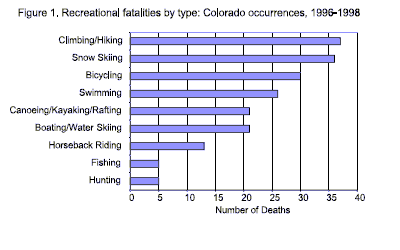
UPDATE: As I noted above, the numbers I gave aren't normalized by the number of participants; I was hoping people might fill that gap in some measure. (I also hope that it's obvious to our readers that without this denominator data, the numerators I give are useful only as a start to answering the question, or at best as a very rough estimate given your rough sense of the order of magnitude of popularity of each activity.)
In the meantime, I did a bit of searching to try to get this information myself; so far, all I've discovered is that in the late 1990s, the U.S. Fish and Wildlife Service reported that about 15 million hunting licenses were sold each year. I'd love to hear what people who know more about hunting licenses can say about how overinclusive (do you often need to buy more than one hunting license to hunt more than one kind of game, or more than once?) or underinclusive (is there lots of hunting that doesn't require such a license?) these numbers might be.
FURTHER UPDATE: A reader who identifies himself as Talon Karrde pointed me (thanking Alphecca) to a Texas Parks & Wildlife Report that reports about 30 accidents per million hunting licenses per year in Texas over 2003-05, including under 3 fatal accidents per million hunting licenses. If this information is complete, and each hunter gets one hunting license per year, then we have a rate of 3 deaths per million per year. If every single American swam (obviously an overestimate), then the 1500 swimming fatalities per year would translate into 5 deaths per million per year; if every American boated (obviously even more of an overestimate), then the 800 swimming fatalities per year would translate into under 3 fatal accidents per million swimmers.
So, if my assumptions about completeness of the Texas records and the hunter-hunting license correspondents are correct, and if the Texas data is generalizable to the country as a whole, then hunting would be less dangerous on a per-participant basis than swimming and boating. We still don't know the relationship, though, on a per-hour-spent basis. If people have statistics on number of participants in swimming and boating, or more accurate information on housing, I'd love to hear them.
Thursday, February 16, 2006
More Details on the Financial Cost of DADT:
I’ve now gone through the recent University of California study of “Don’t Ask, Don’t Tell,” which estimates the costs of the policy in its first ten years (1994 through 2003). The commission that produced the report includes several experts in military and national security policy. Notable among them are former Secretary of Defense William Perry under President Clinton; former Assistant Secretary of Defense Lawrence Korb under President Reagan; retired Admiral John D. Hutson; Professors Donald Campbell and Kathleen Campbell of the U.S. Military Academy at West Point; and Professors Frank Barrett and Mark Eitelberg of the Naval Postgraduate School. Experts in economics, cost accounting, management control systems, and other fields assisted the commission. The Williams Project of the UCLA Law School, which studies gay legal issues and works for gay equality, loaned out the time of Dr. Gary Gates, who provided extensive statistical and conceptual analysis as Senior Project Consultant. While some of those who produced the study may personally oppose DADT, the study itself cannot be dismissed on this basis. It is a serious effort to weigh some of the financial consequences of DADT.
The report breaks down the financial cost of firing service members for homosexuality under DADT into four discrete categories: (1) recruiting costs for enlisted service members; (2) training costs for enlisted service members; (3) training costs for officers; and (4) separation travel costs. Let’s take a look at each of these:
(1) Recruiting costs for enlisted service members fired for homosexuality (1994-2003): $79.2 million
The military spends a lot of money to recruit. Some of this money is spent to recruit service members who are eventually fired for homosexuality. In a February 2005 report tellingly entitled “Financial Costs and Loss of Critical Skills Due to DOD’s Homosexual Conduct Policy Cannot Be Completely Estimated,” the congressional General Accounting Office estimated these costs attributable to DADT at $95.4 million.
The UC Commission believes this overstates the actual cost:
The critical value for estimating this cost, we would argue, is not how much the military spent to replace service members fired for homosexuality. Rather, the appropriate consideration is how much value the military lost as a result of each homosexual discharge. For example, in [an] extreme hypothetical situation [], in which the service member served for almost 30 years in uniform prior to discharge, we suggest that the military barely lost any value from the premature discharge for homosexuality.
To correct this type of error, the UC Commission took the GAO cost for enlisted recruiting of DADT-discharged service members ($95.4 million) as a lodestar and subtracted from that an estimate of the value of this cost the military recovered from the service members’ time in service, as follows:
To determine the military’s monthly return on investment, we divided the average cost of recruiting each enlisted service member ($10,193) by the number of months during which the military could have recovered its investment in that individual’s recruiting. . . . For each enlisted service member, we credited the military with a monthly return on its investment in recruiting for each month served, except for those months spent in initial and mid-career training. The cost of enlisted recruiting was determined by GAO to be $95,393,000. Total recovery on investment . . . is calculated as $16,113,715. The total spent on recruiting, $95,393,000, minus the recovery on investment, $16,113,715 yields a total of $79,279,285.
(2) Training costs for enlisted service members fired for homosexuality (1994-2003): $252.3 million
Once the military recruits a person for service, it invests even more heavily in both basic and initial skills training. The GAO estimated the cost of training recruits fired for homosexuality to be $95.1 million.
This is almost certainly a large underestimate of the cost of training these recruits, for a couple of reasons. First, the GAO number does not reflect training costs for Marines discharged for homosexuality (since the Marines apparently did not provide GAO with training estimates). Second, even the GAO’s training cost figures for the other services are substantially lower than the GAO’s own previous estimates of training costs and estimates available in other public sources. The UC Commission corrected the GAO figures by relying on the Defense Department’s and GAO’s own previous figures for both basic and initial skills training for each of the branches. After that, the UC Commission again credited the military for recovering at least a part of this cost through the member’s service before discharge. Here’s the calculation:
Spending on enlisted training, prior to any recovery of costs, is $331,866,779. Total recovery on investment . . . is calculated as $79,492,728. The total spent on training, $331,866,779, minus the recovery on investment, $79,492,728, yields a total cost to the military of $252,374,051.
(3) Training costs for officers (1994-2003): $17.7 million
The GAO report did not factor the cost of training officers into its report. In the period 1994-2003, 137 officers were discharged for homosexuality.
To quantify the losses associated with firing officers for homosexuality, we estimated the cost of training to commission as well as post-commission training. Then, as was the case with our estimates of recruiting and enlisted training costs, we reduced our estimates by crediting the military with any recovered value on its initial investment in officer training for those officers who served after the completion of their training. Unlike enlisted service members, however, in the case of officers we did not include mid-career training costs in our estimates.
The UC Commission then estimated the cost of training for officers who go through one of five different routes: service academies (like West Point), ROTC, Officer Candidate School, direct appointment, and other paths. Since the UC Commission was unable to get cost estimates for the latter two, it assumed these costs to be zero. This approach yielded these numbers:
Spending on officer training, prior to any recovery of costs, is $27,553,701, of which $15,752,353 is for pre-commission training, and $11,801,348 is for post-commission training. Total recovery on investment . . . is calculated as $9,781,631. The total spent on training, $27,553,701, minus the recovery on investment, $9,781,631, yields a total loss to the military of $17,772,070.
(4) Separation travel costs (1994-2003): $14.3 million
Recruiting and training costs are front-end: they occur at the beginning of a military career. There are also costs associated with separation from the military, the back-end of service. These “out-processing” costs are numerous and are also investments the military must make when it discharges a member. One such cost is travel expense. Using the Army’s own lower-range estimates for such travel costs, and deducting for recovery of costs through time served, the UC Commission found as follows:
Spending on enlisted and officer separation travel, prior to any recovery of costs, is $16,633,308 and $638,381, respectively. Total recovery on investment . . . is calculated as $2,926,816. The total spent on separation travel, $17,271,689 minus the recovery on investment, $2,926,816, yields a total of $14,344,873.
Putting all these numbers together, we arrive at a total cost of $363, 770, 279 to implement DADT during its first ten years.
How accurate is this number? I am not an economist and can’t vouch for the inputs the UC Commission used to calculate costs. Several factors, however, suggest that the UC Commission estimate – while an improvement over the GAO figure – is still a substantial underestimate of the financial cost of expelling gay service members. The Commission itself points to five ways in which its analysis may underestimate costs:
First, we were unable to obtain reliable data for some costs that were omitted from GAO’s original report. For example, we were unable to obtain reliable data for the costs of discharge review boards, security clearances, out-processing costs, investigations into service members’ sexual orientation, re-enlistment bonuses, and officer recruiting.
...
Second, as noted above, our use of the training costs for a surface warfare officer as a proxy for the cost of training all officers reflects a conservative assumption that probably reduced our overall cost estimate. The cost to train a surface warfare officer is $92,924, while the cost to train one jet pilot (T-45 line) is $1,439,754. The list of officers fired for homosexuality includes physicians, pilots, dentists, and other individuals with highly technical training.
Third, many gays and lesbians do not re-enlist after fulfilling their service obligations because they are unwilling to continue to conceal their identity. According to a new survey of 445 gay, lesbian, bisexual and transgendered veterans, 19.6 percent of respondents left the armed forces “voluntarily because they could not be open about being LGBT while in the military.” . . . [T]he military may be losing some of its investment in recruiting and training individuals who would remain in uniform if the ban were repealed.
Fourth, we assumed that the benefits of a service member to the Defense Department accrue evenly over the cost recovery period. . . . This is a conservative assumption given that, as is the case in most industries, service members’ value to the military increases with experience.
...
Fifth, we did not include the costs of marriage benefits for gays and lesbians who get married to opposite-sex individuals to avoid military scrutiny of their sexual orientation, and who then file claims for military benefits for their spouses. According to the new survey of 445 gay, lesbian, bisexual and transgendered veterans mentioned above, 18 percent of respondents (80 individuals) got married to avoid military scrutiny of their sexual orientation.
Of these, the first (additional separation costs) and the third (premature loss of non-discharged gay personnel) seem most likely to add considerably to the real cost of DADT.
There are a few more reasons, in addition to these, that the UC Commission may be underestimating the cost of DADT. At just about every turn, the Commission used very conservative estimates of costs. For example, the UC Commission used a low-ball estimate of the number of service members fired for homosexuality in the ten-year period, putting the number at 9,359 enlisted, active-duty members. But this number, as the Commission notes (fn. 14), does not include some members of the Coast Guard and reserve forces. Including them would add about another 300 discharged under DADT. Further, the UC Commission’s estimate of training costs, though more reasonable than GAO’s, may still be too low. The Commission cites a “senior level military operations research analyst” who estimates that actual training costs are much higher than even the Commission accepts as the basis for its calculations (p. 13). Since enlisted training costs are by far the largest fraction of the overall cost of DADT, under the UC Commission’s own calculation, even small error in per capita costs could have a big effect on the final calculation.
On the other hand, there are a few ways in which the UC Commission may have overestimated the total cost of DADT. First, as the Commission acknowledges, it did not calculate the cost of paying same-sex partner benefits if the ban is lifted. Experience in other countries so far shows this cost is very low. Potentially more significantly, the UC Commission does not attempt to calculate the cost of recruiting, training, and retaining service members who might disdain military service if the ban is lifted. Nobody can know what this cost would be, though it would surely be greater than zero. I doubt it would be a large cost, since open homosexuals would be such a tiny portion of the military services, and whatever the initial cost it could be expected to dwindle as military culture adjusted. The experience of other countries does not indicate any recruitment and retention difficulties attributable to allowing service by openly gay service members. But perhaps the experience of other countries cannot be fully extrapolated to the United States. Finally, as a reader and former service member helpfully noted in a private message to me, the Commission assumes that gay service members discharged under DADT would have served just as long as straight service members if not for DADT. The assumption seems reasonable, and the Commission makes no attempt to defend it. But I do not really know. The difference between the expected length of service and actual service forms the basis for some of the Commission’s cost estimates. If, contrary to the Commission’s assumption, service members expelled under DADT would, on average, serve shorter periods of time than their peers even in the absence of DADT then the “loss” the military suffers because of early discharge would be correspondingly smaller.
Finally, whatever the accuracy of the numbers in the UC Commission report, the financial costs alone do not resolve the debate over DADT, just as financial cost does not resolve a debate over any policy that might be worthwhile. The military exists to deter wars and, when that fails, to win them. If allowing homosexuals to serve openly would likely hinder that mission to any substantial degree, then the financial cost of expelling them would have to be just one more item in the Defense Department’s budget. Nor do “financial costs” alone measure all the costs – in broken careers, broken lives, broken families, in the dignitary loss to gay Americans in general and to those who want to serve their country with integrity in particular – of having a policy that expels American service members simply because we learn they’re gay.
But we cannot have a debate over the overall costs and benefits of DADT without at least a reasonable baseline estimate of the financial costs. For that reason, the UC Commission has made what appears to be a useful and important contribution. Military policy leaders in Congress should take a close look at the study, since Congress is the body that must repeal or amend DADT.
I am interested in readers’ views on the specifics of this study. I am especially interested in hearing from readers who have expertise in economics, accounting, and military-cost analysis.
Wise Words,
apropos the Georgia vibrator law post, from commenter Kieran Jadiker-Smith:
Fear the government that fears your dildo.
Related Posts (on one page):
George Will on NSA Surveillance Program:
George Will has a column today criticizing the Bush Administration's defense of the NSA domestic surveillance program: No Checks, Many Imbalances. An excerpt:
Thanks to Crooked Timber for the link.
[T]errorism is not the only new danger of this era. Another is the administration's argument that because the president is commander in chief, he is the "sole organ for the nation in foreign affairs." That non sequitur is refuted by the Constitution's plain language, which empowers Congress to ratify treaties, declare war, fund and regulate military forces, and make laws "necessary and proper" for the execution of all presidential powers . Those powers do not include deciding that a law — FISA, for example — is somehow exempted from the presidential duty to "take care that the laws be faithfully executed."Will ends the column by calling on Congress to amend FISA to make the NSA program legal: "It should do so with language that does not stigmatize what [the Executive Branch] has been doing, but that implicitly refutes the doctrine that the authorization is superfluous."
The administration, in which mere obduracy sometimes serves as political philosophy, pushes the limits of assertion while disdaining collaboration.
Thanks to Crooked Timber for the link.
The Perks of Being a Professor or Student in Georgia:
I just read a case striking down (on slightly complex grounds that I won't get into here) Georgia's law banning the distribution and advertising of "obscene material" — including "[a]ny device designed or marketed as useful primarily for the stimulation of human genital organs," as well as hard-core porn of the sort that the law describes as "obscenity" — and found this exception:
(e) It is an affirmative defense under this Code section that dissemination of the material was restricted to:
(1) A person associated with an institution of higher learning, either as a member of the faculty or a matriculated student, teaching or pursuing a course of study related to such material . . . .
I know that some people think that professors and students — and especially law professors and law students — are especially in need of sex aids, but it's nice to see that under Georgia law they actually get a special entitlement to them! I realize, of course, that this is limited to people who are "teaching or pursuing a course of study related to such material," but courses of study are not hard to set up, especially given the availability of independent study projects . . . .
Thanks to How Appealing for the pointer to the opinion.
Related Posts (on one page):
- Wise Words,
- The Perks of Being a Professor or Student in Georgia:
Necessary and Proper?
Which Supreme Court Justice called the Necessary and Proper Clause "the last, best hope of those who defend ultra vires congressional action"? Click "show" for answer.
(show)
Computer Crime Law:
It's not just a cool new area for lawyers; it's a "fundamental indicator of the American dream." I like that. (Hat tip: Doug Berman)
A Few Words from the Covenant of the Party That the Palestinians Elected:
From the Hamas Covenant (dated 18 August 1988) (some paragraph breaks added):
The enemies have realised the importance of [the Moslem woman's] role. They consider that if they are able to direct and bring her up they way they wish, far from Islam, they would have won the battle. That is why you find them giving these attempts constant attention through information campaigns, films, and the school curriculum, using for that purpose their lackeys who are infiltrated through Zionist organizations under various names and shapes, such as Freemasons, Rotary Clubs, espionage groups and others, which are all nothing more than cells of subversion and saboteurs. These organizations have ample resources that enable them to play their role in societies for the purpose of achieving the Zionist targets and to deepen the concepts that would serve the enemy. . . . .
For a long time, the enemies have been planning, skillfully and with precision, for the achievement of what they have attained. They took into consideration the causes affecting the current of events. They strived to amass great and substantive material wealth which they devoted to the realisation of their dream.
With their money, they took control of the world media, news agencies, the press, publishing houses, broadcasting stations, and others. With their money they stirred revolutions in various parts of the world with the purpose of achieving their interests and reaping the fruit therein.
They were behind the French Revolution, the Communist revolution and most of the revolutions we heard and hear about, here and there. With their money they formed secret societies, such as Freemasons, Rotary Clubs, the Lions and others in different parts of the world for the purpose of sabotaging societies and achieving Zionist interests. With their money they were able to control imperialistic countries and instigate them to colonize many countries in order to enable them to exploit their resources and spread corruption there.
You may speak as much as you want about regional and world wars. They were behind World War I, when they were able to destroy the Islamic Caliphate, making financial gains and controlling resources. They obtained the Balfour Declaration, formed the League of Nations through which they could rule the world. They were behind World War II, through which they made huge financial gains by trading in armaments, and paved the way for the establishment of their state. It was they who instigated the replacement of the League of Nations with the United Nations and the Security Council to enable them to rule the world through them. There is no war going on anywhere, without having their finger in it. . . .
World Zionism, together with imperialistic powers, try through a studied plan and an intelligent strategy to remove one Arab state after another from the circle of struggle against Zionism, in order to have it finally face the Palestinian people only. Egypt was, to a great extent, removed from the circle of the struggle, through the treacherous Camp David Agreement. They are trying to draw other Arab countries into similar agreements and to bring them outside the circle of struggle.
The Islamic Resistance Movement calls on Arab and Islamic nations to take up the line of serious and persevering action to prevent the success of this horrendous plan, to warn the people of the danger eminating from leaving the circle of struggle against Zionism. Today it is Palestine, tomorrow it will be one country or another. The Zionist plan is limitless. After Palestine, the Zionists aspire to expand from the Nile to the Euphrates. When they will have digested the region they overtook, they will aspire to further expansion, and so on. Their plan is embodied in the "Protocols of the Elders of Zion", and their present conduct is the best proof of what we are saying.
Leaving the circle of struggle with Zionism is high treason, and cursed be he who does that. . . .
This is from the Covenant of the new governing party of the Palestinian Authority. "Why do they hate us?," at least where the "us" is Jews? Could one reason be the stuff they're taught by authoritative voices in their countries? And how does one negotiate with people who have such a tenuous grasp of reality?
UPDATE: Whoops, at first forgot to include the Protocols of the Elders of Zion section; just remedied that.
UPDATE: Roger Alford (Opinion Juris) has more on the Hamas Party Charter.
Censorship Envy, Speech That's Offensive to Muslims, and European Law:
One recurring argument that I've seen from Muslims who want the cartoons legally suppressed is that European laws prohibit other kinds of speech offensive to other groups — for instance, Holocaust denial, which is often restricted chiefly because it's seen as implicitly or explicitly anti-Semitic — and that Muslims should get the same treatment. In practice, those laws don't get used that often, and European speech is actually more free than the laws would suggest. Nonetheless, the laws' presence does make possible the argument I describe; and I suspect it does make many Muslims feel even more aggrieved than they would be by the cartoons themselves, since they are also now aggrieved by what they see as discriminatorily enforced laws.
Consider, just as one example among many, Norwegian Penal Code secs. 135 & 135a (noted here; thanks to Rebecca Davidson for pointing to that article, and to Jill Fukunaga of the UCLA Law Library for finding the English text of the code sections):
§ 135. Any person who endangers the general peace by publicly insulting or provoking hatred of the Constitution or any public authority or by publicly stirring up one part of the population against another, or who is accessory thereto, shall be liable to fines or to detention or imprisonment for a term not exceeding one year.
§ 135 a. Any person shall be liable to fines or imprisonment for a term not exceeding two years who by any utterance or other communication made publicly or otherwise disseminated among the public threatens, insults, or subjects to hatred, persecution or contempt any person or group of persons because of their creed, race, colour or national or ethnic origin. The same applies to any such offensive conduct towards a person or a group because of their homosexual bent, life-style, or inclination.
The same penalty shall apply to any person who incites or is otherwise accessory to any act mentioned in the first paragraph.
These belong to the family of restrictions on "hate speech" and "incitement to hostility" that Europeans (and some Americans) sometimes praise as a model "reasonable" alternative to America's speech protections. But look how broad they are: If you "endanger[] the general peace" by "publicly stirring up one part of the population against another," you can go to prison. If you disseminate a communication that "insult[s]" "any group of persons because of their creed," you can go to prison.
Of course publication of the cartoons would be covered. My providing a link to the cartoons (which I've done in many of my previous posts, since providing such a link is in my view necessary to helping people understand the controversy) would be a crime under Norwegian law: I would be an accessory to a communication that insults some Muslims because of their creed. And of course many Muslims would feel entitled to have this law enforced to protect their sensibilities.
Many Muslims are surely offended enough by the cartoons on their own; but at least in America we can tell them to join the club — American Christians have no legal protection from anti-Christian speech, American Jews have none from anti-Semitic speech, blacks have none from racist speech, Americans generally have none from anti-American speech. What can Norwegians tell them, other than (1) "Sorry, the laws don't protect you," (2) "OK, we'll enforce the laws to suppress this speech that insults you," or (3) "These are bad laws, we're glad that they've rarely been used, we're sorry they were ever enacted, and we are going to repeal them right away" (my preferred suggestion, though not one likely to be implemented, and one that would still be understandably offensive to many Muslims, since the laws' repeal would have been triggered by speech that's offensive to Muslims)?
All Related Posts (on one page) | Some Related Posts:
- Daily Illini Fires Editor Who Published the Mohammed Cartoons:
- President of Bar Association in Pakistan, Plus Major Pakistani Party, Supports Murder of Danish Cartoonists:
- The Twelve Mohammed Cartoons, in Detail:...
- Mohammed Cartoons in the Classroom, in the News:
- Censorship Envy, Speech That's Offensive to Muslims, and European Law:
- Illinois Student Newspaper Editors Suspended for Running the Danish Cartoons:...
- U.S. State Department on the Cartoons Depicting Mohammed:
- Bush Cabinet Member Condemns Anti-Christian Blasphemy, and Points to Laws Restricting Incitement to Hateful Expressions:
- Suppressing Anti-Religious Speech -- an Emerging International Law Norm?
Judge Orders DOJ to Expedite Release of NSA Documents:
The first judicial opinion touching on the NSA domestic surveillance program was issued today, and it didn't go well for the Bush Administration.
The case involved a skirmish over a FOIA request made by the Electronic Privacy Information Center (EPIC) in December for discoverable documents relating to the program, and in particular EPIC's request for expedited processing of its request. EPIC sought the following items from DOJ "from September 11, 2001 to the present concerning a presidential order or directive authorizing the National Security Agency (‘NSA’), or any other component of the intelligence community, to conduct domestic surveillance without the prior authorization of the Foreign Intelligence Surveillance Court":
Judge Kennedy rejected DOJ's position, and ordered DOJ to review the documents, determine what is discoverable, and comply with the request in 20 days. Some of the language was particularly notable:
Thanks to Howard for the link.
The case involved a skirmish over a FOIA request made by the Electronic Privacy Information Center (EPIC) in December for discoverable documents relating to the program, and in particular EPIC's request for expedited processing of its request. EPIC sought the following items from DOJ "from September 11, 2001 to the present concerning a presidential order or directive authorizing the National Security Agency (‘NSA’), or any other component of the intelligence community, to conduct domestic surveillance without the prior authorization of the Foreign Intelligence Surveillance Court":
(1) an audit of NSA domestic surveillance activities;The decision issued today considered EPIC's motion for a prelimary injunction ordering DOJ to comply with its request within 20 days. DOJ's position was that the request should be expedited, but that it should not be required to set a date by which the request would be answered.
(2) guidance or a "checklist" to help decide whether probable cause exists to monitor an individual’s communications;
(3) communications concerning the use of information obtained through NSA domestic surveillance as the basis for DOJ surveillance applications to the FISC; and
(4) legal memoranda, opinions or statements concerning increased domestic surveillance, including one authored by John C. Yoo shortly after September 11, 2001 discussing the potential for warrantless use of enhanced electronic surveillance techniques.
Judge Kennedy rejected DOJ's position, and ordered DOJ to review the documents, determine what is discoverable, and comply with the request in 20 days. Some of the language was particularly notable:
Under DOJ’s view of the expedited processing provisions of FOIA, the government would have carte blanche to determine the time line for processing expedited requests, with the courts playing no role whatsoever in the process. When pressed at the preliminary injunction hearing as to what delay would be excessive enough such that a court could properly invoke its authority to compel production, counsel for DOJ was unable or unwilling to give an answer. Rather, DOJ’s counsel suggested that the court and the requestor simply must take at face value an agency’s determination that more time is necessary, regardless of the time that has elapsed since the request was filed. DOJ’s position is easily rejected.It's only a district court decision, of course. And as critics of the opinion will surely point out, it's a district court decision issued by a Clinton-appointed judge. But my guess is that we'll be seeing more decisions along these lines in the future.
As EPIC suggests, DOJ’s reading of the statute would give the agency unchecked power to drag its feet and "pay lip service" to a requester’s "statutory and regulatory entitlement to expedition." . . . . Adopting the government’s position—that an agency has unfettered discretion to determine how long is practicable for processing expedited requests—would require the court to abdicate its "duty" to prevent "unreasonable delays in disclosing non-exempt documents."
. . .
Beyond losing its right to expedited processing, EPIC will also be precluded, absent a preliminary injunction, from obtaining in a timely fashion information vital to the current and ongoing debate surrounding the legality of the Administration’s warrantless surveillance program. President Bush has invited meaningful debate about the warrantless surveillance program. David E. Sanger, In Shift, Bush Says He Welcomes Inquiry on Secret Wiretaps, N.Y. TIMES, Jan. 12, 2006. That can only occur if DOJ processes its FOIA requests in a timely fashion and releases the information sought.fn9
[fn9: DOJ argues that "[b]ased upon the information that the government has already made public . . . plaintiff is fully able to participate in the current public debate." Def.’s Opp’n at 18. This argument is quickly rejected, for as EPIC correctly argues, "a meaningful and truly democratic debate on the legality and propriety of the warrantless surveillance program cannot be based solely upon information that the Administration voluntarily chooses to disseminate." Pl.’s Reply at 8 (quotation omitted).]
. . .
. . . Finally, given the great public and media attention that the government’s warrantless surveillance program has garnered and the recent hearings before the Senate Judiciary committee, the public interest is particularly well-served by the timely release of the requested documents.
DOJ counters that a preliminary injunction will actually harm the public interest. Specifically, DOJ suggests that requiring the agency to finish its processing within twenty days will increase the chances that the agency will inadvertently disclose exempted documents. . . . To be sure, the court does not wish for DOJ to inadvertently release exempted materials.. . . However, "[m]erely raising national security concerns cannot justify unlimited delay." Id. Congress has already weighed the value of prompt disclosure against the risk of mistake by an agency and determined that twenty days is a reasonable time period, absent exceptional circumstances, for an agency to properly process standard FOIA requests. Here, DOJ has not yet made any specific showing that it will not be able to process the documents within the time period sought by EPIC. Vague suggestions that inadvertent release of exempted documents might occur are insufficient to outweigh the very tangible benefits that FOIA seeks to further—government openness and accountability.
Thanks to Howard for the link.
A Lovely Little Legal Realist Rant,
from Felix Cohen's Transcendental Nonsense and the Functional Approach, 35 Colum. L. Rev. 809 (1935). In a sense, Justice Holmes's "Think things, not words" captures it well and tersely, but sometimes the longer version has its value:
I. The Heaven of Legal Concepts
Some fifty years ago a great German jurist had a curious dream. He dreamed that he died and was taken to a special heaven reserved for the theoreticians of the law. In this heaven one met, face to face, the many concepts of jurisprudence in their absolute purity, freed from all entangling alliances with human life. Here were the disembodied spirits of good faith and bad faith, property, possession, laches, and rights in rem. Here were all the logical instruments needed to manipulate and transform these legal concepts and thus to create and to solve the most beautiful of legal problems.
Here one found a dialectic-hydraulic-interpretation press, which could press an indefinite number of meanings out of any text or statute, an apparatus for constructing fictions, and a hair-splitting machine that could divide a single hair into 999,999 equal parts and, when operated by the most expert jurists, could split each of these parts again into 999,999 equal parts. The boundless opportunities of this heaven of legal concepts were open to all properly qualified jurists, provided only they drank the Lethean draught which induced forgetfulness of terrestrial human affairs. But for the most accomplished jurists the Lethean draught was entirely superfluous. They had nothing to forget. . . .
Breyer on Arriving at the Supreme Court:
In today's New York Times, Linda Greenhouse reports on an interview with Justice Breyer about his early years as a Supreme Court Justice:
"I was frightened to death for the first three years," he said in a recent conversation. . . .
"I was afraid I might inadvertently write something harmful," Justice Breyer said. "People read every word. Everything you do is important. There is a seriousness to every word, and you really can't go back. Precedent doesn't absolutely limit you. In almost every case, you're in a wide-open area. The breadth of that opening, getting up to speed on each case, constitutional law as a steady diet, the importance to the profession. ..." His voice trailed off, and he shook his head. "My goodness!" he exclaimed.
New Jersey Gay Marriage Case:
Over at Concurring Opinions, Mike Dimino has an interesting post on a gay marriage case pending before the New Jersey Supreme Court.
Wednesday, February 15, 2006
Lecture Today @ Wash U:
At noon today (Thursday) I am giving a lecture on "The Presumption of Liberty and the Public Interest: Medical Marijuana and Fundamental Rights" at Washington University in St. Louis as part of the Public Interest Law Speakers Series (scroll down). The event will be held in the Bryan Cave Moot Courtroom.
Last night I had an interesting dinner with members of the board of the Federalist Society Student Chapter including a 2L who, before coming to law school, played "street kid" in The Killer Eye (1998). The food was good too.
On Thursday of next week, I will be speaking on "Scalia's Infidelity: A Critique of Faint-Hearted Originalism" at the University of Texas School of Law.
On Friday, I will be speaking on a panel at the International Contract Law Conference being held at Texas Wesleyan in Fort Worth.
Last night I had an interesting dinner with members of the board of the Federalist Society Student Chapter including a 2L who, before coming to law school, played "street kid" in The Killer Eye (1998). The food was good too.
On Thursday of next week, I will be speaking on "Scalia's Infidelity: A Critique of Faint-Hearted Originalism" at the University of Texas School of Law.
On Friday, I will be speaking on a panel at the International Contract Law Conference being held at Texas Wesleyan in Fort Worth.
California S.C. Hears Arguments on the Friends Sexual Harassment Case:
An interesting report on the arguments yesterady from the N.Y. Sun. My take on the case can be found here. In short,
if the Lyle opinion is allowed to stand, any Californian whose job involves dealing with controversial matters that raise issues potentially offensive to some people — AIDS education, abortion counseling (pro or con), civil rights and affirmative action, and much more — will be at risk of a harassment lawsuit. The only out provided for defendants by the California Court of Appeals is to prove that any "offensive" comments are made "within 'the scope of necessary job performance,'" a determination that, as UCLA law professor Eugene Volokh notes, will necessarily involve vague and subjective perceptions of what speech is "necessary" to any particular job.
More on the Attack on Ronald McDonald:
Turns out that Ronald has been insulting Islam. Classical Values has the details.
But, in fact, the Islamic world should nevertheless be grateful to Ronald for his heroic actions.
Related Posts (on one page):
- More on the Attack on Ronald McDonald:
- Next, They Came for the Plastic Clowns:
Funny Blog Item I Ran Across:
From Joe's Dartblog:
Unlike affirmative action, there seems to be no shortage of supremely justiciable cases on abortion. The South Dakota state house decided to create some today when it voted for a near-outright ban on the procedure. It passed 47-22 after an hour of debate. If the bill is passed by the senate in coming days, it will become prime fodder for a high court review of Roe. If the Roberts courts reverses the core of that decision,Agree with it or not the merits, but it seems to me like an amusing little dig.the ninth circle of Hell will incarnate as a four-winged black demon, swallowing the very essence of human goodness into its fiery mawthe matter will be decided upon by each state’s legislature.
Kissing:
Joshua Foer, writing in The New York Times, reports (among other interesting things):
All across Africa, the Pacific and the Americas, we find cultures that didn't know about mouth kissing until their first contact with European explorers. And the attraction was not always immediately apparent. Most considered the act of exchanging saliva revolting. Among the Lapps of northern Finland, both sexes would bathe together in a state of complete nudity, but kissing was regarded as beyond the pale.
To this day, public kissing is still seen as indecent in many parts of the world. In 1990, the Beijing-based Workers' Daily advised its readers that "the invasive Europeans brought the kissing custom to China, but it is regarded as a vulgar practice which is all too suggestive of cannibalism." . . .
Vaughn Bryant, an anthropologist at Texas A&M, has traced the first recorded kiss back to India, somewhere around 1500 B.C., when early Vedic scriptures start to mention people "sniffing" with their mouths, and later texts describe lovers "setting mouth to mouth." From there, he hypothesizes, the kiss spread westward when Alexander the Great conquered the Punjab in 326 B.C.
The Romans were inveterate kissers, and along with Latin, the kiss became one of their chief exports. . . .
Thanks to David Tice for the pointer.
Saved by Our National Historical Illiteracy:
Just ran across a funny case from July 2005. Twenty-one-year-old Ohio residents Scott Christopher Wurgler and his twin brother Matthew Allen Wurgler, decided to change their names to Sacco Vandal and Vanzetti Vandal. No, said the magistrate, because "the name change would be contrary to public policy" (a general legal reason for why name change applications may be denied) -- the new name, he reasoned, was "synonymous with anarchism, wanton destruction and murder." (By the way, five years before, Ohio courts refused to let a man changed his name to "Santa Claus" because this "would mislead children and interfere with society's proprietary interest in the identity of a beloved icon.")
Scott Wurgler objected, for four reasons -- (1) "he wanted a name that he himself selected," (2) the name "would reflect his Italian heritage," (3) "the new name has a pleasant ring to it and he wished to use the name in his rock band and in other business ventures," and (4) "the new name will help him in his future bid for public office" (uh, really?).
The judge reviewing the magistrate's decision disagreed. "Few people are aware of the name 'Sacco' and its connection to the anarchist movement in 20th century America." "Even fewer would associate the name 'Vandal' with the Vandal hoards [sic] of Europe" -- "A check of a White Pages website reveals more than a dozen presumably law-abiding Ohioans with the surname of Vandal." "If the applicant is using the name change to make a statement to society . . . it is a subtle one. Most people won't 'get it' without a short history lesson and a long social commentary." Name change approved.
Another NSA Program?:
The United Press International reports that former NSA employee Russell Tice, who has been in the news recently as one of the leakers of the NSA surveillance program, is now saying that there is another "more wide-ranging program" beyond the one disclosed by the New York Times in December:
UPDATE: I edited this after posting.
A former NSA employee said Tuesday there is another ongoing top-secret surveillance program that might have violated millions of Americans' Constitutional rights.This disclosure is consistent with Attorney General Gonzales's strong hint before the Senate Judiciary Committee that there are other telecommunications surveillance programs beyond the one disclosed by the Times.
Russell D. Tice told the House Government Reform Subcommittee on National Security, Emerging Threats and International Relations he has concerns about a "special access" electronic surveillance program that he characterized as far more wide-ranging than the warrentless [sic] wiretapping recently exposed by the New York Times but he is forbidden from discussing the program with Congress.
Tice said he believes it violates the Constitution's protection against unlawful search and seizures but has no way of sharing the information without breaking classification laws. He is not even allowed to tell the congressional intelligence committees - members or their staff - because they lack high enough clearance.
UPDATE: I edited this after posting.
Illinois Student Newspaper Editors Suspended for Running the Danish Cartoons:
A Statement from the Publisher in the latest Daily Illini says:
A student task force has been formed by the Illini Media board of directors and the company's publisher to investigate the internal decision-making and communication surrounding the publishing of The Daily Illini Opinions Page of Thursday, Feb. 9.The Daily Illini is an independent nonprofit in which the ultimate decisionmaking authority is in the hands of the publisher and an eight-member board, which consists of four students and four faculty members.The student staff in The Daily Illini newsroom has questioned in print and in meetings the manner in which Editor in Chief Acton Gorton and Opinions Editor Chuck Prochaska produced the page. While the task force convenes for approximately two weeks, these two editors have been suspended, and Managing Editors Shira Weissman and Jason Koch will serve together as interim editor in chief.
The board and publisher reaffirm that final decisions about content in The Daily Illini rest with the editor in chief. But the board and publisher also recognize that journalistic norms regarding professional behavior dictate that it is the editor's obligation to engage other student editors and student staff members in rigorous discussion and debate of sensitive content.
Mary Cory
Publisher and General Manager
Illini Media Co.
I'm pretty sure there's no constitutional problem here; the board of directors of a nonprofit publication is entitled to ultimately control what the publication publishes, and to control who gets to make the daily decisions about such matters. That some of the board of directors members are faculty at a public university doesn't change the matter; I don't believe they're acting in their official capacity, and, even if they were speaking for the university so that the newspaper were a university-controlled organ, the university would generally be entitled to dictate what is published in the media that it controls. (A public university is not entitled to dictate what is published in privately owned student newspapers; but here either the newspaper is private and controlled by a board of directors acting in its private capacity, or [less likely] it would be seen as being controlled by faculty members acting as public officials, in which case it's no longer really quite private.)
Nonetheless, one can certainly question whether the board of directors decision is sound. The cartoons are extremely newsworthy; to understand the worldwide events of the last several weeks, people have to be able to see the cartoons. They are indeed easily available online, but it certainly makes sense that a paper publication would want to make them instantly available to its readers, rather than providing a link that they hope their readers will eventually plug into a browser.
The strongest defense I can see of the Board's decision is if indeed the editor's decision violated traditional consultative norms of the Daily Illini editorial process. If the Daily Illini had indeed generally been run on a principle that, before any "sensitive content" (e.g., potentially offensive criticism of Christianity, material that some readers might find vulgar, and so on) is published, the editor must "engage other student editors and student staff members in rigorous discussion and debate" of the subject, then an editor's departure from this norm might be seen as an undue arrogation of decisionmaking authority. I don't think that there are any general "journalistic norms" requiring such consultation — a dictatorial editorial model is perfectly within journalistic norms, it seems to me (with some possible exceptions that are not applicable here). But if there are such norms at the Daily Illini, the Board may reasonably insist that the norms continue to be followed, to protect a decisionmaking process that it finds valuable.
I'd love to know more about this procedural justification that the Board is giving. Do any readers know more details on what actually happened here, and what Daily Illini practice has been? Has the Board made more detailed statements on the subject? Are the Illini's own "journalistic standards" available somewhere? Here is what one of the suspended editors says (I quote from a Chicago Tribune article on the controversy):
Acton Gorton, 25, said he believes he made a sound journalistic decision in running six of the cartoons because the public has a right to judge their content. He said he consulted with top staff members and journalism instructors before making the decision to publish them in Thursday's newspaper.Here's the contrary view:
[O]n Monday, the paper ran an editorial apologizing for Gorton's decision and called the move "a blatant abuse of power" by a "renegade editor who firmly believes that his will is also the will of the paper."The task force will study whether Gorton made his decision in a vacuum that was improper according to the Illini's journalistic standards, written in 1947.
Thanks to reader Mark Deming for the pointer.
All Related Posts (on one page) | Some Related Posts:
- Daily Illini Fires Editor Who Published the Mohammed Cartoons:
- President of Bar Association in Pakistan, Plus Major Pakistani Party, Supports Murder of Danish Cartoonists:
- The Twelve Mohammed Cartoons, in Detail:...
- Censorship Envy, Speech That's Offensive to Muslims, and European Law:
- Illinois Student Newspaper Editors Suspended for Running the Danish Cartoons:
- Reaction to the Cartoons Descends into Unintentional Self-Parody:...
- U.S. State Department on the Cartoons Depicting Mohammed:
- Bush Cabinet Member Condemns Anti-Christian Blasphemy, and Points to Laws Restricting Incitement to Hateful Expressions:
- Suppressing Anti-Religious Speech -- an Emerging International Law Norm?
The Conspiracy Teams Up With the Federation:
The OpinionJournal Federation of Web sites is up, and I'm pleased to say that we're part of it. (The current list of members is Council on Science and Health, City Journal, Claremont Institute, Commentary, Competitive Enterprise Institute, Dynamist, Eduwonk, First Things, InstaPundit, Larry J. Sabato's Crystal Ball, Overlawyered, Pacific Research Institute for Public Policy, RealClearPolitics, Reason Foundation, Property and Environment Research Center, The American Spectator, The Federalist Society, The Heritage Foundation, The New Criterion, and us.) Right now, the Federation page links to all the sites, plus a featured article from one of them; I'm not sure what more OpinionJournal plans for this, but I look forward to seeing.
Naturally, OpinionJournal exercises no editorial control over what we post here, though of course they're entitled to choose which, if any, of our posts they'll specially link to.
Alito's Law Clerks:
The Washington Post has the scoop on Justice Alito's law clerks. Of primary importance here at the VC, Alito made the smart move and hired Sasha. Alito also picked up Ben Horwich, who was clerking with Sasha for SOC.
For my money, though, the remaining picks are more interesting. Alito selected three of his best former clerks — two of whom went on to clerk at the Supreme Court — to return and clerk for him again. The veteran Alito clerks are Williams & Connolly associate Hannah Smith, who clerked for Alito in '01-'02 before clerking for Justice Thomas in OT03; Sidley Austin litigation partner and former Congressional candidate Jay Jorgensen, who clerked for Alito in '97-'98 before clerking for Chief Justice Rehnquist in OT99; and Adam Ciongoli, who clerked for Alito in '95-'96, was an aide to then-AG John Ashcroft in 2001-03, and most recently has served as General Counsel of Time-Warner Europe.
With that team of clerks, you can bet Alito is going to hit the ground running.
For my money, though, the remaining picks are more interesting. Alito selected three of his best former clerks — two of whom went on to clerk at the Supreme Court — to return and clerk for him again. The veteran Alito clerks are Williams & Connolly associate Hannah Smith, who clerked for Alito in '01-'02 before clerking for Justice Thomas in OT03; Sidley Austin litigation partner and former Congressional candidate Jay Jorgensen, who clerked for Alito in '97-'98 before clerking for Chief Justice Rehnquist in OT99; and Adam Ciongoli, who clerked for Alito in '95-'96, was an aide to then-AG John Ashcroft in 2001-03, and most recently has served as General Counsel of Time-Warner Europe.
With that team of clerks, you can bet Alito is going to hit the ground running.
Live webcast of New Jersey Gay Marriage case:
You can listen now to the live webcast of oral argument before the New Jersey Supreme Court on a case challenging the exclusion of same-sex couples from marriage under the state constitution. It's at http://www.judiciary.state.nj.us/webcast/index.htm.
The Financial Cost of "Don't Ask, Don't Tell":
Under "Don't Ask, Don't Tell," more than 10,000 Americans serving the country in the military have been expelled for homosexuality. A new study sponsored by the University of California has found that in the period from 1994 to 2003, the cost of discharging and replacing gay service members was at least $363.8 million. That figure, which the researchers say is a low-ball estimate, is 91% higher than the estimate released by the General Accounting Office a year ago.
I'll look through the report in detail and report more later. In the meantime it can be found at http://www.gaymilitary.ucsb.edu/Publications/2006-02BlueRibbonFinalRpt.pdf.
Scalia, Living in a Glass House:
"That's the argument of flexibility and it goes something like this: The Constitution is over 200 years old and societies change. It has to change with society, like a living organism, or it will become brittle and break."
"But you would have to be an idiot to believe that," Scalia said. "The Constitution is not a living organism, it is a legal document. It says something and doesn't say other things."
So remind me again, Justice Scalia, how putting people in jail for the noncommercial cultivation and use of marijuana in California by California residents for medical purposes as allowed by California law comes within Congress's power to "regulate commerce ... among the several states." Unless you were an advocate of the "argument of flexibility" and the idea that the Constitution "has to change with society like a living organism," you would have to be an idiot to believe that the Necessary and Proper Clause somehow allows Congress to also regulate noncommercial intrastate activity with no substantial effect on interstate commerce, no?
The Sound of One Hard Drive Failing:
Listen to this — it's the winning entry in a competition to make the most interesting musical track based entirely on sounds made by failing hard drives on Hitachi computers. [Hitachi, it turns out, had posted the various sounds its failing drives make as a troubleshooting guide for users . . .] Seriously. See the description of the contest at the Gizmodo Gadgets weblog. It's quite a lovely little piece of ambient music ... [and thanks to J. Lewis for pointing me here]
Tuesday, February 14, 2006
Will White House Pressure Block Congressional NSA Hearings?:
The Washington Post has the latest.
Next, They Came for the Plastic Clowns:
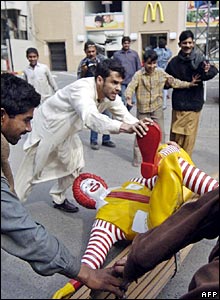
Via Drudge.
Related Posts (on one page):
- More on the Attack on Ronald McDonald:
- Next, They Came for the Plastic Clowns:
A Very Volokh Valentine:
Reading a biography of Alexander the Great (Agnes Savill, Alexander the Great and His Time), I came across the following:
The famous Theban band [of male lovers] was renowned for its heroism; the lovers swore to live or die together and were invincible in war. To gain the admiration of his friend, a young man attempted deeds of valour; the praise of his companion was to him more precious than that of any relative or superior officer.
Not quite invincible, it seems. At the battle of Chaeronea on August 2, 338 B.C., the Greeks were arrayed against the forces of Philip of Macedon, Alexander's father. The Greeks' very independence was at stake, and both Theban and Athenian armies allied to defend it against Macedon. Key to the Theban military was the Theban Sacred Band, the group of 150 pairs of same-sex lovers Savill refers to above. For decades they had been considered the elite of the Theban army. Now they faced the better trained and more experienced Macedonian forces under Alexander's command. In hard-fought battle, the Sacred Band was decimated. Here Savill picks up the narrative again:
When Philip saw the bodies of the fallen lovers after the battle of Chaeronea, he exclaimed with tears: "Perish the man who suspects that these men ever did or suffered anything base."
It is an extraordinary moment: an enemy commander paying tearful tribute to the bravery of an opposing forced comprised of a group of homosexual lovers. Not for Philip, it seems, the peculiar modern American notion that homosexuality is incompatible with military service. Philip is defending the Theban Band against those — and there were such people and regions even in ancient Greece — who would condemn them as vile or disgusting for their very love. In fact, this is among the first times in recorded history that a person of Philip's stature championed the basic dignity and worth of same-sex couples. He speaks to us today, Valentine's Day, more than 2300 years later.
I'm reaching out to Ted Barlow of Crooked Timber
Jury Service:
David Hardy reports:
My ex law partner was walking through the courthouse one day (this is a true story) and he saw an old client in the jury assembly area. They get to chatting, and he notices the guy has a copy of Mein Kampf under his arm. A version with the title in large letters on the cover. He asks what in the heck the guy is doing with it.
"Would you pick someone for a jury whom you saw reading Mein Kampf?"
"Hell, no!"
"Then why are you asking me why I'm reading it?"
Two different lives:
These stories came to me via e-mail. None of the language below is mine. The two stories are both about courage, although in very different ways:
Many years ago, Al Capone virtually owned Chicago. Capone wasn't famous for anything heroic. He was notorious for enmeshing the windy city in everything from bootlegged booze and prostitution to murder.
Capone had a lawyer nicknamed "Easy Eddie." He was his lawyer for a good reason. Eddie was very good! In fact, Eddie's skill at legal maneuvering kept Big Al out of Jail for a long time. To show his appreciation, Capone paid him very well.
Not only was the money big, but Eddie got special dividends. For instance, he and his family occupied a fenced-in mansion with live-in help and all of the conveniences of the day.
The estate was so large that it filled an entire Chicago City block. Eddie lived the high life of the Chicago mob and gave little consideration to the atrocity that went on around him.
Eddie did have one soft spot, however. He had a son that he loved dearly. Eddie saw to it that his young son had the best of everything: clothes, cars and a good education. Nothing was withheld. Price was no object.
And, despite his involvement with organized crime, Eddie even tried to teach him right from wrong. Eddie wanted his son to be a better man than he was. Yet, with all his wealth and influence, there were two things he couldn't give his son; that he couldn't pass on a good name and a good example.
One day, Easy Eddie reached a difficult decision. Easy Eddie Wanted to rectify wrongs he had done. He decided he would go to the authorities and tell the truth about Al "Scarface" Capone, clean up his tarnished name and offer his son some semblance of integrity.
To do this, he would have to testify against The Mob, and he knew that the cost would be great. He testified and within the year, Easy Eddie's life ended in a blaze of gunfire on a lonely Chicago Street. But in his eyes, he had given his son the greatest gift he had to offer, at the greatest price he would ever pay.
Story Number Two:
World War II produced many heroes. One such man was Lieutenant Commander Butch O'Hare. He was a fighter pilot assigned to the aircraft carrier Lexington in the South Pacific.
One day his entire squadron was sent on a mission. After he was airborne, he looked at his fuel gauge and realized that someone had forgotten to top off his fuel tank. He would not have enough fuel to complete his mission and get back to his ship. His flight leader told him to return to the carrier.
Reluctantly, he dropped out of formation and headed back to the fleet. As he was returning to the mother ship he saw something that turned his blood cold.
A squadron of Japanese aircraft was speeding their way toward the American fleet. The American fighters were gone on a sortie, and the fleet was all but defenseless. He couldn't reach his squadron and bring them back in time to save the fleet. Nor could he warn the fleet of the approaching danger.
There was only one thing to do. He must somehow divert them from the fleet.
Laying aside all thoughts of personal safety, he dove into the formation of Japanese planes. Wing-mounted 50 calibers blazed as he charged in, attacking one surprised enemy plane and then another.
Butch wove in and out of the now broken formation and fired at as many planes as possible until all his ammunition was finally spent. Undaunted, he continued the assault. He dived at the planes, trying to clip a wing or tail in hopes of damaging as many enemy planes as possible and rendering them unfit to fly.
Finally, the exasperated Japanese squadron took off in another direction. Deeply relieved, Butch O'Hare and his tattered fighter limped back to the carrier. Upon arrival he reported in and related the event surrounding his return.
The film from the gun-camera mounted on his plane told the tale. It showed the extent of Butch's daring attempt to protect his fleet. He had in fact destroyed five enemy aircraft.
This took place on February 20, 1942, and for that action Butch became the Navy's first Ace of W. W. II, and the first Naval Aviator to win the Congressional Medal of Honor.
A year later Butch was killed in aerial combat at the age of 29. His home town would not allow the memory of this WW II hero to fade, and today, O'Hare Airport in Chicago is named in tribute to the courage of this great man.
So the next time you find yourself at O'Hare International, give some thought to visiting Butch's memorial displaying his statue and his Medal of Honor. It's located between Terminals 1 and 2.
SO WHAT DO THESE TWO STORIES HAVE TO DO WITH EACH OTHER?
Butch O'Hare was Easy Eddie's son.
Tom Wolfe on Fascism:
I wanted to get the source for the "dark night of fascism is always descending in the United States and yet lands only in Europe," so I tracked it down to Tom Wolfe's "The Intelligent Coed's Guide to America," republished in Mauve Gloves & Madmen, Clutter & Vine (1976). In the process, I found a more extended discussion that struck me as worth repeating. Here's the relevant excerpt, from pp. 115-17 of the hardcover edition; it reports on a panel discussion at Princeton in 1965, in which the participants included Paul Krassner, editor of The Realist magazine, Günter Grass, and Wolfe:
The next thing I knew, the discussion was onto the subject of fascism in America. Everybody was talking about police repression and the anxiety and paranoia as good folsk waited for the knock on the door and the descent of the knout on the nape of the neck. I couldn't make any sense out of it. . . . This was the mid-1960's. . . . [T]he folks were running wilder and freer than any people in history. For that matter, Krassner himself, in one of the strokes of exuberance for which he was well known, was soon to publish a slight hoax: an account of how Lyndon Johnson was so overjoyed about becoming President that he had buggered a wound in the neck of John F. Kennedy on Air Force One as Kennedy's body was being flown back from Dallas. Krassner presented this as a suppressed chapter from William Manchester's book Death of a President. Johnson, of course, was still President when it came out. Yet the merciless gestapo dragnet missed Krassner, who cleverly hid out onstage at Princeton on Saturday nights. . . .
Support [for Wolfe's view that fascism wasn't coming to America] came from a quarter I hadn't counted on. It was Grass, speaking in English.
"For the past hour, I have my eyes fixed on the doors here," he said. "You talk about fascism and police repression. In Germany when I was a student, they come through those doors long ago. Here they must be very slow."
Grass was enjoying himself for the first time all evening. He was not simply saying, "You really don't have so much to worry about." He was indulging his sense of the absurd. He was saying: "You American intellectuals — you want so desperately to feel besieged and persecuted!"
He sounded like Jean-François Revel, a French socialist writer who talks about one of the great unexplained phenomena of modern astronomy: namely, that the dark night of fascism is always descending in the United States and yet lands only in Europe.
Not very nice, Günter! Not very nice, Jean-François! A bit supercilious, wouldn't you say! . . .
That's All I Gotta Say About That:
Check out my timely crossword in today's New York Times. http://www.nytimes.com/pages/crosswords/index.html
Update on the ABA and Affirmative Action:
[UPDATED and EDITED for easier reading]
My Weekend Wall Street Journal op-ed (now available slightly updated at OpinionJournal.com) on the ABA's new "diversity" requirements is causing a bit of a stir: a letter to the editor in today's Journal by the ABA president; a puff piece on the new standards in today's Journal (which doesn't even mention the controversy over the blatant illegality of the new standards, nor the point that even less stringent current racial preference standards have been a disaster for many African-American students, with 42% of black matriculants never becoming lawyers); and an article in the Chronicle of Higher Education. The ABA is going on the offensive about this in the media, but hasn't released the underlying document to the public.
However, I've ascertained that Standard 211, the focus of my op-ed, was approved as proposed (see text below). The enacted standard states that "a law school may use race and ethnicity in its admissions process to promote equal opportunity and diversity. Through its admissions policies and practices, a law school shall take concrete actions to enroll a diverse student body." Moreover, "the commitment to providing full educational opportunities for members of underrepresented groups typically includes a special concern [read, racial preferences] for determining the potential of these applicants through the admission process." And, just in case the law gets in the way of preferences, "[t]he requirements of a constitutional provision or statute that purports to prohibit consideration of gender, race, ethnicity or national origin in admissions or employment decisions is not a justification for a school’s non-compliance with Standard 211." [This particular language was not part of the original ABA proposal, but was added in January with the obvious intent of requiring law schools in states that ban preferences to use them anyway.] And, finally, to see whether the standard is met, the ABA will look at "the totality of the law school’s actions and the results achieved."
Despite the obvious intent and meaning of these words, publicly, the ABA is denying that they are requiring quotas, or even preferences. The ABA president writes that "a law school would be permitted, not required, to consider race and ethnicity in its admissions process" [so why bother having a provision that states that laws banning racial preferences must be ignored?] So what is the ABA requiring? One official says: "Law schools, rather than pledging to implement 'equal opportunity and diversity', must now show that they are making adequate attempts to do so, including things such as appointing a diversity officer, hosting forums or making diversity an integral part of recruitment." Another ABA official states that schools must either use racial preferences, or "demonstrate specific steps they are taking to achieve the goal of diversity, such as recruiting at historically black colleges, offering scholarships to minority or disadvantaged students, or holding summer programs to help potential applicants prepare for law school."
So let's take the ABA at its word (ignoring the fact that the ABA accreditation people have been on a pro-preference rampage since even before the new standards were proposed). A law school must either engage in racial preferences, or spend tens or even hundreds of thousands of dollars on diversity officers, special summer programs for minority students, recruitment trips to historically black colleges, and special minority scholarships. A law school that chooses the latter option may, possibly, get off the hook if these efforts don't result in the law school having as many minority students as the ABA accreditation committee thinks it should have. Obviously, the path of least resistance for law schools, especially those with tight budgets, is just to have massive race preferences, and, for that matter, implicit quotas to satisfy the ABA.
So either the ABA is directly requiring racial preferences [which I think is rather clear], or, at best, is giving law schools a choice between utilizing racial preferences or jumping through a series of expensive recruitment hoops that may or may not satisfy the ABA.
You can read the full text of the new standard, along with the "Interpretations" that have just as much weight as the formal standard, below. Note that the standard does not officially become final until the full ABA House of Delegates approves it this Summer.
(show)
Monday, February 13, 2006
Comparisons:
Correlation, we're correctly told, doesn't demonstrate causation. At best, it's a first step towards making causation more likely. But it's striking how some stories hint at causation without even showing correlation.
Here's an example, with thanks to reader Adam Sofen. Slate ran a piece last week on mining accidents, and included the following (emphasis added):
The real obstacle to safety reform is that miners no longer have a powerful union sticking up for them. History shows that when miners have: 1) been organized and angry; and 2) had the strong national leadership of the United Mine Workers of America backing them up, they've been able to push for the legislative changes necessary for lasting advances in safety conditions. Sadly, neither of those two factors exist today. In fact, mining in the United States is only safer today than it has ever been because organized mine workers pushed hard for reforms a generation ago—reforms that are still in effect. Whether those reforms are enough is now in question. The majority of mining deaths in the past few years have occurred in nonunion mines. Sago was not a unionized mine, and, according to public records, federal inspectors noted 46 alleged violations of federal mine health and safety rules at the Sago site during an 11-week review that ended in late December.
Perhaps I'm mistaken, but it seems to me that this suggests that the stated fact -- "The majority of mining deaths in the past few years have occurred in nonunion mines" -- at least tends to indirectly show causation -- lack of unionization decreases safety.
But here's another fact, noted at the end of the sixth paragraph following the quoted ones:
Today, according to the union's own optimistic estimates, only about 30 percent of all mines are organized.
So the majority of mining deaths have occurred in the about 70% of all mines that are nonunionized -- how does this even show a correlation between lack of unionization and lack of safety? And given this, how is the assertion that "The majority of mining deaths in the past few years have occurred in nonunion mines" remotely probative of anything?
Of course, it's possible that the author could show correlation between danger and nonunion status. For instance, if "majority of mining deaths" was 90% of all mining deaths, that would tend to show correlation. If the 30% of all mines that are unionized (aan "optimistic estimate[]") contained 80% of all miners, that would tend to show correlation. But the story gives no such data; the only directly relevant data it gives are the statements that "The majority of mining deaths in the past few years have occurred in nonunion mines," and, six paragraphs later, "only about 30 percent of all mines are organized." (I tried to find such data -- many thanks to UCLA Law School research librarian Jill Fukunaga for her help -- but the closest I could get is that according to the Bureau of Labor Statistics, in 2004 28.9% of coal mine employees were union-affiliated, which I realize may not indicate what fraction of miners were union-affiliated.)
So, an elaboration: Correlation doesn't prove causation. But a statement that "the majority of Xs occur at Ys" doesn't even show correlation. It's at best irrelevant, and at worst misleading. Yet I've seen this sort of "evidence" time and again; watch out for it.
Sedition!
I've pointed out before that there have been relatively few governmental restrictions on antiwar and anti-Administration speech over the past five years; and I still think this is so. Nonetheless, here's an incident that strikes me as quite troubling.
In September 2005, a nurse with the Department of Veterans Affairs wrote a letter to an Albuquerque alternative newspaper (the Weekly Alibi) that stridently denounced the Administration; I reproduce it below:
Dear Alibi,
I am furious with the tragically misplaced priorities and criminal negligence of this government. The Katrina tragedy in the U.S. shows that the emperor has no clothes! Bush and his team partied and delayed while millions of people were displaced, hundreds of thousands were abandoned to a living hell. Thousands more died of drowning, dehydration, hunger and exposure; most bodies remain unburied and rotting in attics and floodwater. Is this America the beautiful?
The risk of hurricane disaster was clearly predicted, yet funds for repair work for the Gulf States barrier islands and levee system were unconscionably diverted to the Iraq War. Money and manpower and ethics have been diverted to fight a war based on absolute lies!
As a VA nurse working with returning OIF vets, I know the public has no sense of the additional devastating human and financial costs of post-traumatic stress disorder; now we will have hundreds of thousands of our civilian citizens with PTSD as well as far too many young soldiers, maimed physically or psychologically -- or both -- spreading their pain, anger and isolation through family and communities for generations. And most of this natural disaster and war tragedy has been preventable ... how very, very sad!
In the meantime, our war-fueled federal deficit mushrooms -- and whither this debt now, as we care for the displaced and destroyed?
Bush, Cheney, Chertoff, Brown and Rice should be tried for criminal negligence. This country needs to get out of Iraq now and return to our original vision and priorities of caring for land and people and resources rather than killing for oil.
Katrina itself was the size of New Mexico. Denials of global warming are ludicrous and patently irrational at this point. We can anticipate more wild, destructive weather to occur as a response stress of the planet. We need to wake up and get real here, and act forcefully to remove a government administration playing games of smoke and mirrors and vicious deceit. Otherwise, many more of us will be facing living hell in these times.
Now the nurse has seemingly gotten into trouble with the VA, apparently on the grounds that the VA suspects that the letter may have been composed on a work computer. According to the Alibi, "[Berg's lawyers] say that a few days after the letter was published, VA Information Security employees seized Berg's computer at the local VA hospital where she works. At the time, she was told this action occurred because of suspicions that she'd composed the letter to the Alibi on government time, on government premises, using government equipment. According to Bach and Kronen, on Sept. 19, 2005, Berg's American Federation of Government Employees Union representative, Thomas Driber, informed Berg that her letter to the Alibi had been sent through 'VA channels' to the FBI in Washington, D.C. The attorneys say this information was confirmed by one of the union's Washington lawyers during a conference call between Driber, Berg and the union lawyer. (Multiple phone messages left at Driber's office by the Alibi were not answered.)"
What most concerns me is the response of the Chief of the Human Resources Management Service at the VA; in relevant part, it says (emphasis added; I quote from a fax of the memo written by the Chief):
In your letter to the Editor of the Weekly Alibi, you declared yourself "as a VA nurse" and publicly declared the Government which employs you to have "tragically misplaced priorities and criminal negligence" and advocated, "act forcefully to remove a government administration playing games of smoke and mirrors and vicious deceit." The Agency is bound by law to investigate and pursue any act which potentially represents sedition. You are reminded that Government equipment is just that, and the Government may apprehend, investigate, use, or permit the use of such at its discretion and direction.
Sedition? As my dictionary puts it, "Conduct or language inciting rebellion against the authority of a state"? Here a citizen is condemning the government and calling for it to be tried, and this is somehow "inciting rebellion"? Please. Either this is a wild overreaction (perhaps based on an unreasonable misreading of "forcefully" as "forcibly," where in context it simply means "effectively">), or -- worse still -- this is a federal bureaucrat treating harsh criticism of the government as somehow criminal. As a First Amendment matter, the letter to the editor is likely protected even against the government acting as employer: It's on a matter of public concern, and I highly doubt that such a letter would so interfere with the effectiveness of the nurse's workplace that this interference would outweigh the First Amendment value of the letter to its writer and to its readers (that's the relevant First Amendment test when the government is acting as employer). Even if it was written on a work computer, which apparently may not be the case here, most government workplaces in practice tolerate light uses of work computers for personal conduct (e.g., sending a personal e-mail, or composing a personal letter). If that's so here, as seems very likely, then concern about supposed misuse of computer resources seems to be just a screen for government bureaucrats trying to suppress arguments that they find offensive.
What's more, talk of "sedition" helps show that the government official's true concern was about advocacy of views he dislikes, and not about control of government equipment -- "sedition" is the name of a crime against the government as sovereign, and not just a subspecies of misuse of government property by a government employee that's punishable by reprimand or firing. And the talk of "sedition" also shows that this particular official has forgotten James Madison's point that "If we advert to the nature of Republican Government, we shall find that the censorial power is in the people over the Government, and not in the Government over the people."
Fortunately, it appears that the nurse has not lost her job, and has gotten her computer back. But I think the incident should make us wonder whether the Chief of the VA Human Resources Management Service is doing his job properly, and with the proper understanding of how the government is constitutionally bound to operate.
Thanks to reader J.D. Knoll for the pointer.
Judges Endorsing Restrictions on Speech That Supposedly Offends International Law Norms:
Recent instances of U.S. judges — most recently, the Supreme Court's moderate liberal wing, plus moderate conservatives Justices O'Connor and Kennedy — using international law in interpreting the U.S. Constitution has led many people to be concerned. I at first wasn't much troubled.
Then, though, I expressed some worry, when I saw an argument (by a prominent liberal U.S. international law scholar) that "If some constitutional norms are more appropriately set at the international level, that should justify a treaty power that, in some cases, overcomes even the Bill of Rights." This scholar endorsed such a result, under which (for instance) international norms supporting the suppression of allegedly bigoted speech could be used to trump First Amendment rules; but I find that a very troubling consequence. And I echoed this most recently as to the cartoon affair, given the calls by a U.N. official to investigate the publication of the cartoons as potentially criminally punishable.
It turns out, though, that there has indeed been a case in which the Supreme Court was asked to uphold a restriction on speech that offends supposed international law norms — a content-based restriction on political speech in a traditional public forum, the sort of restriction that is usually treated as most constitutionally suspect. In Boos v. Barry, a local ordinance banned (among other things) "display[ing] any . . . placard . . . designed . . . to . . . bring into public odium any foreign government . . . or . . . political, social, or economic acts, views, or purposes of any foreign government" within 500 feet of that country's embassy. The ordinance was challenged by anti-Communist picketers who wanted to protest in front of the Soviet and Nicaraguan embassies.
The government, and some judges, defended the ordinance on the grounds that it was necessary to comply with international norms. International law, the argument went, banned certain kinds of speech that insults foreign ambassadors. The First Amendment must be interpreted in light of this international law norm, so that otherwise constitutionally protected speech could be suppressed because of international law. The Supreme Court ultimately rejected this argument, though not without dissent.
Here are the questions:
(1) Which controversial court of appeals judge wrote the lower court opinion that upheld the restriction on speech that insults foreign ambassadors, on the grounds that "the first amendment" "must be accommodated" with "the United States' . . . obligations under the law of nations"?
(2) Which Supreme Court Justice wrote the opinion that endorsed this view?
(3) Which Supreme Court Justice wrote the opinion that disagreed, stressing that "no agreement with a foreign nation can confer power on the [Government] . . . which is free from the restraints of the Constitution," and suggesting that "the fact that an interest is recognized in international law does not automatically render that interest 'compelling' for purposes of First Amendment analysis" (though ultimately not reaching the issue because the Justice concluded that the international law interest could be adequately served without this speech restriction)?
(4) How did the other Supreme Court Justices vote on the matter?
The Forgotten Footnote Four:
Those who believe the President has inherent Article II authority to conduct foreign intelligence monitoring in violation of FISA often rely for authority on United States v. Truong, 629 F.2d 908 (4th Cir. 1980). For example, the DOJ's defense of the program cites Truong (among other cases) for the view that "the President has inherent constitutional authority, consistent with the Fourth Amendment, to conduct searches for foreign intelligence purposes without securing a judicial warrant."
As far as I know, however, believers in the strong Article II argument have not mentioned the very interesting footnote four of the Truong case. This footnote is particularly relevant, as it addresses the effect of the then-recently enacted FISA statute on the Court's analysis. FISA wasn't directly implicated in the Truong case because the monitoring had occurred before the statute was passed. But in the footnote, the Fourth Circuit explained why the Court didn't impose a Fourth Amendment requirement on limited foreign intelligence monitoring even after Congress had passed FISA.
Here is the explanation for the Court's deference:
So here is my question for believers in the strong Article II argument: If Congress has no legitimate role in regulating foreign intelligence monitoring, why is the United States Court of Appeals for the Fourth Circuit stepping aside so that "the political branches" (plural) can "reach the compromises" as part of "the legislative process"? Doesn't this necessarily mean that the Fourth Circuit thought "the compromises" of FISA were binding on the Executive Branch?
I look forward to reading careful, focused, and thoughtful responses to this question.
As far as I know, however, believers in the strong Article II argument have not mentioned the very interesting footnote four of the Truong case. This footnote is particularly relevant, as it addresses the effect of the then-recently enacted FISA statute on the Court's analysis. FISA wasn't directly implicated in the Truong case because the monitoring had occurred before the statute was passed. But in the footnote, the Fourth Circuit explained why the Court didn't impose a Fourth Amendment requirement on limited foreign intelligence monitoring even after Congress had passed FISA.
Here is the explanation for the Court's deference:
While [FISA] suggests that it is possible for the executive branch to conduct at least some types of foreign intelligence surveillance while being subject to a warrant requirement, the complexity of the statute also suggests that the imposition of a warrant requirement, beyond the constitutional minimum described in this opinion, should be left to the intricate balancing performed in the course of the legislative process by Congress and the President. The elaborate structure of the statute demonstrates that the political branches need great flexibility to reach the compromises and formulate the standards which will govern foreign intelligence surveillance. Thus, the Act teaches that it would be unwise for the judiciary, inexpert in foreign intelligence, to attempt to enunciate an equally elaborate structure for core foreign intelligence surveillance under the guise of a constitutional decision. Such an attempt would be particularly ill-advised because it would not be easily subject to adjustment as the political branches gain experience in working with a warrant requirement in the foreign intelligence area.(emphasis added)
So here is my question for believers in the strong Article II argument: If Congress has no legitimate role in regulating foreign intelligence monitoring, why is the United States Court of Appeals for the Fourth Circuit stepping aside so that "the political branches" (plural) can "reach the compromises" as part of "the legislative process"? Doesn't this necessarily mean that the Fourth Circuit thought "the compromises" of FISA were binding on the Executive Branch?
I look forward to reading careful, focused, and thoughtful responses to this question.
"Special Needs" and the NSA Surveillance Program:
The Justice Department has justified the NSA domestic surveillance program under the Fourth Amendent by invoking the "special needs" exception to the warrant requirement. But does that rationale make sense? I thought I would take a closer look.
First, some background. The special needs exception applies when the government is acting in a capacity beyond law enforcement. For example, imagine a high school principal needs to search a student's locker, or a housing inspector needs to inspect a house, or a government employer needs to search an employee's office for evidence of workplace misconduct. In these cases, it would frustrate the legitimate government need beyond law enforcement to require a traditional criminal law warrant. The "special needs" cases recognize that the government may wear lots of different hats, and imposes a more general reasonablness balancing rather than a traditional warrant requirement when the government is pursuing that non-law-enforcement interest.
Here is how Justice O'Connor summarized the basic doctrine in O'Connor v. Ortega:
However, there is an important potential wrinkle in this argument that I don't think anyone has noticed yet. The fact that the exception applies in some way does not indicate exactly how it applies. And there is a plausible case to be made that foreign intelligence is a special need, but that FISA warrants are still required to conduct foreign intelligence surveillance
The key, as I see it, is that FISA warrants are themselves "special needs" warrants. The Keith case that inspired the passage of FISA considered the application of the "special needs" doctrine to domestic intelligence monitoring, and held that the existence of "special needs" justified the replacement of the traditional criminal law warrant with a special intelligence warrant — but, notably, not the elimination of the warrant requirement itself. As a result, it doesn't make sense to apply the "special needs" exception to say that the "special needs" warrants required under FISA are no longer required. Whether a need is "special" is relative to the type of warrant, the thinking would run: In the contect of FISA's warrant scheme, intelligence needs are not "special." So while foreign intelligence collection is a special need relative to the Fourth Amendment requiring criminal law warrants, it is not a special need relative to requiring FISA warrants.
That's the argument, at least. Is it persuasive? What do you think? There are a few counterarguments to be made. For example, you could say that foreign intelligence is different from domestic intelligence. That is, you could say that the special needs doctrine relaxes the warrant requirement from a criminal warrant to a FISA-like warrant in the case of domestic surveillance (see Keith), but that foreign intelligence needs further relax the warrant requirement from a FISA-like warrant requirement to no warrant requirement. In other words, FISA warrants may be special needs warrants, but they are special needs warrants needed for domestic intelligence collection but not foreign intelligence collection. This is a possible argument, but as far as I know no court has directly addressed it: United States v. Truong Dinh Hung, 629 F.2d 908 (4th Cir. 1980), was perhaps the closest, but it was based largely on notions of institutional expertise — and footnote 3 of the opinion ackowledged that the then-recently enacted FISA statute could very well alter the institutional expertise balance.
Second, you could also say that it would be just too strange if the "specialness" of the need varied based on the type of warrants that Congress happen to authorize at any particular time. Congress can authorize all type of warrants, and it may seem intuitively odd that whether the Fourth Amendment requires a warrant hinges on whether Congress has created a statute authorizing that kind of warrant to be granted. For example, imagine Congress created a statute authorizing "home inspection" warrants, which could be issued based on probable cause to believe that a home needs a safety inspection. Would the existence of the new statute mean that housing inspections are no longer a "special need," because the needs are addressed in the new statute? Would the new statute alter the constitutional rule, requiring a warrant (albeit a home inspection warrant) where before no warrant was required? The interaction between constitutional warrant requirements and preexisting statutory warrant authority comes up from time to time in the cases, and hasn't been definitively resolved.
By way of background, it may be helpful to note that, at least as I understand existing law, I don't think the seriousness of the Al Qaeda threat has a direct bearing on whether intelligence surveillance counts as a "special need" under the Fourth Amendment. My sense of the cases is that they ordinarily look to the general interest abstractly (such as a housing inspector's interest in safe houses) rather than the specific interest in the specific context of that particular search. Further, please understand that the "special needs" exception doesn't end the inquiry: other exceptions may apply even if special needs doesn't permit a warrantless search. Still, DOJ is relying on the special needs exception, so I think it's worth thinking critically about how the exception applies in these circumstances.
UPDATE: I added a new paragraph shortly after posting the original.
First, some background. The special needs exception applies when the government is acting in a capacity beyond law enforcement. For example, imagine a high school principal needs to search a student's locker, or a housing inspector needs to inspect a house, or a government employer needs to search an employee's office for evidence of workplace misconduct. In these cases, it would frustrate the legitimate government need beyond law enforcement to require a traditional criminal law warrant. The "special needs" cases recognize that the government may wear lots of different hats, and imposes a more general reasonablness balancing rather than a traditional warrant requirement when the government is pursuing that non-law-enforcement interest.
Here is how Justice O'Connor summarized the basic doctrine in O'Connor v. Ortega:
"[I]t is settled . . . that `except in certain carefully defined classes of cases, a search of private property without proper consent is "unreasonable" unless it has been authorized by a valid search warrant.'" Mancusi v. DeForte, 392 U.S., at 370 (quoting Camara v. Municipal Court, supra, at 528-529). There are some circumstances, however, in which we have recognized that a warrant requirement is unsuitable. In particular, a warrant requirement is not appropriate when "the burden of obtaining a warrant is likely to frustrate the governmental purpose behind the search." Camara v. Municipal Court, supra, at 533. Or, as JUSTICE BLACKMUN stated in T. L. O., "[o]nly in those exceptional circumstances in which special needs, beyond the normal need for law enforcement, make the warrant and probable-cause requirement impracticable." 469 U.S., at 351 (concurring in judgment).DOJ's argument is that the exception applies because intelligence collection is a "special need, beyond the normal need for law enforcement" (emphasis added). And of course, that's right in a formal sense: Intelligence collection is different from law enforcement. So in that sense, there is a "special need," and the application of the doctrine makes sense.
However, there is an important potential wrinkle in this argument that I don't think anyone has noticed yet. The fact that the exception applies in some way does not indicate exactly how it applies. And there is a plausible case to be made that foreign intelligence is a special need, but that FISA warrants are still required to conduct foreign intelligence surveillance
The key, as I see it, is that FISA warrants are themselves "special needs" warrants. The Keith case that inspired the passage of FISA considered the application of the "special needs" doctrine to domestic intelligence monitoring, and held that the existence of "special needs" justified the replacement of the traditional criminal law warrant with a special intelligence warrant — but, notably, not the elimination of the warrant requirement itself. As a result, it doesn't make sense to apply the "special needs" exception to say that the "special needs" warrants required under FISA are no longer required. Whether a need is "special" is relative to the type of warrant, the thinking would run: In the contect of FISA's warrant scheme, intelligence needs are not "special." So while foreign intelligence collection is a special need relative to the Fourth Amendment requiring criminal law warrants, it is not a special need relative to requiring FISA warrants.
That's the argument, at least. Is it persuasive? What do you think? There are a few counterarguments to be made. For example, you could say that foreign intelligence is different from domestic intelligence. That is, you could say that the special needs doctrine relaxes the warrant requirement from a criminal warrant to a FISA-like warrant in the case of domestic surveillance (see Keith), but that foreign intelligence needs further relax the warrant requirement from a FISA-like warrant requirement to no warrant requirement. In other words, FISA warrants may be special needs warrants, but they are special needs warrants needed for domestic intelligence collection but not foreign intelligence collection. This is a possible argument, but as far as I know no court has directly addressed it: United States v. Truong Dinh Hung, 629 F.2d 908 (4th Cir. 1980), was perhaps the closest, but it was based largely on notions of institutional expertise — and footnote 3 of the opinion ackowledged that the then-recently enacted FISA statute could very well alter the institutional expertise balance.
Second, you could also say that it would be just too strange if the "specialness" of the need varied based on the type of warrants that Congress happen to authorize at any particular time. Congress can authorize all type of warrants, and it may seem intuitively odd that whether the Fourth Amendment requires a warrant hinges on whether Congress has created a statute authorizing that kind of warrant to be granted. For example, imagine Congress created a statute authorizing "home inspection" warrants, which could be issued based on probable cause to believe that a home needs a safety inspection. Would the existence of the new statute mean that housing inspections are no longer a "special need," because the needs are addressed in the new statute? Would the new statute alter the constitutional rule, requiring a warrant (albeit a home inspection warrant) where before no warrant was required? The interaction between constitutional warrant requirements and preexisting statutory warrant authority comes up from time to time in the cases, and hasn't been definitively resolved.
By way of background, it may be helpful to note that, at least as I understand existing law, I don't think the seriousness of the Al Qaeda threat has a direct bearing on whether intelligence surveillance counts as a "special need" under the Fourth Amendment. My sense of the cases is that they ordinarily look to the general interest abstractly (such as a housing inspector's interest in safe houses) rather than the specific interest in the specific context of that particular search. Further, please understand that the "special needs" exception doesn't end the inquiry: other exceptions may apply even if special needs doesn't permit a warrantless search. Still, DOJ is relying on the special needs exception, so I think it's worth thinking critically about how the exception applies in these circumstances.
UPDATE: I added a new paragraph shortly after posting the original.
Sunday, February 12, 2006
Reaction to the Cartoons Descends into Unintentional Self-Parody:
Here's a cartoon the Akron Beacon-Journal apparently published a few days ago:
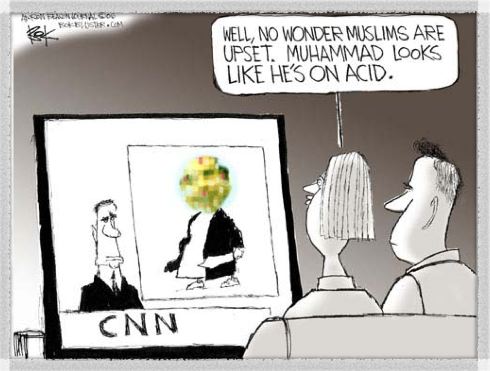
Here's the response:
Several Northeastern Ohio Muslims and community leaders met Friday to express their concerns about the controversial cartoons of the Prophet Muhammad that have ignited outrage and violence.
At issue are the caricatures published in the European press — work that many U.S. newspapers decided against publishing. The group also took issue with a cartoon inked by Beacon Journal editorial cartoonist Chip Bok.
Bok said he did not draw his cartoon with intentions of offending Muslims and has defended his right to free press.
But Muslims on Friday said Bok's cartoon was disrespectful and demeaning.
The level of hurt, they said, was deeper since it was in the local paper.
"It pained me to know that the Beacon Journal printed its own editorial cartoons that sought to challenge the beauty of our community by bringing hate into its pages," said Rabbi David Lipper, of Akron's Temple Israel. . . .
The editorial cartoon has prompted several letters in response. Also on Friday afternoon, there was a demonstration outside of the newspaper's East Exchange Street building.
At Friday's news conference at the Islamic Society of Akron & Kent in Cuyahoga Falls, the speakers were passionate.
A.R. Abdoulkarim, Amir of the Akron Masjid, applauded newspapers that decided against running the cartoons, but condemned those who did. The Beacon Journal, he said, was in a class of its own.
"They take the prize for being the most ill-intended, irresponsible property group," he said. "Allah curses and condemns them and every Muslim in this community should curse and condemn them."
Julia A. Shearson, director of Ohio's Council of American-Islamic Relations, said they want the Beacon Journal to apologize for running the "unethical" cartoon and want the paper to publish their letters to the editor.
After yesterday's press conference, Bok met with several leaders. The cartoonist said he drew the cartoon to take a shot at CNN for "distorting a distortion" and not at the prophet or Muslims. . . .
Still, Muslim leaders said Bok's cartoon was disrespectful because the prophet should not have been depicted in such a way. In fact, they said, there are no pictures or statues of Muhammad because he should not be confused with God. . . .
So I guess it's not just that we aren't supposed to draw pictures of Mohammed as terrorist, or of Mohammed at all; we aren't even supposed to draw pictures that are obviously not of Mohammed, and that are meant to mock the inability to draw pictures of Mohammed.
Well, I have to admit: The folks who are offended by this have a First Amendment right to be offended. They should feel entirely free to be offended.
The rest of us should feel entirely free, as a matter of civility as well as of law, to say: Your decision to be offended by this particular cartoon gives you no rights (again, as a matter of civility as well as of law) to tell us to stop printing it.
More on the underlying conceptual issue — the difficult but necessary distinction between (more or less) reasonable taking of offense and unreasonable taking of offense — later; I also hope then to talk in some measure about the distinction between this cartoon and others that I do think can reasonably be found to be offensive, and that probably shouldn't (as a matter of civility) have been published in the first instance, though it is proper to publish them now in order to explain the controversy. For now, it seems to me that this incident does plenty to illustrate the danger of the "it's wrong to publish any cartoons that offend people" attitude.
Many thanks to This Isn't Writing, It's Typing for the pointer.
All Related Posts (on one page) | Some Related Posts:
- Daily Illini Fires Editor Who Published the Mohammed Cartoons:
- President of Bar Association in Pakistan, Plus Major Pakistani Party, Supports Murder of Danish Cartoonists:
- The Twelve Mohammed Cartoons, in Detail:...
- Illinois Student Newspaper Editors Suspended for Running the Danish Cartoons:
- Reaction to the Cartoons Descends into Unintentional Self-Parody:
- A Second Look at the Second Extra Cartoon.--...
- U.S. State Department on the Cartoons Depicting Mohammed:
- Bush Cabinet Member Condemns Anti-Christian Blasphemy, and Points to Laws Restricting Incitement to Hateful Expressions:
- Suppressing Anti-Religious Speech -- an Emerging International Law Norm?
Showdown Over Subpoenas?:
An interesting Newsweek article on Congressional reaction to the NSA domestic surveillance progam has the following fascinating passage:
The Senate intelligence committee is likely to vote to open an investigation into the NSA's wiretapping program, according to senior congressional aides who declined to be identified discussing sensitive matters. The chairman of the committee, Sen. Pat Roberts of Kansas, will probably follow the White House line and try to keep a lid on the hearings. But three Republicans—Chuck Hagel of Nebraska, Olympia Snowe of Maine and Mike DeWine of Ohio—are expected to join with the Democrats on the committee to vote to demand more information about the secret eavesdropping program from the White House and intelligence agencies.If this story is accurate, Addington's prediction seems misguided to me. The Bush Administration's more aggressive claims of Article II authority are not going anywhere in the courts, and efforts to keep Congress away by invoking executive privilege will be met with equal skepticism. If Congress wants the documents and the Bush Administration refuses to produce them, expect the courts to resolve the disagreement more or less like this.
The White House is likely to be defiant. Cheney's chief aide and counsel, David Addington, has advised his bosses that even if the intelligence committee votes to subpoena secret documents from the executive branch, the demand will not be upheld by the courts. Cheney's attitude seems to be: bring it on.
Bleg for Information on International Women's Peace Service:
The International Women's Peace Service supplies anti-Israel speakers to schools and churhces around the United States. It is led by a Jewish woman from San Francisco named Kate Raphael. According to FrontPage magazine, Raphael is a leader of the International Solidarity Movement. She is the subject of a very brief profile from Discover The Networks. The IWPS and Raphael are also the subject of an enormous amount of positive attention from various IndyMedia websites around the world.
Raphael was expelled from Israel for her role in a demonstration organized by ISM. She claims that the demonstration was peaceful, and others claim that it was not.
I would be grateful if commenters could supply additional information about the IWPS and Raphael. Please do not argue the merits of the pro/anti-Israel issue. Please do supply information about the veracity of IWPS/Raphael, and whether IWPS/Raphael's self-description as "peace activists" is accurate.
Guess Who Wrote This, and About What President:
Here is the quote:
.
President ____ exercised the powers of the imperial presidency to the utmost in the area in which those powers are already at their height — in our dealings with foreign nations. Unfortunately, the record of the administration has not been a happy one, in light of its costs to the Constitution and the American legal system. On a series of different international relations matters, such as war, international institutions, and treaties, President ____ has accelerated the disturbing trends in foreign policy that undermine notions of democratic accountability and respect for the rule of law.Who do you think wrote the passage above, and who was the President?
.
VC Open Thread:
What's on your mind? Comment away.