Food in the United States is relatively cheap -- but it could be even cheaper. There are a wide range of federal policies that increase the price of various foods. Federal marketing orders for various agricultural products increase prices for milk various fruits. Restrictions on sugar imports dramatically increase the price of sugar, and therefore increase the demand for sugar beets and corn syrup. And so on.
The Washington Post reports, the federal government's love affair with corn-based ethanol is further increasing a wide range of food prices.
The nation's unquenchable thirst for gasoline -- and finding an alternative to what's been called our addiction to oil -- has produced an unintended consequence: The cost of the foods that fuel our bodies has jumped.
Beef prices are up. So are the costs of milk, cereal, eggs, chicken and pork.
And corn is getting the blame. President Bush's call for the nation to cure its addiction to oil stoked a growing demand for ethanol, which is mostly made from corn. Greater demand for corn has inflated prices from a historically stable $2 per bushel to about $4.
That means cattle ranchers have to pay more for animal feed that contains corn. Those costs are reflected in cattle prices, which have gone from about $82.50 per 100 pounds a year ago to $91.15 today.
The corn price increases flow like gravy down the food chain, to grocery stores and menus. The cost of rounded cubed steak at local Harris Teeters is up from $4.59 last year to $5.29 this year, according to TheGroceryGame.com, which tracks prices. The Palm restaurant chain recently raised prices as much as $2 for a New York strip. And so on.
"Anybody that knows anything about the marketing of corn knows that when you raise the price of corn you are going to create problems in all of the markets that use corn," said Ronald W. Cotterill, director of the Food Marketing Policy Center at the University of Connecticut.
There are significant negative environmental consequences of the artificially increased demand for corn-based ethanol as well, some of which have yet to receive much attention. For instance, as corn prices rise in response to the incrased demand for corn, farmers are becoming less willing to let fields lie fallow or enroll their lands in various conservation programs. Higher corn prices mean that the opportunity costs of such choices are higher than they were before. In parts of the country, this could have a significant negative effect on wildlife habitat, particularly for migratory birds. So, even if one makes the (dubious) assumption that there are significant environmental benefits from switching to corn-based ethanol, such as a potential reduction in certain emissions, there are significant environmental costs as well.
Yesterday the U.S. Court of Appeals for the Sixth Circuit issued an interesting divided opinion in Walls v. Konteh, a habeas case arising from a particularly interesting — and somewhat unique — set of facts connected to the events of September 11, 2001.
In September 2001, Lawrence Walls was on trial in an Ohio court for for various crimes. On September 11, as the horrific events in New York City and elsewhere began to unfold, the judge declared a mistrial, and rescheduled the case. Walls sought to dismiss the case on grounds that a new trial would constitute double jeopardy, but the judge rejected this motion and conducted a bench trial in November 2001. The court found Walls guilty on several counts and sentenced him to 11 years in prison. The decision was upheld on appeal.
The trial judge in this case testified that prior to declaring a mistrial, he was
concerned about the effect the breaking national news would have on the jury. The
judge noted the seriousness of the charges and testified he was worried the jurors
would not be able to devote their full attention to the evidence given the fact that the
country appeared to be under attack. He further testified that he considered the option
of instructing the jurors to return the next day. He testified he rejected the option
because, once again, he was worried about the jurors’ ability to concentrate and
because he did not know if the courthouse would be open the next day. Based on the
particular facts in this case as well as the foregoing testimony, we conclude that the
trial judge properly exercised his discretion in finding a manifest necessity for
declaration of a mistrial. Appellant’s sole assignment of error is found not
well-taken.
Walls filed a petition for a writ habeas corpus in federal district court. Here the judge concluded that the state court judge's sua sponte decision to declare a mistrial violated the defendant's constitutional right against double jeopardy. A majority of the reviewing panel of the U.S. Court of Appeals for the Sixth Circuit disagreed, however. Judge Norris, joined by Judge McKeague found that the "Ohio Court of Appeals’ affirmance of [the judge's] declaration of a mistrial under these circumstances, grounded as it was on a concern about jury bias, is neither contrary to, nor an unreasonable application of, clearly established federal law as defined by any
holding of the United States Supreme Court," and therefore no writ of habeas corpus was warranted. Judge Gilman dissented.
The majority opinion cites the proper
authorities and engages in the correct analysis, but I believe that it gives short shrift to one key fact that, if adequately factored in, would undermine much of its persuasiveness and lead to the opposite result. Specifically, the state trial judge possessed no knowledge concerning the potential effect of the September 11 attacks on the ability of the jurors to fulfill their civic duties in Walls’s case. Nor, of course, could he have possessed such knowledge; attacks like these had never before occurred on American soil. But the judge’s lack of familiarity with events that were totally extraneous to Walls’s trial distinguishes the present case from each of the cases cited . . . as examples of the deference usually accorded to a trial court’s evaluation of “possible juror bias.”
This article in today's Washington Post cracked me up. It is a story about all the bs answers that fathers make up when they don't know the answers to their kids questions while visiting museums and other tourist sites in DC. My favorite:
John Adami would probably know exactly what McLean means when she laments a museum's "intimidating mantle of authority." The Denton, Tex., dad was visiting Washington's museum row with his wife and five kids last week and had been fielding questions by the minute.
"It's a humbling experience," Adami said in front of the lunar landing display shortly after making a hash of explaining the Apollo programs. "It makes you question your intelligence after a while."
He turned slightly away from the family. "I've even been making up my own words," he said.
The story about the docent's hotline at the end is pretty funny too.
In honor of Father's Day, I invite all you dads out there to provide your best bs answers that you have given in response to one of your kid's questions like those in the story--but only if you got away with it.
Shooting the First Scene:
I am sitting at counsel table in the courtroom next to Marina Sirtis. They are now rehearsing the testimony of an expert witness. I am using my laptop as a prop so I will have it throughout the shoot and can blog as long as I have battery and something to say. They have blocked the first shot and, because it's facing the witness, I am not in it. So I am free to leave for the green room (such as it is), but they asked if I wanted to stay on set to answer any technical questions. Where should the bailiff stand? What would the writ look like? I reminded Marina that there was no jury in this hearing so she should not look at the jury box. Now that the crew and principals know I am here, they are starting to ask lots of questions, some of which have no correct answer ("How would the bailiff stand?"). This is definitely more fun than watching on a video monitor in the next room, or sitting around the cafeteria. I also get to watch the direction as well as see the actors, with each run-through, start to assume their roles on this, the first day they are playing these parts. But since this is a full courtroom set, it also just feels like sitting in a courtroom during a trial.
Update:Just had the camera on Marina and me for our reactions to the testimony--and one take just on me--so this was my first time on camera. Now we're on to the next witness. They seem to be varying the shot for each witness. First close up and now a very wide courtroom shot. Maybe we were waiting for the extras to show up. Now the courtroom really feels authentic with spectators and everything and no cameras in my view.
BTW most of the actors seem to want to talk politics.
Jim Gilmore's National Property Rights Initiative:
Virginia Governor Jim Gilmore, now running for the Republican nomination for President, has just announced as part of his campaign a "National Property Rights Initiative." In general, his program looks pretty interesting and sensible to me.
I've noticed that a few other candidates have also raised the issue of property rights as part of their campaigns, which is encouraging. I hope Gilmore's announcement will encourage heightened public engagement on this important issue going forward.
Casting Call for VC Readers:
James Runcorn is having a bit of trouble getting enough extras as background for the courtroom scenes. One benefit is that you will probably be seated while waiting for shots. You won't get paid, but you do get named in the end credits and IMDB credit. If you live in LA and want to head over to Sylmar TODAY (right away) or TOMORROW, email him at burbankexpress (at) aol.com. Today would obviously be very last minute, but tomorrow would work too. Drop him a line for the details.
7am Call:
Was here at 6:30 am for breakfast before the 7am call. Just a few crew members ate the breakfast, which was basic dorm food. Well. before dorms upgraded the food.
I am now in a conference room set off the courtroom that is serving as the green room waiting to be called to wardrobe and make up. There are no working outlets in this pretend conference center so I don't know if I will have enough laptop battery to blog all day. I hope to be able to do so from the set in between scenes. We'll see. We'll also see if there is enough interesting stuff to blog about.
Am shmoozing with Brandon Ford Green who's playing the court clerk. Finding out about how he got into the acting business. Earlier I was talking with J.G. Herzler ("Star Trek Deep Space Nine") who is moving to Ithaca to teach drama at Cornell. He remarked that, though the Drama Department is next to the law school there, there is no connection between them. He said that because actors are full time liars, and lawyers lie for a living, law students would benefit from some dramatic training. I disputed the liars part, but said that those lawyers who try cases do need to present themselves the way they want to be perceived by others in court and some acting skills would be helpful for that. It is no secret that courtroom work does involve genuine acting, though I would not say that's the same as lying.
Just spoke with James Runcorn, who is playing the bailiff and also casting the background actors. He said it would be great if my mom and dad, who live in Orange County and are coming to visit the set tomorrow, wanted to be spectators in the courtroom scenes. And they would get named credits at the end of the film too. I think that would be especially cool because when I was a real prosecutor in Chicago my parents came to 26th and California to watch me first chair a murder case. Now they would be in a pretend courtroom pretending to watch me pretending to be a prosecutor.
The Dorothy deLacey Early Childhood Education Center is among a handful of schools in the United States that permit even the youngest pupils to pick their own fields of study. The school district that operates the deLacey Center tells us that if a pupil shows an interest in rabbits, the teacher must design a curriculum for that pupil around rabbits -- while other kids in the same classroom try to learn reading and arithmetic through materials on fire engines and dinosaurs. Since its founding the Center has catered to children with special educational needs. In the fall of 1992 the deLacey Center became an "inclusion facility." Pupils with learning disabilities or behavior problems were mixed with those whose challenges were less severe....
[Kindergarten teacher Colleen] Wales was not happy with the turn of events at the deLacey Center.... By November 1992, ... it seemed to Wales that her time was devoted more to self-defense from hyperactive kids than to instruction. Wales called for assistance in managing her class more often than did other teachers. She succeeded in having one child removed from class and sent elsewhere. Schumacher turned down Wales's request for the removal of a second child. Wales promptly took a medical leave and sent Schumacher a lengthy memorandum protesting her management of the deLacey Center. Its final two paragraphs convey the tenor:
Under my contractual obligations with the district, I was employed to serve as a teacher, not as a guard in a detention room. In addition, I have professional and legal obligations to ensure the safety of my students and to provide them with a positive learning environment. This cannot be accomplished under the present lack of procedure and/or lack of complying with established procedure in terms of discipline for students who cannot or will not comply with accepted norms of behavior in a regular classroom setting. In addition, I do not have to expect that being a punching bag for a student is an assigned job task of a teacher.
As such, I would like some form of written documentation and/or clarification, consistent with state statute, as to what actions/procedures will be enacted in order to perform/maintain discipline within the classroom as well as what actions will be taken to ensure that other students, as well as myself, will not be subjected to continued physical abuse without repercussions. As an employee of the district, I feel that it is only right that procedures be clarified and followed through, especially now that the situation has deteriorated to one where my personal health has been affected.
[Soon afterwards, Wales's contract was not renewed; Wales argues it was partly because of her speech. -EV] ...
A school is entitled to insist that its staff carry out the educational philosophy espoused by the elected school board and the principal the board appoints. A Montessori school need not employ teachers who hanker for stern discipline. A memorandum proclaiming support for a disfavored educational approach (removing or disciplining disruptive kids) may be useful to a school in determining how a teacher runs her classroom.
When a communication is simultaneously protected speech (as a call to the public to change the way the schools run) and a sound reason for an employer to act (when it reveals information relevant to performance on the job), it is essential to determine how the speech has been taken into account. Did the school district penalize an expression of views about how the schools ought to run (forbidden) or consider an expression that revealed how the teacher manages or wants to manage her own class (permitted)? ...
Rational employers routinely consider speech: think about a local treasurer's reaction to a subordinate's statement (in private, to avoid disruption) along the lines of "Everyone in this office is underpaid and entitled to steal what he can." ... A school district is entitled to put in its classrooms teachers who share its educational philosophy. This does not mean that Wales is a bad teacher; it reflects only the school district's judgment that she was not well suited to an "inclusion facility" .... Matching a person's skills to the job at hand is a difficult yet vital task for any employer, and the first amendment did not require defendants to retain at the deLacey Center someone they believed was not best for the children.
The ruling came after Steven Cranley pleaded guilty on Tuesday to several charges stemming from an assault on a former girlfriend....
Doctors say Cranley has difficulty coping with rejection and runs a high risk to re-offend if he becomes involved in another intimate relationship.
Justice Rhys Morgan said Cranley "cannot form a romantic relationship of an intimate nature with a female person...."
I don't know Canadian law, so I can't comment on that. In America, it is pretty clear that the law can bar people who were convicted of a crime from having sexual relationships with a member of the opposite sex -- that's what happens to prisoners generally, unless they get conjugal visits (which are by no means constitutionally guaranteed). The question would be whether the law can impose such a requirement as a condition of probation; the test for that (rational relationship to a legitimate penological purpose) leaves the judge a lot of discretion, and I'd be inclined to say that this condition is rationally related to the protection of the public. On the other hand, it is pretty vague, the law having no ready definition of "romantic" (even if "intimate" is understood simply as sexual); maybe that would be the problem. In any case, this isn't my core field, so I don't want to opine too definitely -- I just thought it was an interesting story to pass along.
Textualism and Context (Especially as to Terms of Art):
A reader faults my "free state" analysis on these grounds:
The author introduces extrinsic evidence when the document is internally consistent and clear within its 4 corners.
Some of the extrinsic evidence comes from unrelated political systems and writers unfamiliar with the new governing scheme created by the Framers. Extrinsic evidence supporting the internally consistent definition, such as lawmakers' floor statements, are not considered; indeed, only extrinsic sources supporting the author's definition definition are discussed at length.
He then goes on to elaborate,
I should have said, "the document is internally consistent and thus clear within its 4 corners." That is, one can get a clear definition of "state" on context alone without extrinsic evidence.
Assume you have no dictionary and have no idea what "state" means. You read the Constitution and Bill of Rights, and for 116 out of 116 times the documents use the word "state," context alone indicates that "state" means one of the 50 recognized jurisdictions and not the District. You would judge, based from this text/context, that the "state" in the 2d Amend referred to the same. Of course, EV is correct that one still needs a dictionary and/or understanding of English for the remaining words, but these sources aren't typically considered extrinsic evidence. (perhaps because dictinaries and language knowledge offer every definition of a word, whereas typical extrinsic evidence does not)
This the goal of textualism, yes? That all words in a document have clear meaning based on the text of the document alone, coupled with a knowledge of the language of the text? (of course even textualism allows departing from a dictionary definition where the text specifically redefines a word)
The political branches ought to have incentives to observe textualist rules. Even assuming that the change from "country" to "state" was stylistic, to rely on extrinsic evidence to correct the textualist mistake eliminates this incentive. It permits Congress to pass whatever ambiguous, permissive language will get a majority, improperly delegating to the courts the determination of what the law ought to be.
"Textualism" is a useful label, and textualists do care about the text. But I know of no textualist who thinks that we should ignore context, and in particular the possibility that a particular textual provision was a legal term of art at the time the law was enacted. I think such an entirely acontextual textualism (perhaps we might think of it as "literalism," though even that assumes the conclusion about what the text literally means) is senseless for reasons I've mentioned in other posts in this chain. But in any event it is no textualism I've ever heard legal scholars advocate.
Let's begin with a simple example: How would and should a textualist deal with the Double Jeopardy Clause, "nor shall any person be subject for the same offense to be twice put in jeopardy of life or limb"? Should he say that it applies only to subsequent prosecutions where either the death penalty or dismemberment is at stake? (Does it perhaps apply chiefly to those soldiers who are "quartered in any house" with the owner's consent?) Or should he consider the possibility that "life or limb" is a legal term of art that doesn't mean what "life or limb" normally would?
Likewise, it turns out that the Constitution and the Bill of Rights do not always use "State" to mean "state of the union," even setting aside the Second Amendment: Two clauses of the constitution refer to "foreign State." Would we say that, because nearly all occurrences of "State" mean "one of the United States" or a "member state of a union," the "foreign State" provisions must refer to foreign members of the United States, or perhaps foreign semi-sovereigns that are part of some broader confederacy -- so that, for instance, federal officials couldn't accept offices or titles from the Swiss cantons (as states in a union), but could accept them from Japan (which is not a state in a union)? Or would we recognize that the term "State" in the phrase "foreign State" means something different from "State" in other contexts?
"Free State" is much like this. My article offers what I think is strong evidence that "free State" meant "nondespotically governed country." Blackstone used it this way. Montesquieu used it this way. Cato's Letters used it this way. Hume's Essays used it this way. Many other writers that the Framers read used it, almost exclusively this way. There's thus very good reason to think that when Americans who were raised on those works wrote or read that phrase, they understood it as precisely the same term of art, just as they understood "life or limb" as a term of art or "Suits at common law" as a term of art. No textualist I know of would ignore such evidence, just to give future Congresses an incentive to avoid all legal terms of art (something that would be a pretty hopeless cause in any event).
In the post below, I made a simple claim: You can't tell whether a text is "clear" or "unambiguous" by simply consulting the text — you also need to see whether there is external evidence that the meaning of some term is something other than what you assume it to "clearly" or "unambiguously" be (whether we refer to the meaning intended by the author or the meaning likely understood by most of the author's intended readers). This shouldn't be politically or ideologically controversial. It's just a description of how language and communication works.
Some readers seemed to disagree, for instance asking "Do we need context, etc., to tell us what '2/3' or '3/4' means?" and objecting to "the view that semantic meaning is always necessarily up for grabs." Well, consider this text:
1 + x = 10
This may seem "clear" or "unambiguous," until you see that people sometimes say — and quite correctly,
1 + 1 = 10
So even with mathematical matters, we sometimes can't be sure of their "clear" meaning until we see their context. "10" usually means "ten," and in our culture "ten" is a fair initial interpretation of "10." But we have to be open to the possibility that the number is written in a different base, and adjust our interpretation if there is evidence that this is indeed so. It's not that math is somehow indeterminate; it's just that mathematical notation, like any language, can't be understood without figuring out what it means in a particular context.
Or say you have a contract that reads,
I will turn over to you my car if you pay me twenty thousand dollars.
Usually that's pretty clear; but if it turns out the contract is made by two Canadians in Canada, contemplating a transaction in Canada, we'd realize that "dollars" means something other than what it usually means in America. Even if the contract ends up in American court (say the parties move to California and litigate the matter in California), any American court will correctly look beyond the supposedly "clear" meaning of the text to recognize that the contract meant something quite different. Even the strongest version of the parol evidence rule would not, to my knowledge, require a court to assume that the term "dollar" is "clearly" U.S. dollar, even if that's the first reaction that the judge had to the contract before he learned of its entirely Canadian context.
Again, it's not that meaning is "up for grabs" in the sense that any interpretation is always as good as any other. It's just that language can't be understood without figuring out what it means in a particular context, and recognizing that seemingly "clear" words can become less clear — or clearly something else — when one recognizes the context. Usually the context is as you expected, and the meaning is thus what it clearly seemed at first. But we can't just categorically foreclose the possibility that a word in a 200-year-old document (or even in a relatively new document) means something different than what it clearly seems to be if we look only at the text.
The Cast
In the previous post I mentioned Walter Koenig, who as screenwriter is the moving force behind the film, Marini Sirtis and Richard Hatch. Here are some other principal cast members: Courtney Peldon ("Boston Public"), Eric Avari ("Stargate"), Jay Acovone ("Providence" "Stargate"), Patricia Tallman (various "Star Treks"), Gary Graham ("Alien Nation"), and Richard Herd ("Seinfeld"). Only two actors are here now but most will be in the courtroom scenes, which are the climax of the film and bring together most of the principals. I have no idea what type of interaction I will be having with the actors. The main title actors have trailers just outside the sound stages. I imagine I will just be hanging out between scenes with the crew. Never having done anything like this before, I am a bit anxious about tomorrow But at least I was a prosecutor in real life and, when I was in the courtroom set earlier, it felt very natural. We'll see. At least I don't have to say anything until Monday.
On the Set of "Inalienable":
In 2004, I blogged about what it was like to attend The Night Before, a pre-Oscars party at the Beverly Hills Hotel, and a year later I updated it here. Yesterday, I sent to Aspen the revised manuscript for Constitutional Law: Cases in Context, a new constitutional law casebook I have been working on for the past year. Today, I am at Riverfront Stages in Sylmar California, just north of LA, for the filming of "Inalienable," and independent sci-fi film that culminates in a hearing in federal district court. The script was written by Walter Koenig who played Pavel Chekov on the original Star Trek. On his website, he lists the principal actors and describes the plot:
Still guilt-ridden over the accident that took his family's lives, Eric Norris discovers that his body is host to a parasite from another world. Except, it is more than a parasite: it carries his DNA. Is this his new son or — as the government believes — a threat to mankind?
As I am live blogging this, the crew is setting up a shot for a scene between Walter Koenig and Richard Hatch of Battlestar Galactica. They are both being miked mic'd in the room where the video monitors are, along with the food for the crew. After some problems with the mike they are now rehearsing a scene that takes place in the bathroom. We're watching the scene on a monitor. It's a confrontation between the two principal protagonists that takes place early in the film. We can see the monitor of the bathroom but cannot hear the sound.
Tomorrow begins four days of shooting the courtroom scenes that are supposed to take place over three days. I have just two lines before the final climax on the last day that won't be shot until Monday morning, but I will be at counsel table throughout the hearing. Fortunately, I'll be seated the whole time which should be easy.
I came by today to get the feel of the place, and settle on wardrobe. [now they are getting ready to get the shot and everyone is yelling "quiet!". . . I think they will have to reshoot this because Koenig moved into a position where he was blocked by Hatch.] Tomorrow's shooting starts at 7:00am.
I'll try to provide more info later, but wanted to live blog this whenever possible. (It is 5:45pm here and shooting ends around 7:00pm) I hope to be able to live blog this over the weekend when my scenes are being filmed, but don't know how much I will be able to do. Fortunately there is WiFi throughout the studio.
They are now reshooting the scene but each actor keeps blocking the view of the other. . . . so now they're shooting take 3. . . . & 4, now they're moving on. The whole shoot is just around 15 days so it's going to go really fast.
Hatch and the director just came in for something to eat. It is pretty spartan in here. I am sitting here typing at one of a long bank of folding tables in the back of the room. On the other end of the table the props guy is mixing up a substance that will pass for vomit. It seems pretty trial and error from here. I see instant mashed potatoes, instant grits, food dye and hot water. In the props guy's words, "now it looks like yams," which is not the look he's going for.
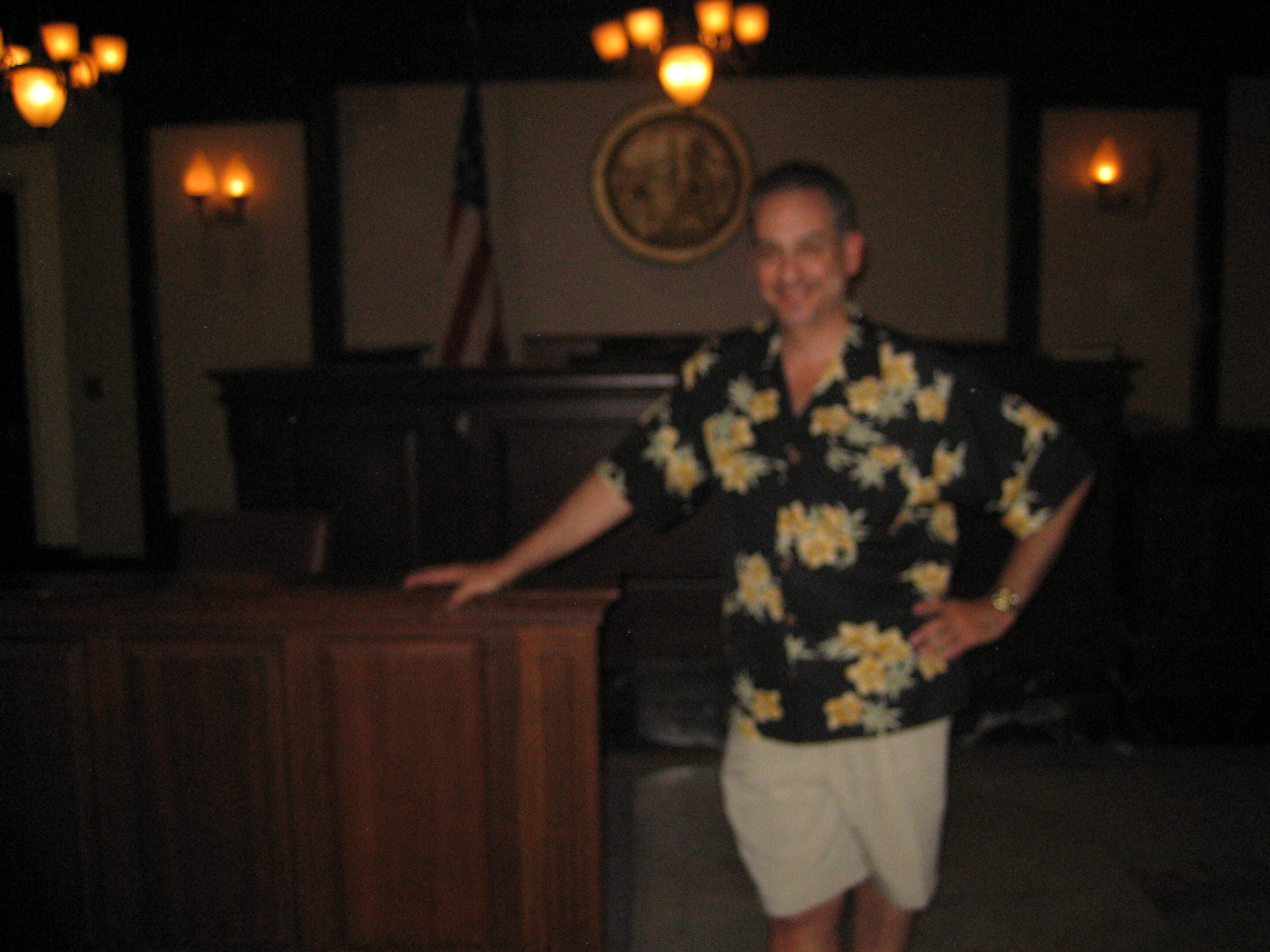
Here's a photo (very blurry, sorry) of me on the courtroom set which is the same set used by Law and Order.
Apropos my evidence on what "free State" meant to the Framers, a commenter writes,
The author introduces extrinsic evidence when the document is internally consistent and clear within its 4 corners.
Some of the extrinsic evidence comes from unrelated political systems and writers unfamiliar with the new governing scheme created by the Framers. Extrinsic evidence supporting the internally consistent definition, such as lawmakers' floor statements, are not considered; indeed, only extrinsic sources supporting the author's definition definition are discussed at length.
This, I think, raises a broader question: How do we decide whether a 200-year-old document "is internally consistent and clear within its 4 corners," and what its clear, consistent meaning is?
Recall that we can never understand the document simply by looking within its own four corners: We have to look at the document's text coupled with our mental dictionary of what each term means. But it's possible that people of the era in which the document was written had a different mental dictionary; it's possible that terms such as "free State" or "militia" or "life or limb" or "common law" or "an establishment of religion" meant something different to them than they do now -- or meant something clearer or less ambiguous than they do now, or meant something vaguer or more ambiguous than they do now.
That's why I'm skeptical of "just the text, ma'am" interpretation, especially when it comes to old documents. It's always text plus dictionary, but when the dictionary is of a slightly foreign legal language, we need to do more research than just from reading the text.
My article on "free State" is meant to give a sense of what the phrase meant in the Framing generation's mental dictionary. That's why I don't hesitate to use instances of the phrase used in discussing ancient Rome, Renaissance Europe, or 1600s and 1700s England. I'm looking at what the phrase "free State" meant in the language of the time, and if it consistently meant something like "nondespotically governed country" in the works that formed the Framing generation's political and legal education, that's powerful evidence that the Framers continued to use it this way. (I'd also talk about legislative floor statements if they said something clear about the meaning of the phrase "free State," but they didn't.)
But more broadly, I wanted to write a separate post to stress the difficulty of focusing solely on the four corners of the constitutional text, stripped of "extrinsic evidence." I don't think you can understand the text without looking at extrinsic evidence of what the terms in the text meant at the time.
The petitioners urge that, contrary to the reasoning of the Court of Special Appeals, the Rayburn primary duties test does not mean that, "participation alone [is] not enough." We do not agree.
The context helps, but not a lot (emphasis added):
It is not enough to say that Moersen's music is central to the church's method of worship; it would be just as easy to say that the manufacturer of the organ contributes to the church's worship, or that the people involved in the upkeep of the organ and worship place contribute to the church's ability to maximize the participation in religious ritual. Where does one draw the line?, that is the question. As stated in a case cited by the petitioners, Musante v. Notre Dame of Easton Church, No. 301-CV-2352, 2004 WL 721774, *6 (D.Conn. Mar. 30, 2004), "the religious nature of the employer is not dispositive of the inquiry, since it is unlikely that a church custodian would ever be considered a ministerial employee."
The petitioners urge that, contrary to the reasoning of the Court of Special Appeals, the Rayburn primary duties test does not mean that, "participation alone [is] not enough." We do not agree. In Rayburn, the court considered whether the position of associate in pastoral care was important to the spiritual mission of the Seventh-day Adventist Church. 772 F.2d at 1169. Concluding that it was, the court stated: ....
No, that's worse. We're #1 squared! No, that doesn't help much either. We're #0, or, maybe better yet, #-1! Huh, maybe not.
In any case, I'm delighted to report that my colleagues at Mayer Brown Rowe & Maw have been rated #1 in appellate law by Chambers and Partners, to go along with our #1 rating for appellate and Supreme Court work from legal500.com. It's a privilege and a pleasure for me to be affiliated with the Mayer people.
What Does "Free State" Mean in the Second Amendment?
I thought I'd pass an excerpt from a new article of mine, "Necessary to the Security of a Free State," which will be coming out in the Notre Dame Law Review this Fall. I might blog more excerpts from it next week, but for now here's the Introduction; to see citations, and the rest of the article, look here.
As usual, I'd love to hear whatever corrections, suggestions, or disagreements people might have -- but please look through the entire piece beforehand, just in case other sections already deal with the issue. Thanks!
* * *
"A well regulated Militia, being necessary to the security of a free State," the Second Amendment says, "the right of the people to keep and bear arms, shall not be infringed." But what did the Framing generation understand "free State" to mean?
If the answer is "state of the union, free from federal oppression," that would tend to support the collective or states' rights view of the Amendment. It would suggest that the right might cover only those whom each state explicitly chose as its defensive force, perhaps a state-selected National Guard. And it would suggest the Amendment does not apply outside states, for instance in the District of Columbia. I suspect the intuitive appeal to many of the states' rights theory stems from the Amendment's reference to the term "State."
But if "free State" was understood to mean "free country, free of despotism," that would tend to support the individual rights view of the Amendment. "The people" would then more easily be read as referring to a right of the people as individuals, even if a right justified by public interests, much as the term "people" is understood in the First and Fourth Amendments. The right would cover people regardless of whether they were enrolled in a state-chosen defensive force, since the right would be unrelated to preserving the independence of the states. And it would apply to all Americans, whether in states or in D.C.
Likewise, consider James Madison's original proposal: "The right of the people to keep and bear arms shall not be infringed; a well armed and well regulated militia being the best security of a free country."
Some assume the change from "free country" to "free state" was understood as purely stylistic, sometimes pointing to the absence of recorded controversy about the change of "free country" to "free state." This would cut in favor of the individual rights view. Others assume it was a substantive shift in the direction of a states' rights provision, and point in support to the Constitution's general use of "state" to mean state of the union (except where "foreign State" is used to mean "foreign country").
This Article makes a simple claim: There's no need to assume. There is ample evidence about the original meaning of the term "free state."
"Free state" was used often in Framing-era and pre-Framing writings, especially those writings that are known to have powerfully influenced the Framers: Blackstone's Commentaries (which I'll discuss in Parts II and III), Montesquieu's Spirit of the Laws (Part IV), Hume's essays (Part V), Trenchard and Gordon's Cato's Letters (Part VI), and works by many of the other European authors who are known to have been cited by Framing-era American writers (Part VII). [I choose these writers because I have systematically gone through Donald Lutz's list of the 36 writers most cited by Americans from 1760 to 1805; Montesquieu and Blackstone head the list, Hume and Trenchard and Gordon are in the top 10, and the other writers are all in the top 36.] [The phrase "free state"] was also used by many leading American writers as well (Part VIII), including John Adams in 1787, James Madison in 1785, and the Continental Congress in 1774.
Those sources, which surprisingly have not been canvassed by the Second Amendment literature, give us a clear sense of what the phrase "free state" meant at the time. In 18th century political discourse, "free state" was a well-understood political term of art, meaning "free country," which is to say the opposite of a despotism.
Political theory of the era often divided the world into despotisms and free states (either republics or constitutional monarchies). Free states had certain properties as a result of their being free, and were susceptible to certain threats of reverting to despotism. To remain a free state, the free state had to take these threats into account, and to structure its institutions in a particular way.
"State" simply meant country; and "free" almost always meant free from despotism, not from some other country, and never from some larger entity in a federal structure. That is how the phrase was used in the sources that the Framers read. And there is no reason to think that the Framers departed from this well-established meaning, and used the phrase to mean something different from what it meant to Blackstone, Montesquieu, the Continental Congress, Madison, Adams, or others.
Even given this finding, of course, many important arguments about the nature of the Second Amendment remain. But when we consider those arguments, we should recognize that the phrase "a free State" was not understood as having to do with states' rights as such, but rather as having to do with preserving the liberty of the new country that the Constitution was establishing.
Should Ideology Play any Role in Hiring for DOJ Career Positions?:
A lot of recent news stories echo the claim that the Bush Administration has improperly politicized hiring of career lawyers at the Justice Department (DOJ). There's an interesting question lurking in these stories: Should a lawyer's views of public policy play any role in whether they are hired? And specifically, if an attorney is applying for a position enforcing a politically controversial set of laws, should the attorney's view about those laws enter into whether they should be hired for a career lawyer slot?
At first blush, it's easy to say the answer is "no, those views should never matter." And perhaps that's the right answer. But I think there are actually some interesting issues lurking here, and I wanted to offer a hypothetical that I hope will illustrate them.
Imagine that DOJ has two openings for entry-level career lawyers. The first opening is in the Criminal Division's Child Exploitation and Obscenity Section, for a position prosecuting obscenity cases. The second opening is in the Civil Rights Division's Voting Section, for a position bringing civil suits against states and counties for racial discrimination in the operation of their elections.
There are three equally-well-credentialed applicants for the two positions. The first is Connie the Conservative, a very conservative young lawyer who was President of the BYU Federalist Society. Connie clerked for Judge O'Scannlain on the Ninth Circuit and is now at the conservative-leaning DC office of Kirkland & Ellis. The second candidate is Moe the Moderate, a completely nonpolitical mushy middle-of-the-roader. After graduating from Penn and clerking for Judge Prado on the Fifth Circuit, Moe has been working at a large litigation firm in Philadelphia. The third candidate is Libby the Liberal, a very liberal young lawyer who was very active in the NYU chapter of the ACLU. After clerking for Judge Reinhardt on the Ninth Circuit, Libby has spent the last few years working at the liberal-leaning San Franscisco office of Morrison & Foerster.
During the interviews for the two positions, both Connie the Conservative and Libby the Liberal made their personal views clearly known. In the interview for the position as an obscenity prosecutor, Connie the Conservative expressed enthusiasm for bringing more obscenity cases. "I'm deeply worried about preserving traditional values in America," she explained. "I think your work is extremely important." Libby the Liberal took the opposite view. "To be honest, I don't think the government has any role trying to stop adult pornography," she explained. "I'll work on these cases if it's my job, but I basically think this section should be shut down and you should go after some real criminals instead." Moe the Moderate was more reserved, indicating that he didn't have strong feelings about the work of the section either way.
The roles reversed themselves in the interview with the Civil Rights Division's Voting Section. Libby the Liberal expressed great enthusiasm for the Voting Section's traditional priorities. "I went to law school to fight injustice, and I think your work is incredibly important." Connie the Conservative took the opposite view: "To be honest, I don't think this section's traditional work is needed in this day and age. I'll work on these cases if I have to, but I basically think this section of the Civil Rights Division should be shut down." Once again, Moe the Moderate was more reserved, indicating that he didn't have strong feelings about the work of the section either way.
So imagine you're in charge of hiring at the Justice Department. Who should be offered a job for what slot in what order? Should you favor Libby the Liberal over Connie the Conservative for the Civil Rights Division job? Should you favor Connie the Conservative over Libby the Liberal for the opening in the obscenity section? Does it depend on what the President's priorities are, and in particular what the President's views are about obscenity prosecutions and the traditonal work of this section of the Civil Rights Division?
Broadly speaking, should the candidate's views — views that I think on most scales register as more-or-less "political" — make any difference as to whether they should be the one offered the job?
(Oh, and I should add, any similiarities between the characters here and those existing in real life are purely coincidental. Void where prohibited.)
UPDATE: I have amended the title of the post to make clear that the question is the candidate's ideological views rather than partisan political affiliation. Hiriring on the basis of partisan affiliation is illegal, and I think we all recognize the harm of it; that was not intended to be within the scope of the question.
Language teachers talk about translators' "false friends" -- words in a foreign language that sound familiar, but are quite different. The classic example is the Spanish "embarazada," which does not mean embarrassed. Likewise, the Russian "magazin" means a shop, not a magazine (the latter translates as "zhoornal," cognate to journal).
I'm looking for examples of the legal historian's false friends -- terms (mostly English terms) that might sound familiar to a law student doing legal research today, but really mean something different from what the student would at first expect.
I've seen this, for instance, in my Second Amendment work. "Militia," for instance, pretty clearly meant something like "the armed able-bodied citizenry" (limiting citizens to first-class citizens of the time, and excluding blacks, Indians, and women) rather than "National-Guard-like force" or "small military band," which is what many people tend to think of when they hear "militia" today. Likewise, "free State" meant not "state independent of the federal government" but something like "democracy, republic, or constitutional monarchy" as opposed to a despotism. Neither of these terms have entirely lost the old meaning; but they have acquired enough of a modern meaning that the modern meaning may lead modern readers astray.
Dean William Treanor points to another example, here of a change in grammatical convention:
Justice Thomas, Professor Amar, and others have assigned critical interpretive weight to the fact that, to quote Justice Thomas, "[i]n the Constitution, after all, 'the United States' is consistently a plural noun." This grammar would appear to suggest, as Justice Thomas and Amar have concluded, that the Constitution, as initially adopted, reflected the view that the United States was a collection of states, rather than one nation. What this reading misses, however, is the fact that, in the late eighteenth century nouns ending in "s" were commonly assigned plural verbs, regardless of whether the noun itself was plural or not, a rule gradually displaced as the nineteenth century progressed. It is true that "United States" was often matched with a plural verb in 1787 and consistently matched with a singular verb after the Civil War. But one cannot conclude simply from this change in grammatical practice that the dominant political theory changed, since the same verb shift occurred for the word "news," and there was no reconceptualization of "news."
(I can't personally vouch for the accuracy of this argument, but my sense is that Dean Treanor enjoys a very good reputation as a historian; and, more broadly, this is an example of the sort of thing I'm looking for, even if some might disagree with Dean Treanor's particular argument.)
Allison Weiss Brady, 36, a venture capitalist and philanthropist who is on the board of her family foundation, said she likes to be practical when buying handbags preferring to buy bags in basic colors. Still, she spends $20,000 per season on accessories and typically spends $5,000 per bag, much more than the $2,000 she used to spend a few years ago.
Among Brady's most prized finds recently are a pair of $11,000 earrings at Judith Ripka and a multicolored lizard Fendi handbag for $4,960....
A growing number of stores and shoppers are seeing the need to give back, however. Brady, the philanthropist who divides her time between Miami and New York, prefers to shop at stores where a portion of sales goes to a charity.
The basic characteristics of this Chicago Tradition are: a strong work ethic, an unshakable belief in economics as a true science, academic excellence as the sole criterion for advancement, an intense debating culture focused on sharpening the critical mind, and the University of Chicago's two-dimensional isolation. Much of the credit for the creation of this Chicago Tradition has to go to the University's first president, William Rainey Harper.
That is from Johan van Overtveldt's The Chicago School: How the University of Chicago Assembled the Thinkers Who Revolutionized Economics and Business. I enjoyed this book very much. Instead of stopping at Friedman, Coase and Director, it also offers a comprehensive treatment of the entire Chicago history, including such neglected figures as Herbert Davenport, Laurence Laughlin, H. Gregg Lewis, Albert Rees, Theodore Yntema, and Jim Lorie, in each case noting their roles in the broader story.
There is a separate chapter on each the business school and yes the law school. It is also noted that Friedman (among many others) really didn't want Hayek in the economics department. I wish this book had more analysis of how Chicago succeeded in changing the policy world, but it is a landmark in the history of economic thought and of course also law and economics. I can't recommend it to non-specialists, but anyone who cares about Chicago thought should buy it.
Yeah, that particular religion can't be compared to the other great religions, not straight up. I've listened to those who claim that you MUST read the holy book in arabic, for example, and other translations and usages are substandard.
I'm no expert on Judaism, but wouldn't many Orthodox Jews conclude that to fully understand the Torah you need to read it in Hebrew? I'm not sure they'd have the same theological explanation for this as Muslims would, but wouldn't they still insist (in a way that Christians generally do not) that translations of the Torah are in some measure "substandard"?
Amira Hass, a columnist for Ha'aretz, is, as I recall, an Israeli Jew so sympathetic to the Palestinian cause that she decided to live among them. I read her column regularly, and I think it's fair to say that she routinely places the blame on Israel for anything that goes wrong in Palestinian/Israeli affairs. Until today. Though she halfheartedly throws a few shots at Israel, her column is basically a vigorous attack on both Hamas and Fatah:
As Fatah's mirror image, the Hamas government announced it cannot pay civil servants' wages. But it has found ways to finance the large amount of weapons being smuggled into the Gaza Strip and purchased in the West Bank.
Now it will have full "military" control of the Gaza Strip. Will this bring relief to Gaza's 1.4 million residents? Will it improve the health system and ensure employment for university graduates? Will it remove Israel's land and sea blockade?
It may be assumed that the military takeover of Abbas' symbols of "sovereignty" will serve as an excuse for Israel to sever once and for all the remaining civilian and economic ties between the Gaza Strip and West Bank - a political process Israel started in 1991. Because Hamas, like its mirror image Fatah, has no coherent liberation or independence plan for Palestinians in this lifetime.
Contrary to what some VC readers might think, I was a strong supporter of Oslo, and like many others, was confident in the late '90s that a peace settlement was at hand. I was saddened for both Israelis and Palestinians when the latter's leaders turned out not to have reformed, but to be the same terrorist thugs that murdered Israeli schoolchildren in the '70s.
As I alluded to in a previous post, Fatah and Hamas are at root both criminal gangs masquerading as political parties, though I acknowledge that Fatah, at least, has some members who would like to come to terms with Israel. It's taken Hass and other an extra
six or seven years to recognize this, but perhaps now that the leftist enablers of Fatah and Hamas finally seem to be seeing the light, a useful turning point has been reached that will allow some sort of silver lining from this whole mess. For example, perhaps with Gaza turning into Hamastan, Israel will be able to make a West Bank-only deal with some combined Palestinian/Jordanian interlocutors that will create a confederated Palestinan/Jordanian state there. One of the great shames of the post-2000 crisis in Palestinian-Israeli relations is that I can't imagine that after years of suicide bombs the Israelis will ever feel comfortable enough to have reintegrate the West Bank into the Israeli economy (which previously paid huge economic dividends for the Palestinians), which means that Jordan will be the key to the economic future of Palestinians there.
UPDATE: Here's what Juan Cole has to say on his blog about the recent violence in Lebanon and Gaza, which can't be attributed to Israel: [ This space intentionally left blank ]
Considering the restrictions most Muslim countries place on women I'm surprised that she thinks she can be a police officer in the first place, in a country that expects women cops to drive, handle guns, arrest men, etc., just like the male ones. (Saudi Arabia does have women on the police force, but AFAIK they really function as a sort of auxiliary so male cops don't have to manhandle, search, or even talk to non-related women.) OTOH, if she can be flexible about those restrictions, why can't she be flexible about the head-dress? The department isn't requiring that she go bareheaded, just that she wear the uniform hat. As I understand it, Mohammad only prescribed that women be "modest"; interpreting that as any particular garment is a cultural thing, not Islam.
I've heard similar arguments before, but they've always struck me as quite weak, a weakness that we can see if we adapt them to Judaism or Christianity. We know how varied Judaism is -- yet we don't express surprise when, say, a Reform Jewish man refuses to eat pork but doesn't wear a yarmulke. Nor would we, I think, have prisons deny Jewish prisoners pork-free meals just because the prisoners aren't full-on Orthodox, on the grounds that "they're flexible about some Orthodox Jewish religious laws, why can't they be flexible about pork?"
Likewise, some Christians observe a Saturday Sabbath; some observe a Sunday Sabbath; some observe no Sabbath (in the sense of a day of rest) at all. Many Christians are very serious about following some Old Testament rules, but think the others (such as the Sabbath observance and the kosher rules) have been superseded. Why isn't it equally plausible that some Muslims may interpret Islam to allow women a great deal more latitude than the Wahhabi do, yet still preserve some aspects of traditional Islamic women's garb?
Similarly, it's not uncommon for cultural rules and religious obligations to be closely intertwined. As I understand it, the requirement of wearing a yarmulke is a cultural tradition that is not understood even by the Orthodox as being mandated by the Torah. I'm not sure about this, but my sense is that the wearing of Christian-themed jewelry and the placement of ashes on the forehead on Ash Wednesday is "cultural" in the sense of not being seen as mandated by religion, but is surely linked to religious sentiments.
It may well be that the court's decision in this case is right; I'm not speaking about that here. My point is simply that some American Muslims' rights shouldn't be determined based on what Saudi Muslims do, or even other American Muslims do, just as some American Christians' rights aren't determined based on what other Christians do, and some American Jews' rights aren't determined based on what other Jews do.
Islam, Christianity, and Judaism all include multiple denominations, both formal and informal. And American religious freedom law recognizes that no religion ought to be treated as a monolith with a single Established Official View that somehow affects the rights of all members of that religion.
Should Google Change Our Standards for Attribution of Quotes?
Say that you're writing a book, a magazine article, or some other work in a medium that (1) doesn't allow hyperlinking, and (2) discourages footnoting. And say that you want to quote a phrase you much like — for instance, "The past is a foreign country; they do things differently there."
Naturally, you should quote it, to make clear that you're not claiming authorship. But must you give credit to the author, for instance, "as L.P. Hartley wrote, '...'"? In an earlier time, I would think you should, unless the line was so cliché that its source would be familiar to most readers. (By the way, should it have mattered whether the author was long-dead?) After all, you ought to give credit where credit is due.
But these days, for many such quotes, the attribution is only a google search away — not much harder, generally speaking, than looking up the quote in an endnote, which would be considered a perfectly acceptable way to give credit in those media that allow endnotes. So assume that the google search does indeed yield the proper attribution. Does that relieve you of the obligation to mention the author in your work (again, assuming you include the quotes)? Or should you still mention the author's name somewhere, given that not everyone will be reading your piece with a computer around, or perhaps based on some deeper inherent obligation to give credit in your own work? Or might the ethical question be moot, because the text without the attribution — for instance,
"The past is a foreign country: they do things differently there." Among other things, they speak a foreign language....
-- looks clumsy enough that you ought to add "In L.P. Hartley's words" or some such just to make the text flow better?
UPDATE: Well, there's remarkable unanimity in the comments, and they all answer the question in the title with "no." Fortunately for me, I generally write in media where footnotes and endnotes are allowed, so I can avoid the "As x says" locution and yet give full credit directly in my own work. In any case, thanks for the feedback!
Tips for Law Students Who Are Doing Empirical Research?
I'm also looking for tips that I can pass along (again, in Academic Legal Writing) to law students who are doing empirical research (of whatever kind, and I realize there are many kinds). There, too, I already have quite a few, but it would be great to have more. If you have any suggestions, I'd love to hear them. Thanks!
Tips for Law Students Who Are Writing Articles on Legal History?
I'm looking for tips that I can pass along (in Academic Legal Writing) to law students who are writing articles on legal history. I already have quite a few, but it would be great to have more. If you have any suggestions, I'd love to hear them. Thanks!
Anaheim Mayor Curt Pringle on Development Without Eminent Domain:
Anaheim Mayor Curt Pringle recently published this report explaining how cities (including his own) can promote development without resorting to the use of eminent domain. Many of the arguments are not new, but it is significant that the mayor of a major city is publicly endorsing them. Plus, Mayor Pringle was kind enough to cite my article on the notorious Poletown case as an example of how using eminent domain to promote development often causes more economic harm than good.
CONFLICT OF INTEREST WATCH: Pringle's report was published by the Institute for Justice, the libertarian public interest law firm that litigated the Kelo case. As longtime VC readers know, I have done some pro bono work on takings cases for IJ myself.
Reason magazine editor Radley Balko has, like me, recently spent some time in Buenos Aires, and wrote this interesting piece analyzing Argentina from a libertarian perspective. I disagree with one or two of Radley's points, and a few others deal with issues that I don't know enough about to have an opinion. But I definitely agree with his bottom line conclusion that Argentina is a nation whose great potential has not been fully realized primarily as a result of excessive statism.
"Notable Increase" in Justice Department Hiring from Religious Schools:
The New York Times has an interesting piece on the changing priorities of the Civil Rights Division Justice Department under the Bush Administration. The article, however, contains this curious line: "Figures provided by the department show that from 2003 through 2006, there was a notable increase of hirings from religious-affiliated institutions like Regent University and Ave Maria University. The department hired eight from those two schools in that period, compared to 50 from Harvard and 13 from Yale." The author seems unaware that Ave Maria wasn't accredited until 2002, so it's hardly shocking that hiring from there rose from 0 to an average of less than one per year. Regent was accredited in 1996, and again it's not exactly surprising that as the school becomes more established, an average of slightly more than one of their graduates per year could get jobs at the Justice Department. The statistics quoted look even more like data-dredging when you realize that hiring from BYU went down from 2 per year in 01 and 02 to 1 per year from 03 to 06, and, even more impressive, hiring from Notre Dame went down from 6 in 02 to one in 06, and from Catholic from 4 in 02 to 2 in 06. Put another way, during the Clinton Admnistration, in 1999 the Justice Department hired 9 graduates of religious law schools, and in 2000 hired 7 such graduates. In 2006, with one more law school to draw data from (Ave Maria) and with a much more established Regent, the Bush Justice Department hired 6 graduates of religious law schools (in 2005, the total was nine). If anything, then, the Department is hiring fewer graduates of religious schools from a significantly bigger pool. And the scandal is what? [I should note that there are other religiously affiliated law schools in the U.S., but my data comes from a table accompanying the New York Times article.]
A federal judge said Thursday he will not delay a 2 1/2-year prison sentence for I. Lewis "Scooter" Libby in the CIA leak case, a ruling that could send the former White House aide to prison within weeks....
[U.S. District Judge Reggie B. Walton] never appeared to waver from his opinion that a delay was unwarranted. After 12 prominent law professors filed documents supporting Libby's request, the judge waved it off as "not something I would expect from a first-year in law school."
Maybe I'm missing the context, but this seems rather intemperate. I've read the motion, which is signed by leading constitutional law professors (Vikram Amar and our own Randy Barnett), leading criminal law commentator Alan Dershowitz, and Robert Bork, and which is signed as amici by the same people plus several other well-respected scholars. It's well-reasoned and extremely competent; I'm not sure I'd agree with it, but it makes a thoughtful and plausible case for its position. There seems to me no cause at all for the judge to react this way.
Thanks to Bill Patry for the pointer to the AP story.
Fred Thompson has said he is going to run a "new style" campaign, making use of the Internet. In that vein, I think it is interesting that his campaign blog has a blogroll--and that we're on it.
Also, if you check out his blog, they posted an interview yesterday by Peter Robinson with Senator Thompson filmed at the Hoover Institution. Particularly interesting is a brief colloquy about eight minutes in or so where Peter asks Thompson how he became a conservative, and Thompson mentions reading Barry Goldwater's "Conscience of a Conservative." To this day it remains striking to me for how many people Goldwater's book was a gateway into conservative ideas and the conservative movement.
By an overwhelming vote of 151-45, the Massachusetts legislature just rejected a proposed state constitutional amendment banning gay marriage. The amendment needed 50 votes to get on the ballot for a November 2008 referendum. Though it's still possible for anti-SSM activists to press for an amendment in the next session they would have to begin the long, multi-year process all over — and their fortunes have been moving steadily in the wrong direction for three years now.
What's so striking about the vote today is how dramatically support for SSM has grown in the legislature (and in state public opinion polls) since the state supreme court ordered the recognition of gay marriages in 2004. Back then, before the state had any experience with such marriages, there was overwhelming opposition to the idea. Only about a third of the state's 200 legislators fully supported gay marriage. The only real disagreement was whether the state should constitutionally ban both civil unions and gay marriages or just ban gay marriages. Opponents of gay marriage back then gambled that they could hold out for a broad ban — a tactical decision that cost them.
The delay allowed gay-marriage supporters time to mobilize politically and to let the initial anxiety subside. More than 8,500 same-sex couples got married in the state with no obvious or immediate effect on Massachusetts families or existing marriages. (And most people understood that, however regrettable, Boston Catholic Charities' exit from the adoption field was a consequence of pre-existing state anti-discrimination policy and of the group's own decision to stop serving gay couples — not gay marriage.) Anti-gay marriage legislators were defeated in elections. Others, like the Republican senate minority leader, actually became gay-marriage supporters as time passed.
While SSM opponents gathered 170,000 signatures for a petition to have the issue placed on the ballot, the state's amendment process requires that at least one-fourth (50) of the state's legislators vote to send such a citizen initiative to a vote and to do so in two consecutive sessions. Legislators correctly understood that in such a process, by design, they are not merely "pass-throughs" for a ballot fight. Under state law, they were entitled to, and did, exercise their own judgment about the issue.
Now, even the watered-down ban on gay marriages has only anemic and collapsing legislative support. As recently as January, there were still about 60 votes in the legislature for a ban. A few weeks ago that had dwindled to the low 50s. Today it's at 45.
An even bigger win for SSM, in my view, would have been a successful referendum vote in November 2008. But it's clear there's now a secure beachhead for gay marriage. And thanks to this decisive legislative support, it now has a democratic imprimatur it would not have had absent a strong political challenge to the 2003 Goodridge decision.
Much opposition to gay marriage has been based on hypothetical and not unreasonable fears about an important and untried reform. As time passes, it is growing more and more difficult to make these arguments. In one state, at least, gay marriage is here to stay.
Learned Hand:
Time Magazine's August 25, 1961, issue included this memorial to the great Judge Learned Hand, who had just recently died. If you're a fan of Judge Hand, as I am, it's an interesting read.
As soon as I get a chance, I'm going to write to Gov. Kaine and ask him to commute this sentence. Geez, I remember plenty of beer being available at various Sweet Sixteens I attended (when the drinking age was 18), and exactly no harm came of it.
UPDATE: I didn't mean to suggest that no harm can come out of serving minors alcohol, but rather that it's not such an obviously harmful activity as to justify such a draconian sentence. I doubt, for example, many first time DUIs get anything approaching 27 months.
The couple were charged with 16 misdemeanor counts, however, it was later discovered that seven of the kids at the party had no alcohol in their system. Of the remaining nine who did have alcohol in their system, none were found to be over the legal limit for intoxication.
The couple pleaded guilty to nine counts of contributing to the delinquency of a minor in Juvenile and Domestic Relations Court, and the prosecutor had recommended they get a 90-day sentence. However, the judge was furious about the recent death of one of Ryan's classmates at the local high school from an alcohol-related crash. He decided to make an example of them and sentenced them both to eight years.
This is a bit misleading, because the "legal limit" for minors is zero. Nevertheless, this does show that the parents weren't exactly running a wild, out-of-control drinking party. If the prosecutor, as he claims, really thinks this is the "worst case of underage drinking that he's dealt with in 15 years of prosecuting," then he either lives in a really tame county, or, more likely, underage drinking is rarely prosecuted there. But at least he recommended a much more reasonable 90 day sentence. And I don't see what Ryan's classmate's death has to do with the parents' culpability. I've never been a fan of "making an example" out of some hapless defendant who happens to be at the wrong place at the wrong time.
Today is the 25th anniversary of the end of the Falkland Islands War. Since I am currently a visiting professor in Argentina, I thought it appropriate to mark the occasion, and consider the legacy of the War.
Despite the tragic loss of almost 1000 lives, the impact of the war on both countries was probably positive.
The Impact on Britain
For Britain, the victory helped regain national self-confidence, and also ensured the continuation of Margaret Thatcher's free market reforms by giving her a big boost for the 1983 election. Back in 1982-83, the opposition Labor Party was not yet the Clintonized New Labor we came to know and love in the Tony Blair era. Instead, the party was led by hard-line old school socialist Michael Foot, who would surely have scrapped Thatcherism had he and his party returned to power in 1983. The War made what might have been a close election a slam dunk for the Conservatives.
Effects in Argentina
Argentina probably benefited from defeat even more than Britain did from victory. The war was initiated by the repressive Argentine military dictatorship in part to shore up flagging popular support for the military junta. In the short run, the gambit worked. Even most left-wing Argentines cheered when the junta's forces captured the islands on April 2, 1982. But, contrary to Argentine expectations, the British did not take the invasion lying down, but instead sent a task force that eventually recaptured the Islands. The defeat discredited the military government even among its supporters, and led to its collapse a year later. The restoration of civilian rule in 1983 ended one of the most repressive periods in Argentine history, and led to the trial and conviction of several of the junta's members for human rights violations.
Had Argentina won the war, the military government would have gotten a new lease on life. The resulting harm would surely have outweighed any meager benefit that ordinary Argentineans could have derived from possessing a few small islands with little economic value.
Decisive Victory as the Best Road to Peace
Despite the beneficial impact of the War's outcome, most Argentines remain convinced that their country is the rightful owner of the Islands, and regret their defeat. Official Argentine maps call the Falklands the "Malvinas" and label them a part of Argentina. It is an eerie (though less disturbing) parallel to the Palestinian maps that show Israel as a part of "Palestine."
This view is not quite universal. One Argentine academic told me that he was glad that Argentina lost the war. When I asked why, he explained that he could not support the war because he was "not a fascist" (as was the military regime that started the conflict). Nevertheless, his opinion was in a distinct minority. Probably 80 to 90 percent of Argentineans - including many who abhor the military government - take the nationalistic position. This, despite the fact that Argentina has not controlled the islands since the 1830s, and the population is almost entirely composed of people who want to remain under British rule. Obviously, irrational nationalist ideology is not limited to Argentina, and is just one example of the more general political irrationality that I have analyzed in my academic work. Irrational Argentine irredentism about the Falklands has many parallels elsewhere in the world, some of them far more virulent and dangerous.
Fortunately, polls show that only about 20 percent of Argentineans would support another armed attack to retake the Islands, and relations with Britain have gradually improved since the end of the War. This fact leads to another important less of the conflict: Because Britain's victory was so decisive and overwhelming, most Argentines have no desire to renew the fighting, even though they still believe in the justice of their cause, and the nationalist grievances behind that cause have not been satisfied. Indeed, Britain has taken a somewhat harder line on Falklands issues since the war than it before. Sometimes, the best way to achieve a lasting peace is to defeat an enemy so decisively that they desist from further fighting because they realize it to be hopeless. This approach is often much more effective than trying to address the "root causes" of the enemy's belligerency or trying to appease them.
It is a valuable lesson of the Falklands War that is all too often ignored. It will not work for every conflict, but it certainly did wonders for this one.
Randy Barnett v. the "Gun Nuts" and the 9/11 "Truthers"--
I read Randy Barnett's last post on the nasty attacks he received after his views were misconstrued either by a reporter or a blogger (or both).
One of the funniest evenings I ever spent with Randy was at an AALS convention when a prominent historian told Randy and me about his work, which he said would take on the "gun nuts." Randy switched into his prosecutor mode and began carefully interrogating the historian on just what views qualified one as a "gun nut." Was a scholar who believed that the Second Amendment protected an individual right a "gun nut"? Why would someone refer to people who took such views as "nuts"? And if the scholar didn't mean that individual rights scholars were "nuts," then why would he bother in his historical scholarship to take on some non-rational fringe that no one took seriously?
I don't recall if Randy questioned whether "gun nuts" existed, though his distaste for the epithet was obvious; Randy was quite effectively challenging the tendency of anti-gun rights scholars to label serious people with which they disagreed as nuts.
As I wrote during the Bellesiles scandal, I don't understand the passion with which people on both sides approach guns. On that occasion, my research reached conclusions that made the pro-gun rights crowd happy, but when I later wrote critical things about John Lott, I received some pretty strong emails in the genre that Randy received today.
In the comments to my post on Bacon numbers below, I noted that my Erdős number was 8, but then revised it to 6. Here's what I previously thought my chain was:
P. Erdos, C.D. Godsil, S.G. Krantz & T.D. Parsons, Intersection graphs for families of balls in R^n, European J. Combin. 9 (1988), no. 5, 501-505.
Steven G. Krantz & Norberto Salinas, Proper holomorphic mappings and the Cowen-Douglas class, Proc. Amer. Math. Soc. 117 (1993), no. 1, 99-105.
Gregory T. Adams, Paul J. McGuire, Norberto Salinas & Allen R. Schweinsberg, Analytic finite band width reproducing kernels and operator weighted
shifts, J. Operator Theory 51 (2004), no. 1, 35-48.
Ariel Pakes & Paul McGuire, Stochastic algorithms, symmetric Markov perfect equilibrium, and the "curse" of dimensionality, Econometrica 69 (2001), no. 5, 1261-1281.
Laurence J. Kotlikoff, & Ariel Pakes, Looking for the news in the noise. Additional stochastic implications of optimal consumption choice, Ann. Econom. Statist. 1988, no. 9, 29-46.
Laurence J. Kotlikoff & Lawrence H. Summers, Tax incidence, Handbook of public economics, Vol. II, 1043-1092, Handbooks in Econom., 4, North-Holland, Amsterdam, 1987.
B. De Long, A. Shleifer, L. Summers & R. Waldmann, Noise Trader Risk in Financial Markets, Journal of Political Economy, August 1990, reprinted in Richard H. Thaler, ed., Advances in Behavioral Finance, Russell Sage Foundation, 1993.
Juan Carlos Botero, Rafael La Porta, Florencio López-de-Silanes, Andrei Shleifer & Alexander Volokh, Judicial Reform, World Bank Research Observer 18 (2003), no. 1, pp. 61-88.
This took us through my industrial organization professor Ariel Pakes, former Harvard president Larry Summers, and my adviser Andrei Shleifer. But yesterday I discovered a new chain, of length 6 instead of 8, through Shechao Charles Feng, my one-time co-author on an L.A. Times op-ed on affirmative action, later reprinted in the Journal of Blacks in Higher Education, once of the UCLA Physics Department:
P. Erdős, A. Rényi & V.T. Sós, On a problem of graph theory, Studia Sci. Math. Hungar. 1 (1966), pp. 215-235.
Christian Borgs, Jennifer Chayes, László Lovász, Vera T. Sós & Katalin Vesztergombi, Counting graph homomorphisms, Algorithms Combin. 26 (2006), pp. 315-371.
J.T. Chayes, L. Chayes, Daniel S. Fisher & T. Spencer, Finite-Size Scaling and Correlation Lengths for Disordered Systems, Phys. Rev. Letters 57 (1986), no. 24, pp. 2999-3002.
Daniel S. Fisher & Patrick A. Lee, Relation between conductivity and transmission matrix, Phys. Rev. B 23 (1981), no. 12, pp. 6851-6854.
Shechao Feng & Patrick A. Lee, Mesoscopic Conductors and Correlations in Laser Speckle Patterns, Science 251 (9 Feb. 1991), pp. 633-639.
Alexander Volokh & Shechao Charles Feng, How Race Adds Up for UCLA Entry, L.A. Times (18 July 1995), partly reprinted in Journal of Blacks in Higher Education 9 (Autumn 1995), p. 94.
And just today I accidentally discovered an even shorter chain, again going through economists -- through my adviser Shleifer and my former economics professors Oliver Hart and Eric Maskin -- which gives me an Erdős number of 5!
Paul Erdős, Peter Fishburn & Zoltán Füredi, Midpoints of diagonals of convex n-gons, SIAM J. Discrete Math. 4 (1991), no. 3, pp. 329-341
Peter C. Fishburn, William V. Gehrlein & Eric Maskin, A progress report on Kelly's majority conjectures, Econom. Lett. 2 (1979), no. 4, pp. 313-314.
Sanford J. Grossman, Oliver D. Hart & Eric S. Maskin, Unemployment with Observable Aggregate Shocks, J. Polit. Econ. 91 (1983), no. 6, pp. 907-928.
Oliver Hart, Andrei Shleifer & Robert W. Vishny, The Proper Scope of Government: Theory and an Application to Prisons, Q.J. Econ. 112 (1997), no. 4, pp. 1127-1161.
Juan Carlos Botero, Rafael La Porta, Florencio López-de-Silanes, Andrei Shleifer & Alexander Volokh, Judicial Reform, World Bank Research Observer 18 (2003), no. 1, pp. 61-88.
I know what you're thinking: What's Eugene's Erdős number? If you consider the blog to be a co-authored work, then Eugene could be a 6. On the other hand, if you consider the blog to be a journal where each post is a separate article -- so Eugene and I haven't co-authored anything -- then Eugene might be a 7, because I've co-authored with Judge Kozinski (The Appeal, 103 Mich. L. Rev. 1391 (2005)), and so has Eugene (Lawsuit, Shmawsuit, 103 Yale L.J. 463 (1993)). Or Eugene's number might be lower through his co-authorship with, say, Larry Lessig.
CNS Messes Me Up:
I have had great luck with the press, having never been burned by a reporter using an embarrassing quote that I did or did not say. But this Cybercast News Service story on the Right to Arms panel at the Brookings Institution on Monday really led some people astray. At Brookings, I made the point that those who favor gun control should not use methods of interpretation to negate its meaning that their political opponents can just as easily use against the rights that they support. The two such moves are to appeal to the "underlying" principle or purpose of a provision to limit its scope. The second is to argue that changing circumstances justifies ignoring a part of a written constitution. Speaking after me, Ben Wittes took the honorable position that we should adhere to what a written constitution says and the the Second Amendment clearly DOES protect an individual right. For this reason, he would prefer it be repealed.
Wittes' opinion gained the headline in CNS: Repeal Second Amendment, Analyst Advises. The problem was they then followed with my point making it appear as though I was responding to his proposed repeal by proposing that other constitutional rights should also be repealed! Now the CNS column does not actually put those words in my mouth, but the story is very confusingly written and one blogger unsurprisingly read it this way:
Imagine my surprise. A “guest scholar at the center-left Brookings Institution,” Benjamin Wittes, wants to gut the Second Amendment. Wittes told CNSNews “that rather than try to limit gun ownership through regulation that potentially violates the Second Amendment, opponents of gun ownership should set their sights on repealing the amendment altogether.”
Georgetown University law professor Randy Barnett, however, did not limit his comments to the Second Amendment, suggesting instead that much of the Bill of Rights has “no contemporary relevance.” As an example, Barnett cited the Fourth Amendment. “Sure it was fine that persons should be secure in their papers and effects back in the old days when there wasn’t a danger of terrorism and mass murder.” According to the professor, the Fourth Amendment is “archaic [and] we don’t need it anymore…….”
Of course, MY point was that such an argument could be made by those who opposed the restrictions of the Fourth Amendment. Certainly not my view. And VC readers know I am a strong supporter of the Second Amendment and gun rights, which is why I was on the Brookings program in the first place. See my Was the Right to Keep and Bear Arms Conditioned on Service in an Organized Militia?
One irony is that the motto of another blog site that repeated the above misconstrued report is: “A lie gets halfway around the world before the truth has a chance to get its pants on.” - Winston Churchill
As a result of the CNS story, this blog, or both, the misinformation is spreading rapidly through the right side of the blogosphere. As a result I have now received some charming emails that I thought VC readers would enjoy reading:
Dear Randy Barnett,
I noticed that you said recently that not only should the second amendment go away but that the Bill of Rights has “no contemporary relevance.” That makes you a traitor. You are fascist, New World Order scum. I just pray that a non Council of Foreign Relations candidate gets elected as president so that filth like you have "no contemporary relevance."
Sincrely pissed off,
Martin
Another:
I find it interesting that you ignore Jeffersons stance on an armed population. You and your masters had better realize that the day gun confiscation begins shall be remembered as the first day of the Second American Revolution. You and your ilk will likely be the first with your backs to the wall.
please do not misconstrue this as a threat. I am merely stating what most of the hunters and sportsmen I know are saying. There are TENS million active hunters in the USA. If you think you can disarm them, I comend your attention to a little place called IRAQ!
I do not hunt. I do, however, Agree with Charlton Heston-FROM MY COLD, DEAD, HANDS!
This one was entitled: "Hey, phony prof, you're full of shit, you damned communist!" and reads:
You'd better start all over again, you communist punk! We smell you comin' from a mile away.
JIM DUNN
Austin, TX
This one may be my favorite:
Hi Randy:
I read an article that claims your interested in dismantling the Constitution. Well, sir, that is not for you to decide. I believe you should be charged for treason. Are you making these statements because your paid off? Are you making these statements because of information received and/or based on the main stream media?
Are you aware of the current standoff with Ed and Elaine Brown in New Hampshire? I bet not. Have you even spent an ounce of effort to research the undeniable facts of 9/11? I mention 9/11 because it was the precursor for the ever evolving police state we are entering.
Have you heard of the scholarlars for truth? http://911scholars.org/ How about Dr. Stephen Jones phd-former physicist professor at B.Y.U. ? He has a piece of molten metal from the twin tower debris which contains thermate. OO, you didn't know that? Albert Einstein said," Condemnation without investigation is the height of ignorance."
How about the fact that Jet A-1 (jet fuel), kerosene based, can only burn at a max tempature of 1800 degrees F. That is considering the fuel has a constant and proper mix of Oxygen( a controlled burn). Also, Structural steel melts at 2750 degrees F. Put the two together and what do you get? We know the Towers were a dirty burn-due to the black smoke emitted-indicating a low oxygen supply. Did you know that the Solomon Brothers building(WTC-7) wasn't hit by any aircraft, but yet collapsed in 6.5 sec.(faster the the law of gravity will allow) in it's own footprint? Also. Rudy G. is on video saying he was told the towers would collapse, and then on later video saying he had no prior knowledge? Why didn't the 9/11 commission report even mention WTC-7?
Who is Dr. Ray Griffin?
Now, I am a veteran. I love the United States and I love the U.S. Constitution, (and I took an oath, probably as you did, to uphold the Constitution), but most of all, I love freedom.
I would like to know, why you are bent on destroying the Constitution? And what you are basing your reasoning on?
A response back would be greatly appreciated.
Thankyou.
Steve
C*SPAN taped the program. I have not seen it on the schedule and will post if I find out in advance when it will run.
I cannot imagine what it might be like, while awaiting a prison sentence for a tiny infraction, to see dumb-ass TV-addicted crowds howling with easy, complicit laughter as Sarah Silverman (a culpably unfunny person) describes your cell bars being painted to look like penises and jokes heavily about your teeth being at risk because you might gnaw on them. And this on prime time, and unrebuked. Lynching parties used to be fiestas, as we have no right to forget, and the ugly coincidence of sexual nastiness—obscenity is the right name for it—and vengefulness is what seems to lend the savor to the Saturnalia. There must be more than one "gossip" writer who has already rehearsed for the day that Paris Hilton takes a despairing overdose. And what a glorious day of wall-to-wall coverage that will be!
Stuck in my own trap of writing about a nonsubject, I think I can defend my own self-respect, and also the integrity of a lost girl, by saying two things. First, the trivial doings of Paris Hilton are of no importance to me, or anyone else, and I should not be forced to contemplate them. Second, she should be left alone to lead such a life as has been left to her. If this seems paradoxical, then very well.
Perhaps to compensate for its ridiculous decision to put her on Page One on Friday, the New York Times report shifted from the sobbing, helpless child to the more portentous question of another "high-profile defendant." It cited an even more acid piece of creepy populism, in the form of an order from Judge "Reggie" Walton, who poured his witless sarcasm on those who had filed a brief in support of Lewis "Scooter" Libby. Would such "luminaries," sneered Walton, be equally available for other litigants? It's not his job to arbitrate such a question, and he seems not to understand the law, but if his words mean anything, and from a federal judge at that, they appear to mean that to be a public figure is to risk double jeopardy in the courts. No doubt Judge Walton will relish the coming days in which he can order Libby to report to prison. One hopes that his moral superiority, and his keen attention to public opinion, remain as untroubled and secure as those of Sarah Silverman. It seems that this is now the standard. How splendidly we progress.
Bryan Caplan
asks this question, and answers with a qualified yes:
Would you feel uncomfortable striking up a conversation with a stranger? How about over the Internet? If you're like me, you're a lot more outgoing over the Internet than you are in real life. At the same time, though, I wonder: Has making friends over the Internet made me more outgoing in the real world? I suspect it has, but it's hard to be sure.
In a similar vein, have you ever noticed how some very socially awkward people have charming Internet personalities? Does the charm they practice in the virtual world eventually spill over to real life?
Perhaps the best test of these hypotheses: Compare the nerds of 1987 to the nerds of 2007. No doubt, the nerds of 2007 still have their interpersonal issues. But aren't they a lot smoother than their forebears?
I am not so sure. The internet certainly does help socially awkward people by giving them a way to make connections that is less difficult for them than "real" life. On the other hand, I am skeptical that internet social skills readily spill over into real world social skills. It seems to me that the two skill sets are significantly different. Indeed, to the extent that nerds in 2007 spend more time on the internet and less time improving their social skills in real world interactions, the latter might actually be worse than those of their 1987 predecessors. Tentatively, I would hypothesize that the internet does not improve the social skills of nerds and may even retard them. But it does reduce (somewhat) the cost of having bad social skills by providing a mode of interaction where those skills matter less.
Finally, the impact of the internet on the social skills of nerds probably depends in part on what they use the internet for. Blogging about law and public policy probably doesn't improve social skills much (bummer for us nerdy VC bloggers). But participating in social activities on the net (e.g. - chat rooms), or even blogging about more personal matters, may have a bigger impact. Still, I doubt that even time spent on the latter helps nearly as much as spending the same time improving your social skills in face to face settings.
But, as Bryan says:
What do you think? Non-nerds' opinions count double... if there are any out reading this. :-)
Bryan is surely right that non-nerds are better judges of nerds' social skills than the nerds themselves. So have at it!
Muslim Policewoman Barred from Wearing Khimar on the Job:
The khimar is "a headpiece ... which covers the hair, forehead, sides of the head, neck, shoulders, and chest," but not, at least in this instance, the face.
Philadelphia Police Department Directive 78 apparently prescribes a uniform uniform, with no exceptions for any religious apparel or any religious symbols. The case suggests that the uniform requirement is broad enough to exclude ashes on the forehead on Ash Wednesday, and therefore basically any non-uniform symbols.
Police officer Kimberlie Webb claimed that Title VII of the Civil Rights Act of 1964 required the city to accommodate her religious practice by exempting her from the strict uniformity requirement, and letting her wear the khimar. Title VII does require employers to provide exemptions for employees whose religions conflict with generally applicable work rules, but not when granting such an exemption would create an "undue hardship" for the employer. Courts have set the "undue hardship" bar pretty low, so that anything "more than a de minimus cost" would constitute an "undue hardship" that the employer need not bear.
The court held that requiring a religious exemption from Directive 78 would indeed create an "undue hardship":
The Directive's detailed standards with no accomodation for religious symbols and attire not only promote the need for uniformity, but also enhance cohesiveness, cooperation, and the esprit de corps of the police force. Prohibiting religious symbols and attire helps to prevent any divisiveness on the basis of religion both within the force itself and when it encounters the diverse population of Philadelphia.... Police Directive 78 is designed to maintain religious neutrality, but in
this case in a para-military organization for the good not only of the police officers themselves but also of the public in general.
I always love to brag (blrag?) about my colleagues' successes, and this one is pretty cool: Mayer, Brown, Rowe & Maw, with which I've been a part-time academic affiliate for about a year and a half, has been rated #1 for appellate and Supreme Court work by legal500.com.
Excellent, and from what I've seen of my colleagues' work, extremely well deserved.
Environmental Implications of the Gallenthin Realty Blight Condemnation Case:
Jonathan is absolutely right to point to the environmental implications of the Gallenthin Realty case, discussed in his and my recent posts (linked below). I would add that much of the land that the Borough of Paulsboro sought to condemn in order to make it part of a "redevelopment" project, was in fact being used for environmental and conservation purposes. According to the New Jersey Supreme Court opinion, most of the property consisted of "undeveloped wetlands" that had been designated as protected wetlands by the state Department of Environmental Protection. In addition:
Gallenthin [the owner] leased portions of the property to an environmental clean-up organization, Clean Ventures, in 1997 and 1998. Clean Ventures used the property for river access, employee parking,and storage. Additionally, since 1997, a wild-growing reed, phragmites australis (phragmites), has been harvested from the Gallenthin property three times a year. The reed can be used as cattle feed and, according to plaintiffs, is recognized by the federal Environmental Protection Agency as a valuable plant species that actively neutralizes soil pollutants.
The Gallenthin Realty case Ilya mentions below nicely illustrates the risk that eminent domain can pose to environmental conservation if governments are allowed to take property for economic development purposes -- a problem Ilya and I discuss in our paper, The Green Costs of Kelo: Economic Development Takings and Environmental Protection, 84 Wash U. L. Rev. 623 (2006). The land at issue in this case largely consisted of undeveloped open space, including protected wetlands. The government sought to take the land for a development project because it was "not fully productive." Yet this is something that can be said of virtually all conservation properties; land that is devoted to conservation is not "fully productive," even though it may be providing many valuable functions and services. Indeed, the very point of conservation easements and the like is to protect environmental values by preventing land from being used to maximize economic production. Had the New Jersey Supreme Court held that this was a suitable justification for the use of eminent domain, this would have put made it easier for government agencies in New Jersey to take conservation lands through the power of eminent domain by labeling such lands as "blighted."
New Jersey Supreme Court Limits Condemnation of "Blighted" Property:
Today, the New Jersey Supreme Court issued its unanimous opinion in Gallenthin Realty Development, Inc. v. Borough of Paulsboro, an extremely important case addressing the government's power to condemn property that is "blighted" (hat tip: Seton Hall law prof Marc Poirier). The Court held that property which is merely "not fully productive" cannot be considered "blighted" and therefore cannot be condemned under Article VIII, Section 3 of New Jersey's Constitution, which states that:
The clearance, replanning, development or redevelopment of blighted areas shall be
a public purpose and public use, for which private property may be taken [by eminent domain]. . .
As the Court points out in its opinion, "most property in the state" can be considered "not fully productive" and therefore subject to condemnation as blighted under the state government's definition of the term. Instead, the Court concludes that the term "blight" has a "negative connotation" and is limited to those areas where "deterioration or stagnation that has a decadent effect on surrounding property." This definition strikes me as still excessively broad and vague. After all, all sorts of conditions can be considered "deterioration" or have at least a small "decadent effect" on the surrounding community. If I fail to repave an old driveway on my property, it might start to look deteriorated, and there may be a small impact on the value of neighboring property. Nonetheless, the Court's definition is at least somewhat more reasonable than the virtually limitless definition (including all property that is "not fully productive") in the New Jersey blight law it struck down.
Unfortunately, the problem of overly expansive definitions of blight is not limited to New Jersey. It is a nationwide problem affecting many states, as I discussed in this op ed for the Legal Times last year. Even many recent post-Kelo eminent domain reform laws incorporate definitions of "blight" that still permit condemnation of virtually any property (see this paper for details).
In today's Wall Street Journal (available online only to subscribers), Bob Barr comes out against "Don't Ask, Don't Tell" and lambastes the Republican presidential field for timidity on the issue:
As a conservative Republican member of Congress from 1995 to 2003, I was hardly a card-carrying member of the gay-rights lobby. I opposed then, and continue to oppose, same-sex marriage, or the designation of gays as a constitutionally protected minority class. Service in the armed forces is another matter. The bottom line here is that, with nearly a decade and a half of the hybrid "don't ask, don't tell" policy to guide us, I have become deeply impressed with the growing weight of credible military opinion which concludes that allowing gays to serve openly in the military does not pose insurmountable problems for the good order and discipline of the services.
Asked about reconsideration of the don't ask, don't tell policy in favor of a more open and honest approach, the simplistic responses by several Republican presidential candidates left me -- and I suspect many others -- questioning whether those candidates really even understood the issue, or were simply pandering to the perceived "conservative base." The fact is, equal treatment of gay and lesbian service members is about as conservative a position as one cares to articulate.
Barr gives several reasons for his change of mind on the issue -- unnecessary invasion of privacy through intrusive investigations, the drain on personnel in a time of war, the wasted tax money, and the fact that attitudes toward gays have softened both within and outside the military since 1993. The arguments are not new ones; the piece is noteworthy chiefly for its author and the place of publication.
Response to a Comment About Al-Marri:
I've received a number of interesting comments in response to my Al-Marri posts. (Thanks for all the comments, by the way; I think this has been a very useful and rewarding discussion.) One of the more common arguments is one I find puzzling, however. An anoonymouscommenter put the argument this way:
The reason OK's position is so frustrating is that he is not a hack but someone who is usually very intelligent, sensitive and fair. And the point is not that criticism of Al-Marri is somehow inappropriate but rather that OK has criticized it in a maddening fashion and glossed over the fact that his approach, if adopted by the courts, would allow the administration to continue horrific practices. The reasonable and just inference from the fact that this administration has used its broad claims of "executive authority" to horrifically and pointlessly violate the basic human rights of detainees, including detainees who have nothing to do with Al Qaeda or the Taliban, is that there is something drastically wrong with that framework. Yet OK ignores this reality entirely, choosing instead to . . . . offer intellectual support to the legitimacy of that framework.
Here are two responses (in addition to appreciation for the compliment in the 1st sentence — thanks for that).
First, there are hundreds of different issues raised by the legal side of the war on terror. I think the Bush Administration is right on some of them; wrong on others; and I just don't know enough about many of them to have an informed opinion. Given that, my brain only works by taking these questions issue-by-issue. I can understand why this seems frustrating if you don't view them issue-by-issue, and instead have a more global reaction (whether for or against). But for whatever reason, that's how I approach it.
Second, even if you agree with the comenter's view of the Bush Administration, it's not like the Bush Administration will be around forever. It's going to take anywhere from 6 months to 18 months before we have a final decision on the Al-Marri case, depending on whether the 4th Circuit goes en banc and whether the Supreme Court hears the case. Given that there are only 18 months left of the Bush presidency, the resolution of Al-Marri will come either at the tail end of the Bush Administration or the beginning of the Obama/Thompson/Clinton/McCain/Giuliani/Edwards (OTCMGE) Adminitration.
I don't know what positions President OTCMGE is going to take on legal policies surrounding terrorism. But I suspect the new President will probably want to make a bunch of changes, and it seems to me that the question of what to do with cases like Al-Marri is really about the options for President OTCMGE more than the options for President Bush.
I was on Jeopardy! with Alex Trebek, who was in Random Hearts with Blair Brown, who was in Loverboy with Kevin Bacon!
Also, if we get to count radio (and why not, if we can count TV?), I, as well as Eugene, also have a Bacon number of 3 through Warren Olney — we were both, at various times, on his radio show Which Way, L.A.?, and Warren Olney was in Enemy of the State with Paul Majors, who was in The Woodsman with Kevin Bacon.
Eugene's number is also 3 through Dennis Prager, who was in Heavy with Pruitt Taylor Vince, who was in Trapped with Kevin Bacon. I was on Dennis Prager's show, but only as a call-in listener. Query whether call-in listeners count, in the same way that an extra, even an accidental extra, would count in a movie.
Moral: There are a lot of people in Hollywood — 145,024 — with Bacon numbers of 2.
UPDATE: My wife Hanah also has a Bacon number of 3, as she was in a stage production of Peer Gynt in Pasadena with Michael York, who was in Austin Powers 2 with Tim Robbins, who was in Mystic River with Kevin Bacon.
UPDATE 2: My sister-in-law Dahlia, by the way, has a Bacon number of 2, if you allow for working on the crew. Dahlia was an office production assistant on Chasing Ghosts, and Michael Rooker from that movie was in JFK with Kevin Bacon.
You were in a Bullshit! episode with Penn Jillette.
Penn Jillette was in the Aristocrats (which is a good movie by the way--if you ever want to watch it with someone and you're in DC, give me a call) with Kevin Pollak.
Kevin Pollak was in A Few Good Men with Kevin Bacon!
I can also be linked, Oracle of Bacon reports, via Carolyn McCormick instead of Kevin Pollak. And, as a special bonus, I'm citing Francis Bacon in a forthcoming law review article.
Pretty Amazing Demo:
Here is the description from the TED website:
Using photos of oft-snapped subjects (like Notre Dame) scraped from around the Web, Photosynth (based on Seadragon technology) creates breathtaking multidimensional spaces with zoom and navigation features that outstrip all expectation. Its architect, Blaise Aguera y Arcas, shows it off in this standing-ovation demo. Curious about that speck in corner? Dive into a freefall and watch as the speck becomes a gargoyle. With an unpleasant grimace. And an ant-sized chip in its lower left molar. "Perhaps the most amazing demo I've seen this year," wrote Ethan Zuckerman, after TED2007. Indeed, Photosynth might utterly transform the way we manipulate and experience digital images.
In my post below on the autoadmit case, I noted that the pseudonymous posters faced huge professional risks from being identified. But say that one of them decides to fight the case to trial (unlikely, but assume he does).
In a typical libel case, the plaintiff may worry that filing the case, and having a trial, will only further spread the libelous accusations. Even if the accusations are ultimately disproved, more people will have heard them, and some may pay more attention to the accusations than the ultimate disproof. This isn't really an issue here, I suspect; I doubt that anyone will really believe that plaintiffs really do have sexually transmitted diseases, for instance.
But libel cases also let defendants discover many things that plaintiffs might find embarrassing. Consider, for instance, Doe I's claim that the "harassing, offensive, and false statements posted by defendants" caused her to get no job offers through the on-campus interview process, even though she had sixteen on-campus interviews and four callbacks (paragraphs 30-33 of the complaint). I'm skeptical that there was any causation here; as Ilya pointed out,
First, most people know that anonymous comments on chat sites are often inaccurate, and intelligent employers are unlikely to give them great credence — especially if doing so leads them to pass up a strong job applicant from what is arguably the nation's most elite law school. Second, even if law firm hiring committees did believe the comments, ... [m]ost big law firms care very little about associates' personal lives outside the office, so long as those associates are racking up the billable hours. Even if one or two firms were deterred from making offers to this student by the internet comments, it is highly unlikely that all sixteen (or even a large percentage of them) were.
Instead, it seems to me that the likely reasons for Doe I's striking out were among the normal reasons why many people who look great on paper don't do as well in the hiring market as they'd like — they don't seem that interested in firm jobs, their credentials aren't really that good, they come across as too quiet or nervous, they come across as too brash and self-important, they flub some questions, they rub the interviewers the wrong way, some of their professors are unimpressed by them and say so, and so on.
But even if I'm wrong, surely defendants would be entitled to try to prove that there was no causation here, given that plaintiffs are making an issue out of this (an issue that bears directly on actual damages, and indirectly on presumed and punitive damages). Presumably defendants would subpoena the firms involved and ask them why they didn't hire Doe I. (I don't see any reason why such an obviously relevant matter would be found undiscoverable or inadmissible.)
Even if I'm wrong and the firms were somehow influenced by the online nastiness, I expect that their hiring people would do anything short of outright perjury to minimize that and to maximize the conventional reasons why they thought Doe I was unsuitable. If I'm right, or at least right as to many firms, those firms would quite candidly explain why they thought Doe I was unsuitable. Some of them may be politic ("we had an exceptionally strong pool that year, and she just wasn't quite as fantastic as the other Yale applicants"), but others may not be. (Remember that while many firms are reluctant to say anything bad about an ex-employee, for fear of a libel lawsuit, witnesses are immune from libel lawsuits for their testimony.)
So the result will be testimony from sixteen prominent law firms explaining why they didn't want to hire Doe I. What's more, the law firms aren't being painted as the bad guys in this law suit, so it's not a case where (for instance) someone sues an employer for discrimination and the employer's badmouthing of the plaintiff could be put off to the employer's racism or sexism or what have you. It's just sixteen law firms that come across as largely disinterested bystanders (despite the possible reason to shade the truth that I mention above, a reason that is likely not to be prominent in observers' mind) and that talk about how Doe I botched her interview, or about how her grades were really pretty weak. That's not exactly the best publicity for an aspiring young lawyer, especially given that the case about online chatter is likely to lead to online chatter.
Again, perhaps all this is moot because there's virtually no chance that this case will get to trial or even to discovery. Still, it's the sort of thing that libel plaintiffs ought to worry about in similar cases, and perhaps even in this one.
UPDATE: Ann Althouse has more thoughts on this, and the AutoAdmit controversy more broadly. Plus, one of the great things about Ann is that she mixes highly accessible posts about interesting legal controversies with asides about pretty technical but important legal questions, such as federal court jurisdiction — she has some thoughts about that in the second post. (Recall that she's a jurisdiction, federalism, and constitutional law scholar.)
Patterico has more (also here), which is more sympathetic to the lawsuit than Ann Althouse's posts are.
The two women law students who were generally badmouthed and insulted by pseudonymous commenters on the AutoAdmit Web site have sued. They've sued Anthony Ciolli, who helped found and manage AutoAdmit, and they've sued the pseudonymous commenters. The claims are copyright infringement (based on someone's apparent copying of some photographs of Doe I to which the copyright was owned by Doe I), appropriation of name and likeness, disclosure of private facts, false light invasion of privacy, and intentional and negligent infliction of emotional distress. The suit seeks compensatory and punitive damages, "permanent removal of the message threads from the AutoAdmit Site," "authorization to Google permanently to remove the cached message threads," and costs.
A few thoughts:
1. Ciolli's liability: If Ciolli is being sued solely because of his operation of the AutoAdmit thread — as opposed to any posts he himself might have made — then he should be immune under 47 U.S.C. § 230, which generally immunizes people from liability for online speech by other people (such as the pseudonymous commenters here). Section 230 doesn't apply to copyright liability, but even if there was a copyright-infringing photograph posted to AutoAdmit, I quite doubt that there'd be material damages. Only actual damages, an injunction, and court costs are available unless the photograph was registered within three months of its original posting, which I expect it wasn't. (AutoAdmit might also have some 17 U.S.C. § 512 protections, but only if satisfied section 512's agent identity notification requirements, which I doubt.)
2. Permanent removal of message threads: Many (but not all) jurisdictions allow injunctions in libel cases, after a finding on the merits that the speech is libelous. The same might be true of injunctions against speech that is found to fit within another First Amendment exception (such as a threats exception, or an intentional infliction of emotional distress exception, if there is one). But nearly all courts that have considered the issue have held that 47 U.S.C. § 230 preempts injunctions against online speakers based on speech of other parties, as well as damages. So I see no basis here for an injunction against Ciolli as AutoAdmit's operator, except perhaps as to removal of the infringing photograph, if it is indeed on AutoAdmit's site. (Of course, it's possible that Ciolli will give in on this score because of public pressure, because of fear of liability, or because of worry about the expense and burden of litigation; on the other hand, his § 230 defense is strong enough, and the case interesting enough, that I imagine he would be able to prevail either by himself or with some pro bono help.)
UPDATE: I had assumed that Ciolli still had some legal power over what comments stay on the AutoAdmit site, since otherwise this demand would have been pointless. If, as some correspondents have suggested, Ciolli no longer has this power, then the demand to permanently remove the message threads is especially out of place -- it can't work (even setting aside the 47 U.S.C. § 230 problem) unless the complaint is amended to join AutoAdmit or its operators as parties.
3. Authorization to Google permanently to remove the cached message threads: This is just odd; Google needs no such authorization — it can remove whatever it pleases from its cache. Perhaps there's some Google policy under which Google removes material only following a finding that the material is libelous, or perhaps plaintiffs think such a finding would in any event persuade Google to remove the material. But they can't seek such "authorization" as a remedy; there is no legal doctrine under which the court can grant such authorization, and there is no legal need for such authorization.
4. Liability of the pseudonymous posters — libel / false light: Some of the statements mentioned in the complaint may well be libelous, for instance the ones that accuse plaintiff of having herpes, and of being sexually promiscuous (assuming the statements are false, which I expect they are), or at least false plus highly offensive (which in these circumstances would suffice for a false light claim). They are on matters of private concern and about a private figure, so the defendants would be liable for actual, presumed, and punitive damages.
Defendants' only defense would be that in context a reasonable reader wouldn't understand the statement as a factual claim, but just a loose insult that lacks factual content (much as "motherfucker" may be insulting because of the connection to its literal factual meaning, but is almost always used as a pure insult and not a factual claim). That's a not implausible defense, but far from a sure winner.
5. Liability of the pseudonymous posters — other causes of action: Some of the statements mentioned in the complaint may also be actionable as intentional infliction of emotional distress, because they do seem pretty outrageous when made in a publicly accessible medium. (I doubt the other causes of action are particularly strong, but the distress one might be.) Does the First Amendment preempt such claims?
Some of the statements may be interpreted as threats of rape and the like; if they are interpreted this way, again as opposed to loose hyperbole (see Watts v. U.S. for the leading hyperbole case, though one that arose in a political context), they may be constitutionally unprotected, and there would be no bar to tort liability for them. Most of the statements, though, are just general nastiness; and it's not clear whether crude, personally insulting speech on matters of private concern about a private figure is constitutionally protected against intentional infliction of emotional distress liability.
I think it should be protected, because the emotional distress tort is in my view unconstitutionally vague as applied to otherwise protected speech (even nasty speech on matters of private concern), and because I'm generally skeptical about the courts' ability to reliably draw the public/private concern line (see PDF pages 46-52 of my Freedom of Speech and Intellectual Property). But a few courts have allowed liability without finding First Amendment problems, as in the radio station "Ugliest Bride" contest case, Esposito-Hilder v. SFX Broadcasting Inc., 665 N.Y.S.2d 697 (App.Div.1997). And of course this is the sort of case where liability seems especially apt, and especially harmless when one just looks at the particular speech involved here. The case for First Amendment protection would have to be made based on the concerns about the long-term consequences of a new "private-concern speech inflicting emotional distress" exception to First Amendment protection.
6. Disclosure of the pseudonymous posters' identities: But I think the real punitive remedy that plaintiffs may get is disclosure of at least some of the pseudonymous posters' identities, given that plaintiffs have at least plausible tort claims that should suffice to justify discovery of defendants' identities. I'm not sure whether this is primarily what plaintiffs want — but it will be much cheaper to get, since it could be gotten just using some subpoenas plus amendment of the complaint to reveal the true defendants, with no need for a trial or for anything else. (Of course, if the identities can't technically be gotten, because the site's logs are incomplete, because the posters adequately cloaked their identities, or for some other technical reason, then no remedy, social or legal, would be available.)
The posters' actions are pretty disgusting and unprofessional; they violate codes of basic decency endorsed by most of society, left, center, and right. If their identities are disclosed, they are likely to lose their jobs (or job offers), lose friends, and be set back for many years and by many hundreds of thousands of dollars in their careers.
Ciolli himself apparently lost a job over all this, even though his asserted sin was simply providing a largely unrestricted forum. We can debate the ethics of providing such forums, and declining to delete trash posts like these ones. But even if what he did reflects some lack of professional or other ethics, what the posters did reflects a far worse ethical standard. If Ciolli got some professional flak, the posters would likely get far more.
In any case, that's my main thinking. I'll also post a little shortly about a possible risk to one of the plaintiffs should the case go to trial (which is unlikely) — a risk that illustrates one of the many difficulties that libel plaintiffs face.
Horace Cooper, writer and legal commentator, will be discussing the legal myths in the Anna Nicole Smith case on Tuesday, June 12 at 1:00 p.m. EDT. He will explain why Dannielynn may not be the million-dollar baby that so many have made her out to be. Cooper feels the real tragedy is that Dannielynn is more likely to be saddled with substantial legal debt if Larry Birkhead and Howard K. Stern decide to proceed with Smith’s claims. Cooper will be featured in Smith’s much hyped E! True Hollywood Story on Monday, June 11 at 8:00 p.m. EDT.
Few remember that the trial of record was not Anna Nicole Smith’s much hyped Supreme Court appearance, but rather a five-month jury trial in the Texas Probate Court in 2001 finding that J. Howard Marshall’s son Pierce was the legal heir. Furthermore, the jury found that there was no evidence to indicate that the will was interfered with and the case affirmed that Marshall had no intention of making Smith his heir.
Tuesday, June 19 will mark the first hearing in Anna Nicole Smith’s probate trial, and after the courts declare official custody this Friday, June 8, both Stern and Birkhead will begin their legal posturing to move full speed ahead with their pursuit of J. Howard Marshall’s estate. Behind the high profile, celebrity nature of the case is an example of audacious and alarming forum shopping and serious questions about state and federal jurisdiction.
I have read such discouraging remarks about Anna Nicole's suit, but IMO they seem to be at least partly beside the point. I have trouble understanding why Cooper thinks that the Texas case is "the trial of record" on the issue of her suit: tortious interference with a lifetime gift to Anna Nicole. If Cooper were right, it seems likely that Anna Nicole Smith would have lost her case in the US Supreme Court. As I seem to recall from a quick reading of the opinion some months ago, the U.S. Supreme Court held that the Texas probate case did not bar Anna Nicole's case in federal bankruptcy court under the probate exception (because her federal counterclaim did not interfere with the probate of J. Howard's estate in Texas).
Perhaps I'm missing something, but Smith's federal judgment for $88 million was NOT in a Texas probate court and did NOT purport to find her an "heir" of the estate. Her claim was based on Pierce's allegedly tortious (and fraudulent) prevention of J. Howard's attempts to give Anna Nicole a LIFETIME GIFT by setting up a trust for her.
I have no idea whether Anna Nicole's estate will win in the end, but I don't see how her case is as obviously weak as Cooper claims or that what he mentions as legal impediments are impediments at all. As her federal claims were not as an heir to Howard's estate (but rather as the victim of tortious interference with her being a beneficiary of a lifetime gift), her claims appear to be not prevented by the Texas probate case.
Of course, Anna Nicole's estate might still lose. A federal court might not find the evidence persuasive (though the lower courts did). Or the US Court of Appeals might hold that there is no action for tortious interference with an inter vivos trust under Texas law (though the lower court held there was, but with very little support for its holding). My knowledge of federal procedure and bankruptcy is limited enough that there might be other significant hurdles for Anna's estate. But without a detailed knowledge of the case, I would think that her estate's chance of winning would be somewhere between 25% and 75%--i.e., it could go either way.
Here is another view that seems to assume that the Texas case does not bar the federal action and that Anna's estate has a plausible claim.
But not being an expert on federal procedure, I might be missing something.
If there are any experts out there who know why some commentators have been so pessimistic about Anna Nicole's case, perhaps they could enlighten us in the comments below.
Thoughts on the Continuum Between War and Crime:
My post last night on what to do with Al-Qaeda cell members who can't be charged in criminal court led to a fascinating and long comment thread — about 100 comments in two hours last night, plus another 120+ so far today — and I wanted to follow up and respond to some of the comments. In particular, I want to to talk about the continuum between fighting wars and fighting crime, and where I think the Al-Marri case fits on the spectrum.
First, let's talk about some first principles. Our traditions know two basic ways of dealing with hostile actors: through war and through the criminal justice system. Within each system, there is a balance of factors at play in creating the rules. As a general matter, however, war is about self-protection: we try to disable the enemy from attacking us, and we take whatever measures are necessary to do that. There are limits, of course, conventions as to the laws of war and rules that each side adopts. But by and large the goal of self-protection by disabling future attacks takes priority.
The modern criminal justice system is different. Incapacitation is only a small goal of that system. Rather, we are primarily interested in punishing to discourage future harmful acts and to further the ends of justice. We create law enforcement offices to investigate and prosecute the acts to make this possible, but we intentionally give them only limited powers because we don't want them to be the problem rather than the solution. We make the police jump through a lot of hoops and face punishment for breaking the rules: they have to prove their cases in particular ways, subject to strict evidentiary rules, confrontation rights, the exclusionary rule for search and seizure violations, and the like. The intuition is that limited police powers can prevent abuses while giving the police enough authority to investigate a reasonable amount of crime.
What's interesting about these two different systems is that we can think of many cases that are somewhere along the continuum between the two poles. Consider the following persons detained by the United States in various circumstances:
1. U.S. citizen seized in Afghanistan, suspected of helping the Taliban forces in battle. 2. U.S. citizen suspected of blowing up a federal building as part of a plot to overthrow the U.S. government. 3. Suspected German soldier seized on the battlefield on D-Day in 1944. 4. Frenchman seized on the battlefield on D-day in 1944 suspected of helping the Germans. 5. Suspected crack cocaine dealer arrested in New Jersey. 6. Suspected Al Qaeda terrorist seized in U.S. after entering the U.S. to launch another 9/11. 7. Suspected Al Qaeda terrorist seized in Iraq after entering Iraq to join fight against U.S. 8. U.S. citizen who lives in Detroit and suspected to be a supporter of Al Qaeda; evidence suggests he sent $10,000 to a "charity" that is really a fun to help Al Qaeda launch more attacks in United States. 9. Egyptian citizen in the U.S. on a tourist visa seized in the U.S. on suspicion of planning attacks against a U.S. military base. 10. U.S. soldier in World War II suspected of being a double agent for the Germans.
From the standpoint of policy, which of these cases should be handled under the "war" rules and which under the "crime" rules? And how do you tell the difference? My sense is that most people would say that there are difficult line-drawing issues here. Not everyone on this list should be dealt with under the "war" rules; not everyone on this list should be dealt with under the "crime" rules.
Plus, we have a range of different criteria to use to determine which set of rules should apply, without any one criteria being the obvious factor that should control as a matter of policy. Some might want to focus on the seriousness of the perceived threat; others on whether there has been a formal declaration of war; others on whether a foreign country is involved; others on the individual's citizenship; others on the location or circumstances of the seizure.
All of these are possible lines to draw, but none are widely agreed to be the most important; as a result, we have a continuum from war to crime with some cases seeming to be somewhere in the middle. (Plus, while court cases help resolve some issues at the far ends, the existing cases are not very consistent; compare Ex Parte Milligan with In re Quirin. There's not a lot of consistent guidance from them, so we have one side making Milligan arguments and the other side making Quirin arguments.)
Now, back to my hypothetical in which we have admitted Al Qaeda terrorists who entered the U.S. to launch an attack but who can't be charged criminally. The Al-Marri case tells us that we have to deport them or set them free, a result that I described in one of my less articulate moments as "bizarre." Many commenters objected, asking, what's so bizarre about that — isn't that how the criminal justice system works? I think that's the wrong box, though; I see the case as much or more a "war" case than a "crime" case.
Why? There are two primary reasons I see it that way. The first and most important is that members of a terrorist cell see themselves at war; they see themselves as soldiers in a holy war against the United States, and are acting accordingly. When a group sees themselves as soldiers at war trying to kill you, it seems fair that you should want to return the favor. Second, the members of the group have no connection to the United States other than as soldiers. The only reason they are here and not on the battlefield abroad is that they have chosen to attack the enemy's civilian population rather than its soldiers. They not only see themselves as soldiers; they are here as soldiers. When you put those two factors together, it seems to me that the case is as much or more a "war" case as a "crime" case. I realize it won't seem that way to everyone, but it does to me.
Now, so far I've mostly ignored the question of how you know if someone is who they are suspected of being. "Sure," you might say, "maybe we detain an Al Qaeda cell member who enters the U.S. just to attack us — but how do we know who that is?" But here I think the Hamdi plurality had a pretty good solution — kinda made up as a matter of constitutional law, perhaps, but not bad as a pragmatic solution to the problem. Under the Due Process approach offered in Hamdi, an individual's procedural rights — what trial they get to test their detentions — is a sliding scale depending on who the person detained is, where they were detained, why, citizenship, etc. As I see it, it's a mushy balancing test that ends up largely replicating the continuum from crime to war; it's a blend of the crime model and the war model. The closer a case gets to a traditional crime category based on known and acknowledged criteria, the more Due Process rights resemble a criminal trial. On the other hand, the closer a case gets to the traditional war category based on known and acknowledged criteria, the more those rights resemble the traditional standards used in war.
What I found odd about Al-Marri is that it seems to treat most cases of Al Qaeda terrorists here to attack us as crime cases. It seems to me like an effort to bypass the Supreme Court's sliding scale war-crime framework in Hamdi and to replace it with a regime in which all the Al-Qaeda bad guys are forced into the crime model. I don't think this is the right box, which is why I see the Al-Marri framework as odd.
Anyway, that's my take. I realize a lot of commenters disagree, but I hope we can approach the disagreements in good faith with the understanding that we are all trying to grapple as best we can with a very difficult set of problems.
Does Amended Federal Rule of Evidence 702 Go Beyond the Daubert Trilogy?:
I've argued before that it does, in particular in absolutely requiring that a technique be used properly in the case at hand, but other vehemently disagreed. One common criticism has been that I seemed to be the only person who adopted this position. I now have company. Paul C. Giannelli & Edward J. Imwinkelried, Scientific Evidence 66 (4th ed. 2007) ("The amendment goes beyond merely codifying Daubert and Kumho. It requires the proper application of the technique in the particular case."). Of course, all three of us could be wrong, but it's nice to have some distinguished allies.
Prowling around the web while taking a break, I stumbled across some interesting information on the Republican Presidential nomination that I figured I'd pass along.
If I'm reading the most recent set of polls correctly, it looks like the major impact of a Fred Thompson entry into the race for the Republican nomination would be to draw from John McCain. In fact, the RCP Poll average has Thompson now leading McCain and eyeballing the chart it looks like Thompson's recent rise in the poll largely mirrors McCain's fall.
Of course, this is all national data. Polls in Iowa and New Hampshire look somewhat different, as Romney does much better in those state polls than nationwide (John Edwards has a similar scenario on the Democratic side in Iowa).
One interesting observation is that Rudy Giuliani seems to be polling unusually well in Florida, compared to other states. This may be in part because of one factor I hadn't previously consideredthe high level of migration of New Yorkers into Florida:
The 2000 Census revealed that, between 1995 and 2000 alone, 308,000 people moved from New York to Florida – the largest state-to-state flow in the U.S. At last count, nearly 1.5 million Floridians were born in New York, including five members from Florida’s current House delegation. Two are Democrats born in Queens: Debbie Wasserman Schultz and Robert Wexler. The three Republicans were born outside New York City: Ginny Brown-Waite was born in Albany, John Mica in Binghamton and Dave Weldon in Amityville.
Assuming Florida is a key battleground state again, the Florida-New York connection is an interesting wild card in the Presidential election for Rudy (as well as Hillary Clinton presumably, but to a lesser extent). Moreover, this raw number of immigrants may understate the New York influence on Florida--my in-laws, for instance, are NYC-Florida snowbirds who hold Florida as their primary residence. They don't seem atypical in this. Many Floridians seem to remain very attached to New York, even going so far as to maintain their allegiance to the Knicks, a demonstration of how deep their roots run.
Thompson is also now trading at the highest price on Intrade . There too McCain's stock appears to be falling. I wasn't able to find a prospectus on him in the Iowa Electronic Market, so unless I missed it, he is still in the Rest of Field there.
Yesterday I linked to a summary discussion of the internal deliberations inside the Reagan administration regarding the famous "Tear Down this Wall" speech. Peter Robinson has provided more details at Powerline today, along with some White House pictures of the final meetings.
To mark the date of the speech, today is also the grand opening of the new "Victims of Communism" memorial in Washington, DC. The Washington Times had a front page story here. The official website of the memorial is here.
Juanita Swedenburg, the successful plaintiff in the interstate wine shipment case of Granholm v. Heald, has passed away at the age of 82. The Washington Post has her obituary here.
Reducing False Positives in Lexis/Westlaw Searches:
A while back, I briefly mentioned ATLEAST, NOT W/, and SY,DI() searches, and a lawprof friend of mine wrote me,
You can probably do a big favor to a lot of VC readers, including me, by explaining [these search options].
So here's a brief explanation.
All three of these help reduce the number of false positives returned by your Lexis (ATLEAST, NOT W/) or Westlaw (SY,DI()) search, without much increasing false negatives.
1. Lexis's pretty bad Index feature doesn't help much here -- try searching for ATLEAST and NOT W/, and you'll get nothing -- but if you look in the online help under Searching/Using Terms and Connectors/Connectors, and you'll see:
The NOT W/n connector tells the research software to find documents in which at least one occurrence of the first search term is not within n searchable words of the second term....
EXAMPLE: ... rico NOT W/2 puerto
This finds documents that have at least one occurrence of "rico" (possibly standing for Racketeer Influenced and Corrupt Organizations Act) that has no occurrences of the term "puerto" within two searchable words of it. This does not mean the same document could not have these two words within two searchable words of each other elsewhere.
So NOT W/ is better than AND NOT -- rico AND NOT puerto will miss cases that have both Puerto Rico and a standalone RICO, but rico NOT W/2 puerto will catch them.
2. The online help, if you properly navigate it, will also tell you about ATLEAST: Searching for, say, atleast10(copyright) will find all documents that contain the word copyright at least 10 times.
3. SY,DI() is a Westlaw connector: Searching (using terms and connectors, not natural language searching) for SY,DI(search terms) finds all cases that contain the search terms in the Synopsis -- usually a paragraph that appears at the start of the case and that was written by West, though for some courts by the court itself -- and in the Digest entries for the case. This will thus focus on what West has seen as the heart of the case's holdings, and skips casual mentions in the facts or in a parenthetical briefly discussing some other case.
Note that SY,DI() searching will exclude many unpublished cases, for which West often doesn't prepare synopses and digests, but that may be part of your goal.
If you folks have other such research tips to add, either as to Westlaw or Lexis, please post them in the comments.
Blackstone and Copyright and Patent as (Limited) Property:
Here, by the way, is Sir William Blackstone -- often a good guide to background legal principles as the Framing generation understood them -- on property in copyrights and patents:
There is still another species of property, which (if it subsists by the common law) being grounded on labour and invention is more properly reducible to the head of occupancy than any other; since the right of occupancy itself is supposed by Mr. Locke, and many others, to be founded on the personal labour of the occupant. And this is the right, which an author may be supposed to have in his own original literary compositions; so that no other person without his leave may publish or make profit of the copies. When a man by the exertion of his rational powers has produced an original work, he seems to have clearly a right to dispose of that identical work as he pleases, and any attempt to vary the disposition he has made of it, appears to be an invasion of that right.
Now the identity of a literary composition consists entirely in the sentiment and the language: the same conceptions, clothed in the same words, must necessarily be the same composition: and whatever method be taken of exhibiting that composition to the ear or the eye of another, by recital, by writing, or by printing, in any number of copies, or at any period of time, it is always the identical work of the author which is so exhibited; and no other man (it hath been thought) can have a right to exhibit it, especially for profit, without the author's consent.
This consent may perhaps be tacitly given to all mankind, when, an author suffers his work to be published by another hand, without any claim or reserve of right, and without stamping on it any marks of ownership; it being then a present to the public, like building a church or bridge, or laying out a new highway: but, in case the author sells a single book, or totally grants the copyright, it hath been supposed, in the one case, that the buyer hath no more right to multiply copies of that book for sale, than he hath to imitate for the like purpose the ticket which is bought for admission to an opera or a concert, and that, in the other, the whole property, with all it's exclusive rights, is perpetually transferred to the grantee.
On the other hand it is urged, that though the exclusive property of the manuscript, and all which it contains, undoubtedly belongs to the author, before it is printed or published; yet from the instant of publication, the exclusive right of an author or his assigns to the sole communication of his ideas immediately vanishes and evaporates; as being a right of too subtile and unsubstantial a nature to become the subject of property at the common law, and only capable of being guarded by positive statutes and special provisions of the magistrate.
The Roman law adjudged, that if one man wrote any thing on the paper or parchment of another, the writing should belong to the owner of the blank materials meaning thereby the mechanical operation of writing, for which it directed the scribe to receive a satisfaction; for in works of genius and invention, as in painting on another man's canvas, the same law gave the canvas to the painter. As to any other property in the works of the understanding, the law is silent; though the sale of literary copies, for the purposes of recital or multiplication, is certainly as antient as the times of Terence, Martial, and Statius. Neither with us in England hath there been (till very lately) any final determination upon the right of authors at the common law.
But whatever inherent copyright might have been supposed to subsist by the common law, the statute 8 Ann. c. 19 hath now declared that the author and his assigns shall have the sole liberty of printing and reprinting his works for the term of fourteen years, and no longer; and hath also protected that property by additional penalties and forfeitures: directing farther, that if, at the end of that term, the author himself be living, the right shall then return to him for another term of the same duration: and a similar privilege is extended to the inventors of prints and engravings, for the term of eight and twenty years, by the statute 8 Geo. II. c. 13, and 7 Geo. III. c. 38, besides an action for damages, with double costs, by statute 17 Geo. III. c. 57. All which parliamentary protections appear to have been suggested by the exception in the statute of monopolies, 21 Jac., I. c. 3, which allows a royal patent of privilege to be granted for fourteen years to any inventor of a new manufacture, for the sole working or making of the same; by virtue whereof it is held, that a temporary property therein becomes vested in the king's patentee.
This is entirely consistent with treating this kind of property differently from other kinds of property in certain ways -- for instance, treating it as limited in duration, or subject to certain kinds of use by strangers that would not be allowed for land. My point is simply that there is at least a broad and deep legal tradition of treating copyright as property; such a view is no modern innovation, as some have suggested.
A commenter on the Madison / IP thread uses the intellectual property/tangible property analogy to argue for injunctions against infringement of intellectual property (apparently including infringement that doesn't interfere with the owner's use of the property), and goes on to say (in response to another commenter's argument),
[T]he analogy to trespass does not require an actual dimunition of your own use. It's 1L property law that a trespass is actionable even if nothing is broken, if you're not home, if your use of the property is not denied in any way. The offense is crossing the property line.
Now, the amount, impact, and circumstances of the trespass relate to damages, but liability starts from crossing the property line. There's not, nor has there been, a requirement that the property owner's actual use be diminished for there to be a trespass, as opposed to, say, conversion.
I can't say with confidence when injunctions should or should not be available in intellectual property cases; here, I just want to alert people to a common problem with analogies -- the simple problem that the analogized-to body of law is often more complex than the analogizer suggests.
For instance, let's assume that intellectual property is analogous in important ways to tangible property. There are (at least) two important classes of tangible property: real estate and personal property (also known as chattels, and generally just referring to all tangible property that is not real estate).
The "1L property law" rule to which the commenter refers is a rule applicable to real estate. But the rule for tangible property is different: As Restatement (Second) of Torts § 218 puts it,
The interest of a possessor of a chattel in its inviolability, unlike the similar interest of a possessor of land, is not given legal protection by an action for nominal damages for harmless intermeddlings with the chattel. In order that an actor who interferes with another's chattel may be liable, his conduct must affect some other and more important interest of the possessor. Therefore, one who intentionally intermeddles with another's chattel is subject to liability only if his intermeddling is harmful to the possessor's materially valuable interest in the physical condition, quality, or value of the chattel, or if the possessor is deprived of the use of the chattel for a substantial time, or some other legally protected interest of the possessor is affected as stated in Clause (c). Sufficient legal protection of the possessor's interest in the mere inviolability of his chattel is afforded by his privilege to use reasonable force to protect his possession against even harmless interference.
See also Intel Corp. v. Hamidi, 71 P.3d 296, 302 (Cal. Supreme Ct. 2003).
Now maybe the rule as to personal property is wrong. Or maybe intellectual property is more analogous to real estate than to personal property. Or maybe many (most? all? some?) infringements of intellectual property are like those infringements of personal property rights that do warrant an injunction. Or maybe the analogies aren't really helpful here, and we should support injunctions against infringements of intellectual property for other reasons.
But the one thing that should be clear is that, even to the extent the intellectual property / tangible property analogy is sound (and it certainly is an analogy that's long been recognized in many respects by the law), we have to recognize that the analogized-to category is not legally homogeneous. Before we apply by analogy "1L property law" rules relevant to one class of tangible property, we should acknowledge that there are other rules relevant to another class of tangible property, and explain why we are choosing one sort of rule and not the other.
This is a real question. Over the weekend I wrote an article for NRO on the new Bush climate initiative and the G-8 summit, and came to the conclusion that the Bush Administration has potentially set the stage for a meaningful international agreement on climate by, among other things, proposing an approach that could be acceptable to China, India, and other major emitters in the developing world. Given the Administration's relative inaction on climate change over the past six-and-a-half years, this is something of a surprise. As my column concludes:
If someone had predicted a month ago that President Bush would lead the way toward a meaningful global climate-change policy, they would have been labeled a loon, or worse. In the days leading up to the G-8 summit, policy mavens predicted the likelihood of a policy breakthrough was slim. But something funny happened on the way to Heiligendamm: The president proposed an alternative way to generate international agreement on climate policy, and now other nations are listening. If we see a climate policy breakthrough in the years ahead, it is possible President Bush will deserve much of the credit.
Let me be clear that I am not saying that the Administration's approach is perfect or the be-all, end-all of climate policies. What I am saying, however, is that given the very real political constraints on meaningful climate measures both at home and abroad, the Bush Administration appears to be setting a course toward something that could produce real results. Time will tell.
Madison on the Federalist Papers:
The story of how the Federalist Papers came to be written is well-known, but I thought readers might like to read Madison's own account, which is found in the Detached Memorandum:
The papers, so entitled, were written in the latter part of 1787, & the early part of 1788 by Alexander Hamilton, John Jay and James Madison. The original and immediate object of them was to promote the ratification of the new Constitution by the State of N. York where it was powerfully opposed, and where its success was deemed of critical importance.
According to the original plan & in the early numbers, the papers went out as from a Citizen of N. Y. It being found however that they were republished in other States and were making a diffusive impression in favor of the Constitution, that limited character was laid aside.
The undertaking was proposed by A. Hamilton to J. M. with a request to join him & Mr. Jay in carrying it into effect. William Duers was also included in the original plan & wrote two or perhaps more papers, which tho' intelligent & sprightly, were not continued; nor did they make a part of the printed Collection.
I suggested to Mr. H. that [name scratched out but seems to be "King," possibly Rufus King] might be a proper auxiliary, as he had been a member of the Convention, and well understood the subject to be discussed. He spoke respectfully of Mr [blank] talents but did not consider them as altogether of the sort required for the task in view.
The papers were first published in the Newspapers of the City. They were written most of them in great haste, and without any special allotment of the different parts of the subject to the several writers, J. M. being at the time a member of the then Congress, and A. H. being also a member, and occupied moreover in his profession at the bar, it was understood that each was to write as their respective situations permitted, preserving as much as possible an order & connection in the papers successively published.
This will account for [any] deficiency in that respect, and also for an occasional repetition of the views taken of particular branches of the subject. The haste with which many of the papers were penned, in order to get thro the subject whilst the Constitution was before the public, and to comply with the arrangement by which the printer was to keep his newspaper open for four numbers every week, was such that the performance must have borne a very different aspect without the aid of historical and other notes which had been used in the Convention and without the familiarity with the whole subject produced by the discussions there. It frequently happened that whilst the printer was putting into type the parts of a number, the following parts were under the pen, & to be furnished in time for the press.
In the beginning it was the practice of the writers, of A. H. & J. M. particularly to communicate each to the other, their respective papers before they were sent to the press. This was rendered so inconvenient, by the shortness of the time allowed, that it was dispensed with. Another reason was, that it was found most agreeable to each, not to give a positive sanction to all the doctrines and sentiments of the other; there being a known difference in the general complexion of their political theories.
Madison then addresses the dispute over exactly who wrote which paper.
Madison on So-Called IP:
In the course of finishing my casebook on constitutional law, I was reading James Madison's "Detached Memorandum" that was discovered in 1946. It ranges over many topics including that of monopoly, in which category he includes the protection for authors and inventors that, on his motion, was included in the Constitution. The passage makes clear that he does not see this grant of monopoly as "property" given that it is granted for strictly limited times, and that it might be a good idea if the State had the right to buy it back:
Monoplies tho' in certain cases useful ought to be granted with caution, and guarded with strictness agst abuse. The Constitution of the U. S. has limited them to two cases, the authors of Books, and of useful inventions, in both which they are considered as a compensation for a benefit actually gained to the community as a purchase of property which the owner might otherwise withold from public use. There can be no just objection to a temporary monopoly in these cases: but it ought to be temporary, because under that limitation a sufficient recompence and encouragement may be given. The limitation is particularly proper in the case of inventions, because they grow so much out of preceding ones that there is the less merit in the authors: and because for the same reason, the discovery might be expected in a short time from other hands.
Monopolies have been granted in other Countries, and by some of the States in this, on another principle, that of supporting some useful undertaking until1 experience and success should render the monopoly unnecessary, & lead to a salutary competition. . . . But grants of this sort can be justified in very peculiar cases only, if at all; the danger being very great that the good resulting from the operation of the monopoly, will be overbalanced by the evil effect of the precedent; and it being not impossible that the monopoly itself, in its original operation, may produce more evil than good.
In all cases of monopoly, not excepting those specified in favor of authors & inventors, it would be well to reserve to the State, a right to terminate the monopoly by paying a specified and reasonable sum [to the holder.] This would guard against the public discontents resulting from the exorbitant gains of individuals, and from the inconvenient restrictions combined with them.
Update: Eugene usefully points out that Madison referred to "literary property" in his Vices of the Political System of the United States. I think this is a fair point and a useful correction. Indeed re-reading the quote, I notice that Madison refers to the monopoly grant for limited times as "compensation for a benefit actually gained to the community as a purchase of property which the owner might otherwise withhold from public use." So let me revise my point to the more limited observation that Madison saw these grants to be a narrow exception to the general objection to monopolies, that were dangerous and should be carefully limited. And however these limited grants are labeled, they do not have all the attributes we normally associate with tangible property. Given that they typically involved interference with the freedom of others to trade what was theirs, the sorts of monopolies to which the Founders strongly objected are not the same as the "monopoly" one has on one's own tangible property. And it is to this objection, Madison made a narrow exception to provide a public subsidy for writers and inventors.
Law Review Article Roadmaps Without Roadmap Paragraphs:
I've long disliked the "roadmap paragraphs" that many law reviews require you to write, usually as the last paragraph in the Introduction. Here's the one from my student article:
This Comment, in Part I, explains what speech harassment law restricts, and how it restricts it. Part II confronts the arguments, made by some courts and some commentators, that harassment law can already be justified under some of the existing First Amendment doctrines -- for example, as a time, place, or manner restriction, or a legitimate attempt to protect a captive audience -- but finds that none of the arguments has merit. Finally, Part III introduces the directed speech/undirected speech distinction, and argues that it is the most practical place to draw the line between harassing workplace speech that must be protected and harassing workplace speech that may be restricted.
Seems forced, boring, and hard to read -- yet unfortunately many roadmaps are framed pretty much the same way. (Just search for "Part I" in the same paragraph as "Part II" and "Part III" and you'll see.)
Yet I agree that having some roadmap of which part of the article will do what is useful. The key, I think, is to try to make the roadmap an integral part of the discussion, and the best way I've found is to make the Introduction itself a roadmap. Here's an example from my latest published article:
[Four hypotheticals that aim to illustrate my point omitted. -EV]
My claim is that all four cases involve the exercise of a person's presumptive right to self-defense--lethal self-defense in Katherine's case, and what I call "medical self-defense" in the others.
Part I [each part corresponds to one of the hypotheticals -EV] argues that the right to medical self-defense is supported by the long-recognized right to lethal self-defense: the right to protect your life against attack even if it means killing the attacker. The lethal self-defense right has constitutional foundations in substantive due process, in state constitutional rights to defend life and to bear arms, and perhaps in the Second Amendment. But even setting aside those constitutional roots, the right has long been recognized by statute and common law. Even if the Supreme Court stops recognizing unenumerated constitutional rights, legislatures should presumptively protect people's medical self-defense rights just as they protect people's lethal self-defense rights. While a legislature need not fund people's self-defense, it generally ought not substantially burden people's right to defend themselves.
Part II discusses one context in which medical self-defense has already been recognized: Roe v. Wade and Planned Parenthood of Southeastern Pennsylvania v. Casey secure not just a previability right to abortion as reproductive choice, but also a separate postviability right to abortion as medical self-defense when pregnancy threatens a woman's life. And it can't be that a woman has a constitutional right to protect her life using medical procedures, but only when those procedures kill a viable fetus; given that Alice has a right to defend herself even when doing so means aborting a viable fetus, Ellen and Olivia should have the same right to defend themselves through other medical procedures. Alice is free to have surgery in which a doctor inserts devices into her body to excise a fetus that, tragically, threatens her life. Ellen should likewise be free to have a procedure in which a doctor inserts chemicals into her body to destroy a tumor that threatens her life. And the government should not place substantial obstacles in the way of Olivia's having a procedure in which a doctor inserts an organ into her body to replace a failing organ that threatens her life.
Parts III and IV apply the abortion-as-self-defense and lethal self-defense analogies in more detail to experimental drugs and to compensation for organs. Part III argues that the right of medical self-defense offers extra support for the Abigail Alliance panel's controversial holding. Part IV contends that the right makes the organ sales ban presumptively improper and unconstitutional as applied to organs that are needed to protect people's lives; some concerns about organ transactions may justify regulation of organ markets, but not outright prohibition of such markets.
Part IV also argues that, while this presumption of impropriety and unconstitutionality is rebuttable, it should take much to rebut it. Recognizing medical self-defense as a constitutional or moral right means the government should need a very good reason to substantially burden that right, and any restrictions that do burden it should be as narrow as possible.
In particular, while the exercise of the right to medical self-defense may be regulated in some ways--for instance, to prevent organ robbery--such regulations can and should be far less burdensome than the current total ban on organ sales is. We respect and value self-defense rights enough that we allow lethal self-defense, despite the risk that a false claim of self-defense will be used as a cloak for murder. Rather than prophylactically banning all use of lethal force, we outlaw certain uses and rely on case-by-case decisionmaking to discover and deter these improper uses. A similar approach should apply to payments for organ transplants.
Finally, the Conclusion argues that a right to medical self-defense is not only logically supportable, but also viable both in political debate and in the judicial process. Both liberal and conservative judges and voters may be open to it, and I hope that the analogies in this Essay can be used to help persuade them.
The Introduction summarizes the argument in my article, and as it summarizes what is said in each Part, it refers to that Part. My sense is that this better lays out where everything goes, and does it without a clunky roadmap paragraph that no-one enjoys reading. One can also just include the same summary but include the part number references as footnotes.
What do others think? Does the Introduction-as-roadmap work better than the roadmap paragraph? Are there still better ways of solving this problem? Or is it a false problem -- should we just abandon roadmaps altogether?
What Should Happen to Al Qaeda Cell Members Discovered in the United States?:
I've been mulling over the Fourth Circuit's decision in Al-Marri v Wright, and I have two tentative thoughts about it. First, as a matter of policy, its reasoning can lead to results that are completely bizarre. Second, those possible results help explain why I think the U.S. Supreme Court would look at the case very differently than did the Fourth Circuit.
To see why I think the results of Al-Marri are so puzzling, consider the following hypothetical. An Al-Qaeda cell of five individuals, all citizens of Qatar, enter the United States on student visas. The cell members' plans are to detonate a "dirty bomb" in New York City, and they rent a hotel room in Jersey City, New Jersey (just across the river) to build the dirty bomb. One of the hotel employees thinks the group is suspicious, and he calls up the local police and tells an officer that there is a group of Arab men in the hotel staying in one room and acting very secretively.
The officer visits the hotel when the men are out one day and he requests that the hotel employee show him the room. The employee agrees; he opens the door with his key and shows the officer inside. They immediately see the bomb-making materials along with several photographs of Osama bin Laden and the 9/11 attacks taped to the walls. The officer contacts the FBI and the Department of Homeland Security. An hour later, the FBI has obtained a search warrant for the room and arrest warrants for the five men.
The men are arrested and charged criminally. A search of the hotel room discovers all the bomb-making materials. The room search also uncovers videotapes the men made celebrating their pending attack; the men each spent a few minutes on tape describing what attacks they will execute and hoping and praying that the streets of New York will "run red with Jewish and imperialist blood."
But there's a major problem with the criminal case: The evidence against the cell members was obtained in violation of the Fourth Amendment. Under Stoner v. Califonia, the men have a reasonable expectation of privacy in the hotel room and the hotel clerk lacks authority to consent to a law enforcement search. As a result, the evidence against the five men was obtained in violation of their Fourth Amendment rights. The evidence -- including the videotapes in which they each celebrated the attacks and confessed to their plans -- must be suppressed.
So what should the government do? It seems to me that under the Fourth Circuit's decision in Al-Marri v. Wright, the government has two choices: it can either deport the men or else must set them free. The military cannot hold them, Al-Marri teaches; they are not "enemy combatants" but rather are merely "civilians." Sure, they're Al Qaeda cell members who entered the United States to execute another 9/11, but hey, they're still civilians with Due Process rights against detention. It would be different if the men were Taliban soldiers, Al-Marri tells us; then they would be "enemy combatants." But since they're just everyday Al Qaeda cell members instead, they can't be held under that authority. Under Al-Marri, the government has to either deport the men or set them free. (There could be a possibility of detaining the men on material witness warrants, but in this hypothetical they are the only people involved in the plot.)
From a standpoint of policy, this result seems incredibly bizarre to me. Could it really be the case that the U.S. should have to deport or set free an Al Qaeda cell tying to blow up a nuclear bomb in the U.S.? I agree that there are often legitimate issues of proving that alleged terrorists are really terrorists; if the President declares that the five men are Al Qaeda members who want to blow up a dirty bomb, we may want to see some proof. But in this hypothetical, there is no doubt that the men are terrorists: just watch the tapes the men made before being caught in which they boast of their attacks. Could it really be the case that the most the government can do in light of the Fourth Amendment violation is to deport the men to a foreign country? I find that possibility just bizarre.
My reaction is part of the reason why I think the Supreme Court would have a very different take on Al-Marri than the Fourth Circuit did. Compare Al-Marri to Hamdi v. Rumsfeld. Hamdi was an American citizen captured and believed to have been fighting with the Taliban; he was brought to the United States and detained there. He argued that his detention violated 18 U.S.C. 4001, which prohibits the detention of U.S. citizens "except pursuant to an Act of Congress." The Court disagreed, holding that Hamdi could be detained because the AUMF was the required Act of Congress. Hamdi then argued that his detention violated Due process; a plurality held that the detention was constitutional so long as Hamdi was given some process in the determination that he was an enemy combatant. It then remanded the case for the relevant proceedings.
I find it pretty unlikely that a majority of the Supreme Court would say that Hamdi can be detained (if he is given the necessary hearing) but Al-Marri has to be let go. It seems plausible to me that Hamdi and Al-Marri have equivalent rights to have their cases heard in court via the writ of habeas corpus: Hamdi because he is a U.S. citizen, and Al-Marri because he was detained in the United States. But once you get past jurisdiction, isn't the case for detaining Al-Marri a lot stronger than the case for detaining Hamdi? First, Al-Marri is a non-citizen while Hamdi is a citizen. Second, Al-Marri is at the core of what the AUMF was all about, while Hamdi was more at the periphery.
For this latter point, recall what the AUMF actually says:
The President is authorized to use all necessary and appropriate force against those nations, organizations, or persons he determines planned, authorized, committed, or aided the terrorist attacks that occurred on September 11, 2001, or harbored such organizations or persons, in order to prevent any future acts of international terrorism against the United States by such nations, organizations or persons.
Isn't that pretty clearly directed at a member of an Al-Qaeda cell who entered the U.S. on September 10, 2001 to commit attacks -- much more directly than a United States citizen who was fighting against the Northern Alliance? That's part of the reason why i think the Supreme Court would look at this case differently than the Fourth Circuit; I suspect they would see a case like Al-Marri as being a core AUMF case, much more so than Hamdi. An alien Al Qaeda cell member who entered the U.S. to execute attacks is exactly the kind of person that Congress was trying stop with the AUMF; the case that he's an "enemy combatant" is stronger than the case for Hamdi. If anyone is an "enemy combatant," it's Al-Marri (assuming the allegations against him are true).
That's why I think Al-Marri would be a repeat of Hamdi if it got to the Supreme Court. I imagine the Court holding that the AUMF is sufficient to detain non-citizen Al Qaeda members who entered the U.S. to execute attacks, and then moving on to what kind of Due Process hearing Al-Marri is entitled to receive to test whether he is in fact such a person. The Court would then remand for further proceedings based on whatever the Due Process standard turns out to be.
Anyway, that's my initial take; obviously it's open to revision if there's something I'm missing, which is always a possibility. Finally, I should add that there is a possible way out of the Fourth Amendment holding described above: A court could hold that members of an Al Qaeda cell who enter the U.S. to commit attacks have no Fourth Amendment rights under United States v. Verdugo-Urquidez because they lack sufficient legitimate connections with the U.S. If so, then the cell members would not be able to invoke the Fourth Amendment to challenge the illegal hotel search, and the evidence could be admitted against them.
My theory is that the way Russian names got transliterated basically had to do with whether an obvious English equivalent exists, and whether they were well known among the broad public at a time when the relevant people — that is, those who popularized the person in the English-speaking world — didn't care (as they seem to do now) about keeping the name in the original language.
This explains Nicholas II and Leo Tolstoy, as well as Joseph Stalin if the "ancient" period of not caring is extended to the 1950s. The exception seemed to be Pyotr Ilich Tchaikovsky — whose last name, which we would now spell Chaykovsky or Chaikovsky or Chaikovskii, comes to us from the French, back when Russian musicians were popularized that way. (The French were also into the double-ff instead of v at the same of "-ov" and "-ev" names. See, for instance, the scientist Ilya Mechnikov, also known as Elie Metchnikoff.) So I did a bit of digging in the Library of Congress catalog, where I found items calling Tchaikovsky Peter — a 1880 picture, a 1905 biography, a 1906 English translation of the biography by his son Modeste, and a 1953 "Story of Peter Tchaikowsky." All the stuff from the 1970s and afterward that I've seen with his first name has Pyotr or Piotr. The old versions also have inconsistent last name conventions, from Tchaikowsky to Tchaikovski, which is usual for Russian names back then.
So here's my theory: A Russian first name would naturally have been converted into the English first name if:
there's an obvious English equivalent (so no on Fyodor, Ivan, etc.);
the person was well known among the masses, not just among people who studied that subject; and
the person became known in the 1950s or before.
But the basic idea isn't so much that the English name would stick, but rather that people didn't really care about accuracy. So you might easily have alternate spellings as well as the Russian name. So Peter could have been Piotr or Pyotr then; Stalin could have been Iosef or Josef. (Josef is probably because that's how it often is in Central European languages; and just like with Tchaikowsky, everyone used their own transliteration style, which often consisted of taking a transliteration they had picked up from a different language.)
This leaves one more question: What about names that changed back in the last generation, when people started to care? Why did we go to Pyotr Tchaikovsky but stick with Joseph Stalin? So in the more modern period, I would predict that you'd see the Russian name used almost uniquely, except for people who first became known during the earlier period and are well known enough that their Anglicized name stuck. This threshold may be different than the previous threshold. So Tchaikovsky could have become Peter at the turn of the century and gotten converted to Pyotr; but Stalin and Tolstoy got Anglicized names and were too well entrenched to have gotten converted.
So the two thresholds give us three categories of people: (1) old people who were never converted like Dostoyevsky + new people like Gorbachev, (2) old people who were converted and then converted back, like Tchaikovsky, and (3) old people who were converted and were too far gone to convert back, like Stalin and Tolstoy.
In response to some of the commenters from Eugene's post:
The "tsar"/"czar" business is again from when people didn't care. "Tsar'" is short for "Tsesar'," that is, "Caesar." (These guys took the title "tsar'" precisely to avoid being kings and instead to proclaim their imperial pretensions.) Even into the 20th century, the Tsar's son was called not just "Tsarevich" but also "Tsesarevich." Anyway, in olden times when people didn't care, "Caesar" to "Csar" to "Czar" is an easy set of hops. As for the German "Kaiser," that's the German form of "Caesar" too, and that's even easier — we're inclined to keep the spelling of something originally written in the Latin alphabet.
Christopher Columbus and Gustavus Adolphus are from cultures with traditions of Latin forms. Columbus is Latinized just because he's old and folks who wrote about him at that time did so in Latin, same reason we talk about Mercator, Lassus, and Erasmus, as well as city names like Vienna; similarly with Charlemagne, since only Germans would talk about Karl der Grosse, and similarly with Frederick Barbarossa. Swedes seem to have retained this Latinizing tradition into more modern times, which is how we get Linnaeus and Gustavus Adolphus.
The French have always been more into Gallicizing foreign names — Barberousse, Christophe Colomb, pronouncing "Mozart" without the German "z" sound and with a silent "t", etc. Actually, they used to put the "-us" and similar endings on classical names (just read Montaigne), but sometime between then and now they dropped that. (Same goes with Russians, who used to say "Kolumbus" for Christopher Columbus but now say "Kolumb.") Though note that Leonardo da Vinci is Leonard de Vinci for an additional reason — he also worked in France during his life, and that's how he would actually have been known in France.
The same theory as for Russians also goes for other nationalities, like why Juan Carlos is Juan Carlos now but Felipe II is still Philip II. If there had been a widely known Spanish king called Juan Carlos in the 17th century, when no one cared about this sort of thing, I would bet he would have been called John Charles.
[Blankenhorn] wants to lift the gay-marriage debate from its isolation in the mud-pit of the partisan culture wars and place it within a larger theory of marriage. He also wants to put an end to the days when gay-marriage advocates can say that there is no serious case against gay marriage. In both respects, he succeeds.
Nevertheless,
Blankenhorn has painted himself into a corner, one where the American public will never join him. If, as he insists, we cannot sustainably mix and match values and policies–combine adult individualism with devoted parenthood, for example, or conjoin same-sex marriage with measures to reduce divorce–then we must choose whether to move in the direction of the Netherlands or Saudi Arabia. I have no doubt which way the public would go. And should.
In fact, however, the public will reject the choice Blankenhorn offers as a false one; and, again, the public will be right. . . . People in countries recognizing same-sex unions are more accepting of co-habitation and single parenthood than Blankenhorn and I would prefer; but their project is not to reject marriage, except perhaps on Blankenhorn’s reductionist account of it, but to blend and balance it with other values of liberal individualism.
States are experimenting with reforms to strengthen marriage and reduce unnecessary divorce, and the proportion of African-American children living in two-parent, married-couple homes has stabilized or increased. Those modest but heartening improvements come at precisely the time when gay Americans in the millions–the ordinary folks, not the academicians–have discovered and embraced marriage and family after years of alienation from both.
. . . From his new book, I’ve learned that the public’s view of both marriage and society is nonetheless richer, wiser, and more humane than David Blankenhorn’s–and possibly, for that matter, than my own. Which gives me hope that, whatever the experts say the real purpose of marriage is or is not, the public can ultimately get it right.
For my critique of Blankenhorn's argument, see here.
In Argentina, where I am currently based, the custom is to tip restaurant waiters 10%, while cab drivers get no tip at all. Obviously, this is very different from American norms.Tipping customs in other countries diverge from both Argentina and the US.
What explains the variation? Is it just a result of chance? Are there deep cultural differences at work? If the latter, how does one explain differences between countries with similar cultures? Perhaps there is a good academic paper on this subject that I have missed. If so, comments are open.
Religion has been under more fire than usual lately [by writers such as Daniel Dennett, Sam Harris, and Christopher Hitchens]....
Most reviews of these books and interviews with the authors have raised the not-so-hot record of atheistic societies. The authors, of course, promptly dismiss these concerns. As The Economist review of Mr. Hitchens "God is not Great" puts it:
"To the objection that irreligious fascists and communists found plenty of non-religious reasons for murder in the 20th century, Mr Hitchens retorts that these beliefs were types of secularised religion, and as such do not count."
However, it is not clear at all why "secularized religions" should not count. A world in which everyone stopped believing in God would likely provide fertile ground for such secular faiths. These secularized religions are what we would really have if we somehow got everyone to stop believing in God....
The obvious examples of secularized religions are communism, socialism, and fascism, each of which generally involves worshipping government by slightly different rituals or for slightly different reasons......
Even if the secular authors' ire is well-justified, we are never going to live in a world in which the vast majority of people don't have faith in something, whether that something is God or Government. As an atheist I feel much less threatened by someone who is willing to put off perfection by relegating it to another place than I do by someone who thinks they can create it here and now.
Reitz is certainly correct in concluding that many religions are less harmful than the very worst atheistic ideologies, such as communism (though he is wrong to assert that "fascism" was an atheistic ideology; most fascists, including Adolf Hitler, believed in God, and some, such as Franco were supported by the religious establishment in their societies). But Reitz is wrong to assume that "secularized religions" such as communism are the only realistic alternatives to traditional religious belief. Reitz does not deny that atheism is in fact compatible with a wide range of views on moral and political issues (a point which I defended in detail here). But he appears to assume that the an embrace of harmful secular ideologies is the most likely result of widespread atheism. Empirically, this is false. There are numerous majority-atheist nations that show no signs of falling prey to communism or other similar ideologies. Consider the cases of Japan, the Czech Republic, and Denmark, among others - in all of which atheists are the majority of the population (for detailed stats, see here). Even in those countries where majority atheism was combined with horrendous totalitarian rule, it does not follow that atheism caused the atrocities. Indeed, communists seized power in Russia and elsewhere at a time when populations of those countries were overwhelmingly religious. It was the rise of communism which caused the rise of atheism in these countries, not the other way around. Officially imposed atheism was just one facet of a broader totalitarian ideology. And atheism certainly does not entail "worshipping government." Many of the greatest advocates of libertarianism - including Hayek, Friedman, and Ayn Rand - were atheists.
Finally, Reitz is overly dismissive of the possibility that religious ideology can also lead to totalitarianism and other abuses. He appears to believe that religious folk are immune to such temptations because they relegate the search for utopian "perfection" to the afterlife rather than trying to "create it here and now." Some believers do indeed fit this characterization. But many do not. Osama Bin Laden is just one example of a religious believer who clearly does think that he has a religious duty to help his God create perfection by acting in the "here and now." Even communism, the classic example of a secular totalitarian ideology, had its religious supporters, such as the "liberation theologists."
Both religious and secular ideologies can lead to horrible oppression. It depends on the details of the ideology in question. The spread of atheism does not in and of itself make such an outcome more likely. Neither does religious belief somehow immunize a society against it.
Atheists should oppose government-imposed atheism, just as we should be against government imposition of religion. But there is no reason to believe that the voluntary adoption of atheism poses any greater risk of spreading harmful ideologies than does voluntary adherence to religious beliefs.
UPDATE: The original text of this post accidentally misidentified Daniel Dennett as "Brian Dennett." I have now corrected the error, which was helpfully pointed out by commenters.
In a pique of boredom this evening I scanned in and annotated the map that comes with Tengai Makyou: Daishi no Mokushiroku (The 4th Apocalypse). This is a Saturn RPG famed for its historical parody humor; the first three games take place in Japan, but the fourth is set in America.
This map is basically what would happen if you got a bunch of Japanese guys in a room, got them drunk, and then asked them to draw what they could remember about America on a bar napkin.
Funny; and thanks to GeekPress, which should be on your regular reading list.
Foreign Name -- Translate or Transliterate (or Copy)?
Compare Leo Tolstoy and Fyodor Dostoevsky. There are many possible axes of comparison, but I want to focus on their names. To his mother (and other compatriots), Tolstoy was and is Lev, since that's the Russian equivalent of Leo; yet to English speakers, he is Leo. Dostoevsky, on the other hand, could be Teddy. Well, OK, he wouldn't be, but he could be Theodore, since that's the analog of Fyodor; yet he remains Fyodor.
Likewise, compare Czar Nicholas (Nikolai) and Joseph Stalin (Yosif) with Mikhail — not Michael — Gorbachev. (I don't know why some people render Stalin's name as Josef, since it doesn't approach the Russian pronunciation any better; note also that while Stalin was born in Georgia, the name was borrowed into English from Russian, not from Georgian.) What's up there?
I have some suspicions, for instance relating to how similar the name is to the English version (which explains Lev becoming Leo, but Fyodor staying Fyodor, but doesn't explain Mikhail staying Mikhail), and relating to the time of English adoption. But I wonder whether others have studied this more closely, not just as to Russian but also as to other foreign-alphabet languages.
Related question: What about the occasional Anglicization of names from Latin-alphabet languages? The one example I know off the top of my head is Popes; is that just simply related to the Church's willingness to speak to people in their own language (even during the era when the Mass was in Latin), or is there more to it? Are there other examples?
Fourth Circuit Rules That Suspected Terrorist Cannot Be Seized and Detained in U.S. WIthout Being Charged With Crime in Court:
In a stunning decision, a divided panel of the Fourth Circuit has squarely rejected the Bush Administration's view that it can detain an alien terrorist suspect lawfully in the United States as an "enemy combatant." The case is Al-Marri v. Wright, and the opinion was authored by Judge Motz and joined by Judge Gregory. This is a very important case; I suspect the Supreme Court will take it if the Fourth Circuit doesn't go en banc. While I'm at it, I'll wager a guess that the Supreme Court will reverse.
Ali A-Marri is a citizen of Qatar who attended college in the U.S. in the late 1980s and early 1990s. Al-Marri then left the U.S.; he returned to the states on September 10, 2001, allegedly to attend graduate school at Bradley University. The government believes that Al-Marri is an Al-Qaeda member who is supposed to be part of the "second wave" of teror attacks following 9/11. Al-Marri was arrested in December 2001 in illinois and was charged criminally, but in 2003 President Bush signed an order declaring Al-Marri an "enemy combatant." Since then, Al-Marri has been held as an enemy combatant.
In today's decision, the Fourth Circuit ordered that l-Marri must be set free from military detention. After holding that Congress did not strip jurisdiction over the case in its 2005 and 2005 habeas legislation, the court held that the government does not have any statutory authority to detain Al-Marri and has no "inherent" constitutional authority to do so. According to Judge Motz, Al-Marri was not an "enemy combatant" who could be detained under the AUMF because unlike Hamdi, Al-Marri was just a suspected Al-Qaeda terrorist: he was not someone who had been connected to international hostilities like the war in Afghanistan. The court takes a very narrow view of the category "enemy combatant"; if I read the court correctly, it sees the category as basically limited to the catgeory of military opponent in battle rather than Al-Qaeda terrorist:
[U]nlike Hamdi and Padilla, al-Marri is not alleged to have been part of a Taliban unit, not alleged to have stood alongside the Taliban or the armed forces of any other enemy nation, not alleged to have been on the battlefield during the war in Afghanistan, not alleged to have even been in Afghanistan during the armed conflict there, and not alleged to have engaged in combat with United States forces anywhere in the world. See Rapp Declaration (alleging none of these facts, but instead that “Al- Marri engaged in conduct in preparation for acts of international terrorism intended to cause injury or adverse effects on the United States”).
In place of the “classic wartime detention” that the Government argued justified Hamdi’s detention as an enemy combatant, or the “classic battlefield” detention it maintained justified Padilla’s, here the Government argues that al-Marri’s seizure and indefinite military detention in this country are justified “because he engaged in, and continues to pose a very real threat of carrying out, . . . acts of international terrorism.”
According to the Fourth Circuit, this left Al-Marri as a "civilian," and thus entitled to the Due Process protections of anyone lawfully in the United States. In other words, the AUMF just doesn't reach so far as to permit the military to detain a civilian terrorist suspect in the U.S. like Al-Marri.
The Court next rejects the government's claim that the President has inherent authority to detain Al-Qaeda suspects. In language that David Addington isn't going to like, Judge Motz takes a very different view of the President's inherent powers:
[A]bsent suspension of the writ of habeas corpus or declaration of martial law, the Constitution simply does not provide the President the power to exercise military authority over civilians within the United States. The President cannot eliminate constitutional protections with the stroke of a pen by proclaiming a civilian, even a criminal civilian, an enemy combatant subject to indefinite military detention. Put simply, the Constitution does not allow the President to order the military to seize civilians residing within the United States and detain them indefinitely without criminal process, and this is so even if he calls them “enemy combatants.”
To sanction such presidential authority to order the military to seize and indefinitely detain civilians, even if the President calls them “enemy combatants,” would have disastrous consequences for the Constitution — and the country. For a court to uphold a claim to such extraordinary power would do more than render lifeless the Suspension Clause, the Due Process Clause, and the rights to criminal process in the Fourth, Fifth, Sixth, and Eighth Amendments; it would effectively undermine all of the freedoms guaranteed by the Constitution. It is that power — were a court to recognize it — that could lead all our laws “to go unexecuted, and the government itself to go to pieces.” We refuse to recognize a claim to power that would so alter the constitutional foundations of our Republic.
My prediction: I tend to doubt this decision will stand. My very tentative guess is that either the en banc Fourth Circuit or the Supreme Court will reverse, holding that the AUMF is broad enough to authorize an Al-Qaeda suspect like Al-Marri and therefore the detention is authorized by statute.
Finally, a note to readers: This is a long and complex decision that I have blogged very quickly in light of its importance. If I've missed something, or have a factual error, please e-mail me and I will correct the error.
Today's Washington Times has stories that remind us of how much the world has changed in the past 20 years.
This week marks the 20th Anniversary of Ronald Reagan's famous Brandenburg Gate speech where he implored Gorbachev to "tear down this wall." My friend and Dartmouth board colleague Peter Robinson penned that speech, and the Times recounts the story behind it here:
His 1987 speech at the Brandenburg Gate, invoking the name of Soviet leader Mikhail Gorbachev, was destined to become his most famous. A little more than two years later, in November 1989, the Berlin Wall was torn down -- not by Mr. Gorbachev, but by the German people -- dramatically symbolizing the collapse of communism.
Yet the speech's most famous phrase nearly didn't make it into the final draft.
Mr. Robinson, then a 31-year-old in his first full-time job, had been inspired by an earlier visit to West Berlin. There, he met with a group of residents, including Ingeborg Elz, who spoke bitterly of Mr. Gorbachev's promises of "glasnost," or openness, and "perestroika," or reform.
"If this man Gorbachev is serious with his talk of glasnost and perestroika, he can prove it," Mrs. Elz told Mr. Robinson. "He can get rid of this wall."
As he recalled in his 2003 book, "How Ronald Reagan Changed My Life," Mr. Robinson decided to include that demand in the Berlin speech Mr. Reagan was due to deliver in June. The president liked the idea. The State Department and the NSC, however, disapproved.
Among those who urged Mr. Robinson to omit "tear down this wall" from the speech were Secretary of State George Schultz, White House Chief of Staff Howard Baker, and Colin L. Powell, who was deputy national security adviser at the time. But Mr. Robinson argued in favor of keeping the phrase, and Mr. Reagan agreed.
Peter recounts the full story and Reagan's determination to keep it in, finally asking the diplomats, "I'm the President, right?" After receiving an affirmative answer he declared, "Ok, it stays in." By the way, I recommend Peter's book highly--fun, insightful, and of course, marvelously written.
In somewhat related news, the Times reports that the French Communist Party is on the verge of bankruptcy after being massacred in the recent presidential elections, receiving less than 2% of the votes and expecting to retain only 4 of its 21 seats in the parliament in yesterday's elections. Au revoir.
Twenty years ago I would've never predicted such a thorough rout of Communism.
Claim back pain. It's an easy injury to get medical documentation for, says Joe L., a workers' comp exec. "There's a 70 percent chance an MRI will show something wrong in your lower back, even if you feel fine."
So the advice is: Get a day off (just for fun, presumably, rather than because you have a genuine medical condition) by (1) lying to your employer, and (2) undergoing an unnecessary medical test, at the expense either of taxpayers or your fellow policy holders. (It's also possible that such tests would slow down service to genuinely ill people, though presumably over time more machines and demand would come available to serve the greater demand, and the long-term effect would just be higher cost.) Lovely.
Musbah Abu al-Kheir, 17, passed several armed checkpoints on his way to school from a refugee camp outside Gaza City.
"Fatah and Hamas have no appreciation for the fact we are having final exams today," he said. "How are we supposed to take exams to the sounds of gunfire and ambulance sirens?"
Memo to Mr. Abu al-Kheir: criminal gangs that blow up school buses and pizzerias, and then celebrate the murders, aren't likely to particularly care about your final exams, even if you are a fellow Palestinian.
President Bush's recent nomination of Dr. James Holsinger for Surgeon General has drawn a lot of criticism. In 1991, Holsinger wrote a paper for a committee of the United Methodist Church studying homosexuality entitled "Pathophysiology of Male Homosexuality." Holsinger cited and quoted from a few studies and concluded thus:
When the complementarity of the sexes is breached, injuries and diseases may occur as noted above. Therefore, based on the simplest known anatomy and physiology, when dealing with the complementarity of the human sexes, one can simply say, Res ipsa loquitur - the thing speaks for itself!
Holsinger compares human sexuality to pipe fittings; some pipes fit right and some don't. Res ipsa loquitur!
The idea of a "natural complementarity" of the sexes has been a recurrent theme in anti-gay discourse for decades. The point of the idea is to suggest that, in addition to moral and religious objections to homosexual acts, nature itself condemns them. "Anatomy" and "physiology" tell us, on this view, that there's something objectively wrong with homosexuality. Holsinger's paper was thus an attempt to give some patina of scientific legitimacy to long-standing, essentially religious condemnations.
Besides the highly problematic idea of appeals to some conception of "nature," "anatomy," or "physiology" as a basis for normative conclusions, it turns out that Holsinger's paper shares another problem common to much anti-gay literature: it's junk science. Jim Burroway has checked Holsinger's sources and found lots of problems with the paper. He concludes:
The whole point of Holsinger’s paper is to draw a sharp contrast between gay relationships and heterosexual relationships. But to do so, he culls his evidence largely from papers which describe injuries from nonconsensual intercourse to denigrate consensual relationships, he describes odd sexual practices that are enjoyed by heterosexual couples to denigrate the minority of gay couples who indulge in those same practices, and he misleads his readers by padding his bibliography with more references to papers explicitly describing injuries experienced by heterosexual men and women to imply that they describe gay men instead. . . .
What he wrote was no error, nor is it a simple misreading of the medical literature. In fact, it is simply impossible to write what he wrote by accident or in error.
Holsinger wrote this paper as part of a church inquiry where the greater considerations for Truth ought to hold sway. This makes Holsinger’s actions all the more disquieting. If he’s willing to commit an act of false witness on behalf of the church — in the service of his God — what assurances can we have that he will act differently on behalf of the nation?
If Burroway is right, Holsinger's paper is not just wrong. It is embarrassingly incompetent. And it is dishonest. All of us make mistakes and occasionally allow our ideological pre-commitments to cloud our better judgment. But when a man wants to be the next chief medical officer of the United States, we should hold him to a high standard of ethical and rigorous medical judgment. Holsinger deserves very close scrutiny from the Senate during his confirmation hearing, and Burroway's critique will be a good starting point.
"Doesn't Get the Free Market" Quote of the Day:
Today's "doesn't get the free market" quote-of-the-day comes from Graham Marks, children's editor at the British-based trade magazine Publishing News. Marks was asked to comment on the fact that large booksellers are competing on price to sell the new Harry Potter book, resulting in low sale prices that make it hard for many bookstores to sell the book at a profit. Marks comments:
Everywhere you go there is huge, ridiculous discounting by the chains. [Booksellers] are literally not going to make one penny out of the book. It is stupid -- just throwing money away ... The world has gone mad.
Five New Decisions:
The Supreme Court handed down five decisions this morning; the opinions haven't been posted yet, but SCOTUSblog should have them up shortly (and already has short summaries posted).
UPDATE: The opinions have been posted. As a commenter accurately points out, these are really pretty technical and dry cases on the whole.
Update on the Walter Murphy Story:
Regular readers will remember a series of posts back in April about the flying experience of Walter Murphy, a Professor Emeritus at Princeton, who felt that his name was placed on a Terrorist Watch List as retaliation for a speech he gave that was critical of the Bush Administration. Two months have now passed, and I was wondering what had happened to Professor Murphy with any flights he might have had in the interim.
I contacted Professor Murphy by e-mail, and he graciously agreed to update us on his flying experience since March. Here is his e-mail:
I've flown twice since the debacle in March, to Austin in April, TX, and to Charleston, SC, in late May. On both occasions, I was initially denied a boarding pass, once when I tried to check in via the WWW, once when I tried to check in via a kiosk in the airport, and both times when I tried to check-in at the counter. I was fortunate that, in each of the 3 instances, I encountered a clerk (twice for AA, once for Continental) who was willing to take up the cudgels for me. Eventually, I was issued boarding passes. As a judge in the audience at Princeton in September 06 warned me, after I publicly criticized Bush, "these people will find a way to punish you." Fortunately, I always carry an ID card showing I'm a retired Marine Colonel and that has, so far, made clerks if not the people from Homeland Security, sympathetic.
Professor Murphy adds that the House Oversight and Government Reform Committee, headed by Rep. Henry Waxman, is looking into the story and is collecting evidence of other such cases.
I too found it hard to see any sensible justification for Judge Walton's footnote. Brief background:
Twelve current or former constitutional law professors — mostly conservatives, but also a libertarian (our own Randy Barnett) and two liberals (Vik Amar and Alan Dershowitz) filed an amicus brief arguing that (1) there are serious constitutional problems with special prosecutor Patrick Fitzgerald's appointment and (2) Scooter Libby thus has serious grounds for an appeal. This is relevant to the decision whether Libby should be let out on bail pending appeal, though the brief doesn't take a stand on this ultimate judgment, only on the inputs to that judgment (which is whether there's a close question about the appeal's merits). Four of the amici (Amar, Barnett, Dershowitz, and Judge Bork) also sign the brief as the lawyers.
Judge Walton allows the filing of the brief, but writes this odd footnote:
It is an impressive show of public service when twelve prominent and distinguished current and former law professors of well-respected schools are able to amass their collective wisdom in the course of only several days to provide their legal expertise to the Court on behalf of a criminal defendant. The Court trusts that this is a reflection of these eminent academics' willingness in the future to step to the plate and provide like assistance in cases involving any of the numerous litigants, both in the Court and throughout the courts of our nation, who lack the financial means to fully and properly articulate the merits of their legal positions even in instances where failure to do so could result in monetary penalties, incarceration, or worse. The Court will certainly not hesitate to call for such assistance from these luminaries, as necessary in the interests of justice and equity, whenever similar questions arise in the cases that come before it.
Yet this makes no sense. The point of amicus briefs is to express the signatories' views on some matter that they especially care about, in which they have a special interest or on which they have special expertise. A pro-abortion-rights organization, for instance, may file such a brief in an abortion rights case. Constitutional law professors who believe the Constitution, properly interpreted, supports abortion rights may do the same. No-one pretends that it's an "impressive show of public service," except insofar as any not terribly difficult action on behalf of a legal view that you think is the right view is a form of public service.
Such amici (whether advocacy groups or professors) surely incur no professional or moral obligation to start helping other litigants who raise other issues about which the amici don't are, or on which they lack expertise. Would you demand that a pro-abortion-rights professor who filed a pro-abortion-rights brief also file a brief in an assisted suicide case? Would you demand that he file such a brief even in an abortion rights case that raises a different issue? I would hope not — there's just no reason to think that because someone cared strongly about issue X he must now express his views about issue Y, or even that his views about issue Y would be helpful. The same applies here.
Now perhaps Judge Walton was suggesting that these amici would somehow have to file this brief only in cases that raise the same issue — the constitutionality of independent counsel. But while that's one way of interpreting his reference to "similar questions," it's not consistent with the rest of his footnote, in particular the preceding sentence: He's referring to "numerous litigants, both in the Court and throughout the courts of our nation, who lack the financial means to fully and properly articulate the merits of their legal positions" — but independent counsel prosecutions are not "numerous" (especially "throughout the courts of our nation"), and generally do not tend to involve litigants "who lack ... financial means to fully and properly articulate the merits of their legal positions." That's why I doubt that Judge Walton was only talking about the amici's supposed duty to file similar briefs only in independent counsel cases.
Yet even if he did mean this, what's the point of the sarcasm? I take it many of the signatories would be happy to express the same view in a future case raising the same issue. Some might not — and according to standard professional conventions, they are entitled to decide which litigants to speak on behalf — but many might. (Why would Amar or Dershowitz, to take the most obvious examples, treat a future Democratic special prosecutor target any worse than a future Republican?) The snideness thus seems at the very least premature.
Finally, as I understand it courts do have the power to require members of their bars (which may well not include many of the twelve amici) to represent some litigant, though that is a power that is rarely used today. But I doubt they have the power to require anyone to file a brief in his own name, a brief in which the person expresses his own view rather than just advocating on behalf of counsel — such a requirement would, I think, be a violation of the right to be free from speech compulsions.
And it seems to me that it would be unconstitutional for courts to require someone to shoulder an extra burden as punishment, retaliation, or other reaction to that person's past constitutionally protected actions, here the filing of a brief before the court. (The filing of briefs before courts is generally protected from retaliation by the Petition Clause, at least so long as the briefs comply with the proper court rules.) So if the court is threatening, or even sarcastically pretending to threaten, that he will "call for" assistance in a mandatory sense — rather than just suggesting he would offer a nonbinding invitation — then that strikes me as threatening to do something the court is not allowed to do.
UPDATE: Thanks to commenter Leo Marvin for pointing out an error in my original post; I wrote that the brief urged that Libby be let out on appeal — in fact, the brief declined to express a view on the subject, though the likely and probably intended (by many signatories) effect of the brief is to support the claim that Libby be let out on appeal.
Today the nation's obsession with secrecy is redefining public and private institutions and taking a toll on the lives of ordinary citizens. Excessive secrecy is at the root of multiple scandals -- the phantom weapons of mass destruction, the collapse of Enron, the tragedies traced to Firestone tires and the arthritis drug Vioxx, and more. In this self-proclaimed "Information Age," our country is on the brink of becoming a secretocracy, a place where the right to know is being replaced by the need to know.
For the past six years, I've been exploring the resurgent culture of secrecy. What I've found is a confluence of causes behind it, among them the chill wrought by 9/11, industry deregulation, the long dominance of a single political party, fear of litigation and liability and the threat of the Internet. But perhaps most alarming to me was the public's increasing tolerance of secrecy. Without timely information, citizens are reduced to mere residents, and representative government atrophies into a representational image of democracy as illusory as a hologram.
Does Gup overstate his case? Is America more a "Nation of Secrets" than other countries? Or is there a real and dangerous increase in secrecy in America? I'd be curious to hear what readers think.
Like others, I was initially struck by the footnote in Judge Walton's order granting the motion for leave to file an amicus curiae brief on whether Scooter Libby should be released on bail pending appeal.
It is an impressive show of public service when twelve prominent and distinguished current and former law professors of well-respected schools are able to amass their collective wisdom in the course of only several days to provide their legal expertise to the Court on behalf of a criminal defendant. The Court trusts that this is a reflection of these eminent academics' willingness in the future to step to the plate and provide like assistance in cases involving any of the numerous litigants, both in the Court and throughout the courts of our nation, who lack the financial means to fully and properly articulate the merits of their legal positions even in instances where failure to do so could result in monetary penalties, incarceration, or worse. The Court will certainly not hesitate to call for such assistance from these luminaries, as necessary in the interests of justice and equity, whenever similar questions arise in the cases that come before it.
"Ouch," I thought. Yet the footnote's sting subsides dramatically upon reading the actual motion in question. The snark hardly seems justified given that the amici law professors seek to address a serious constitutional question well within their academic expertise in a high profile case. More here.
Speaking of Linkin Park, the latest issue of Wired has an interesting story about how a techie at the Sandia National Labs cyber-stalked LP frontman Chester Bennington. It's good to know that someone working at one of the nation's top-secret nuclear research labs can spend their time infiltrating the life of a celebrity, taking over e-mail accounts, and the like, and evade detection for so long.
Sunday Song Lyric:
Many people love to hate Linkin Park. Based on record sales, however, even more love their music. Hybrid Theory was extraordinarily successful for a debut album, selling some 24 million copies.
The new album, Minutes to Midnight is a bit more "mature" than LP's earlier work -- if by "mature" one means it substitutes political commentary for the angst-written, angry-at-the-world nu-metal vibe that dominated their earlier work. Rolling Stonelikes the evolution; NME was not so impressed. Love them or hate them, here's a taste of the lyrics from the first single, "What I've Done":
In this farewell
There's no blood
There's no alibi
'Cause I've drawn regret
From the truth
Of a thousand lies
So let mercy come
And wash away...
What I've done
I'll face myself
To cross out what I've become
Erase myself
And let go of what I've done
"What I've Done" seems to be doing well so far, but I would be shocked if the new album replicates the success of Hybrid Theory.
In today's Washington Post, columnist David Broder defends Judge Walton's decision to sentence Scooter Libby to 30-months in prison.
I think [conservatives] have a point. This whole controversy is a sideshow -- engineered partly by the publicity-seeking former ambassador Joseph Wilson and his wife and heightened by the hunger in parts of Washington to "get" Rove for something or other.
Like other special prosecutors before him, Fitzgerald got caught up in the excitement of the case and pursued Libby relentlessly, well beyond the time that was reasonable.
Nonetheless, on the fundamental point, Walton and Fitzgerald have it right. Libby let his loyalty to his boss and to the administration cloud his judgment -- and perhaps his memory -- in denying that he was part of the effort to discredit the Wilson pair. Lying to a grand jury is serious business, especially when it is done by a person occupying a high government position where the public trust is at stake.