Suppose that sometime around the year 3,800 A.D., someone wrote a newspaper that began: "According to a recently-discovered document, which appears to have been written sometime before 1926, Benedict Arnold did not attempt to betray George Washington and the American cause, as is commonly believed. Rather, Benedict Arnold was acting at the request of George Washington, because Washington wanted Arnold to help him create a dictatorship of the proletariat and the abolition of private property."
A reader who knew her ancient history would recognize that the newly-discovered "Arnold document" was almost certainly not a historically accurate account of the relationship between George Washington and Benedict Arnold. The reader would know that the terms "dictatorship of the proletariat" and "abolition of private property" come from a political philosophy, Marxism, which was created long after Washington and Arnold were dead. The reader would also know that the most reliable records from the 18th century provided no support for the theory that Washington or Arnold favored a dictatorship of the proletariat or the abolition of private property.
This Friday's coverage of the so-called "Gospel of Judas" in much of the U.S. media was appallingly stupid. The Judas gospel is interesting in its own right, but the notion that it disproves, or casts into doubt, the traditional orthodox understanding of the betrayal of Jesus is preposterous.
In the March 2 issue of USA Today, ancient Egyptian documents expert James Robinson correctly predicted that the owners of the Judas Gospel manuscript would attempt to release it to coincide with the publicity build-up for "The DaVinci Code" movie, but explained that the "gospel" was part of a genre of pseudo-gospels from the second century onward, in which the authors simply made up the stories. In contrast, virtually all serious scholarship about the canonical gospels (Matthew, Mark, Luke, and John) believes that they were written much closer to the events they describe--sometime in the first century a.d.
The influential Christian bishop Ireneus, in his treatise Against Heresies, written in 180 a.d., denounced the Gospel of Judas as the product of a gnostic sect called the Cainites. (Book 1, ch. 31, para. 1.)
The "Gospel of Judas" asserts that Jesus asked Judas to betray Jesus so that Jesus's spirit could be liberated from its earthly body. ("You will exceed all of them. For you will sacrifice the man that clothes me.") This statement is a classic expression of gnosticism, and for that reason is antithetical to Christianity.
Unfortunately, the amazingly mendacious DaVinci Code presents a picture of gnosticism that is wildly false — so it is helpful to set the record straight about what gnostics really believed.
The roots of the Gospel of Judas and of gnosticism go back to Marcion (approx. 100-160 a.d.). After he was excommunicated for heresy, he founded his own sect, the Marcionites. The Marcionites never grew as numerous as orthodox Christians, but for several centuries they were important rivals to the orthodox.
The Marcionites believed that the physical world was created by the angry god of the Old Testament, and that Jesus had been sent by a different god, who had nothing to do with the created world. Marcionites strove to avoid all contact with the created world. They were celibate, and ultra-ascetic. They did not even allow the use of wine at communion, insisting only on bread. Consistent with this highly ascetic view, they rejected war in any form. The Marcionites also denied the authority of the Old Testament, and most of the Gospels. Their only scriptures were portions of Luke, and ten epistles from Paul. (The idea of expunging the Old Testament from the Christian Bible was reintroduced by Adolf von Harnack, a very influential late-nineteenth and early twentieth-century liberal Protestant theologian. The Nazis enthusiastically adopted Harnack’s proposal.)
The great nineteenth-century Catholic theologian John Henry Cardinal Newman explained that gnostics such as the Marcionites believed in "the intrinsic malignity of matter." The rejection of the Old Testament was necessary because the Old Testament is replete with stories about the wonders of the created world. In the first chapter of the first book of the Bible, God looked at his newly-created natural world, "and God saw that it was good." Then, "God created man in his own image, in the image of God created he him; male and female created he them....And so God saw every thing that he had made, and, behold, it was very good." The Song of Songs rejoices in a newly-married couple’s sensuous love. Ecclesiastes celebrates the natural cycle of life.
The New Testament agreed that the God who was the father of Jesus was the same God who had made the material world. In Acts, the Apostles prayed "Lord, thou are God, which has made heaven, and earth, and the sea..."
Newman also pointed out that "All the Gnostic sects seem to have condemned marriage for one or another reason." This is the opposite of the mainstream Christian view which, while recognizing that celibacy can be a special calling for some people, celebrates "holy matrimony." The Marcionites acknowledged that Jesus had been born of a woman, but claimed that the fetal Jesus never touched Mary’s body or received any nourishment from her womb.
The Marcionite and other forms of Gnostic pacifism have a reasonable internal logic. If the entire world and every human body is repulsively unclean (if one looks on the whole creation the same way that the Old Testament regarded a leprous corpse), then it makes sense never to lift a finger to defend a human being who is being attacked. Why try to preserve the evil human body from destruction? And how sinful it would seem, in the Gnostic view, to involve oneself in the material world so greatly that one would actually use a physical weapon.
The earliest Christians seem to have foreseen that something like gnosticism would attempt to substitute itself for Christianity. In the First Epistle to Timothy, Paul specifically warned about the false teaching that would arise from "doctrines of devils." The evil doctrines that would arise in "latter times" would be "Forbidding to marry, and commanding to abstain from meats, which God hath created to be received with thanksgiving of them which believe and know the truth. For every creature of God is good, and nothing to be refused, if it be received with thanksgiving."
Timothy’s instructions also drew an important parallel between the carnal eating of meat and the carnality of marriage. Both are gifts which God created for humanity.
Gnosticism’s hatred of the created world sets it in direct opposition to Jewish and Christian doctrine from the first chapter of Genesis all the way through the New Testament.
The Gospel of Judas adds no historical information to the biography of Jesus, but it does provide additional information about the gnostic heresy which thrived in the mid-second century, and which has attracted many adherents today as well.
UPDATE: Fantastic Planet provides very interesting, thoughtful commentary about the Gospel of Judas, written by a modern Gnostic.
Saturday, April 8, 2006
Friday, April 7, 2006
As both a libertarian and an atheist, I rarely find myself in agreement with Pope Benedict XVI, who tends to be socially conservative and economically statist. Benedict also suffers by comparison with his predecessor John Paul II, who played a key role in the fall of Communism and did much to combat anti-Semitism and improve Catholic-Jewish relations. As John Allen shows, however, Benedict seems to have gotten at least one important issue right that John Paul did not. An excerpt:
There is, however, one intriguing area of contrast [between Benedict and John Paul]: Islam. To put it bluntly, Benedict is more of a hawk, pursuing a kind of interaction with Muslims one might call "tough love." ......
In his March 23 session with cardinals, much conversation turned on Islam, and there was general agreement with Benedict's policy of a more muscular challenge on what Catholics call "reciprocity." In essence, it means that if Muslim immigrants can claim the benefit of religious liberty in the West, then Christian minorities ought to get the same treatment in majority Muslim nations.
To take the most notorious example, if the Saudis can spend $65 million to build the largest mosque in Europe in Rome, in the shadows of the Vatican, then Christians ought to be able to build churches in Saudi Arabia. Or, if that's not possible, Christians should at least be able to import Bibles, and the Capuchin priests who serve the Arabian peninsula ought to be able to set foot off the oil industry compounds or embassy grounds in Saudi Arabia without fear of harassment by the mutawa, the religious police. The bishop in charge of the Catholic church in that part of the world recently described the situation in Saudi Arabia as "reminiscent of the catacombs."
It's the kind of imbalance that has long stuck in the craw of many senior figures in the Catholic Church, but these complaints were largely suppressed in the John Paul years as part of the pope's Islamic Ostpolitik. John Paul, who met with Muslims more than 60 times over the course of his papacy, and who during a 2001 trip to Damascus became the first pope to enter a mosque, believed in reaching out to Islamic moderates and avoiding confrontational talk.
Benedict XVI clearly wants good relations with Islam, and chose to meet with a group of Muslim leaders during his August trip to Cologne, Germany. Yet he will not purse that relationship at the expense of what he considers to be the truth.
The rest of the Allen article contains a lot of interesting information about Benedict's policies and a critique of the conventional wisdom that he is a heavy-handed conservative. I don't know enough about the issues involved to know if Allen is right or not, but it's certainly an interesting take on the Pope.
UPDATE: I think that some commenters have been confused by the article's reference to "reciprocity," which they interpret as implying that the Pope believes that Muslims in Europe should only have freedom of religion contingent on the granting of similar rights to Christian minorities in the Muslim world. I highly doubt that this is Benedict's position. At least since Vatican II, the Catholic Church has consistently taken the view that adherents of all religions should have freedom of conscience (even if it has often failed to speak up actively against religious repression in the Muslim world). I am not aware that Benedict has done anything to change the Church's position on this, though I admit that I haven't followed his policies closely.
Agora reports:
Feature article from Politiken, April 1st, 2006
By Ibrahim Ramadan
My religion is threatened in this country.
Not because I am a part of a Moslem minority in a Christian country. Not for lack of Mosques. And not by the Danish People’s Party and their stereotypical depiction of Moslems.
My religion is threatened by people who claim to belong to the same faith as I do. Threatened by organisations such as Hizb-ut-Tahrir and by people such as Ahmed Akkari, Abu Laban and Raed Hlayhel who all claim to work to spread the word of God. In reality, they’re working towards another goal entirely -- to control what other Moslems should believe, think and do.
Some Moslems in Denmark have accepted the Danish Imams’ words and take strong exception to Naser Khader. They think he has sold out the Arab cultural heritage and that he’s shed Moslem values to become accepted by the Danes.
But what few Moslems in Denmark understand is that Naser Khader more than any other works to ensure that we qua Moslems are seen as assets and aren’t looked down upon as a problem in Denmark.
Is it really so heretical when Naser Khader dares say that to achieve that, we Moslems must embrace Democracy and Freedom of Speech and that it must mean that we reconsider some things in our cultural and religious background.
Lately this had some inhuman consequences for Naser Khader and his family. Some fanatical fellow Moslems have tried to threaten him into silence because they would rather not have other Moslems critically analyze the context in which our religion is seen.
But it’s time that we -- the great silent majority of Moderate Moslems in Denmark -- let our voice be heard and take our watch as champions of Democracy. We can’t let Naser Khader carry that burden by himself.
Because what we are witnessing at this moment in Denmark, of all things resembles most an inquisition, one which doesn’t leave out much from the horrors the unorthodox thinkers of the Christian world had to go through during the Middle Ages. In the year 2006, Moslems who don’t approve of authoritarian Islam are condemned as heretics with no right to call themselves Moslems....
Read the whole thing, as they say.
Yeah, I know the election is way over, but I never got around to blogging this heartwarming picture of Israeli democracy in action.
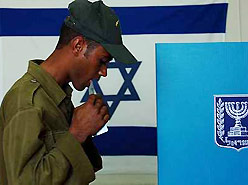
(The photo was captioned someting like "Israeli soldier casts his vote.")
UPDATE: My Israeli wife asked, "What's the big deal about this picture?" I responded to the effect that the fact that you don't think it's a big deal explains why it's a big deal. In the U.S., it took hundreds of years and much violence to win black Americans full civil rights, including the right to vote. With much public support, Israel over the past two decades welcomed poor, uneducated black Jews from Ethiopia, and provided them with full civil rights. The picture above appeared in an Israeli newspaper, as an unremarkable election-related scene.
It's available here.
Alastair Chivers is a Scottish university student (Robert Gordon University) who is doing a dissertation on journalism and blogging; as part of the study, he's put up some questionnaires that he's hoping users and bloggers might answer:
The intention of this project is to look at what role weblogs of a journalistic nature play in a user's consumption of news online. Are journalistic weblogs used as a sole news source by internet users? Is the popularity of these sites increasing like blogging in general? What inclines people to find and regularly read journalistic weblogs?
If anyone would like to take the questionnaire for this study then please click on the appropriate link below, you would be greatly helping me in my study. There is a seperate questionnaire for users of journalistic weblogs and the bloggers of such sites. User questionnaire. Blogger questionnaire.
Davide Berretta, in today's International Herald Tribune, has a very smart piece about Silvio Berlusconi ("Il Cavaliere," as the press sometimes refers to him here in Italy) and the current national election campaign. Things have been getting a bit weird during this final week (voting is Sunday and Monday) of the campaign. First, in Monday night's debate, Berlusconi, during his final summation, announces that he will abolish the property tax on residences if he wins the election. It came completely out of the blue, and would mean about a 30% loss of revenue for local governments ... and then, after the debate, he was asked by a reporter how he thinks the vote will go; he replied: The Left can't win; I have too much respect for the Italian electorate to think "che ci siano cosi tanti coglioni" -- that they would have the balls -- to vote against their own interests. It is (apparently) a very vulgar expression, not the sort of thing Italians expect their PM to say -- although, as Berretta points out, maybe Berlusconi gets to play by new rules.
Thursday, April 6, 2006
This is a post I sent to a con-law e-mail list about Eugene's analysis of the Miami school's decision to exclude a pro-Castro book from the school library. I thought it might be of interest to some VC readers as well:
It seems to me that running a public school necessarily involves choosing between different ideas on the merits, and excluding at least some of them. We cannot teach all conceivable viewpoints in, say, a public school history class. Therefore, schools will probably teach the Holocaust without much (if any) consideration of the views of Holocaust deniers. Similarly, they will teach science courses without including the views of the Flat Earth Society. To say that this is unconstitutional is to say that public schooling itself is unconstitutional.
The same goes for school libraries. They cannot stock copies of every book ever published. Therefore, they have to make choices based in part on the quality of the book's content and how it fits in with the school's curriculum. The perceived accuracy of the ideas in the book is going to be a part of any evaluation of quality. Holocaust denial books, pro-flat earth books, and others will inevitably get short shrift.
Although I agree with the Miami school's decision in this particular case, I do not like the general idea of giving government such power. Obviously, they will sometimes use it to indoctrinate children in ideas that are wrong and exclude ideas I think are right; and even the exclusion of mistaken ideas can also cause harm for Millean reasons. Worse, the indoctrination - if adopted as policy by a state or federal government - could spread to millions of children across a wide area, not just to those who attend any one school.
To my mind, the best solution would be to get government out of the business of supplying education (though it could still fund it through vouchers or tax credits). That would reduce, if not eliminate, the state's ability to engage in large-scale indoctrination of children. Individual private schools might still make bad decisions on these issues, but there would be no centralized authority capable of enforcing a dangerous orthodoxy throughout the whole of the nation or an entire state. But I do not think that this approach is required by the Constitution. So long as we have public schools, we must also give the state the power to determine which ideas will be represented in the curriculum and which will not.
UPDATE: This is not essential to the more general argument I am making in the post. But it may interest readers to know that my parents (like nearly all children in the Soviet Union) were members of the Soviet Pioneers, the youth organization group on which the Cuban Young Pioneers were explicity modeled (even the name is virtually identical). The main purpose of both organizations was to indoctrinate children in communist ideology and teach them to hate the regime's enemies (both domestic dissidents and foreign opponents, especially the US). Most if not all the children were well aware of this for the good reason that it was constantly drummed into them. An elementary school textbook that discusses the Pioneers without mentioning their main function is inexcusably misleading. It would be like a textbook that portrayed the Hitler Youth (which had many similarities to the Pioneers) as an organization focused on sports and camping without mentioning that its main purpose was indoctrinating German children in loyalty to the Nazis.
I still remember watching a documentary on the Hitler Youth with my father when I was 9 or 10, and him commenting on how the rituals and indoctrination methods portrayed in the film were so similar to those he experienced in the Pioneers.
Related Posts (on one page):
- Public School Curricular Decisions and the Constitution:
- School Libraries and Kids' Books That Seem To Put Communist Cuba in a Positive Light:
South of the Suwannee writes [UPDATE: I originally credited this to University of Miami lawprof Michael Froomkin, but i was mistaken; Michael was just the person who pointed me to this post]:
Embargo of the Mind
"The book has content and pictures that are reflective of the current Communist regime. Staff is following approved School Board rules to remove the book from all libraries."
Miami-Dade Schools Supertendent Rudy Crews, in a memo regardng a book on Cuba.
The publication Vamos a Cuba/A Visit to Cuba is part of a series described by Publishers Weekly:
Grade 2-4-These informative and colorful books can be placed either in a reference collection or in a circulating collection. The title pages feature a world map with the respective country highlighted, and a table of contents outlines the broad subject categories covered (e.g., points of interest, homes, food, clothing, work, transportation, language, education, entertainment, celebrations, and the arts). Information is offered in simple statements without commentary, the attractive layout features full-color photographs of children in many different scenes, and selected words are bolded within the text and later explained in the glossary. Appended are key facts about the country, an index, a bibliography, and a short list of words and their many variants (e.g., apartamento-departamento; bus-autob#s-cami?n; calabaza-guaje). These books will be invaluable for homework assignments and will appeal to readers who are curious about life in other countries.
Sorry, we'll tell you what countries you are allowed to be curious about.
This is quite close to the issue that the Supreme Court failed to decide in the 4-1-4 Board of Education v. Pico (1982) case. My sense is that Justice Rehnquist had the better of that argument — a school library is a means for the school to communicate to children those views that it thinks are accurate, educational, and generally right (or at least plausible). It may well be good for the school to take a latitudinarian approach to this, and to include even things that are controversial, that contradict each other, or that contradict some of the values that the school is trying to inculcate. But that seems to me a judgment call for the school to make, and not a constitutional command.
This is especially so as to books aimed at second-to-fourth graders. Consider how the Miami Herald article that Michael points to describes it:
A portrait of kids outfitted as Pioneers — Cuba's communist youth group — is emblazoned across the book's cover. Inside pages show scenes of a joyous carnival held on July 26, the anniversary of the Cuban revolution....
The publisher's website says the series is intended to help readers understand what it's like to be a child in another land. The books are geared toward children ages 5-7 in grades K-2....
It seems to me that a school board might reasonably conclude that the book conveys an inaccurately positive image of life in Communist Cuba, and improperly implicitly praises the Cuban revolution and its works; others might interpret it differently, but a school board ought to have very broad discretion deciding what books 5-to-7-year-olds should be seeing in the school board's library.
By the way, what if there had been a similar travelogue on "A Visit to South Africa" in the mid-1980s, showing pictures of smiling happy white children in White Summer Camps wearing uniforms of some pro-apartheid youth group, plus a picture of smiling happy black children in Black Summer Camps for good measure? Seems to me that when school libraries contain such books, children — especially very young children — might reasonably see the things being described in those books as good; and school officials should therefore be entitled to exclude books that positively depict things that school officials do not want to endorse.
Related Posts (on one page):
- Public School Curricular Decisions and the Constitution:
- School Libraries and Kids' Books That Seem To Put Communist Cuba in a Positive Light:
WorldNetDaily reports (and please e-mail me if you have transcripts or quotes that confirm or deny this):
United States churches are secretly run by Jews who converted to Christianity with the intention of controlling religious Americans including President Bush, a top Hamas member claims.
"Even the churches where the Americans pray are led by Jews who were converted to Christianity, but they were converted to keep controlling the Americans," Mohammad Abu Tir, the number two Hamas terrorist in the newly formed Palestinian Authority government said during an exclusive interview from his home yesterday with top radio host Rusty Humphries and WND Jerusalem bureau chief Aaron Klein.
"I made a study and I know very well that all this radicalism in some parts of the Christianity, (including) the Anglicans who are being led by Bush, is because of the control of Zionists," said Abu Tir....
Abu Tir was elected to the number two spot in the PA in January's legislative ballots in which Hamas won by a large margin. He spent nearly 25 years in Israeli prisons for directing terror activities, including the attempted poisoning in the early 1990s of Israel's water supplies....
The Atlanta Journal-Constitution reports:
Denise Grier, who was cited in DeKalb County for her "I'm Tired of All the BUSH—" car decal, has had her case thrown out.
"We couldn't prosecute it," DeKalb Recorders Court Chief Judge R. Joy Walker said because Georgia's lewd decal law was ruled unconstitutional in 1990. Walker said a letter of dismissal was mailed to Grier's home last week....
Related Posts (on one page):
- More About Profanities on Bumper Stickers:
- Profanities on Bumper Stickers:
Inspired by the interest generated by my post on "The Law of Star Trek," I thought I would devote a post to the intersection between science fiction and fantasy literature and one of my major academic research interests - federalism and decentralization. Despite the quip in the previous post, I think there is some value to exploring political themes in SF, although that value is easily overestimated. And even if there isn't any value it's still fun!
In sharp contrast to legal scholars and other academics, the majority of whom tend to favor relatively centralized government, major science fiction and fantasy writers tend to support decentralized political systems or even anarchy. I am not arguing that decentralization is the main theme of these works and in some cases it isn't even conscious. But it does seem to be there.
A few examples:
1. J.R.R. Tolkien
Sauron and Saruman's efforts to unify Middle Earth under centralized rule are portrayed negatively. When the "good guys" win at the end, King Elessar (Aragorn) establishes a highly decentralized state, with regions such as the Shire and Rohan enjoying near-total autonomy. This was actually a conscious theme of Tolkien's work, as he hated what he considered the excessive, homogenizing centralization of modern industrial society, and also despised the centralizing policies of Britain's post-WWII Labor government.
2. Ursula LeGuin
LeGuin is, of course, an anarchist, and many of her books explicitly promote anarchy and denounce government, particularly The Dispossessed.
3. J.K. Rowling's Harry Potter series.
The Harry Potter series portrays government so negatively that even the "most cold-blooded public choice theorist could not present a bleaker portrait." The state is portrayed as both venal and incompetent throughout the series and virtually every positive achievement is the result of decentralized private initiative.
4. Isaac Asimov's Foundation.
A centralized galactic empire breaks down as a result of bureaucratic sclerosis (symbolized by the literally labyrinthine bureaucracy on the capital planet of Trantor). Only decentralization combined with the private initiative of the shadowy Foundation saves the day. The work is somewhat ambiguous because the Foundation's goal is to eventually establish a new and better empire. Nonetheless, the evils of centralization are powerful portrayed, while its benefits receive short shrift.
5. Marion Zimmer Bradley.
In The Mists of Avalon, Bradley is very hostile to the efforts of the Church and the central government to curb the autonomy of local communities (including Avalon itself) and impose a unified state and religion. Centralization is also viewed skeptically in her Darkover series.
6. Robert A. Heinlein.
Heinlein attacked centralization in many of his books. Not surprising, given that he was a libertarian.
7. Vernor Vinge.
Same as Heinlein above.
8. David Brin.
Defends decentralization in several of his novels.
9. Frank Herbert
In his famous Dune series, a horrendous war arises from the efforts of the galactic Emperor to extend his power over a what had been a relatively decentralized political system (Dune). Even more carnage arises from the hero's efforts to consolidate his own imperial authority after he overthrows the previous emperor (Dune Messiah). Eventually, only the destruction of the empire enables humanity to be saved and renewed (God Emperor of Dune).
10. Orson Scott Card.
This is a partial exception. Card's Ender series portrays sympatheticallyPeter the Hegemon's efforts to unify Earth under a single (and increasingly powerful) government. However, the effort succeeds only because dissenters are given the chance to establish colonies on other worlds that will be highly autonomous.
Two prominent examples from TV sci fi:
1. Star Trek.
The Federation is a very loose federal system with each planet enjoying a high degree of autonomy. This is portrayed favorably, while centralized empires such as the Romulans, the Dominion, and the Borg are viewed negatively.
2. Babylon 5.
There is a sympathetic portrayal of the efforts of Mars and other colonies to secede from Earth. Centralized empires (the Vorlons, the Shadows) are criticized for their efforts to destroy local autonomy. Even the efforts of "the good guys" to establish a UN-like Interstellar Alliance are portrayed as a failure that ends up making the situation worse.
Conclusion:
What is interesting about the strong support for decentralization in sci fi and fantasy works is that it cuts across ideological lines. It is not just libertarian (Heinlein, Vinge) and conservative (Tolkien) writers who favor it. So too do liberal (Rowling, Herbert, the creators of B5 and Star Trek), and radical ones (LeGuin, and also Samuel Delaney, whose work I probably should have included in the list). In several cases, particularly LeGuin, Tolkien and Vinge, the critique of centralized authority and advocacy of decentralization is a consciously intended theme.
Of course, this is not an exhaustive analysis and I'm sure I've missed some counterexamples as well as inevitably oversimplified the work of the writers I've covered. Nonetheless, this is an interesting trend, especially given the contrast between the sci fi and fantasy writers and the views of most other intellectuals, particularly those on the political left.
UPDATE: I thought it was reasonably clear in the original post that decentralization does NOT = libertarianism. Although most libertarians support political decentralization, so too do some nonlibertarians. Thus, I tried to point out that the support of LeGuin, Rowling, etc. for decentralization is interesting - in part - precisely because they are NOT libertarian or conservative. However, it seems that I was not as clear about this as I thought, so I have tried to restate the point here.
Related Posts (on one page):
- Decentralization and Federalism in Science Fiction and Fantasy Literature:
- The Law of Star Trek:
The San Francisco Board of Supervisors has issued this nonbinding resolution:
Resolution urging Cardinal William Levada, in his capacity has head of the Congregation for the Doctrine of the Faith at the Vatican, to withdraw his discriminatory and defamatory directive that Catholic Charities of the Archdiocese of San Francisco stop placing children in need of adoption with homosexual households.
WHEREAS, It is a insult to all San Franciscans when a foreign country, like the Vatican, meddles with and attempts to negatively influence this great City's existing and established customs and traditions such as the right of same-sex couples to adopt and care for children in need; and
WHEREAS, The statements of Cardinal Levada and the Vatican that "Catholic agencies should not place children for adoption in homosexual households," and "Allowing children to be adopted by persons living in such unions would actually mean doing violence to these children" are absolutely unacceptable to the citizenry of San Francisco; and,
WHEREAS, Such hateful and discriminatory rhetoric is both insulting and callous, and shows a level of insensitivity and ignorance which has seldom been encountered by this Board of Supervisors; and
WHEREAS, Same sex couples are just as qualified to be parents as are heterosexual couples; and
WHEREAS, Cardinal Levada is a decidedly unqualified representative of his former home city, and of the people of San Francisco and the values they hold dear; and
WHEREAS, The Board of Supervisors urges Archbishop Niederauer and the Catholic Charities of the Archdiocese of San Francisco to defy all discriminatory directives of Cardinal Levada; now, therefore, be it
RESOLVED, That the Board of Supervisors urges Cardinal William Levada, in his capacity as head of the Congregation for the Doctrine of the Faith at the Vatican (formerly known as Holy Office of the Inquisition), to withdraw his discriminatory and defamatory directive that Catholic Charities of the Archdiocese of San Francisco stop placing children in need of adoption with homosexual households.
The San Francisco city government, it seems to me, is quite entitled to express its views on gay rights questions, and to condemn groups that, in its view, express "hateful" ideas. It's entitled to do this even when those groups are religious groups -- whether the Catholic Church, some Islamic denomination, the Church of Scientology, or any other religious group.
It's possible that expressing views on a religious group's purely theological claims (as opposed to claims related to worldly conduct that affects other people) might violate the Establishment Clause. There is even some language in the Court's opinions, which condemn "endorsement or disapproval of religion," that suggests that any condemnation of a religious organization by name would beunconstitutional. But it seems to me that the right rule is that government officials must be able to comment on religious groups when their actions touch on secular matters, for instance arguing that terrorism is antithetical to the proper understanding of Islam, or that the Catholic Church's views on adoption by homosexual couples are wrong.
Still, though the resolution is constitutionally permissible, isn't there something a bit troubling about it?
Start with the old those-Catholics-are-controlled-by-a-foreign-potentate thing that has historically often been used to discredit American Catholic politicians, and that seems to me to have no relevance to the moral issues involved here. Opposition to same-sex adoption is right or wrong with no regard to whether the leaders of the opposition are in Italy or here.
Then we have waving the bloody shirt -- the centuries-old bloody shirt -- of pointing out that Cardinal Levada's organization was once "known as the Holy Office of the Inquisition." Yes, it was (this was not the Spanish Inquisition but the "Roman Inquisition, [which] was intended to combat Protestantism, but ... is perhaps best known historically for its condemnation of Galileo"), but hasn't just a little bit of time passed since then, and hasn't the Church slightly altered the practices that gave the Inquisition a bad name?
Levada's position today is really no different than the position of any leading theologian who is helping set policy for a hierarchical church, whether a foreign or domestic one, and whether one that has a long-ago history of physical abuse of heterics or not. Over the centuries, many religious groups and organizations have done some pretty bad things; it seems to me irrelevant and, especially for a government entity, needlessly divisive to dredge up their past sins in criticizing the actions of their present leaders.
It seems to me that if the San Francisco Board of Supervisors really wanted to act as "the government of [a] tolerant community" by "treat[ing] its minority populations with care and respect" (I quote here from another recent resolution, to avoid "creat[ing] a divisive atmosphere," and to "reflect the diversity of the community," it should have avoided suggesting that serious Catholics who follow the Church hierarchy's teachings are agents of a "meddl[ing]" "foreign country," or irrelevantly faulted their cherished institutions for those institutions' centuries-old sins.
Many thanks to Marty Lederman, who pointed out the matter to me, though I should make clear that he doesn't object to the Supervisors' general criticisms, and shares their view of the merits of the policy question (though not the religious one).
An ode to Cricket Alley Corp. v. Data Terminal Systems (from a poet in my Contracts II class):
Facts:
DTS sold registers to Cricket’s
To automate bookkeeping wickets.
The shop owner said, “Dang!
These won’t talk to my Wang.
We’re stuck with hand entered sales tickets.”
Holding:
Cricket’s needs were expressed or implied.
On salesmen’s claims Cricket had relied.
Damage was foreseeable
And so we’re agreeable
Consequence relief can’t be denied.
Wednesday, April 5, 2006
VC bloggers Todd Zywicki, Dale Carpenter, and I are among the two dozen panelists at a conference on "Censorship and Institutional Review Boards" being held at Northwestern Law on Friday, April 7.
The Northwestern Law Review is hosting the conference at the law school in downtown Chicago. Both Todd and I are on the last panel on Friday afternoon at 3 pm. Dale is on the earlier panel at 12:45.
The program is here.
Legal Affairs has an interesting review of a new volume of articles by legal scholars on the role of law in Star Trek. Although I like science fiction (despite not being a "Trekkie"), I wonder if this is the most productive possible use of academic research effort. It certainly won't help law professors overcome the invidious stereotype that we are a bunch of nerds who have no life!
Finally, at the risk of being inundated with angry e-mails by Star Trek fans, I have to say that, in my view, the treatment of law and politics in Star Trek is not as interesting and sophisticated as that in other sci-fi series such as Babylon 5 and the new Battlestar Galactica. But for fear of really reinforcing the invidious stereotype noted above, I'm not going to write an essay justifying this conclusion!
Related Posts (on one page):
- Decentralization and Federalism in Science Fiction and Fantasy Literature:
- The Law of Star Trek:
Andrew Fraser will defy the Human Rights and Equal Opportunity Commission by not apologising to the Sudanese community for his study linking African refugees to high crime rates. In a landmark ruling that raises fresh questions about the limits to which academics can engage in public debate, HREOC chairman John von Doussa has found Professor Fraser's comments were unlawful because they amounted to a "sweeping generalisation" that was not backed by research. ... Sudanese Darfurian Union secretary Safi Hareer complained to the human rights commission that Professor Fraser breached the Racial Discrimination Act in a letter published in the Parramatta Sun newspaper. The letter said experience showed an expanding black population was a "sure-fire recipe" for increased crime and violence. In a letter received by Professor Fraser yesterday, Mr von Doussa rejected his submission that his comments were made for "genuine academic purposes in the public interest". Mr von Doussa said while the legislation allowed for fair comment on matters of public interest and for genuine academic discussion, the comments were not made with "sufficient constraints and proportionality". ... But Professor Fraser said he would not apologise to anyone. "Even those who disagree with me should be appalled at this attack on the freedom of academic debate," he said. "This gives the lie to all those politicians who've claimed that racial hatred legislation would not curb freedom of expression in Australia."
Indeed. Imagine allowing civil rights establishment bureaucrats the power to determine whether one's speech on a public issue contained "sufficient constraints and proportionality." Shudder.
Thanks to reader Fred Ray for the link.
NBCSanDiego.com reports:
In the wake of last week's immigration-reform protests, one school district is taking drastic measures, banning all symbols of patriotism, both U.S. and Mexican.
Beginning Monday, the Oceanside Unified School District is banning all flags and patriotic clothing. According to school officials, some students are using the garments and flags to taunt classmates.
Some critics of the move are calling it a violation of free speech protections guaranteed by the Constitution.
The American Civil Liberties Union points to the landmark Supreme Court case Tinker v. Des Moines. In that case, school officials attempted to stop students who were protesting the Viet Nam War from wearing black armbands.
"The school has to be able to show a strong likelihood that there is going to material and substantial disruption of school, and if they don’t meet that standard, then they can't censor student speech," said Kevin Neenan of the ACLU....
School officials are saying that the ban is just temporary and that they were just trying to prevent violence. They would not say how long the ban would be in effect.
[NOTE: I originally omitted the first paragraph from the quote, but added it because some comments suggested that it was important.]
The ACLU is right that under Tinker v. Des Moines Indep. School Dist. (1969), the First Amendment protects student speech (including the display of symbols) unless the speech seems likely to be disruptive (or, a later case holds, vulgar). But California state law (Education Code § 48950) provides extra protection to public high school students:
(a) School districts operating one or more high schools ... shall not make or enforce any rule subjecting any high school pupil to disciplinary sanctions solely on the basis of conduct that is speech or other communication that, when engaged in outside of the campus, is protected from governmental restriction by the First Amendment to the United States Constitution or Section 2 of Article 1 of the California Constitution....
(d) Nothing in this section prohibits the imposition of discipline for harassment, threats, or intimidation, unless constitutionally protected....
(f) The Legislature finds and declares that free speech rights are subject to reasonable time, place, and manner regulations.
So California high school districts can't restrict display of the American or Mexican flags just on the theory that it might be used in a threatening (or "harass[ing]," whatever exactly that means) way — it can only restrict such display that is itself threatening or harassing. (The time, place, and manner exception probably doesn't justify even a temporary ban on flag, display, since "time, place, and manner regulations" is a First Amendment term of art that refers only to content-neutral regulations, and a ban on the display of particular flags is not content-neutral.)
Thanks to reader Cory Andrews for the pointer.
Andy Sabl says, "not very," and makes some quite plausible arguments, responding to Michael O'Hare on the same blog (Reality-Based Community). I'm not sure he's right, but if you're interested in these questions, Andy's post is much worth reading.
I am the Editor of an interdisciplinary academic journal, the Journal on Firearms and Public Policy. The Journal is now accepting submissions for its next volume, our 18th year of publication. Some sample issues, in PDF, are here. (We hope eventually to put all volumes on-line.) Because we are interdisciplinary, articles may be written in a variety of academic and citation styles, including law, history, social science, philosophy, and so forth. The JFPP's circulation is vastly larger than most academic journals. If you would like to submit an article, or send a query about possible submission, please write me at the e-mail link on the lower-left column of my website.
Barrels of ink have already been spilled over the Supreme Court's narrow 5-4 decision in Kelo v. City of New London, including some by yours truly. In "The Green Costs of Kelo: Economic Development Takings and Environmental Protection," environmental law professor Jonathan Adler and I have now put together the first article to systematically examine Kelo's implications for environmental policy. It is available here, and currently under review by journals.
We argue that the Supreme Court's decision to allow government to condemn property for transfer to other private parties in order to promote "economic development" may well harm the environment. In particular, private conservation land (an increasingly important tool for protecting environmental amenities and wildlife) is likely to be targeted for condemnation by developers and their allies in local government because conservation property contributes little to development and is usually not subject to property taxes. Allowing economic development condemnations also harms the environment in several indirect ways that we detail in the paper.
Some environmentalists fear that forbidding economic development takings would undermine the use of eminent domain for environmental purposes. Jonathan and I show that these fears are probably groundless. Not even the hint of such a trend has arisen in the nine states where economic development condemnations are banned by state constitutional law. And nearly all environmental takings can easily be justified under one of several legal rationales that would remain intact even if economic development takings are banned.
I won't go into the legal nitty-gritty here. But constitutional law, property, and environmental policy buffs are welcome to read about it in the paper and give us your thoughts.
Others are, of course welcome to comment as well. Though if you want to address the technical legal issues, I hope you will at least skim the paper first.
UPDATE: To avoid confusion, it is important to note that the paper discusses the consequences of the Kelo majority's decision to permit economic development takings as opposed to banning them. We argue that the latter approach is, overall, superior from an environmental point of view. Accordingly, it makes no difference to our thesis that the Supreme Court's pre-Kelo jurisprudence also did not ban economic development takings, a point that is acknowledged in the paper itself. It is still the case, or so we argue, that banning economic development takings, as several states have done, would be preferable from an environmental point of view (as well as for other reasons).
Tuesday, April 4, 2006
[Please note UPDATE below.] The Daily Mail (U.K.) reports on the new British policy:
Burglars will be allowed to escape without punishment under new instructions sent to all police forces. Police have been told they can let them off the threat of a court appearance and instead allow them to go with a caution.
The same leniency will be shown to criminals responsible for more than 60 other different offences, ranging from arson through vandalism to sex with underage girls....
A caution counts as a criminal record but means the offender does not face a court appearance which would be likely to end in a fine, a community punishment or jail.
Some serious offences - including burglary of a shop or office, threatening to kill, actual bodily harm, and possession of Class A drugs such as heroin or cocaine - may now be dealt with by caution if police decide that would be the best approach.
And a string of crimes including common assault, threatening behaviour, sex with an underage girl or boy, and taking a car without its owner's consent, should normally be dealt with by a caution, the circular said.
The Home Office instruction applies to offenders who have admitted their guilt but who have no criminal record....
The crisis of overcrowding in UK prisons has also prompted moves to let many more convicts out earlier.
It emerged last month that some violent or sex offenders, given mandatory life sentences under a "two-strike" rule, have been freed after as little as 15 months....
A number of crimes - notably shoplifting - are now regularly dealt with by fixed penalty notices similar to a parking fine....
I may be missing some important aspects of the British justice system that might explain why this is going on, and make it more sensible than it appears. Moreover, most crime is not committed by people who lack a criminal record, and if the British justice system continues to go after people who have such a record (which apparently includes "cautions"), then the free first bite at the apple might not have that much of an effect. Still, my quick reaction is that this is a bad idea, and is likely to substantially increase crime and reduce Britons' sense of security. The British burglary rate has apparently been falling since its mid-1990s modern records (see part 4.2), and is now at roughly the U.S. levels (see table 1). But it's still pretty high — 2.7% of all households are burglarized each year — and the essential decriminalization of first-offense burglary seems to me likely to drive it higher. (Incidentally, it may well be that some American and continental European jurisdictions have similar policies; I'm not suggesting that this is a quintessentially British failing.)
Thanks to Glenn Wright Bowen for the pointer.
UPDATE: I originally misread the story, and improperly titled this post "Burglarize a House, and You Won't Even Have To Go to Court" — according to the article, the caution policy applies only to burglaries of shops or offices. I've revised the heading accordingly; my apologies, and my thanks to the readers who e-mailed to correct me.
Some federal district court decisions recently have said "yes," applying the federal Voting Rights Act and extending a Ninth Circuit decision from late last year. Lawprof Rick Hasen (generally something of a liberal) urges the Ninth Circuit to issue an emergency stay of one such decision that's currently being appealed.
Hasen sets forth his arguments in this column from last December (following the original Ninth Circuit decision). Sacramento Bee columnist Dan Weintraub seems to agree. I'm not a Voting Rights Act maven, but my sense is that Rick is probably quite right.
UPDATE: The Ninth Circuit refuses to issue the emergency stay (in a short decision by Judges Kozinski and Rymer).
An interesting Chicago Tribune article on statutes and proposed statutes aimed at restricting such picketing. Here's my First Amendment analysis of such laws.
Related Posts (on one page):
- Federal District Court Strikes Down Parts of Funeral Picketing Ban,
- Funeral Picketing:
- ACLU Backs Funeral Picketers:
- AP Error About Funeral Picketing Restriction Makes Its Way Into New York Times:
- More on Newly Passed Federal Anti-Funeral-Picketing Bill:
- Congress Enacts Anti-Funeral-Picketing Bill:
- Funeral Picketing:
- Funeral Picketing:
I'm very grateful to Eugene for clearing up my gender identity crisis.
And like some of the commenters, I certainly wish we had more female libertarians - for both ideological and, ahem, nonideological reasons:).
Related Posts (on one page):
- Gender, Language, and Names II:
- Gender, Language, and Names:
Yes, it's true, almost all our readers are from the U.S. (and it's also true that determining a user's location from his IP address is not 100% reliable). But it's still a cool map.
I've just put up a new version of my forthcoming Stanford Law Review article on the subject; it has two whole new sections, on the Establishment Clause and on state Religious Freedom Restoration Acts. The issue, as before, is whether the government may limit a subsidy to groups that don't discriminate based on various criteria, given that the groups may have a constitutional right to so discriminate (in the wake of Boy Scouts v. Dale). I think the answer is "yes"; I'm not a big fan of the antidiscrimination rules involved, but it seems to me they are indeed constitutional, even when applied to ideological groups that have ideological reasons to discriminate based on religion, sexual orientation, sex, race, ethnicity, and the like. Interestingly, the strongest argument for exemptions for those rules comes not under the First Amendment, but under state Religious Freedom Restoration Acts (see Part VI of the article).
If you're up on the First Amendment or religious accommodation jurisprudence that touches on this subject -- and, better yet, the Court's jurisprudence on refusals to subsidize abortion, private schooling, and other constitutional rights, a jurisprudence that I rely on heavily in my piece -- I'd love to hear your views. I should say (realizing that beggars can't be choosers) that while there are lots of interesting broad philosophical issues that my topic touches on, I would prefer to get comments from people who have read (or at least skimmed) the paper, and who are up on the somewhat technical legal doctrines that the paper relies on.
Within the legal academy, I think it's clear that Lochner is slowly losing its status as an anti-canonical case, in part for precisely the reasons David suggests. That is not to say that most law professors agree with it - they do not. But far fewer than before regard it as unquestionably wrong and as a symbol of judicial evil.
In addition to the excellent historical research by Siegan, David, and others, Lochner's reputation has also benefited from the return of free market economics to intellectual respectability over the last 30 years. In order for a decision to enter the anti-canon, it usually has to be regarded not only as unquestionably wrong from a legal point of view, but also as an endorsement of what is seen as an obviously evil policy result. That's why Plessy and Dred Scott are so widely reviled, while numerous other decisions with equally bad or worse legal reasoning have not suffered the same fate.
Obviously, most law professors (though a smaller percentage than before) still don't like the policy impact of Lochner. But since the rise of law and economics it's much tougher for them to claim that that impact was obviously negative. For example, even the con law textbook from which I teach, coauthored by four prominent liberal academics, seems to endorse the now conventional view that the maximum hours statute invalidated by Lochner was enacted for the purpose of driving small bakeries that employed poor immigrant bakers out of business in order to benefit their competitors - larger bakeries that primarily employed somewhat wealthier native-born workers. In other words, far from benefiting "the workers" at the expense of "the capitalists," this law was benefiting relatively wealthier capitalists and workers at the expense of poorer, less-established members of both classes. And that's not even to mention the impact of higher food prices on consumers, which also disproportionately harmed the poor; this part, I think, is not given sufficient attention even in the revisionist scholarship. None of this proves that the law was unconstitutional (many harmful laws are not). But it does throw a wrench into the standard class warfare morality tale that used to be the unchallenged conventional wisdom on Lochner.
That said, Lochner's reputation has changed much less (if at all) among lawyers outside the academy than within the ivy walls. That may begin to change as more attorneys educated within the last 10-15 years enter the top echelons of the profession.
(I should add that I'm not sure that David's description of attitudes towards Lochner and Justice Holmes is accurate. But I really just posted this for the joke.)
For most of the last century, Holmes's greatest defenders and promoters have been left-wing "Progressives." But Holmes's views on a range of issues are now repugnant to the left. Beyond a general solicitude for (some types of) freedom of expression, Holmes had no regard for civil rights or civil liberties. See, e.g., his majority opinion in Buck v. Bell (upholding coercive sterilizaton, which he clearly thought was not only constitutional but a good idea), his dissent in Meyer v. Nebraska (arguing that states should be allowed to ban the teaching of foreign languages), his (unpublished) dissent in Buchanan v. Warley (arguing that banning blacks from buying houses in white neighborhoods is a reasonable regulation of property and should be upheld). A sign of the times is Alschuer's very critical biography, Law Without Values. An even more significant sign of the times is that if I'm remembering correctly, this book received a very positive front page review in the New York Times.
A few on the right, such as Judge Posner, continue to admire Holmes, but Holmes's skepticism, Social Darwinism, commitment to moral relativism, and general contempt for "values" and individual rights is hardly likely to win him any friends among either libertarians or moral traditionalists (see, e.g., this review in National Review). I'd even say that I hear far more criticism of Holmes emanating from every ideological corner than I hear praise.
Related Posts (on one page):
- Why Oliver Wendell Holmes's Reputation Has Declined:
- Holmes and Reputation:
Related Posts (on one page):
- Why Oliver Wendell Holmes's Reputation Has Declined:
- Holmes and Reputation:
To answer Orin's query below, there aren't many scholars who have argued that Lochner was correctly decided, but there are some, including not just Siegan, but the VC's own Randy Barnett, Richard Epstein, Ellen Frankel Paul, Roger Pilon, among others. There are a number of other scholars who are generally sympathetic with Lochnerian cases, but haven't endorsed the particular holding of Lochner, including Alan Meese, Michael Phillips, and Chris Wonnell. Yet another group of scholars argue that the Court went too far in the Lochner era, but that the Court then went too far in the opposite direction in completely refusing to protect economic liberty. Walter Dellinger, Rebecca Brown, David Strauss, among others, fall into this category. A fourth group, including Bruce Ackerman and Owen Fiss, seems to think that Lochner was correct for its time, but properly didn't survive the New Deal Reformation.
Meanwhile, revisionist legal historians including myself, G. Edward White, Barry Cushman, and Howard Gillman have spent the last couple of decades placing Lochner and its progeny in historical context, destroying the myth that Lochner was a "Social Darwinist" opinion issued by a Court seeking to favor corporate power over the rights of workers, and showing that the Court's reasoning was consonant with American political and judicial tradition. Meanwhile, Justice Holmes, author of a famous pithy dissent in Lochner, has seen his reputation plummet.
Contrast the above with the virtually universal condemnation of Plessy or Dred Scott, and one can see that Lochner is no longer in the same anti-canonical league as those opinions. And contrast the above with the way Lochner and its progeny were universally condemned a couple of decades ago, to the extent that after a reasonably exhaustive search I could find only one law review article published between 1937 and 1980 (the year Siegan's book was published) even mildly praising "economic substantive due process." All in all, Lochner is losing its anti-canonical status, and Siegan is as responsible as anyone.
Related Posts (on one page):
Siegan's influence is an important reason that Lochner is gradually losing its place in the constitutional law "anti-canon;" who would have believed pre-Siegan that leading liberal scholars such as Bruce Ackerman, Owen Fiss, Walter Dellinger, and others would express at least tepid regard for the Court's decision in Lochner (even if they think that it either went too far, or quickly became anachronistic in its principles)?Maybe I'm just missing the boat, but it doesn't seem right to me that Lochner is "gradually losing its place in the constitutional law anti-canon." My sense is that some elite scholars are less harsh in their condemnation of Lochner today than were elite scholars a few decades ago, for reasons that David has written about at length in a number of very interesting articles. But does anyone think that Lochner was actually correct?
Related Posts (on one page):
- More on Lochner
- Lochner and the Anti-Canon:
- Bernie Siegan, R.I.P 2
- Bernard Siegan, R.I.P.:
I just wanted to second (or rather "third") the tributes to Bernard Siegan. Unfortunately, I never met Prof. Siegan, but I well remember the exciting experience of reading his book Economic Liberties and the Constitution as a college sophomore. It certainly opened my eyes to many aspects of constitutional history that I had never even heard of before (and, as I later learned, neither had mainstream legal scholars at the time the book was written and for some time thereafter).
Sadly, Prof. Siegan never got the full credit he deserved for his pioneering efforts. And he also suffered the indignity of being "Borked" by the Senate.
But if you read almost any recent article or book on constitutional economic liberties, Siegan's influence shines through, even if the authors themselves often fail to recognize it.
I, however, would never mention the injustice of his being rejected by Senate Democrats for a seat on the Ninth Circuit after being nominated by President Reagan. Such a memory must have been painful for him, and I could not bring myself ever to bring it up. According to the L.A. Times:
Had he foreseen the negative reaction in Congress and in the press, the University of San Diego law professor later said, he would have turned down the appointment by President Reagan.In addition to his path-breaking work that David ably summarizes, Bernie was one of the sweetest persons I have ever met. With his disposition, it was hard to believe he was a lawyer, much less a former very successful Chicago real estate transactions lawyer before entering academia. I had not known he was ill (nor realized he was 81!), and his passing is a real loss to all those who love liberty, and especially to all classical liberal law professors who followed in his wake. He was a pioneer whose trail-blazing did not leave him unscathed, but who will live on in our memories of him and in his works.
"At times, I felt like Public Enemy No. 1," the soft-spoken Siegan told The Times in 1988 after the Senate Judiciary Committee denied his confirmation along party lines.
Related Posts (on one page):
- More on Lochner
- Lochner and the Anti-Canon:
- Bernie Siegan, R.I.P 2
- Bernard Siegan, R.I.P.:
Monday, April 3, 2006
Languages in which nouns have gender sometimes have the noun's gender turn on the noun's ending. In Russian, for instance, nearly all inanimate singular nouns that end with "a" or with the letter that's transliterated as "ia" (or "ya") are feminine. My tentative sense is that this is also generally true in Spanish, and in French with the "e" ending. English nouns of course don't have gender, but generally speaking English first names, and the standard nicknames, have "a" as a marker of femininity, though with a few relatively rare exceptions (e.g., Asa, Dana, and Ezra).
But here's the funny thing about Russian: Though the "a"/"ia"-feminine rule is indeed so for nearly all inanimate singular nouns, it is not the rule for nouns referring to people (for instance, "papa" is father, "diadia" is uncle, "starshyna" is platoon leader); and it is not the rule for names. In fact, some not uncommon Russian male first names -- such as Ilya and Foma -- and most Russian male nicknames (Sasha and Zhenia, which can also be a female nickname, Vania, Misha, Dima, and many more) end in "a" and "ia."
This is all a long way to mention that our guest-blogger Ilya is a Mr. Somin (unless you want to call him Prof. Somin or just plain Ilya) rather than a Ms. Somin. A commenter made the mistake of calling him Ms. Somin, so I thought I'd disabuse others of that notion.
Related Posts (on one page):
- Gender, Language, and Names II:
- Gender, Language, and Names:
I regret to report that Professor Bernard Siegan of the University of San Diego Law School died last Monday. Siegan was author of the 1980 book Economic Liberties and the Constitution, which revolutionized thinking about the "substantive due process" jurisprudence of the Lochner era. Typical of pioneering books, this book had some flaws, but was basically right in the essential points it made: (1) the idea that "due process of law" was not satisfied by mere judicial process, but also necessitated protection of individual liberty from arbitrary legislative action, was not invented by the Lochner Court, but had historical roots going back to the Founding and well beyond; (2) looked at in economic terms, especially considering public choice factors, the most reviled cases of the Lochner era, including Lochner itself, had positive consequences for social welfare, and especially for the welfare of despised minority groups; (3) the roots of modern civil liberties jurisprudence lie in the cases of Meyer v. Nebraska and Pierce v. Society of Sisters, both of which are in exactly the same jurisprudential traditional as the economic liberties cases more often associated with Lochner; and (4) economic liberty is an important civil right that was foolishly disregarded in the wake of the post-New Deal statist consensus.
Having spent a considerable part of my academic career researching Lochner-related issues, I'm amazed how much Siegan was able to intuit in this one book, with almost no help from the existing literature. For example, he concluded based on rather scant evidence that the maximum hours law at issue in Lochner was anti-competitive legislation promoted by unionized bakers and their employers at the expense of more recent immigrants who worked longer hours. Many scholars scoffed at his conclusion, but I've recently completed an exhaustive historical inquiry into the origins of the law at issue, and have concluded that Siegan was largely correct. More generally, Siegan's influence is an important reason that Lochner is gradually losing its place in the constitutional law "anti-canon;" who would have believed pre-Siegan that leading liberal scholars such as Bruce Ackerman, Owen Fiss, Walter Dellinger, and others would express at least tepid regard for the Court's decision in Lochner (even if they think that it either went too far, or quickly became anachronistic in its principles)?
I had the pleasure of meeting Prof. Siegan only once, at a conference at USD a few years back. I don't believe that I got the opportunity to thank him for his contributions (of which the book described above is only one) to the revival of classical liberal thought in the legal academy. I hope this posting will serve as posthumous thanks.
UPDATE: When I was a student at Yale, one of my professors, the author of eminently forgettable and inconsequential works on law and economics, referred to Prof. Siegan as "that nut from San Diego, what's his name?" This is the sort of thing that first generation libertarian professors like Siegan had to routinely put up with, and those of us who have followed in his path owe a debt of gratitude.
Related Posts (on one page):
- More on Lochner
- Lochner and the Anti-Canon:
- Bernie Siegan, R.I.P 2
- Bernard Siegan, R.I.P.:
Although I am an atheist myself, I have never, until this series of posts, commented on atheist issues publicly. I didn't do so because I thought that, ultimately, hostility towards atheists was a relatively unimportant issue. After all, American atheists are, by and large, an affluent, successful group that has not in recent decades suffered much from systematic discrimination. Although I oppose government endorsement of religion and think many instances of it are unconstitutional, ultimately I don't believe that "In God We Trust" on coins and the like are major issues worth going to the barricades over.
I do not believe that atheists in this country are an "oppressed" group, and I would not support affirmative action for atheists or reparations for atheists. And I certainly don't want people to feel sorry for us and commiserate with our status as "victims." However, there are several ways in which widespread anti-atheist prejudice causes real harm.
I. Discrimination in Child Custody Cases.
In a recent article, co-blogger Eugene Volokh has documented numerous instances where atheist and agnostic parents lose out in child custody disputes because of judicial bias against their religious views. The cases Eugene cites are not situations where there is a "disparate impact" against atheists or cases where some atheist had a subjective feeling that the judge was biased against him. These are cases where the judges themselves state in published opinions that a principal reason for awarding custody to one parent is the atheism of the other. Obviously, for every case where a judge was willing state such a thing in public, it is likely that there are other cases where such considerations influenced judicial decisionmaking without being documented. Many of the cases cited in Eugene's paper are recent, and they are by no means confined to the Bible Belt.
II. Exclusion From Public Office.
As I noted in my previous post, open atheists are almost completely excluded from the highest elected and appointed positions, and there are extremely few even in low-level ones. To be sure, this does not mean that atheists are wholly without political influence. They can still use their votes and campaign contributions to try to influence theist politicians. Nevertheless, there is at least some benefit to having members of one's own group in positions of political power. Otherwise, it would be difficult to explain why virtually all other groups - from evangelical Christians to homosexuals - consider it important to have at least some such representation. Moreover, symbolism matters too, even if its importance is often overstated. Most would agree that there is something wrong with a political system if no Jew or black or Catholic were ever able to attain high public office - even if Jewish, black, and Catholic voters were effectively represented by political leaders from other groups.
Nor should we completely discount the harm to those atheists would like to pursue careers in public service. By writing this series of posts, I have probably signed away whatever chance I might have had of becoming a federal judge. While this has never been an important objective for me, it certainly could be for other ambitious atheist lawyers.
III. Social Exclusion.
While the extent to which this is a problem varies greatly from place to place and is very difficult to measure, it probably is a significant issue in some areas. As some of the atheist commenters to my first post noted, atheists often have to hide their views in order to avoid opprobrium in situations where believers feel perfectly free to express theirs. For many, this is a minor problem that rarely occurs, but for others it can be a more serious one. I am willing to bet that there is a considerable number of "closet atheists" out there, though of course there are no firm statistics. While closeted atheists probably don't suffer as much as closeted gays do (because atheism is, for most, a less fundamental element of identity than sexual orientation), neither is the suffering completely trivial. Certainly, few theists would be willing to tolerate a situation where they had to keep their own religious beliefs secret.
Except for the first, none of the above problems can or should be remedied through government coercion. But that does not mean that we should just ignore them.
UPDATE: Many of the child custody cases cited in Eugene's article deal not with disputes between atheists and theists but disputes where one parent was more observant than the other and/or provided more religious training (often in the form of church attendance) to the child. See footnote 4 of Eugene's paper (linked above). In some ways, this actually makes things even worse for atheists, since a judge who favors a more-observant theist over a less-observant one is likely to disfavor atheists even more than less-observant theists. As Eugene observes (pp. 1-2), "presumably an outright atheist would be at even more of a disadvantage" in such a jurisdiction than the less observant of two theist parents. Theoretically, instruction in atheistic thought could also perhaps be considered "religious" teaching, but the decisions cited by Eugene make it clear that they have in mind theistic training and/or church attendance only. Nonetheless, I regret my failure to make this distinction in the original post, and I hope this update remedies the mistake.
All Related Posts (on one page) | Some Related Posts:
- Appeals to Religious Hostility from the Texas Republican Party:
- Mixing Politics and Atheism:
- Holocaust-Denying Atheist Candidate for Alabama Attorney General Gets 43.5% of the Primary Vote:...
- Larry Darby, Holocaust-Denying Atheist Alabama Attorney General Candidate,
- Hostility to Atheists III - Why Does it Matter?
- Hostility to Atheism II - Are Atheists Themselves Responsible for the Prejudice Against Them?:...
- Hostility to Atheists:
- Leading Atheist Legal Activist and Candidate for Alabama Attorney General
- Discrimination Against Atheists:
In my previous post on hostility to atheism, I did not address the causes of anti-atheist prejudice. Here, I consider the common claim that the hostility is really the fault of atheists themselves.
I. Atheist "Attacks" on Religion.
Backlash against "atheist attacks on religion is perhaps the most common explanation for hostility to atheists offered by many social conservatives. They claim that public hostility to atheists is the product of such atheist actions against religion as lawsuits against religious displays on public property and the inclusion of "under God" in the Pledge of Allegiance.
The first major problem with this theory is that widespread hostility to atheism long predates these types of lawsuits. Indeed, surveys show that the public has actually gotten somewhat less hostile to atheists in recent years, even as these types of lawsuits have become more common (see,e.g., here).
A second shortcoming of the argument is that the lawsuits in question are mostly generated not by atheists but by organizations such as the ACLU and Americans United for the Separation of Church and State, both of which are predominantly run by liberal religious believers (the latter is actually headed by Barry Lynn, a Protestant minister). True, many conservative pundits portray these groups as "atheist" and no doubt much of the public believes them. However, the deliberately inaccurate portrayal of these organizations is itself driven by a political calculation to the effect that portraying an adversary as atheist is likely to arouse public hostility against it. Social conservatives would get far less traction by trumpeting a liberal Protestant or Jewish "War on Christmas" than they do by pinning it all on the atheists.
Much more fundamentally, however, there is an anti-atheist double standard built into the claim that these lawsuits are "attacks on religion" in the first place. Whatever their legal merits (in my view some are defensible, while others are not), the cases in question target not religion, but merely government endorsement thereof.
Imagine if the shoe were on the other foot. How would religious believers react if local governments routinely displayed atheist parapharnelia on public property, if our coins had inscriptions proclaiming "In Atheism we Trust," and if every Congressional session began with a paean to atheism by a "secular humanist" leader? Surely, believers would not take this lying down. They would use every legal and political lever they could to put an end to it. And they would be right to do so! Atheists cannot be accused of "attacking" religion merely because some of us try to curtail governmental behavior that believers would never tolerate if the same thing was done to them. But if atheists are nonetheless hated by many for doing so, that is more a consequence of anti-atheist bias than a cause.
This is not to deny that there are some atheists who make unjustified or even bigoted criticisms of religion. However, such people are no more common in the atheist community than are religious leaders who make equally or more bigoted statements about atheism. And the latter often have considerably higher public profiles than the former. I highly doubt that very many religious believers have ever so much as seen an atheist spokesman on TV (I don't think I ever have myself!). By contrast, Jerry Falwell, Pat Robertson and others appear in the media all the time and what they have to say about atheists is far from complimentary.
II. Communism.
There is no doubt that Communist regimes were atheistic and that they committed horrendous crimes. However, it is difficult to show that reaction to communism accounts for any significant part of the hostility to atheism observed in the US today. As in the case of the ACLU lawsuits, hostility to atheists long predated the rise of communism and has outlasted its fall. Moreover, surveys show that hostility to atheists in the US actually declined somewhat during the years of the Cold War.
Finally, many religious regimes have also been severely oppressive, in some cases almost as much so as communist governments were. Some religious groups, such as the "liberation theologians" actually endorsed communism itself. Yet few claim that liberation theology, the Taliban, Iran, and the Inquisition prove that all religion is by nature oppressive, and those who do are rejected by the vast majority of Americans. Mainstream public opinion readily recognizes that these regimes do not represent religion in general but only a subset thereof. Similarly, communism is just one of many political ideologies compatible with denial of the existence of God. Indeed, atheism is not intrinsically connected to any particular views on moral and political issues other than, perhaps, the separation of church and state.
The double standard in judging oppressive religious regimes as compared to oppressive atheistic ones is - like that regarding atheist "attacks" on religion - is more likely to be a consequence of anti-atheist prejudice than a cause.
NOTE: Some cite Nazi Germany as an atheistic regime (and therefore a possible cause of hostility to atheists). But although Hitler did show contempt for Christianity, he also repeatedly reiterated his belief in God and claimed to be doing His work. The Nazis were anti-Christian and certainly anti-Semitic, but they were not atheists.
UPDATE: A slight variation on the argument that the Establishment Clause cases caused hostility to atheists is the claim that the anger is due to the fact that atheists are supposedly using judicial power to overrule the will of the majority. However, this claim ignores the fact that nearly all the major Establishment and Free Exercise Clause cases were brought not by atheist litigants but by liberal Protestants, Jews, or members of small Christian denominations such as the Amish and the Jehovah's Witnesses. This was true of the school prayer cases, most of the display cases, and others. Moreover, conservative Christians have been no slouches in the field of using religion clause litigation to overturn the policies of elected officials. For example, conservative Christian litigants brought the recent Good News Club (conservative Christian student seeking to overturn a ban on religious meetings on school property), and Locke v. Davey (Christian student studying to be a minister seeking to force the state to let him be eligible for a scholarship competition) Supreme Court cases. I happen to think that the conservative Christian litigants were right both times. But if believers can use judicial review to their advantage without attracting hostility, the same should go for atheists.
All Related Posts (on one page) | Some Related Posts:
- Appeals to Religious Hostility from the Texas Republican Party:
- Mixing Politics and Atheism:
- Holocaust-Denying Atheist Candidate for Alabama Attorney General Gets 43.5% of the Primary Vote:...
- Hostility to Atheists III - Why Does it Matter?
- Hostility to Atheism II - Are Atheists Themselves Responsible for the Prejudice Against Them?:
- Hostility to Atheism - The Last Socially Acceptable Prejudice?...
- Hostility to Atheists:
- Leading Atheist Legal Activist and Candidate for Alabama Attorney General
- Discrimination Against Atheists:
I know some NYU people read this blog -- can you report on what, if anything, students and faculty are saying about the university's refusal to let a student group display the cartoons at a publicly accessible event? Is it "Glad the university did it, I'd hate to have some terrorist come to campus to blow himself up" (echoing NYU's chief justification)? "Glad the university did it, we can't allow offensive speech like that on campus"? "What an awful violation of academic freedom"? "Did you watch the basketball game?"?
The Times Higher Education Supplement (U.K.) reports, Mar. 17, 2006:
Academic freedom is under threat in even the most modern democratic nations, John Sexton, president of New York University, warned this week.
He told a joint meeting of the New York-based Scholars at Risk and the UK's Council for Assisting Refugee Academics that for too many scholars the problem of freedom, or the lack of it, was painfully concrete....
"Forces outside our gates increasingly threaten the sanctuary of our campuses.
"The very diversity of the global village that enriches us simultaneously activates those, including some holding great power, who would limit the scope of our conversations and silence the diversity of voices....
"[E]very university president at some point faces external pressure because a speaker deemed 'controversial' is coming to campus ....
"Those who care about vibrant debate within the university must resist such doctrinaire approaches -- what a colleague has called 'a culture of constraint' -- whether from the Left or Right."
Yes, indeed. And, only two short weeks later ....
Related Posts (on one page):
- Message from the NYU Provost About the Mohammed Cartoons Matter:
- How True!
- NYU President Sexton on Academic Freedom:
- We Are All Danes Now, Continued:
- NYU's Explanation of Its Actions:
- NYU Violated Its Own Expressed Policies in the Cartoon Case:
- Latest NYU Panel Development:
- NYU Mohammed Cartoons Event Effectively Closed to the Press:
- Seemingly Troubling Behavior from NYU:
Who are they? I don't know the answer, but I suspect Senator Byrd (born Nov. 20, 1917) and Justice Stevens (born April 20, 1920) are right up there. I haven't checked the House of Representatives, though.
Post your answers in the comments, with birthdays (exact or approximate) and pointers to sources supporting your claim. I'm looking for current employees, not past ones. I'm also looking for full-time employees, not retired or semiretired ones.
A new study by University of Minnesota sociologists Penny Edgell, Joseph Gerties and Douglas Hartmann confirms the longstanding research finding that public hostility towards atheists is considerably more widespread than that towards any other ethnic or religious minority group. Edgell, et al. conducted a survey of American public opinion on attitudes towards different groups and found that prejudice against atheists topped the scale. For example, almost 40% of respondents characterized atheists as a group that "does not at all agree with my vision of American society." Note that the question did not ask whether the respondent disagrees with atheists on some issues (which would be a perfectly understandable and noninvidious view), but asks if they are a group that does not at all share his views.
The figures for other groups on this question (with rounding to whole numbers):
Muslims: 26%
Homosexuals: 23
Conservative Christians: 14
Recent immigrants: 13
Jews: 8
Scholars have long recognized that a key indication of tolerance for a group is willingness to accept intermarriage with its members. Here too, intolerance for atheists leads the pack. Below are the percentages of respondents stating, with respect to particular groups, that "I would disapprove if my child wanted to marry a member of this group" (rounded to whole numbers):
Atheists: 48
Muslims: 34
African-Americans: 27
Asian-Americans: 19
Hispanic-Americans: 19
Jews: 12
Conservative Christians: 7
Obviously, some people simply oppose intermarriage with any religious group other than their own. However, this cannot explain the high opposition to intermarriage with atheists, as it is clear from the results that numerous non-Jewish and non-Muslim respondents are willing to accept intermarriage with Jews and in some cases with Muslims, but unwilling to do so in the case of atheists. A particularly interesting point is that hostility towards Muslims on both this question and the previous one lags well behind hostility to atheists - even despite 9/11.
The Minnesota results are consistent with other survey evidence going back for years. For example, atheists consistently score at the bottom when respondents are asked whether they would be willing support a "qualified" presidential candidate nominated by their party who was a member of a particular group (even homosexual candidates, the next most unpopular, are less widely rejected).
Other, more qualitative, indicators of prejudice also point to widespread hostility towards atheists, even as compared to other relatively unpopular groups. For example, despite considerable antagonism towards homosexuals in many quarters, there have been quite a few openly gay members of Congress, including even some conservative Republican ones such as Rep. Jim Kolbe and Rep. Steve Gunderson. By contrast, there has never been, to my knowledge, even one openly unbelieving congressman or senator, despite the fact that atheists and agnostics are roughly 3% of the population (about the same as the percentage of gays, and a bit larger than the percentage of Jews). Nor has there ever been an openly atheist president, vice-president, governor, Supreme Court Justice, or member of the Cabinet. While I certainly would not argue that justice requires proportional representation of atheists in these bodies, the absence of even one open atheist in high political office is still striking.
Similarly, organizations such as the Boy Scouts have taken considerable flak for their refusal to accept gays. But the Scouts have gotten far less criticism for their equally categorical rejection of atheists. As in the case of intermarriage, I have no principled objection to groups limited to people who share their particular religion (e.g. - an all-Catholic or all-Jewish group). The Scouts however, accept members of any and all religions - no matter how odious their beliefs on various issues may be - but reject all avowed atheists and agnostics. I am not arguing that the government should force the Boy Scouts and other similar groups to accept atheists. In my view, it shouldn't. However, that should not stop us from criticizing their bigotry.
A common argument for various forms of discrimination against atheists is the claim that atheism is a belief system, not an involuntary identity like race or homosexuality. It is indeed sometimes appropriate to show hostility towards people because of their reprehensible beliefs (e.g. - in the case of KKK members). But we generally reject such categorical hostility towards members of most religious groups such as Jews or Catholics. The same principle should apply to atheists - especially since atheism, unlike some religions, is actually compatible with a very wide range of views on moral and political issues. For example, there have been prominent socialist atheists (e.g. - Marx), prominent libertarian ones (e.g. - Ayn Rand), and even notable conservative atheists such as Whittaker Chambers. The only common belief that all atheists share is denial of the existence of God, and that should not be a sufficient reason to hate them or discriminate against them as a group.
To avoid misunderstanding, I am NOT suggesting that the position of atheists in the United States is worse than that of homosexuals or African-Americans. In fact, I believe the opposite is actually closer to the truth. However, the data do strongly suggest that hostility towards atheists is more widespread (even if perhaps less intensely felt) and considered more socially acceptable than racism and homophobia. Even if the survey results are biased by the unwillingness of some respondents to admit racist views, it is still noteworthy that fewer people seem to have such inhibitions about admitting hostility towards atheists.
NOTE: the link to the Minnesota data above is to a summary on an atheist website because this is the most thorough description I was able to find on the internet. However, the study itself was not conducted or funded by any atheist organization.
CORRECTION: After checking, it turns out that I was wrong to say that Whittaker Chambers was an atheist even after becoming a conservative. However, I stand by the broader point that atheism is compatible with a wide range of moral and political views, including conservatism. Thus, hostility towards atheism on the grounds of its alleged political and/or moral implications is unjustified.
All Related Posts (on one page) | Some Related Posts:
- Appeals to Religious Hostility from the Texas Republican Party:
- Mixing Politics and Atheism:
- Holocaust-Denying Atheist Candidate for Alabama Attorney General Gets 43.5% of the Primary Vote:...
- Hostility to Atheism II - Are Atheists Themselves Responsible for the Prejudice Against Them?:
- Hostility to Atheism - The Last Socially Acceptable Prejudice?
- Murders of Atheists Because of Their Beliefs About Religion:...
- Hostility to Atheists:
- Leading Atheist Legal Activist and Candidate for Alabama Attorney General
- Discrimination Against Atheists:
The key cases for us are Stenberg v. Carhart (SCOTUS, 2000) and Planned Parenthood v. Gonzales [PDF] (9th Circuit, 2006). Stenberg establishes two propositions: (1) There is a separate and surviving fundamental right to life (and health) even after the right of privacy is overcome by the state's interest in protecting the life of a viable fetus. (2) A medical procedure cannot be prohibited unless there is no reasonable medical dispute that the procedure is never necessary to protect the life or health of a woman. Planned Parenthood essentially follows Stenberg but adds the following: The issue to be addressed by Congress (to which the courts should defer) is not whether the medical procedure is necessary, but whether there is a consensus among medical authorities that it is necessary. In the latter case, it was not rational for Congress to find the existence of a consensus since substantial disagreement obviously existed.
In Raich, the need for medical cannabis to preserve life is strongly supported by some medical authorities, including the Institute of Medicine (for example in the case of wasting syndrome or nausea accompanying chemotherapy). So under Planned Parenthood and Stenberg, given the existence of ample objective support for its use among medical and public health authorities (though not, of course, a complete consensus), the government may not completely prohibit the medical use of cannabis when a licensed physician says it is necessary to preserve one's life. However, the government may, if it so chooses, heavily regulate its use to ensure it is not misused or abused (as it presently does with cocaine, methamphetamine, and other Schedule II controlled substances).
[NOTE: If you click on the above link, you will be prompted either to save the file to disk or open with Windows Media Player. Some have had a problem playing directly from the link without first saving to disk. Also, if the previous direct link does not work you can use this link to request case number file 03-15481.]
Update: A commentator asks:
Why isn't the FDA approval process the heavy regulation that you concede is permissible in your hypothetical world? Medicinal marijuana will be perfectly available once the FDA just goes through the process of approving it.The short answer is that putting the onus on a seriously ill person to undergo the FDA approval process before she can use a homegrown substance to save her life places an "undue burden" on her right to life under Planned Parenthood v. Casey. Under Stenberg, "regulation" is to be distinguished from complete "prohibition." The FDA process you describe is used to determine permitted from prohibited. The regulations that would be permissible are those, such as with Schedule II controlled substances that ensure access to the drugs by those who need it while preventing abuse without imposing an undue burden. Such access cannot be denied so long as there exists substantial medical authority for the necessity of such a medical procedure.
Or, put another way, so long as there is no consensus among medical authorities that such a procedure is never necessary. Other possible regulations are suggested by those in Canada, e.g. requiring two physicians concur that using cannabis is necessary for a particular patient and/or requiring that other substances be tried first and be shown ineffective. This is all a matter for Congress, not the courts.
Think of it this way. Lots of dangerous drugs like cocaine and methamphetamine are available by prescription and we rely on state-licensed physicians to be the gateway between these substances and patients who need them. We do not rely upon a single physician to determine whether a particular substance should be permitted or prohibited, but when substantial medical authority exists for a procedure's necessity it cannot be prohibited.
From NYU President John Sexton's statement on the NYU Web site (a generally very thoughtful and interesting work, incidentally):
Forces outside our gates threaten the sanctity of the dialogue on campus. Begin with an obvious example. Every university president, and most deans, at some point have to face sometimes enormous external pressure because a controversial speaker is coming to campus. Inviting speakers from the right or from the left, from the fringes or even from the majority, often attracts varying degrees of protest and accompanying demands that the speaker be banned.
He gives various examples of events triggering this pressure, and of the importance of resisting it, such as "the visit of the Cuban Minister for Justice, Carlos Amat, to the NYU Law School while I was Dean," or a conference that (among other things) "provide[d] a platform for critics of America from the Islamic world." He also points to -- and I take it, implies the need to resist -- attempts to suppress speech through "intimidat[ion]," such as when "[a] group like People for the Ethical Treatment of Animals (PETA) assaults, targets and intimidates faculty and students engaged in research.
Sexton also rightly points out that "the president must speak to [the] fragility [of open dialogue] on campus and be resolute in resisting attacks upon it." And he (also rightly) points out that if "a faculty member or club sponsors a panel to discuss the Arab/Israeli conflict and invites a speaker who contends that Arabs and Palestinians have turned to violence to empower themselves and that, in this context, the attacks of September 11 are at least explainable," the speaker should not "be banned from campus," even "[i]n the face community of the inevitable thousands of phone calls and emails to the president's office the week before the event." And that though the inclusion of the speaker this will create "a short-term cost -- perhaps considerable," such as offense or "profound[] alien[ation]" to some, loss of contribution to the university, and more broadly "costs of all sorts" --
the short-term costs will be counterbalanced by long-term gains resulting from consistent fidelity to the principle of inclusion across an array of issues[, and] the long-term costs of exclusion, which in this case would involve a direct restriction of the freedom of members of the university to shape their own conversation within bounds of civil discourse, would be staggering. By introducing this form of censorship into the university's dialogic space, thereby narrowing even the scope of civil discourse, we would unleash a process of exclusion with which, history reveals, communities become all too comfortable applying all too widely and all too quickly. The temptation to retreat into comfortable conversational space is so alluring -- and so antithetical to the nature of the university we must build -- that it must be resisted at the outset.
Excellent words. But NYU's deeds in the cartoon controversy are not consistent with those words. These are, as people have pointed out, likely the most newsworthy cartoons in the history of cartooning. It's impossible to thoughtfully discuss the controversy over them, certainly with the concreteness and depth that an academic exchange demands, without showing them. Are they racist, as some say they are? Are they fair criticism or excessive criticism? Would much of esthetic or political value be lost by foregoing the representation of Mohammed in cartoons, movies, and the like? It's impossible to discuss this without displaying the cartoons and pointing out their details in the process of discussing them.
Though some have argued that the cartoons are outside the bounds "of civil discourse," that is the very point that the cartoons panel was trying to explore; and it seems to me that no university committed to academic freedom can just categorically accept claims that any depiction of Mohammed, or even any depiction of Mohammed used in the process of condemning Islam, is outside "civil discourse" and thus censorable. Discussing them in front of not just a purely NYU audience, but one that includes both NYU students, faculty, and staff and members of the public, simply fulfills the university's traditional role as a creator of knowledge and debate for the public's benefit, rather than some insular community of savants speaking only among themselves. NYU's own rules, and I suspect NYU groups' consistent practice, specifically contemplates that student-group-run events may be open to the public.
The sentiments set forth in Sexton's statement would thus dictate that NYU unambiguously protect a student group's rights to display and discuss the cartoons. Yet the theoretical possibility of some violent reaction -- coupled, of course, with concern over "the sensibilities of its students" -- seems to have been enough to make NYU abandon its high-minded academic freedom principles.
Never mind that NYU's own policies acknowledge that NYU "is committed to maintaining an environment where open, vigorous debate and speech can occur," which "may ... involve paying for extraordinary security measures in connection with a controversial speaker." Never mind that the risk of violent reaction to the cartoons in the U.S. seems fairly remote. Never mind that one can easily imagine the same level of risk whenever the violent fringes of any movement (the animal rights movement, the anti-abortion movement, the environmentalist movement, the anti-Castro movement) decide that they want to shut down speech they dislike through the risk of violence.
How easy it was to make NYU go back on its stated policies and principles: Just the possibility of thuggery was enough to the job. A sad day for elite American higher education; a sad day for NYU; and a sad day for the Sexton presidency and the Sexton legacy.
Related Posts (on one page):
- Message from the NYU Provost About the Mohammed Cartoons Matter:
- How True!
- NYU President Sexton on Academic Freedom:
- We Are All Danes Now, Continued:
- NYU's Explanation of Its Actions:
- NYU Violated Its Own Expressed Policies in the Cartoon Case:
- Latest NYU Panel Development:
- NYU Mohammed Cartoons Event Effectively Closed to the Press:
- Seemingly Troubling Behavior from NYU:
Sunday, April 2, 2006
As this article explains, the upcoming New Orleans mayoral election involves extensive efforts by candidates to woo the numerous residents of the city who have not returned since Hurrican Katrina. By some estimates (see above link), about half the population, including a disproportionate percentage of the city's poor African-American population, has not come back since the hurricane.
Lost in the debate over the election is the possibility that things might be better for both the evacuees themselves and our political system if many of them choose NOT to come back. Others have extensively detailed the extent to which the damage done by Katrina was exacerbated by the incompetence of New Orleans Mayor Ray Nagin, Louisiana governor Kathleen Blanco, and other state and local officials (see, e.g., here and here).
As I have argued in my academic work (see, e.g., here and here, pp. 63-68), one of the best ways citizens have for holding state and local governments accountable is by "voting with their feet" and moving to jurisdictions with superior policies. Often, this is actually more effective than traditional ballot box voting, because the latter is more prone to collective action and "rational ignorance" issues. Through foot voting, states with incompetent or corrupt governments (and Lousiana has a long history of both) lose some of the taxpayers and businesses they need to fund programs that help get them reelected. In the case of Nagin and Blanco, they might end up losing many of the poor black voters on whom Louisiana Democrats depend for electoral support. If Nagin and Blanco are punished in this way, future state and local officials in Louisiana and elsewhere will have an incentive to do a better job in planning for the next natural disaster.
This point also implies that federal assistance to disaster relief should be channeled as much as possible to the evacuees and other victims themselves, as economist Steven Landsburg recommends, rather than to state and local governments. That way, state and local officials can only benefit from the relief funds if they adopt policies attractive enough to persuade evacuees to return and other residents to stay. They won't be rewarded for their earlier incompetence with grants unrelated to future performance as judged by the flood victims themselves. Instead, they will have to earn the money by persuading residents to spend it in their jurisdictions rather than elsewhere.
It is true, of course, that incompetence by the Bush Administration and FEMA also contributed to the disaster, and this post should not be interpreted to suggest otherwise. Federal government failure, unfortunately, is not easily punishable by foot voting. This, to my mind, is an important consideration in favor of decentralizing government power. In the meantime, however, we can at least hope that foot voting will help to punish the failures of Nagin and Blanco, and deter their would-be future imitators in other states.
UPDATE: Two standard criticisms of "voting with your feet" are 1) that it doesn't work because moving is costly and 2) that it doesn't work for the poor. The latter is empirically false: the poor are actually more likely to make interstate moves than other Americans, as data cited in my two articles cited above shows. Historically, even VERY poor and severely oppressed people, such as the many African-Americans in the Jim Crow-era South who moved to northern states (also discussed in my work) have improved their position by leaving for relatively better jurisdictions. The cost point is true in a sense (moving IS costly), but people will still vote with their feet if the benefits of moving out of a poorly governed jurisdiction outweigh those costs (as, empirically, they often do). In the case of New Orleans, the cost issue may not even apply for many of the evacuees because they are already out of the city and many have little or no property left in New Orleans to return to.
Northern Virginia Available Homes Inventory
March 1, 2005(left number) April 2, 2006 (right number)
Alexandria City 121 846
Arlington County 159 807
Fairfax City 26 90
Fairfax County 800 5,764
Falls Church City 6 46
Loudoun County 708 3,369
Manassas City 34 269
Manassas Park 18 125
Prince Will. Cty 673 3,708
Source: Virginiamls.com
A common argument against the recognition of same-sex marriages is that it will head us down a slippery slope to polygamy. I think this argument is wrong as a matter of principle and as a matter of politics, for reasons I've explained here before.
But whatever you think of gay marriage, one distinction between recognizing gay marriages and recognizing polygamous marriages should be clear. Recognizing gay marriages will involve primarily technical and word changes to existing marriage laws. For example, sex-specific references in statutes to "male" and "female" or to "husband" and "wife" would need to be changed to account for the fact that same-sex marriages are now legal. This itself will greatly trouble many people who believe something significant is lost in the elimination of that statutory language, but as a matter of draftsmanship it's not troubling. A couple of fairly minor substantive issues will have to be addressed as well (e.g., what do we do about the presumption of paternity in the case of a same-sex marriage?). Gay marriage will be an important change in policy. But it will not be all that big a change in statutory law itself because marriage will remain dyadic and existing rules presume a dyad. Massachusetts nicely illustrates the comparative ease with which the legal change can be made; literally nothing has had to change in state marriage law except that same-sex partners may now marry.
Contrast that with polygamy. Recognizing multiple-partner marriages would not only represent a big change in marriage policy, but as this post nicely explains in more detail, it would involve a very significant rewriting of marriage-related statutes. We could not simply say, "OK, now you may marry as many partners as you like," without having to give a great deal of forethought to how this change will affect the existing statutory attributes of marriage. The issues will not simply be technical or a matter of draftsmanship. Existing rules for property, inheritance, child custody, health-care decisions, financial responsibilities and rights, and divorce, will all have to be adjusted -- and in some cases adjusted dramatically -- to account for the presence of multiple stakeholders and decisionmakers. That's just a short and very general list. None of these policy complications apply to the recognition of dyadic same-sex marriages.
We could address all of these technical and substantive issues if we thought recognizing polygamous unions was, on balance, a good idea. But the fact that we'll have to address them, and might have to change some of the rules even for dyadic marriages as a consequence, must be counted as a significant cost against polygamy. By contrast, there's no analogous cost to recognizing same-sex marriages. And what's more noteworthy for the slippery-slope argument is how little of our extensive reconsideration of marriage rules would depend on whether we first recognized same-sex marriages.
Former Liberian dictator Charles Taylor will soon go on trial for his many crimes. Amidst many negative political developments over the last few years, one clear improvement over the status quo is the increasing trend towards trying and punishing repressive dictators. Taylor will be third in six years, following Serbia's Slobodan Milosevic and, of course, Saddam Hussein.
To be sure, the trials of Saddam and Slobo did not exactly go like clockwork. Milosevic's trial took almost six years and he died in prison before it could be completed. Saddam's trial often seems on the verge of turning into a circus. And we don't yet know whether the UN-supported special tribunal scheduled to try Taylor is going to be any better than the one that bungled Slobo's trial.
Even so, the fact that these people are behind bars and facing punishment is a change from the period between the Nuremberg Trials and 2000, when even the most vicious of dictators rarely had to suffer a fate worse than going into exile to live off the ill-gotten gains they stashed away in their Swiss bank accounts.
Theories of criminal justice hold that the twin purposes of punishment are retribution and deterrence. There is no category of criminals more in need of both than Taylor and his fellow dictators.
Over the last century, repressive dictatorships have been responsible for over 100 million deaths If we can deter even a small percentage of this kind of carnage in the future, it will be more than worth it.
UPDATE: A standard criticism of these trials is that they only target dictators who run afoul of US or Western strategic interests. This is a very hard argument to make in the case of Milosevic, where there were few if any Western strategic interests involved (unless preventing mass murder is itself circularly defined as a "strategic" interest). It is an even tougher argument in the case of Taylor, which involved even fewer Western interests than that of Milosevic (and in any case the Western role in Taylor's overthrow and arrest was fairly modest). The Saddam case is different, of course. It clearly did involve major US interests not directly related to Saddam's record of repression. Even here, however, had Saddam been a relatively benign ruler, he would have been less likely to take many of the actions that led him to run afoul of the US in the first place (invading Kuwait, seeking to acquire WMD, supporting terrorists, etc.).